Episode 12 on Writing Emails
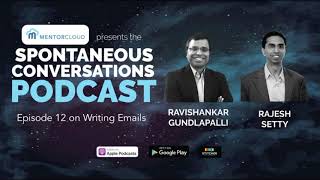
A recorded conversation (Episode 12) between Dr. Ravi Gundlapalli and Rajesh Sethi about effective email practices. They argue emails should be chosen only when appropriate (not for anger or sensitive topics), emphasize strong subject lines, single-purpose/forward-ready messages, clear time references, and framing emails as opportunities rather than opportunity costs.
Chapters
Hi, welcome to episode number 12 of spontaneous conversations. I'm going to do it reverse. I'm here to introduce Rajesh Sethi, serial entrepreneur and author.
And you are Ravi Gundafalli, who is my very good friend and he is the founder and CEO of Mentor Cloud. Okay.
This was spontaneous also, by the way. So the topic we chose today is something we do thousands of times in a week. It's about writing emails.
Yes.
So Rajesh, you picked the topic and hit the record button. So tell me what was going in your head.
Yeah, so anyway, we picked the topics only five seconds before. So I am as raw as you are. But writing emails, because it's a powerful way of communicating people get emails all the time. I have thought about it a lot for a long time because I write a lot of emails. And one of the things that I just came to the conclusion is that sometimes writing a good email may not even mean that you should write that email. Because a lot of things are said right in person or on the phone. Because emails is very difficult to carry the emotions along with it and you don't know what the other person, especially bad news, something like a conflicting thing, something that you want to make sure that you are saying it in the right method. Email may not be the communication, although the topic is writing good emails. I always want to say that while it is very easy to write an email, always think before you write that email. Is this a phone conversation? Is it an in person conversation.
Or can it be done via email? That is my first opening point.
Very, very interesting. Because.
What'S going on in my mind is, let's talk about communication. Because email is a communication platform, there are multiple elements to it, right? What is that you're saying? Okay, to whom you are saying it, how you are saying it and when you are saying it, right, all four are equally important. Now all four sentiments can be best captured and best communicated in an in person reaction. You can look into the eye of a person. You can pick a time when the other person is ready to receive and you can say it with love or you can say it with some seriousness. Now unfortunately, email can only communicate two of them.
Like who is saying it to whom it is going. It does not have any sense of time. The other person can read the email at a time when they are really unhappy, end of the day and they get so upset by what you said and you did not mean it. So an email doesn't always carry all the attributes of a good communication.
I totally agree. Especially a thing like expressing Your anger. You always have to be extremely careful not to use the email as the communication medium. Because what I have found, I have done a lot of research on this is that when somebody gets a very irritating email or bad email, something that is accusatory or anything, they won't read it once. It's like a movie that they are playing again and again.
They go back and read it and say the anger keeps building up.
Exactly. It's like instead of punching the person once, you set up a subscription program to punch them again and again and again.
Yeah, and so we talked about the importance because it's easy to do. It doesn't give you the right to do it.
You have to be thoughtful about it.
You have to be thoughtful about it. And if it can be done with the communication, with a phone call or if it can be done together from your desk and go to somebody and talk, why write an email?
Exactly.
And sometimes I've seen people who do reply all and the whole thing, it causes chaos and everybody out of context start reading it. Not only you're wasting their time. If somebody is reading something that they're not supposed to be reading, it completely puts them on a different track and it affects their productivity. You have not essentially done a good job versus just walking across the office to speak with somebody or just getting on a phone call.
Totally agreed. So a few more things about writing good emails. I am a very big stickler for good subject lines. Why? Because nowadays people read emails in their phones and sometimes I get an email with the subject line hi and then I don't know what to do with it. And there is another subject line. Meet Tuesday 10am OK, question mark. Now there is a specific. There is already a lot that subject line is saying, but hi. I have no idea.
Yeah, subject is very extremely important because like you already said, we open emails. That subject looks interesting. Or if you are a real loser, you are opening all the emails, which is bad. Which is really bad. You are being very, very unproductive.
Yeah, there is just a caveat on that. I think you will agree with me on this. We open emails first based on who is sending it that more than the subject line. That's the prior pecking order. Right? Suppose you send me an email and a random blog reader sends an email. I all respect all of them, but I don't know them. But I know you and I know that you would have taken care to make sure that that is an important email that I need to pay attention. I will always pick your email. I will get to the blog reader's email. Of course I will get to it. But in the pecking order they are not first, that's the first thing within the people that you already know. Then the subject line becomes important because that shows what this email is about. Should I read it now, should I read it later? I have to decide that because you don't have unlimited time to process all the emails.
Exactly. And I think some aspects that I have followed Rajesh.
I think.
The good emails should definitely have a very strong subject line and they should address the person saying dear Rajesh or hi Rajesh or something, have a very nice greeting and then immediately come to the point as to why you are writing that email saying look, it was awesome to meet with you and I'm looking forward to having the next conversation. So get to the point really really quickly in less than four, five lines. And always don't leave the email. Especially if you're writing an email to somebody who's senior more experienced than you. Don't just leave the email with asking something because other person is thinking why should I even respond to this email?
Yeah, good point. Just to close out on the subject line. There is also a tendency for people to take any email and make it any other email. Meaning that they will be starting the subject with when can we meet for lunch? And then as we know, by the way, I was supposed to return that book to you, I will return it later and somehow you respond to it and I say are you also available for a movie next weekend? And it's the same when can you meet for lunch? Will be the subject line. But that email has transformed itself into a beast. And then after some time you don't know what this email is about and you are searching for something and you are lost. That's why always say more than one exchange. If the subject of the email changes, subject line has to change.
Yeah, I know some people just leave the subject line as is and it goes on for 18, 19 different conversations. And that can be very annoying. And I think another good rule is every email transaction or communication thread is focused on addressing one situation.
Exactly.
And should have multiple situations in one single email.
Yeah, and there is another reason for keeping the email very self contained. Why? Because I will tell. Give an example. Suppose I want to ask you to introduce me to someone. Right. This is Ravi, you know Bob. I would like to meet with him. And these are the reasons why Bob will be interested in meeting with him. And then I say by the way, I saw this wonderful movie called OKA Laila Kossam. And this was what's happening now you are in a stuck. You want to introduce me to Bob? So let's say you want to forward that email to Bob and say, this is my friend Raj wants to meet with you. Now you have to think, what is this Okala? First of all, it is not even an English movie. What will you understand? You have to go and doctor that email and say remove everything.
Yeah. You are wasting time. Right?
Exactly. So that is why I always think if there is a third party involved, assume that it will be forwarded and make sure that it's a forward ready email.
It's a forward ready email. That's very, very good. Because that's.
So. I think you make an interesting point. The metaphor in my mind is one of an arrow. So every email should have one target. Whether it is the target expectation, target result you are expecting. That is, this email will produce an output that confirms a time to meet, that confirms a particular.
Strategy that you are taking, whether it's good or not. So every email should be one arrow. You cannot throw ten arrows. Right?
Yeah. Very, very nicely said. I'll give another tip. That has worked very well for me because I introduce a lot of people. There are people, sometimes they have to be coached as to how to ask for an introduction. So sometimes they say, hey, can you make an introduction to Ravi? I always respond back and sometimes I just call them or I just use the phone, record a message and then send that message back and say, that's great. I will be happy to introduce. I know you both. But send me a separate email. Make the subject line, request an email intro to Ravi and put a semicolon and say why? And then say something about you. What's in it for you? What's in it for them? I want this email to be so good that if I forward it to Ravi, he should say, man, you are giving me a gift with this introduction. I would love to meet this person. So I make the other person do the work and send me a forward ready email so that I can make my life simple. And that results in multiple benefits. Ravi, one of the things is it's not a one time benefit. I get next time. They already know if they are asking for an introduction, what kind of an email they should send.
Also you're setting an expectation. You cannot just simply ask, they know what Rajesh needs.
And also you're also kind of setting a good habit in other people because you want them to do the work. Right. And a good email also Is very transparent. You're saying, hey, look, I want to meet Jason, and I've read his book. There are some things that I feel very strongly.
Very.
That kind of very synergistic, which is why I want to meet with Jason. Oh, by the way, I'm also looking for inviting Jason to one of our events. So there's something very clear that you know why I want that introduction so that it will make you saying, okay, Ravi has given this, has done the homework.
Totally beautifully said. I always say that a transformation has to happen from an opportunity cost to an opportunity. So that is where a good introduction happens. And email is the best way to do it because it's low cost. And Jason can say, no, I don't want to meet with Ravi. The timing is not right. The project is not interesting or anything. Or you might say, love it. Just introduce me. When can I talk to Ravi? That depends on how much work you have done. For some reason, you are not done. It becomes my responsibility to make sure that you think through it and say that at this time, without good work done in preparation, it's an opportunity cost for Jason. With preparation, it's an opportunity for Jason.
Opportunity cost versus opportunity.
Yes.
So one very interesting.
The preparation eliminates the cost from the opportunity cost.
The cost is on you, basically.
Right.
You know, it's a very interesting thing. Let's draw a parallel in what happens in real life. Let's say I walk up to you and say, hey, Rajesh, I want to meet again. Let's use the word Jason. First question I want to ask is why?
I will ask the first question. What's in it for Jason?
Yeah, first of all, why? Why do you want to meet that person? Because I just want to know. So.
In real world, we don't just randomly correct people. Such people will never become successful connectors. By the way, there are some people who will. Oh, you want that person? That person. Now, if the person is really of high value and caliber, the amount of credibility that they would give to you is going to be very low. Because you're randomly sending people to him.
Right?
Beyond a point, you'll say, okay, fine, Rajesh, just ignore that email right now. I have met some amazing people. Because of your amazing quality of making introductions, you always want to make it meaningful. Other person you will say, jason, you will love. It will be beneficial to you to meet Ravi. Even though Ravi wants to meet Jason, you make it a point to Jason to say, not only is Ravi wants to meet with you, Jason, Jason, you will actually be better by meeting with Ravi. And that's what makes Rajesh you so special in the kinds of networks you have built. Because every introduction that you made to me have turned out to be beautiful. Mutually, mutually beneficial connections.
Yeah. The way I always look at it, Ravi, is I take a lifetime view. If I connect two people for the rest of their lives, could they do something that will make it better for each other for the rest of their lives?
It's not a very transactional connection.
Yeah. Now, getting back to the emails, I'll give some more tips that has worked for me. First is nrn. This is something I learned from someone. It's no response required. So that's. You have to use it all the time. When you send forward something, you say, this is fii. No response required. That means I sent it to you. You don't have to say, thank you for sending this. More work for the other person. It just says, okay, delete it. It's fii done. That's another one. Second, time zones and times, very important. Like yesterday morning, I received an email second saying, do you have time to meet tomorrow? And I looked at the timestamp.
It's 12:44am the standard issue, Right?
Standard issue. So I respond back to them. Just to clarify, did you mean today Wednesday or tomorrow Thursday? And then I always teach them, so next time they send a mail to somebody else, make sure that there is no confusion. Because Joe Polish, one of my favorite podcasters, and he's a brilliant connector, he always said that in one of his episodes, he said, communication is definitely about making sure that the other person understands. More importantly, the communication is something that the other person cannot misunderstand.
That's very key, right?
Yes.
Because the misunderstanding can lead to all kinds of consequences. Missed meetings, missed, you know, intentions. People can get upset. So I think.
If each of us, I mean, there are at least 2 billion people sending emails every day. If each of us sends one less email.
Yes.
I think the.
Effect that it will have on productivity of so many other people in the world will be just amazing. So next time, I want. In closing, what I want listeners to think about is if you want to start writing an email, just take five seconds and think.
Should I actually call that person or just walk over and talk to them or instead of just sending an email. So just ask that question and you will find amazing beauty when you don't actually email and go meet that person or have a conversation.
Beautiful. My closing comment is ask another question before sending that email.
Is this particular email going to create an Opportunity cost for the recipient or going to create an opportunity for the recipient. Once that gets drilled into your head that I want to create opportunities, I don't want to be an opportunity cost. The way you will craft that email, the. The way you will think before you craft that email, the way you will approach life will be very different. Email is just a communication tool, like you said, but it's about life because there are communications happening, transactions are happening. The transformation is in our head. I don't want to create an opportunity cost in other people's lives. And email is the fastest way to create it because your priority becomes their obligation. So, in fact, not only I don't want to create an opportunity cost, I want to create opportunities in people's lives. And the way you will write emails will be very different.
Extremely well said, Rajesh. Again, just want to say that emails are very good for very transactional items, but conversations are good for transformational.
Situations. So emails don't build relationships whereas conversations do.
Yeah. I would say just because we don't want to leave the topic undebated is basically, if you are thoughtful, you can create value in any medium. Like suppose I read a book about Kathy Sierra and then said, ravi, you are building mentor cloud. This is going to change the life of mentor cloud. Because I read something brilliant from Cathy. You need to know this. Here is the paragraph. I know you don't have the time to read it, but just read this and reflect on it and things will happen. You created value. The idea is in our heads. Whatever. Be the medium. It has to be about creating value. Not be an opportunity cost, but be an opportunity and then things will change.
Yeah. In fact.
I'm thinking, could the E be used to represent enhancement?
Enrichment.
Enrichment. It's not electronic mail. It's enrichment mail. It's enriched mail. Empowering mail.
So I think let's reflect on the E in a future conversation.
Beautiful. So should we sign off?
Yes. Signing off. Ravi Gunlapalli. Thank you for listening. Founder, CEO of medicloud. Com and Rajesh.
Signing off. Rajesh Sethi. I'm a serial entrepreneur. You can learn more about me at rajeshati. Com blog.
Thank you.
More from Dr.

Essentials of an Entrepreneur by Dr. Velumani Arokiaswamy, Founder of Thyrocare

Skills & Traits for Better Employability | Amritkaal Mentors – An Initiative by MentorCloud

What Leaders Look for First-Time Job Candidates | Amritkaal Mentors – An Initiative by MentorCloud

How to Innovate and Lead Wisely in Today’s World with Navi Radjou - An Initiative by MentorCloud

Crafting Your Academic Journey with Dr. Manish Kothari - – An Initiative by MentorCloud



Advaitha Jagruti: Awakening The Spirit Of Adi Shankara In Indian Youth | Dr. Ravishankar Gundlapalli

Testimonial | Sanjeev Sharan | Catalyzing Growth From Within | MentorCloud Mastermind

How to Make a Mentee Feel Comfortable #mentorcloud #mentoring #coaching #wisdom #experience

Testimonial | Kellie Teal-Guess | Catalyzing Growth From Within | MentorCloud Mastermind