Episode 13 on Inflection Point
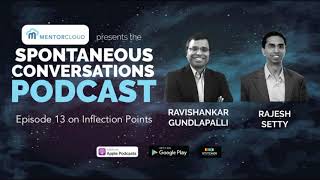
Ravi Gundlapalli and Rajesh Sethi discuss inflection points—sudden shifts in direction that reshape your life. You can't predict them, but you can choreograph them by staying curious, building a network of people slightly ahead of you, and deliberately operating at the edge of discomfort. Ravi's decision to study away from home in 10th grade led to IIT and a US PhD.
Chapters
Hi, there. Welcome to episode number 13 of spontaneous conversations. This is Ravi Goondlapalli, founder, CEO of Mentor Cloud.
This is Rajesh Sethi, friend of Ravi and a serial entrepreneur in the Bay Area.
Fantastic, Rajesh. We actually picked a topic.
Which may actually represent a state in our own journey with spontaneous conversations. And the topic we picked was inflection points. Yes, it can be very mathematical or it can be very transformational. So tell me, what does inflection point mean to you, Rajesh?
See, for me, Ravi, inflection point is a significant change in the trajectory of your life or a significant change in the velocity in the right trajectory in your life.
Okay, so significant change. So again, if you look at what it means in inflection point, it's basically a change of slope. You are going, things are going well, and suddenly something happens, and boom, things change. And every investor would want to invest in companies that are at the inflection points of where things take off. But here's the irony of it. You never know you are in an inflection point until after the fact. But I can guess the reason you kind of pick this topic is you can actually choreograph to be at an inflection point. You can do certain things to increase the odds that this incident turns into an inflection point.
You guessed it right. You almost spoke my mind.
That's why we are such conversational companions, Rajesh.
That's right. So before this, we hit the record button. You were sharing that you had an inflection point in your own life very early in your life. And can you share that story?
Oh, is that why you thought of making this the topic of the inflection point? Yeah, you know, I really know I was in one. So this was way back when I was in 10th grade. I came number seven in India, which was a big accomplishment. Parents were happy, we were all celebrating, and I was all set to study the next two years of high school at a local college. And so one evening, I was hanging around outside my principal's office, and I had two of my friends, one 50ft to my left and one 50ft to my right and yelling at each other, okay, we'll see you in the evening at the train station. And you know, that curious person in me kind of caught on the word train station. Guys, where are you going? You know, we're all supposed to be enjoying holidays. So that question alone told me that these guys were off looking at colleges outside my Hometown to study 11th and 12th, because they also came in number nine and number 11 in the country. So I said, okay, why I will also come. So within two hours I told my dad, my friends are going to a different city, which was Chennai, also called Madras. They are going. And my dad said, I don't know what mindset he was in. He said, okay, sure. I said, but dad, everybody's dad is accompanying them. But he said, you know, we can't get two tickets right now. It's just a short time frame. Why don't you go and I will support you. And that changed my trajectory. I ended up going to college in a whole new town. Lived in a dormitory that exposed me to the fact that there is something called iit, which is one of the toughest institutions to get into. I got into iit, which is when I figured out that everybody goes to US for masters because nobody in my family went to college for engineering. Nobody went to iit, nobody went to the United States. And now I have a PhD and I'm here and I look at that incident being a very, very critical turning point for me.
Yeah, that for me is an inflection point. Imagine if that conversation, you didn't overhear that conversation. Maybe you would have ended up in the same place. But the odds of that are very low.
Exactly. And you know, I've also kind of spoken about this story in other talks I have given. I could have easily said, okay guys, have a wonderful time. But I highly encourage people. I mean, not be curious like the cat, be curious to say what else is out there? What else can I do with this God given life and time? So the curiosity in me, instead of just wishing those guys have an awesome time and I go back to my own business is that curiosity really opened up a whole world of opportunities that neither me nor my family was exposed to because of where we came from.
Yeah, for me I call it the curiosity with a qualifier. Curiosity with the right bias with a cue, maybe. Yeah. So curiosity with the right bias means you are not curious just for the sake of being curious. You just want to know where they are going and that ends there. So with the right bias means with the bias towards exploring new possibilities, the bias to take action with the bias to grow. So when you have that bias, the curiosity is very different. You want to see what else is out there. What am I missing? Where is the opportunity? And without that, even if you have an inflection point, you may not even see it. Like you mentioned, you always see the inflection points in the back. I'll tell you, hundreds of people would have had the opportunity to see those inflection points, but they didn't have the curiosity with the right bias.
Correct. I think the operating word is curiosity.
And always kind of being very fertile. There is another word called serendipity. People think serendipity is lucky, but serendipity also needs a fertile ground. One of my good friends.
Kind of wrote this blog about that. To be lucky, you got to have done some work beforehand to kind of express your aspirations, desires to be out there networking people. And luck doesn't happen just like that. So even inflection point doesn't just happen just like that. It's happening because you're constantly thinking about your future. You are very aware of what's happening around you and looking to what else can I do to make the next second thousand times better than what it is right now?
I totally agree. You said it right. About preparation as part of getting lucky. There is that famous old saying, the definition of luck is the meeting point of your preparation with the opportunities that are passing by.
That's very, very true. Because that's extremely. Well, very relevant quote.
Because opportunities are always there. If you just sit back and you just kind of locked it up in your own cubicle, then you may not ever see these opportunities. So I think the point that I'm kind of both agreeing on is that inflection points can be choreographed. Is that right?
I totally agree. And that's what I wanted to lead to. But I have a story about.
Oh, yes, please. You actually had.
No, this story is not about me. We can talk about it later. But Jack Ma, the CEO of Alibaba, he shares a story of how Alibaba even started. Right. So first of all, he tried to get into a job, and he could not get into many, many jobs. He was just removed. He was in the United States with his friend, and that's where he was telling about the Internet and everything. So Jack Ma was curious with a bias towards. With the right bias, he said, you can find anything. He said, yeah. So.
The first thing we searched was beer.
And then of course, there were some search results and everything. And he wanted to get beer from China. So China beer or something. There was none. So he said, why is there none? Because nobody is selling there. Why is nobody selling there? And then there are so many people who manufacture beer. And of course, there is a long story, but that alone. He is not a programmer. He does not know how to code. He is a teacher. But now with the right bias towards action, exploring possibilities and exploring how to grow and everything. What started off as a thought, why is Chinese beer not available in the United States?
Was that really the question he asked that led to Alibaba?
Yeah.
Oh, my God. You know, if I go back to your story and kind of, it's the questions he asked himself and the questions he asked other people. Right. So these are very probing questions, not for the sake of knowing.
But for the sake of kind of figuring out and where is this diamond that is hidden? And if you don't ask the right questions, they don't lead you. The world doesn't lead you to the right answers.
Correct. It definitely starts with asking the right question. And it should not stop there. He said, why is Chinese beer not available in the United States? Hmm. Very interesting. That's good. At some point in time, we have to think about it. But then he takes action. He says, I don't know how to build a website and everything, but somebody else knows there. I can choreograph this and whatever it takes, I'll bring the right people. And today, Alibaba is. Everybody knows who is Alibaba.
Exactly. And you also. The episodes we talked about, fierce conversations and your famous line that one conversation can change your trajectory. That's that life changing inflection point conversation that Jack Ma had with somebody.
About something that was interesting. And I think I almost feel like that spark was kind of ignited at that point for him. It was there. The spark was there. It was waiting for the moment to just get ignited. And that was just that conversation.
Yeah. And these people have heard this from many entrepreneurs. It's almost like if they find a hole. We talked about it in the previous episode or something, it becomes a hole in their life. They have to do it.
They have to do it.
So it becomes incomplete. Otherwise, why not? I will do whatever it takes to make that complete. And moving on, Ravi, we talked about, we touched upon it, how to choreograph an inflection point. Now we know that it happened in the past. That means without our knowledge, it happened in the past. But we are all smart. Why not make it happen in the future with our smartness?
I think that's an excellent point for our listeners is inflection points can be choreographed by kind of being in the company of right people, by asking the right questions, by, you know, again, you know, I think. Was it Marshall Goldsmith who wrote the book what Got yout Here Won't get yout There?
Yes.
So that's just awareness that my trajectory up until now is not going to be, you know, guarantee it's not going to guarantee my trajectory from now onwards.
So.
So what can I do today to change it? Because Marshall said it so beautifully. What got you here doesn't get you there. I know. Having been a very successful executive in the corporate world did not make me a great entrepreneur. I had to completely do things, undo things, undo my learning, change my surroundings, completely meet with whole bunch of new people. But I did it very consciously because I wanted the trajectory of my life to change.
Totally agreed. Let's double click on what you said because that's what I was leading to, but you said it in a summary fashion with getting together with the right people and having the right questions and having the right conversations. Now I'll tell you where it gets difficult is how do we get together with the right people? So, for example, everybody moves in bands, meaning that among their friends, they all have a similar capacity to contribute or create value. Because if it is too different, then they will feel out of place. Either the person who is creating massive value, 10 times the value that is in the group, he will feel out of place, or the tribe becomes a little bit uncomfortable. The person may not be uncomfortable. The tribe thinks he is somewhere kind of thing. So the right crowd could be one or two levels above in terms of their capacity to create value. How do we jump to that tribe? It's always a question. You are becoming uncomfortable, Right? So.
There are few things that I have written before. It's about the competitive advantage of being very nice. If you are very nice, people think it's a sign of weakness. Some people may think it's a sign of weakness. But if you are relentless in growing and you are a nice person, you can punch one or two classes above your weight class by thinking, what can I bring to that tribe which is one or two levels above me, so that I am an opportunity rather than an opportunity cost.
So you are essentially expanding on the surrounding yourself with the right people. Obviously, if everybody is just like you, there is no way that an inflection point is likely to happen. Whereas, and you are saying for you to have the inflection point possibility, you want to be in a tribe that is slightly better or at least one or two levels above you, not super high above you. But then to be part of the tribe, you have to be thinking, what can I do to belong to the tribe to be worthy of it. I think that's an excellent. I mean, because it's all about people. There's not going to be a shooting star that comes and changes your trajectory right you got to read some new book, you got to have a new conversation, you got to go to an event and kind of listen to something inspiring. And of course you have to take some actions that are sort of new behaviors too. Your behavior has to change also if you want to see an inflection point in your career.
Yeah. That's why they say, Ravi, that if you keep doing what you are doing, you will keep getting what you are getting. So just a reflection on the last week, right? If there is nothing that made me uncomfortable in the last week when it comes to my projects, startups or books or teaching or anything, then I am not traversing on the edges. I am not exploring. I don't want to fail. So I am in the middle of the circle, just happy go Lucky. Because we both can be doing what we are doing without traversing the edges and we will be just fine. The family will be taken care of and things will keep moving in a steady state. But if you are not uncomfortable, then you are not on the edge. But if you are not on the edge, how do you know where the real boundary is?
That's so, so beautiful. I think we can actually make that. The closing remark is always be if you aspire for larger, bigger things in life, then you should be feeling the sense of uncomfort and you will know that's the time you know that you are being stretched in terms of your skills, in terms of capabilities and you know you're on the edge. And inflection points happen at the edge. Is that a good way to summarize it?
Yeah, because at the center you are very familiar with what is happening. And in inflection point, if it comes, if it could have happened, you will miss it because you are so comfortable with the surroundings. It has to be a game changer. And the game changers cannot happen at the center of where you are playing. It has to happen at the edges. Fantastic.
So in closing, inflection points can be choreographed with good networking and being part of tribes that are higher in terms of achievements and capabilities.
And definitely, like you said, being on the edge.
Yeah. So my closing comment is that once you realize that inflection points can be choreographed already you have a different level of awareness that you don't have to wait for some stroke of luck or God given serendipity or something. You say, you know, I may not be able to choreograph 100% of it, but like you used the word, if I have a fertile mind and open to new possibilities, at least I know I can increase the odds of getting to an inflection point.
Yeah. There's also a quote, right? You miss 100% of the shots you don't take.
Yes.
So it is really worth taking shots in life because life is short.
Yeah. Beautifully said. With that, should we sign off?
Yes. Thank you all for listening. Ravi Gunlapalli signing off@mentorcloud.com this is Rajesh Sethi.
And you can find more about me on my blog, Rajeshseti.com blog.
More from Dr.

Essentials of an Entrepreneur by Dr. Velumani Arokiaswamy, Founder of Thyrocare

Skills & Traits for Better Employability | Amritkaal Mentors – An Initiative by MentorCloud

What Leaders Look for First-Time Job Candidates | Amritkaal Mentors – An Initiative by MentorCloud

How to Innovate and Lead Wisely in Today’s World with Navi Radjou - An Initiative by MentorCloud

Crafting Your Academic Journey with Dr. Manish Kothari - – An Initiative by MentorCloud



Advaitha Jagruti: Awakening The Spirit Of Adi Shankara In Indian Youth | Dr. Ravishankar Gundlapalli

Testimonial | Sanjeev Sharan | Catalyzing Growth From Within | MentorCloud Mastermind

How to Make a Mentee Feel Comfortable #mentorcloud #mentoring #coaching #wisdom #experience

Testimonial | Kellie Teal-Guess | Catalyzing Growth From Within | MentorCloud Mastermind