Episode 15 on Stress Spontaneous Conversation 1
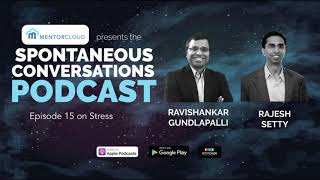
Episode 15 is a recorded spontaneous conversation between Dr. Ravi Gundlapalli (founder & CEO of Mentor Cloud) and Rajesh Sethi (serial entrepreneur) about stress—especially among entrepreneurs in the Bay Area. They identify major causes (comparison via news and social media, mismatched expectations vs. capacity) and offer coping approaches: welcome productive stress, adjust perspectives on news/social feeds, assess and build personal/network capacity, take deliberate actions (seek supportive conversations, mentorship), and use calming practices (walks, music, meditation). The episode closes with reframing stress as often transitional and an opportunity for growth.
Chapters
Welcome to episode number 15 of spontaneous conversations. This is Ravi Gundlapalli, founder, CEO of Mentor Cloud.
And this is Rajesh Sethi. I'm a serial entrepreneur in the Bay Area.
Okay. In the past episode, we talked about a fun topic and I want to talk about another fun topic that could be fun. We selected the topic of stress.
Yeah. I think in the Bay Area there is an oversupply of stress if you think about it. Right. So I'll tell you just from an entrepreneurial standpoint, why stress happens is because you look around, it's in the air. Everybody is starting a company and.
Look at the newspapers. Everybody. There is a success story out there. Three months ago, they started a company, it got snapped up by a bigger company. Something else happened. They got valued at 200 million and they are now raising series B. It almost looks like.
If they can do it, I can do it.
It's almost like everybody's having an awesome life. And in fact, Facebook again.
It also amplifies this phenomena. Like somebody is having an ice cream, but two hours before they would have had some argument with somebody, but all you know is they had ice cream, they went on a vacation, you know, somebody wished them happy birthday. So you see the snapshots of life of other people and think that that's what they're doing all the time. And you think, oh, my God, there's nothing exciting. So you are now kind of forced to add on an event that shows joy. And so that actually adds stress, in my opinion, because you are under pressure to show something when everybody else is adding some fun topics. But reality is that's only a sliver of their entire day.
Yeah, I am with you, Ravi, because if you don't look at the news and the social networks with the right perspectives. So news, because I was a journalist before, news, is a collection of exceptional items. Exceptions. It's always a collection of exceptions. Because if it is normal, it is.
There is no news.
Right? That is one.
That's a good way to look at it. Yeah.
Social networks are a collection of a series of fortunate events that means the best version of you being displayed again and again. Look, look, ma, I am here kind of thing. So on one side there are a collection of exceptions and the other side is a series of fortunate events in people's lives masking the roller coaster ride that happens in reality because it never gets reported in news. And all the real life that is happening because that nobody will volunteer that information saying, today at 8am I had an argument and 11am I had another argument. And 1pm, believe it or not, it was like a mother of all arguments. And my life is full of arguments. Who will say it right?
And six o' clock, I shared a picture of, you know, a beautiful ice cream cake that I'm having with my friends. And that picture goes promptly on Facebook or Instagram. And everybody's thinking, that's, that's, that's what I.
So, again, I think the point that we are both making in this candid conversation is that stress in today's world is really caused by everything around us. It's not coming from within. We are forced to look at so many things and then kind of relate to ourselves that cause that imbalance. And I'm reminded of a definition by Sri Sri Ravi Shankar, who is the founder of Art of Living, who defines stress as the stage in which you are out of sync with your surroundings.
So he said. The definition resonated me so beautifully because let's say you go to a new place and it's too hot. People are like, not as clean as you expect them to be. Things are not the way you expect them to be. You can actually be in a lot of stress. I know many people who go back to India are, after several years, they're so stressed out. But whereas if you somehow kind of resonate with the surroundings that you accept that you are right now here, you can actually have a fantastic time. So the example that you started with being in Silicon Valley, if you can find a way to be in sync with your surroundings, there is no stress.
Yeah. The second thing that might happen, Ravi, is basically.
If your expectations are way out of sync with the capacity for you to reach those expectations. So if you think that there were three startups that went blockbuster hits and because they were all your classmates, and you can also do it, you don't know what they were doing when you were watching movies or when you were on Facebook, what those three entrepreneurs were doing, because that is below the surface. That never shows up. Like I always say that public victories are preceded by relentless private practice.
Very good. Public victories are preceded by relentless private practice. Yeah, they're all working hard. I mean, somebody just suddenly walk into the door and said, I'm going to buy your company. A lot of hard work went in, but we kind of don't give that much importance as much as we give to the end outcome.
Correct. So if you think through that.
When you think that what they got is what you should also get without paying the price of what they paid, but you want it easy, then It's a surefire recipe for tremendous stress.
Right. So I think.
Kind of looking at news, which is a series of exceptional events, looking at snapshot of other events that are going on around you, and having high expectations that may not be.
Suitable to your capabilities and where you are in your career can all kind of lead to stress. So, Rajesh, let's spend a few minutes on.
We are both agreeing that it's a part of life. So how does one handle it?
Yeah. First of all, the right kind of stress, you should welcome it. And for me, the right kind of stress is doing things that are slightly above your capacity so that you are stretching your muscles, mental muscles, and all those things so that you are growing. If you are complacent and have, like zero stress, that you are very happy doing exactly what you want and life is moving on, that might also be a problem. So you have to welcome the right kind of stress. Where you say, I need to grow. I need to catch up to the next level so that I am growing. Second is to view the outside world with the right lens, like we talked about news and exceptions and fortunate events in social networks. Third, if for some reason the expectations don't match reality, then the only first thing that you have to look at is your own capacity.
Correct?
Right. So your capacity is a loaded word because it includes your capacity like personal capacity and the capacity that comes from reciprocation from the network that you have built. Not your network's capacity, but only part of it, which could be reciprocated back to you at the right moment.
So you're kind of defining sort of the conditions of. I mean, how would I best summarize it?
Yeah.
Three things just so that for listeners understand those three aspects.
Yeah. One is welcome the right kind of stress. Right. So basically.
Yeah, welcome. Okay, right kind of stress.
Second is the right perspective to watch news and social networks because that is where you are consuming content. Third thing is you look at always reflect on your capacity of your personal capacity and the capacity that is brought to you by the power of reciprocation from the network that you have built. So that's your total capacity. And if.
If that capacity is not enough, rather than expecting to change the outcomes, which can only be influenced by your capacity, which is in your control, you start looking at how do I build the capacity, which is your personal strengths and contribution to the network, so that the reciprocal power increases.
So you are essentially kind of leading to this handling of stress with having a completely different perspective and also taking action because Just being stressed about the fact that you didn't expect, you didn't get the job that you're expecting or the result that you're expecting. Just thinking about it and kind of worrying about it is not going to change the result. It's only going to make you feel even more low. So one of the ways is to really, really quickly reflect on why there was a discrepancy between the expectation and the result and really do the right things so that the next action that you are taking there is a lot more alignment with what you are expecting and the outcome.
Yes. See, there is an upside for the right kind of stress. There is really no upside for the wrong kind of stress. Because if you are stressed out for the wrong reason, basically what you are doing is you are getting a license for inaction.
Yeah, I think I want to double click on the word action. Because to get out of stress, you have to take action. And some actions that come to mind is having a very pleasant conversation with somebody who doesn't deny your stress. First of all, if somebody says, oh, your stress is absolutely meaningless, that can actually stress you even more. So one of the ways that I encourage people is when somebody comes to you with a problem, first acknowledge it. Just first receive it. So other person feels that, okay, this person has received it, and then you kind of give them a different perspective and open a new world to them. The way they are thinking, the way they are acting, the way they are approaching a particular problem, so that other person feels more comfortable. So the best way to reduce stress is to have conversations with good people. And I highly encourage everybody to have on their phone book three or four people that they can talk to who not only just acknowledge the stress, but are able to help you out.
I may not be saying it right. Paraphrasing a quote from Albert Einstein, he said, the problems that you are creating at this level cannot be solved by the thinking at this level. So which means that you have to have a higher level conversations, like with a mentor or someone who can not only understand the problem, but bring a fresh perspective.
Exactly. Because one of the ways you can get into sort of a vicious cycle is you go talk to somebody about the stress, other person is also stressed, and it kind of creates a very bad vicious loop. Now both of you are angry, both of you are dejected. So that's why I want to highlight the point is that you do want some sort of stress relievers. Definitely excellent conversation with people that can always understand that know who you are, and who recognize that the stress you are feeling is very transitional. That's the key.
Totally agree. See, the stress that leads to sympathy exchange won't be good. What do you mean by sympathy exchange? I come to you with a stressed out point about my boss. My boss is a jerk, Ravi. I mean, I try to explain to him, he don't understand and you start saying, rajesh, I totally feel for you. Because my boss is also a jerk. And I'll tell you, he's not exactly the same kind of jerk. It's the color blue and mine is color purple.
Correct. You're just acknowledging the stress, but you're not giving a solution.
Correct. And also if somebody is going down because of stress.
Hitting him on the head will not make him get up. They are looking for a lifting hand that lifts them. They are not looking for a foot leg that kicks them.
Yeah. So I think we talked about conversations as a way because we said stress is bound to happen in today's world because of external influences and in our own unmatched, unmatched between expectations and outcomes. So we talked about conversations as one way to alleviate stress and the other is maybe taking a nice walk in the park or listening to good music or even meditation. Rajesh, you are a big meditator. Why don't you share.
Your perspectives on how meditation helps you calm down.
Yeah, see, I also meditate and I also listen to music, which is the baroque music. Both of them will bring down.
The chatter in the brain. That's what it will. Because we are always running some movies in the brain that sometimes if it is a bad movie, rather than moving it to the trash can, we re run them again and again. Look, he should not have told me that. Oh my God, that's really bad. How could I say this? 10 years I have been friends. Keep on repeating it, only making it worse. Meditation and listening to the right music, both of them will tone down on both of this chatter and it will slow you down so that you are calmer.
When you finish that session. Plus, what has worked for me very well. Ravi, if you look back in your history, did you have any stressful events? It's a rhetorical question. You said yes, at that time they were very stressful. Isn't it? When you look back now, don't you feel that you should have said, you almost feel many times that maybe you overreacted to it, you could have handled it better. So that is the reaction I get from many, many people when they look back at historical stressful events. Right. So. So if that is the Case, why not sort of.
Mimic that in the mind and saying, fast forward ten years from now. If I look back today, what do you think I will be feeling about the stress that is happening today? It will not be the same as what I am feeling now.
Correct. It will just be one of those transitional events in life. In fact, Mark Twain has a very interesting quote. He said 99% of things that I worried about never happened.
Which is the truth of life. So two things again in closing about this, looking at the past stresses as a way to handle the current one. The first is you should feel so good that you overcame that situation and you are here today. If you did not, you would be in the situation. So something you did that got you out of it and you're successful, you are probably, you know, more wealthier, more healthier, more happier. Right. So you can always reflect on, oh, I kind of overcame that. I can overcome this one also. And second thing is that this is also a transitional phenomenon. That the fact that knowing that it's transitional also can kind of calm you down. And so that's what I just want to end my comments saying that stress is here, but make it as short lived as you can.
Yes, I have two things to comment, closing comments. One is if I ask people where were their biggest spurts of growth, what happened? What did they do? They always tell me a challenge that they were facing and how they overcame them because that's where the biggest growth happened. Right.
And what is it?
Breakthroughs follow breakdowns.
Yeah, beautifully said. So if that is true, then why not bring that perspective that this might be a growth spurt. God has given the opportunity to grow, is put a challenge in front of me and then why not capitalize on it? That is one. Second, I have a small note in my workplace and it has only, it is a very small sentence. I am here, full stop. Where next? And if I keep thinking about it, I will situate myself very quickly, whatever be the situation and first acknowledge that I am here, this is happening and it is not a dream. And I acknowledge that this is happening, I am in this situation. The next two words, where next? Put me in the mood of possibilities or some action. Yes, because where next? I have to say something. Next will be make that phone call kind of thing.
Excellent, Rajesh. I think this is a very important topic and I'm sure we touched upon some.
Attributes of how stress comes and some examples of things that they can do to make that stress be as short as possible. So with that, I hope your listeners will provide us feedback on this spontaneous conversation. Signing off, Ravi Gunlapalli, founder, CEO of Menta Cloud.
And this is Rajesh Sethi. You can read more about me on my blog, Rajeshcti.com blog.
More from Dr.

Essentials of an Entrepreneur by Dr. Velumani Arokiaswamy, Founder of Thyrocare

Skills & Traits for Better Employability | Amritkaal Mentors – An Initiative by MentorCloud

What Leaders Look for First-Time Job Candidates | Amritkaal Mentors – An Initiative by MentorCloud

How to Innovate and Lead Wisely in Today’s World with Navi Radjou - An Initiative by MentorCloud

Crafting Your Academic Journey with Dr. Manish Kothari - – An Initiative by MentorCloud



Advaitha Jagruti: Awakening The Spirit Of Adi Shankara In Indian Youth | Dr. Ravishankar Gundlapalli

Testimonial | Sanjeev Sharan | Catalyzing Growth From Within | MentorCloud Mastermind

How to Make a Mentee Feel Comfortable #mentorcloud #mentoring #coaching #wisdom #experience

Testimonial | Kellie Teal-Guess | Catalyzing Growth From Within | MentorCloud Mastermind