Episode 16 on How to validate ides? Spontaneous Conversation
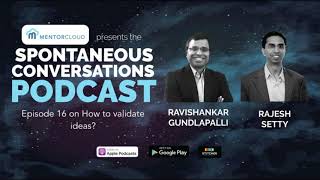
Dr. Ravi Gundlapalli and Rajesh Sethi discuss how founders validate ideas by talking to potential customers and testing willingness to pay. They stress sharing ideas early, running low-cost landing page experiments, and looking for concrete commitments like deposits or people willing to join as proof people actually want what you're building.
Chapters
Hi there. Welcome to episode number 16 of spontaneous conversations. This is Ravi Gundlapalli, founder, CEO of Mentor Cloud.
And this is Rajesh Sethi, a serial entrepreneur and a co conspirator with Ravi for this series.
Yeah, it's truly a conspiration, you know. So the topic, Rajesh, we selected just before we hit the record button is how to validate ideas.
Yes.
You know, they say, ideas, anybody that takes a shower has ideas. Ideas keep coming into our head. And you know this. I also heard ideas are dime a dozen. But how do you take. I mean, you are an expert of bringing ideas to life, you know, which is a fascinating way to describe yourself. So that's why maybe that idea came to my head is how do we help people validate that idea which can eventually see the light of day?
Yeah. So, Ravi, I'll start and then of course we'll have a conversation about it. Say, I always believe that if the idea is really, really compelling, somebody will be willing to pay for it even before it's manifested in real life. So whenever I work with someone, people tell me that I have this brilliant idea. I ask them, have you tried to sell this to someone? I said, but I don't have a product yet. Said, assuming the product was going to be there, have you tried to sell this to someone? People always say, no, but what if they ask me, show me the product and everything? So although they overanalyze what might be the conversation looking like, in reality they are afraid that their idea is not good and they will get exposed. So they don't even try to talk to someone to say, if the product was built, would you buy it? And if you are going to buy it, can you make a deposit? If you don't want to make a deposit, can you sign an mou? So those hard conversations will really, really help, but they don't want to do it. The second reason people tell me is that I do not want because I have not even built it. I don't want the idea to get out, which means that somebody else may steal it. See, in a big company, Ravi, let's say Boeing or some company like that, there are trade secrets and everything. So. So nobody wants to give away what's coming up in the next version of their jet or something because it can be disastrous. In a startup world, I always believe that nobody. It's very difficult for people to steal ideas because people are not waiting, okay, where is the idea? Next idea I can steal. I'm just waiting to steal somebody's idea. Nobody is doing it. So my advice to all these people is if you have a really good idea, you know who you are targeting, just have the conversations with them and see whether they will buy the idea now, whether they will make a deposit, whether if it is that good.
What will they put something at stake for them?
Correct. No, I think that those are excellent, you know, inputs. Rajesh. I think I remember I used to work at ITWO Technologies and you know, the founder of itw, Sanjeev Sidhu, sold the idea first, the idea of supply chain management. And he went to a company and said, I have this idea. And just the sheer passion, the way he described that idea, the way he wanted to build the product, he got a five million dollar check saying, just your passion, your energy and your innovation. We love it. We think if there's anybody who can take the idea into reality, it's only you. So that's how we built ITWO Technologies into one of the greatest supply chain companies. But you didn't wait to build the product. So your first thing about finding somebody who really sees the passion and the seriousness about your idea I think is extremely valid and excellent advice.
Yeah. Plus Ravi, you and I know that good ideas are very helpful, good products are very helpful. But without good distribution, both of them are useless. So somebody has to make that idea and the product built on top of the idea meet the market, which means the distribution has to be there. So when I say tell people that, start talking to people. I'm just telling them to test the distribution channels. Like one of the distribution channels for a founder is himself or herself because she is the one who is believing in it passionately. Working day, night, weekends, early mornings, late nights, everything. So he or she has to have the ability to sell the value of the idea. The second thing on that front is sometimes people think that because they have had a problem, they think the whole world has a problem.
Correct. That's a very important point, is that that's where this so called customer validation comes in. Because definitely as an entrepreneur you have to have a problem because most startups are, hey, I tried to do this. It didn't work very quickly. I realized I'm not alone. There are 10 million people that have this problem. So let me create an entrepreneur, let me create.
A product or a company. I think that's really important to get that validation very quickly. Is it only you or are there enough people like you? I think that's the first point of validation.
Yeah, totally agree, Dhruvi. See, it starts at whether the problem is Painful enough for which somebody is willing to pay anything. Sometimes there are problems. People live with it. They say it's good enough, and the cost of changing with the solution that comes to solve that problem is so high that it's better to live with the problem itself.
Right. And you use that magic word, you know, that are willing to pay. So we are living in a world where there are lots of things that are free. So one of the things that the new economy has actually taught us is is that paying with money or paying with their time. The fact that people are spending time on Facebook is they're paying with their time on Twitter, on Instagram, there's no money exchanging hands there. But people are sort of drawn to your product. They're willing to spend time, which indirectly gives you a business model once there are enough people using it. So pay with their attention is as good.
Yeah. So we live in that economy, which is called the attention economy. So if they're paying with their attention, that attention can be monetized because somebody else needs that attention and they can broker that attention. They can sell somebody's attention for somebody else's money. So one more thing I want to bring up, Ravi is.
For the founder. He or she should be able to highlight the problem for which they are creating a solution. So they have to amply be able to amplify the problem itself in a story such that people will say, yeah, that's right. That was a problem. I was living with it. Why am I living with it? I can solve it and there is a solution for it. I didn't know that this was a big enough problem. So they should be able to define that problem so well that people say, I see it.
Correct. I think what you are highlighting is it's not a solution looking for a problem, but a problem being identified, everybody relates to, and then you have a solution for it.
Correct.
So a lot of you come up with ideas and there's really no problem and it's not big enough, it's not painful enough, like you said. So that's the way to validate your idea, is that.
Did you get the idea in the first place because of a problem that you had?
Yes.
I mean, 99%, that's the case. Like you were trying to watch a game and you couldn't watch it. That's a problem. Now, six months later, you probably got an idea how to solve it. But don't talk about the idea quickly. Kind of dig deeper into what was the problem that happened yesterday, last week, or six months before. That kind of got your brain to think, this is an idea.
Yeah, makes a lot of sense. The good news, Ravi, is this. If you are an introvert, for example, you are a brilliant thinker, but you are an introvert. And you are also little bit conservative just to add to the complexity, but you think you have a great solution and you want to talk to the customer, but you are not ready because you feel somewhat. I do not have it. This is the first time I am building a company. How can I go without bidding preparation? Let me actually put some money and build the product and everything. Our theory here is that before that, go and validate. But you are an introvert, so how do you do it? The good news is 15 years ago you could not do it. Now you can just see this is the target market that I'm going after. What are the keywords that people will be using when they have a problem? People in this target market have a problem and search on it and then use that and put some money for advertisement like Google AdWords or something. Create a compelling landing page and offer them something white paper or like a freeview of something and then actually see if somebody actually bites that. So for $1,000 being an introvert, conservative and anything, and another $500 to create that copy landing page and everything, you can actually test the idea because somebody is even interested to download anything related to that idea.
Yeah. I think two thoughts come to my mind when you say that is one that's probably not an introvert's problem as much as an engineer's problem.
Right.
The engineers don't want to look stupid in front of other people that, hey, what a silly idea. You want to look good, and the more intellectual you are or more smart you are, the worse it is to kind of expose yourself or be vulnerable. So most people end up spending a lot of money. And I have done that. I have done that spending so much money upfront. So now when I mentor entrepreneurs, I am telling them, don't spend a single money, single dollar until you have talked to enough number of people and there's somebody out there to say, yeah, this is good. So you don't need a pretty product. In fact, Reid Hoffman said, if you like your product, you have waited long enough, too long. So being able to put a dirty idea out there, being able to put something, that something has been cooked up, it doesn't matter. Even if you have to hold two wires together to make a point, that's good enough. So encouraging entrepreneurs really to not be afraid about sharing ideas the other second point is people think, oh, there are all the people have their antennas up to listen to ideas, but everybody is so busy in today's world, they have so much going on. When I was starting Mentor Cloud, people would say, hey, why are you openly talking about it? Wouldn't Cisco do something? Wouldn't LinkedIn do something? They have their own things. And the story I always give is just because my friend talks about going to Hawaii, I will not go because I have the money. It has to mean something to me. Right? So similarly, when ideas are shared, companies don't jump and implement them. They have their own things, they have the money. Can Cisco do something? Yes. Do they have the smartest people in the world? Yes. But it doesn't fit into what they are doing. So ideas should be shared.
Yeah. I'll tell you one place where people have to be careful. See, somebody thinks they have an idea and they have an idea for a company, but in reality that idea is just a feature for another product, but they think it's the full company product. First of all, they think it's a company that may be wrong or they think it's a product that may also be wrong. It probably is just a feature that is when somebody might steal that idea because for them this is just a feature for our product. Let's just incorporate it in one, put two developers there and everything. So when somebody says some big company stole the idea.
Most of the time it was just a feature.
The whole product itself, like you rightly said, companies are not waiting. Okay, let's look at all the startups. Which can we steal? Because they move very slow, first of all.
Correct? Yeah. They have their own headaches, they have their own internal bureaucracies and so on. So I think the point that I want to highlight in what you just said is, is the idea a feature in a bigger product or is the idea is the product itself? I think entrepreneurs or anybody that says they have an idea, this distinction is very, very important.
Because then their own expectations of what can be done with this idea will become a lot more real.
Totally agreed. It makes a lot of sense. We are at about 13 minutes, so should we give some closing comments?
Yes. So I think I highly encourage all our listeners to write down every idea that comes. The first thing is when an idea comes in your head, the problem with our mind is thoughts keep coming and ideas vanish. So they should have a notebook in their car, in their room, or in their bedside that they're writing down these ideas and then validate them and the idea that bugs you the most over a period of time is the idea you should work on. Because entrepreneurs, something bugs them, that's why they just jump and do something. Out of 10 ideas, if one is constantly coming to your mind, that's the one you want to probably most likely be successful with.
That. Yeah. So my closing comment is this. In addition to what you just said, I always believe that the only way, surefire way to have a good idea is to have a lot of ideas because most of them will be junk and small percentage of them will be good. And when I talk about validation, I also want people to think the ideas can get validated not just by customers, but by investors or people who say, this is really cool, Ravi, I'm willing to put some $50,000 in this if you do it. That's validation. Not directly as the customer validation, but somebody is willing to put something at stake or somebody will say, you know, Ravi, if you do this, I'm going to quit my job and I come and join you. That's again, putting something at stake. I'm always looking at what will somebody put something at stake because they are so wedded to the idea, the potential that comes with it. So the only way to know it is by sharing it with many, many people without having to worry about getting stolen. And if it gets stolen, there is a really good chance that it was not a product or forget about company, it was not a product, it was just a feature in somebody's product.
And I think one of the other things to keep in mind is people can copy idea, but they can't copy you.
Yeah, the structure cannot be copied.
The structure cannot be copied. Right.
So that's one thing people should remember is look, if yours is simple idea, somebody can copy it, then it's probably not worth your time to take it and create a company and then have some surprises later.
Yeah, if that could be that easily copied, even when you build it, it's out in the open anyway.
Exactly.
Somebody else will copy it.
Exactly. So you have wasted all this money time and somebody copied it. So really it is a reality check. The more you share, you're actually saving a lot of agony by realizing early on that this is a feature, like you said, that nobody is willing to. How many people are willing to pay for it with their attention or with their money? And you will know it only by sharing, not by building a product in vacuum for one year, spending a lot of money and then tada, here's the product and, and then what's the big deal, you know. So sharing is the only way to validate your idea and saves you a lot of agony as an entrepreneur.
Very good. So signing off. This is Rajesh Sethi and you can.
Find more about me@rajeshti.com and this is Ravi Gundlapalli. You can visit us, you can learn more about us@mentecloud.com thank you for listening.
More from Dr.

Essentials of an Entrepreneur by Dr. Velumani Arokiaswamy, Founder of Thyrocare

Skills & Traits for Better Employability | Amritkaal Mentors – An Initiative by MentorCloud

What Leaders Look for First-Time Job Candidates | Amritkaal Mentors – An Initiative by MentorCloud

How to Innovate and Lead Wisely in Today’s World with Navi Radjou - An Initiative by MentorCloud

Crafting Your Academic Journey with Dr. Manish Kothari - – An Initiative by MentorCloud



Advaitha Jagruti: Awakening The Spirit Of Adi Shankara In Indian Youth | Dr. Ravishankar Gundlapalli

Testimonial | Sanjeev Sharan | Catalyzing Growth From Within | MentorCloud Mastermind

How to Make a Mentee Feel Comfortable #mentorcloud #mentoring #coaching #wisdom #experience

Testimonial | Kellie Teal-Guess | Catalyzing Growth From Within | MentorCloud Mastermind