Episode 17 on When should an employee transition to being a full time entrepreneur
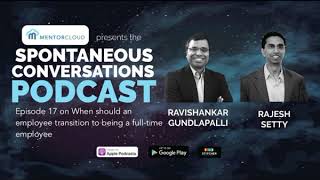
A 14-minute spontaneous-conversation episode (Ravi Gundlapalli & Rajesh Sethi) discussing when an employee should leave a job to become a full-time entrepreneur. Key themes: internal conviction (dreams that keep you awake), practical readiness checks (customer/product validation, savings/safety net, ‘push-button’ access to help), and the importance of built-up reciprocity/goodwill and a doomsday recovery plan before switching.
Chapters
Hi, welcome to episode number 17 of spontaneous conversations. This is Ravi Gundlapalli, founder CEO of Mentor Cloud.
Hi. This is Rajesh Sethi. I'm a serial entrepreneur and a co conspirator with Ravi on this spontaneous conversation series.
Excellent, Rajesh. So the topic, Rajesh, we selected is something that a lot of people come to me, so I thought it will be a good conversation to have is when does a person who is working full time in a company and has a bunch of ideas, which was the topic for the previous episode, is when do they make the transition from being an employee to actually becoming a full time entrepreneur? I think that's a problem that many people face. So I just wanted us to discuss what are some of those checklists or things that an individual should look at before they make their switch? Very important switch at that.
Yeah, it's a great topic, Ravi, only because we both can relate to it.
We both can relate to it very well because we both were employees and we became entrepreneurs and somebody somewhere always switches from that employee to an entrepreneur kind of thing. So I was talking to Desh Deshpande, founder of Sycamore Networks and all those things on the same topic and he was interesting. Yeah. So it relates very well. And Desh was mentioning that during his speaking engagements and in general, because he is multi billionaire and very, very successful entrepreneur, people keep coming and asking him one question. He says, I have this idea and then I think it's going to be a fantastic idea. Desh, should I do it? And Desh's answer always is don't. And I asked him, why would he say that? He said.
He said something very interesting, Ravi. He said, if somebody is waiting for an external validation to start on something, they are not ready for it yet. It's beautiful.
The validation has to come from the inside.
Inside. And he was telling the keyword, Raj, he said, is conviction. What is the level of conviction you have on your idea? And he gave a beautiful analogy. Ravi and I want to share it, please. And he said, hey Raj, imagine as a young kid, they brought you your first bicycle. It so happened that you learned to ride a bicycle. And the first bicycle, they bought it your parents. And then you are ready to ride it. But it's already the sun has set and it's going to be night. And then you want to quickly assemble it and ride it. And the parents told you that, hey, you can't ride it today, it's already evening. Tomorrow morning you can ride it. And imagine what you would have done that whole night you almost would have not slept thinking, God, when will the sun rise? And then I want to ride it. That's the kind of wanting you need to have in the entrepreneurial world for you to say, I'm ready to jump in.
That's a great story because an entrepreneur have to have that childlike curiosity, childlike energy, childlike belief. So the story is really very appropriate. And having that conviction from the inside, I think is a very important checklist. Am I ready for it? And even if the entire world says no. Now, we talked about the customer validation, idea validation. So I think while you are working, I would recommend people to validate their idea and to make sure that there is something there. It's not a feature, it's a full product. And then. But when you are really fully convinced and are willing to give you 100%, maybe 200% from our own experiences of being entrepreneurs. So I think that's a great story from very, very successful entrepreneur. And I made the switch. When I look back at my own journey is I was really convinced that I saw something and it was bugging me. And I am reminded of a quote by India's president, former president, who recently passed away, Dr. Abdul Kalam. He said, dream is not what you see when you're asleep. Dream is what keeps you awake.
Beautiful.
For me personally, Rajesh, that desire to do what I'm doing today was keeping me awake. I just couldn't wait for me to do this. And I just had to one day just cut it and do it. And of course there are few others that I want to say when to do it and what are the checks and balances you want to keep before you do that. But it's the dream that keeps you awake.
Yeah. Desh also continued Ravi, and of course he's always super insightful and he said a time to do it is when not doing it is no longer optional for you. It is. So you are so much convinced about the idea and you are committed to the idea. It's like you can't not do it anymore. The time has to come. And I want to step back once why people will not make that switch. I want to talk about it.
Yes, because that's where they are stuck, Rajesh. Most people are stuck because there is some fear. Something like that. But yeah. Please elaborate on why that switch doesn't happen.
The switch does not happen, Ravi, because think about it. As you get older, the stakes get higher to make that switch in many ways. One is professionally, the other is personally. So when you are young you are not married. Suppose something goes wrong or anything. The only person that will be affected is you, right? As you get older, you get married. And now you have to think of one more person at least saying that I can take a rash decision or a risky decision. But I have to make sure that one more person is covered. Because it's not just you. Once you get kids, then you have. Depending on how many kids you have, the risk factor multiplies. Then you buy a home. And when you buy a home, now you have to think about not just one person, your kids. I have to say, by the way, I have to worry about the mod kids.
So it's a family, it's the mortgage, what else?
And after that you have also got aging parents. Because it's not just your family and kids but it's also the parents, siblings and everything. Because they are also getting older. So the chance of what can go wrong, what can break, keeps getting higher. And plus that is on the personal side, professional side. There is a whole other intellectual problem. The fact that you got an idea and you want to pursue it, you must be really smart, right? That where did you get that smart label is because you are very good in your current job, correct? Right. So when you have that really good smart label attached to it in your own world, you are very smart. People know you. But suddenly you are now playing another game where you are not that smart because you have never done it before.
So people are afraid that in this new space do you have the capacity and the wisdom to survive on your own versus being under the umbrella of a large corporation? Right?
Exactly.
So that's where the fear comes in, Rajesh. Because they are afraid that. Can I manage?
Yes. There is a third one which is even deeper. But that never gets discussed.
Do you have enough reciprocity built in in your bank account so that when you leave and embark on a journey the people who are all your friends because you are in a good position in a big company, will they come and support you in a venture that has 90% chance of failure?
You know, that's a fantastic point. Can I elaborate on that? Because you know, in my own journey, Rajesh, the day I decided to become an entrepreneur and I told people by then I have already earned a lot of that so called. You know. What did you call that word?
Reciprocity.
Reciprocity quotient. Right. I think just to expand on that word, that's a very complicated word. But once you explain it, it is about what have you done to other people. You should Be helping a lot of people and being able to build that quotient that when you do need help. Because as an entrepreneur, Rajesh, you and I know we need help. We are all alone in a company. You have secretaries, you have everything, you have benefits. As an entrepreneur, you have nothing. So unless you have built enough of that so called deposit of goodwill, I don't think you should jump. And many people make the mistake and they fail as an entrepreneur because nobody wants to give them. And for me personally, I'm so grateful. I kind of realized this early on. I didn't do this because I want to be an entrepreneur. I think we all should be working towards building that reciprocity quotient or so called gratuity quotient by helping people as much as possible. Because that deposit will come to you handy when you become an entrepreneur.
Correct. So in my opinion, Ravi, I always think what makes an entrepreneur success, There are many, many skills, right? But I always think that do you have push button access to great help?
Because you will never be able to figure out everything. There is so many moving parts. The product has to be right, user interface has to be right and sales, there is distribution channel, there is teamwork and competition that's catching up. There is no way you will be able to figure out everything. Imagine at the push of a button you get access to amazing help and insight. Automatically the odds of succeeding goes up. But many times people don't realize that lot of their friends are friends professionally because of their current position in their big company.
Oh, that's again a very important element I think Rajesh, that you bring up is just because you are doing extremely well in the corporate world, it does not guarantee your success as an entrepreneur because you are under an umbrella. You are under a very protective environment where people who are nice to you because of your position, like you said, they report to you or they are doing a project with you. But once you are on your own, there's no obligation.
Exactly.
There's no professional obligation to work with you, to help you. And so that's a very, very important checklist item.
And to add to the complexity, Ravi, if you start meeting someone to validate the idea when you are in a big position, they will definitely give you that meeting because.
They want to be nice to you and you still hold that position in that big company. So obviously you will think, look at me, I am so smart. I'm just asking a lot of my professional friends for a meeting to discuss my idea. And then they so simple, they are just meeting Me, they are not interested in the idea. They are interested in continuing to build that relationship with you. It's a courtesy meeting.
Yeah. So another checklist is when you are meeting people to validate your idea, when you are ready to switch from being an employee to an entrepreneur, being able to screen those courtesy meetings versus people that are genuinely willing to work with you, help you open their network, put some money, or maybe join you. You have to be able to screen that because courtesy meetings will not do anything. Because they are doing themselves a favor. They are not doing anything to you.
Correct. Because they think that by meeting they took care of your request, and in the process, they now earned a right to make another request for you that might help them pursue whatever they want to pursue because of your position. The second kind of meetings that come up are curiosity meetings, because everybody wants to know what's happening.
Yeah. What are you doing? What's the idea?
Correct. And they may not even be interested in doing anything with you, but they are just curious. They know that you are very successful in your current position. What kind of an idea that Ravi or Raj have come up with? I am just curious. And they will ask you a lot of questions and almost makes you feel like they are really interested. They are really interested just to know what you are doing. Correct.
Not to help. Yes, not to help. So I think, you know, I think this is another important topic to expand on. But a few things to kind of bring everything together is make sure you have built enough help quotient that people are willing to help when you need it, and you will need lots of it when you are alone. Make sure that your safety net, in terms of savings, in terms of your family, in terms of your parents and children, there is enough safety net built that even if things don't go well for a year, two years, you can sustain and make sure that all the validation that we talked about in the previous episode of your idea and how big it is, and there are people that are willing to put money and time into your. So I would say those are the three things that come to my mind.
Yeah.
In closing, we are coming to about 14 minutes. In closing, what I want to say, Ravi, is that do you have people saying, do you have a plan B? I always say, before you jump in, I always ask people, do you have a plan D? And it's not plan A, B, C and D, it's doomsday plan. If everything goes south, do you have a plan D to recover from it without risking your family and the structure and not causing.
Heartburn for people that love you and also your own reputation because you don't want to shortchange anyone. So the only way to do it is like you rightly said, you build a lot of good karma. Correct.
And you will need lots of it as an entrepreneur because we have all been helped as entrepreneurs. Both me and Rajesh can clearly vouch for the fact that we are who we are today because many people have helped us and the reason they helped us is because we have done some good karma ourselves. Mentoring people, helping people, guiding them, making them successful and using our time. Because it all comes back to you.
Yes correct.
So with that this is Ravi Gundlapalli and I encourage everybody to think like an entrepreneur but really go through this very important checklist items before you make the switch so that you can save yourself a lot of grief. Ravi Gunlapalli Founder CEO of Mentor Cloud.
This is Rajesh Sati signing off. You can read more about me at rajeshati. Com. Until next time. Goodbye.
More from Dr.

Essentials of an Entrepreneur by Dr. Velumani Arokiaswamy, Founder of Thyrocare

Skills & Traits for Better Employability | Amritkaal Mentors – An Initiative by MentorCloud

What Leaders Look for First-Time Job Candidates | Amritkaal Mentors – An Initiative by MentorCloud

How to Innovate and Lead Wisely in Today’s World with Navi Radjou - An Initiative by MentorCloud

Crafting Your Academic Journey with Dr. Manish Kothari - – An Initiative by MentorCloud



Advaitha Jagruti: Awakening The Spirit Of Adi Shankara In Indian Youth | Dr. Ravishankar Gundlapalli

Testimonial | Sanjeev Sharan | Catalyzing Growth From Within | MentorCloud Mastermind

How to Make a Mentee Feel Comfortable #mentorcloud #mentoring #coaching #wisdom #experience

Testimonial | Kellie Teal-Guess | Catalyzing Growth From Within | MentorCloud Mastermind