Episode 2 on Mentoring
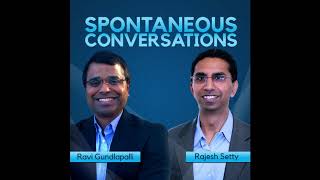
Dr. Ravi Gundlapalli and Rajesh define mentoring as sharing what you know with someone you care about. Ravi mentored a blind student, Srikanth, who went on to MIT Sloan and founded companies. They discuss what makes a good mentor and mentee, and how to find one.
Chapters
Hi there. This is Ravi Gundlapalli in our episode number two of spontaneous conversations. And I'm here with Rajesh. Hey, Rajesh.
Hi, Ravi. I'm excited to have the conversation. And today what are we talking about? Ravi?
Yeah, last time was about conversations. And maybe today we can talk about a topic that is close to both of us, which is mentoring. And that's the topic. I kind of been part of my life for many years, Rajesh, and you know, which is what brought us together in the first place. So let's talk about that.
Very good. I think what was fascinating to me, Ravi, all the time, how I have known you for so many years, but that one story about a student that you helped get into an Ivy League school. Why don't we start with that story? How you met him, what happened, what kind of mentoring you provided, and what is happening with the student now?
Yeah, I feel that I've been fortunate and I think all of us have such opportunities. So I was in India talking about igniting youth leadership and I wanted some local students to also talk about what leadership means to them. So this was at the Indian School of Business in Hyderabad, India. And soon after I finished my talk, a 16 year old blind student walked up to me and said, sir, I really liked what you said. Can you help me get into mit? Because I cannot study science and math in India because I'm blind and I want to prove myself. And that kind of intrigued me. You know, being in Silicon Valley for so many years, I never had people walk up to me and say, say things like that with such an audacious goal for their life. So I kind of started to learn more about him. And fast forward four years, I've been able to mentor him through mit. He got into mit, finished from Sloan School and is now running two companies. And that experience really taught me that I had something that is stuck in my head that would not have seen the light of day if this person did not come up to me and said, can you help me? Because I don't. That's not my job. Helping people get into MIT is not what I do. But we all have that hidden expertise that doesn't get activated. And that gets activated only in a serendipitous interaction like this. Which later I found out I was actually mentoring him. But what I'm actually doing was sharing what I know, opening my network, genuinely caring for his success.
Beautiful story, Ravi. Every time I hear it, I almost have tears in my eyes because it is awesome in so many respects. Because first of All a normal student, not a blind one, but a really good student. Trying to get into MIT is a tall order for anyone in that somebody from India who is a blind student getting into mit. Hats off to both of you. But let us look at the lessons learnt here. In my opinion, my thinking is going back to the first conversation about conversations. And this was one of those life changing conversations for both of you. For him, his dream came true. And for you, you realized that you have more power than you think.
Right. I remember from the last conversation you said a statement from this book called Fierce conversations, like one conversation can change life. Right? It certainly did for my mentee Srikanth. It did for me as well. Because that was a perfect match of somebody having the desire to learn and kind of prove himself and someone else having the desire to share and learn and be of significance. It was a perfect match. And that conversation changed me in the way I look at the world. Because helping somebody who cannot see, I cannot just say, go get 10 copies for this. I have to think. So it taught me really the power of sight and vision, which I also blogged about. There are many blind people walking around on the planet who have sight but no vision. And here is the person who taught me that sight and vision are two different things.
Yeah, amazing story. See, let's go back to the fundamentals of it. And because you are running a company called Mentor Club, which is all about mentoring. And in your opinion, how do you define it? If somebody says, what is mentoring? How is it different from coaching and is it paid? It is not there. People have so many things and people use the word a little bit loosely. So I have thrown so many mentors as if it's a pride of honor. What, in your opinion is mentoring?
Yeah, I mean, I have a very simple definition. You know, sharing what you know with someone you care about is mentoring.
Yeah, right.
Obviously you have to be good in some, some area of expertise and you're not going to sit in on the street and start shouting what you know to everybody. You really want to genuinely connect with someone that you care about. So sharing what you know with the people you care about, mentoring and from the other side, learning what you need to know from the people you respect is mentoring. So you got to have the desire to learn. You have to be a student for something, but you cannot learn from anybody. It only comes when you start respecting the other individual and say, that's the guy I want to learn from or that's the woman I want to learn from. So it is about sharing and caring from the mentor side and aspiring and respecting from the mentee side. When that combination happens, the relationship can be short term to satisfy a particular need, or it could be a long term where things go on and we just enjoy and so many new things are coming out because of that perfect match.
Very nice. Very nicely said. And the keyword that I took away from this is caring. Because if you don't care enough, then the level of sharing and the level of intensity with which you will share will be different. So in my experience, what I see is mentoring for me is a series of uplifting conversations where the mentee and the mentor both get lifted to the next level because of the series of conversations that are happening. So in my experience, being on both sides of the mentoring world, even today, I have a few mentors who help me lift myself and help me contribute better. I always look back, what is that they are doing? Ultimately, they are having conversations with me. And if I am hungry enough, I will be open, curious, and willing to learn. And they can sense it whether Rajesh is hungry enough or whether it wants to be educated or whether he wants to be entertained in the name of education. And they will lift their own level if I know that I am hungry enough.
Yeah. Again, the other person has to be willing to receive. So that hunger comes from a genuine desire to really learn. And one of the key, another attributes of a good mentee in the relationship is you have to be willing to listen. Lot of people want to hear what they want to hear and they miss out on the things that are being told.
So true, Ravi.
So a mentee really should be willing to listen because mentor may not say, now listen to my sermon. It never happens that way. Let me tell you three things in those you call lectures. You know, you go to school for this. These are the three Newton's laws.
Or if you learn on a YouTube.
Video or a YouTube video. But a mentor is genuinely sharing. You know, my mentor, for example, Bibi Jagadeesh, we are just such a great, successful entrepreneur. We are just having conversation.
And sometimes when, like sometimes he said, ravi, you got to move from being the founder to a CEO. And then I said, wow, what does that mean? I am founder and CEO. What does that mean? It's the mindset change. It didn't come out as a specific. Today I'm going to tell you this. It happened out of a conversation that transformed the way I speak, the way I look at the company. Now, because the company is no longer in this baby stage, it now needs to be. I need to look at the company as a CEO. And that came of a conversation that when I told it back to him, he said, wow, did I say that? I said, yeah, you did. And that changed the whole thing for me. And he said, oh, I'm so glad you really caught that.
And timing becomes very important, isn't it? So what time he said it, how he said it, and how much of care he put in while he said it. The other question I want to move on to when it comes to mentoring and this people have asked me so many times, how do I find a good mentor? As if they can order one.
Yeah. You know, I used to say that it is easy to find a local Starbucks because Google has pretty much, you know, indexed all the locations, but we have not indexed all the wonderful mentors that are out there that are walking on the planet. And we don't know where they are. So that's one of the reasons what our company is trying to do is kind of index those people that are genuinely willing to share, but we don't know where they are. They could be next to you in the same street. They could be in Australia. And we want to really make the discovery process easier. But in general, you can't go somebody to say, from tomorrow, you are my mentor. The mentorship is a relationship. It starts with an acquaintance. First, you have to respect somebody. Hey, I got to meet this person. Either you write a blog about that person or a blog that the person wrote or a talk that he gave. So you got to start the respect. And second, when you meet that person, you want to really earn it. You got to earn it. Because there are mentors everywhere. And if somebody is telling they're too busy, but they're really superstars, they're essentially saying, I don't think my time I will be spending with you is really worth my time. That's what they're saying. They're not busy. Nobody's busy.
You are not a priority enough.
It is not a priority enough. So finding a good mentor is actually.
Being ready for mentorship has to be earned. You have to genuinely show that you are not there to just get something very quick, but you are making the other person feel good about the conversation, like our last conversation. So when that happens, you become good friends and you say, hey, you know, I'm going through this particular situation. Would you mind maybe spending half an hour every other week? And, you know, in return is anything I can do for you. I know you like music. I know you like, you know, you do a lot of writing. I'd be happy to return the favor. So the attitude should be one of, in a mutual giving of respect and be clear in the expectations. Then people open up out of nowhere.
I totally agree with you. I always say that if you want to find a good mentor, you just don't even go and ask them. You start becoming a positive possibility in the future they are creating for themselves because they are also going somewhere in their life because they have achieved so much and they have their own needs, desires and they are going to their next level. And if you start working as if you are not looking for anything and you are just adding on to whatever they are doing, accelerating their own needs, their own journey towards wherever the next step. The good part, Ravi, I found that we are living in an amazing age earlier. Suppose 20 years ago, suppose we both were having the same conversation and I said, you have to start becoming a positive possibility in the future your mentors are creating for themselves. First question you will ask is, but how do I know? Because why will they tell me? Because I am nobody. Why will they tell me? Look at today, they are blogging, they are on social media, they are giving speeches, their stuff is on YouTube. Whenever you hear whatever they are sharing, what will they be sharing about? They will be sharing about what matters most to them. It's so easy to listen. And you said it nicely, you have to be able to listen. And my thinking is, even before you meet with them, you have to already listen to the things that I have shared before so you can start caring for what they care about. And sooner than later, if they think there is so much this person is doing, this man or woman is doing, let me put some attention to them. So how can I help you? And that starts a conversation that might lead to they becoming a mentor.
You are again absolutely correct because like I said, you have to earn it. And so doing that homework upfront and you becoming a success story for them is very important. They should be able to say, hey, this guy I'm working with, he's awesome. Because ultimately everybody wants good stories. Everybody wants to leave a legacy. And you should make sure that you are that person that's going to give them a good story, that's going to give them a legacy. And you know, if you want to find a good mentor. I heard a story actually at Runway, there were these two entrepreneurs in Oxford, in Cambridge, in London rather uk. So they wanted to, they were following this guy like you said, following his tweets, following his blogs. He's an amazing guy, very, very successful. And they found out that he comes to London every Wednesday by a 2 o' clock train. Okay. So they found it. They said, this is the only way. How do we get in touch with him? So they went to the train station and, and held his name plate and said, we are here to pick you up. And he was like, I didn't order a cab today. Who are these people? So he said, he just laughed. And they introduced themselves. We are entrepreneurs and we love you. And he said, okay, I'll come with you.
So.
He drove with him with those two people and they had a great conversation. And this guy made an investment in the company and also is an active mentor. And this guy apparently makes a million pounds a month or something like that. What a creative way to do this, right?
Yeah, it's an out of the box way of finding a mentor. Yeah, that's what it takes.
Yeah. So we are about 12, 13 minutes already, Ravi.
Yeah, I know. We can keep talking on this topic forever, I think so. We talked about the importance of earning that mentorship. We talked about it being very mutual. And you don't go searching for mentors. You don't go to Google and say, where is a Starbucks? Where is a mentor? That's not an attitude. It's almost like finding the right person or persons with whom you want to have good conversations. And it's not that you feel that you're having good conversation. It has to be mutual if the other person is not responding, just kind of being nice to you. So another tip that I want to share is some people are just being nice to you because they don't want to come across as.
Rude or.
I have it all, so I don't need anything. So being nice versus genuinely giving you access to their network, genuinely responding to you and really listening to you is a good indication to separate out the people that are being nice and the people that are actually caring for you.
Yeah, I totally agree with you. I think in closing, what I can always say is my life has changed because of the mentors and the conversations that I have had. And I have heard so many people saying, I met my mentor and my life changed. I'm sure you can relate to that as well. And my thinking is that if somebody has not experienced the power of mentorship, they are missing something and they may not even know what they are missing.
Absolutely. We live in an age, Rajesh, that people have experienced the advantage of a good friendship. And Facebook has made now friendships so global, open source and acquaintances because acquaintances help us get jobs, get business leads and so on. And LinkedIn has made that possible. So the next.
Step in this revolution that we are seeing in the Internet world is having those friendships that are genuinely going to uplift your career. And those are the mentors. And so making mentoring a part of your how you approach, I think is a very critical component for people to be successful as well as for people to leave a.
Strong legacy for themselves.
Beautiful. Maybe you can share where they can find more about you and then we can.
Yeah, I blog regularly. They can go to our website, mentacloud.com to learn more about what we do. But I encourage every listener to just reflect and say if they don't have a mentor, they should start looking for one using the tips we shared. And if they're not mentoring, they should really make time in their day. And 15, 20 minutes is all it takes to change somebody's life.
Beautiful. And this is Rajesh signing off. And you can read more about me on my own blog, Rajesh Sethi.com blog and until next episode, I wish you all a fantastic week ahead.
Excellent and really enjoying this. And please provide feedback with your spontaneous feedback, like we are having the spontaneous conversations.
More from Dr.

Essentials of an Entrepreneur by Dr. Velumani Arokiaswamy, Founder of Thyrocare

Skills & Traits for Better Employability | Amritkaal Mentors – An Initiative by MentorCloud

What Leaders Look for First-Time Job Candidates | Amritkaal Mentors – An Initiative by MentorCloud

How to Innovate and Lead Wisely in Today’s World with Navi Radjou - An Initiative by MentorCloud

Crafting Your Academic Journey with Dr. Manish Kothari - – An Initiative by MentorCloud



Advaitha Jagruti: Awakening The Spirit Of Adi Shankara In Indian Youth | Dr. Ravishankar Gundlapalli

Testimonial | Sanjeev Sharan | Catalyzing Growth From Within | MentorCloud Mastermind

How to Make a Mentee Feel Comfortable #mentorcloud #mentoring #coaching #wisdom #experience

Testimonial | Kellie Teal-Guess | Catalyzing Growth From Within | MentorCloud Mastermind