MentorCloud Webinar Series: Smart, But Stuck by Rajesh Setty
Rajesh Setty explores why intelligent people get stuck and how to break free. He covers change management, taking action, communication, and how gratitude and likability factor into moving forward.
Chapters
Hello everyone. Good morning. We are just waiting for a few more people to join and then we'll start in about less than a minute.
Hope you all can see the screen.
If you can see the screen, type yes in the chat box.
Let's give us one more minute. A few people joining in it.
Just check how many more people.
Okay, let us begin. And then the topic today is Smart but stuck. So it has been. This question has haunted me for years. The question is why smart people get stuck? So this. I had just written my book a bit in 2009 and then I thought I was just thinking about what is the next book to write. And at that time I was finding out a lot of my smart friends. I'm stuck here, I'm stuck there. And I'm thinking why are these people stuck? They're so smart, they should not be stuck. And then I got a sort of a quote unquote brilliant idea. I thought if I can figure out why smart people get stuck, find that one reason that.
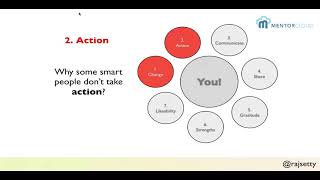
I'll find out why every smart person is stuck, then I can write a book and then the book will be read, bestseller, it'll sell million copies and I'll become a billionaire and all those things. But obviously I think I got stuck there because there is no one reason why smart people get stuck. So I was the project that was going to be a six month project went on to become a five and a half year project. And I had to basically change the structure of the research itself. Rather than finding out why smart people get stuck, I broke it down to really really small mini research topics. Why smart people get stuck when they are communicating. Why smart people get stuck when they know they have to take action but they don't take action. And 40 sub research topics. So it's basically it became a manageable research and finally it is becoming a book now called Smart but stuck. So in this webinar I'm going to share a few things but before that, a question for you. So if there is one question, it's the same answer for both of them. What is your greatest asset? And the answer is something. And the next question is what is your greatest liability? Answer happens to be the same thing. And I want for paucity of time. The answer is you. You are the greatest asset. You are the greatest liability. So the entire webinar I'll focus on you. And then I picked seven topics, right? So why smart people like you happen to get stuck when they. When you want to make a change, when you know how to take action. But you won't take action when you want to communicate something to get your buy in, but then you're not getting that buy in. Why would that be? And this also I have observed, which is baffled me forever, that there are so many smart friends that I have and I always think this person should be so smart. She should be writing a book. She should be writing a book. They won't even publish a blog post. And then I just analyzed it over a few weeks. Why they don't share. And if they share, they can build their brand and they can contribute more and a lot of things. But why don't they share the question? And lastly, in the negative terms, there are five negatives and two positives. So in the negative, some smart people take other people for granted. Why do they do that and what happens when that happens? It's not gratitude is like new age kind of stuff. Like because we should be grateful, because my mother said we should be grateful kind of thing. There's a practical reason to be grateful. And I'll go over that and two positives. Just like you want to take care of your weaknesses, if you don't focus on your strengths and amplify them, that also becomes a problem. Why don't they focus on the strengths? And lastly, how to increase likability. This is another woohoo kind of stuff. But likability has proven to be a big USP for many people. So let's start. So why change is hard for many smart people? And I've asked this question in when I speak at conferences and I get answers like, you know, change is unfamiliar.
All sorts of things. Without going into all the so many good answers. Here is my answer. So there is a concept called control on short term outcomes. When you are doing something that you have never done before, your control on short term outcomes is very, very small. But as you get familiar with it, you start gaining more and more control. So with change, as you can see, the graph is moving up. So basically start becoming better and better and better. Like if public speaking is something that is new to you, the very first time you go and speak on public, you will not have good control on short term outcomes. There will be butterflies in the stomach and all those things. As you give some speeches, you start becoming comfortable with yourself. Now without change, the control on short term outcomes is very good because you feel in control, you feel confident and everything. So what happens when you want to make a change is that you start on that path and there are some inflection points that every now and Then.
You will start questioning yourself at that time, you know, I'm still not confident in it. And whenever that inflection point, whenever that self doubt, whenever there is a criticism, those kinds of things, you immediately jump back to the place where there is no change. You go back to your old roots. Like whatever you were doing before you start focusing on that. That is the reason why it is hard for smart people to change. And what is the solution? There are many solutions, but in this. Let me share one of them. First thing is to remember that before anybody becomes a professional, he or she has to go and go through the amateur phase. Like everybody is an amateur before they become a professional. So when you want to make a change, you set really, really small goals for yourself in the new phase of the change behavior. So that way your expectations is small. And you become comfortable with self deprecating kind of humor saying that you announce yourself that you are an amateur, you know you are trying something new and you don't know whether you will succeed, but you are willing to try it. And you just become comfortable with criticism and those kinds of things. So whenever there is that inflection point that happens, self doubt, criticism, not confident, all those things, you force yourself to stay on the path rather than jumping back to the place where there is no change. Let's go to the next one. This is interesting. Why smart people don't take action. So they know that they have to take action. Like somebody wants to write a book, somebody wants to start a company, somebody wants to take up a franchise or whatever it is. They are smart, they know they ought to do it. And sometimes people tell me that their goal is to write a book. And then five years later I meet them and they say the goal has not changed. It's very consistent. The goal is to write a book. But have they done anything? They have done nothing. So here is the thing. Whenever they want to take a big action, like starting a company or anything, so they assume that they need something else to happen. Like for example, when you want to start a company, they think I need to become good at sales or marketing or whatever. It is one big thing. And then there is a threshold capacity. Like how good should you be in sales? Like should you be 9 out of 10? Should you be 7 out of 10? Should you know how to sell online? There are so many ways, right? In your own mind you create a threshold capacity. I think I should be good to that level. In your own metric. And then you assess your current capacity. Let's say it was you need to be 7 out of 10 and you are at 3 out of 10. So you say, oh, the gap is like another 4. So I need to get better at it. And I'll read some books, I'll attend some conferences, I will talk to brilliant salespeople, and that's today. And then this happens. This is one of my favorite quotes from Stanford professor called Jeffrey Pfer. He says in order to know the level of incompetence on a topic, you need to be reasonably competent on that topic. Let's say it was sales. You think you don't know something. As you start learning, when you become reasonably competent in sales, you will know that you don't know a lot more than what you thought you don't know. So when apply that and then one month later, you know enough about sales to know how much you don't know about sales. So you increase the threshold capacity. I think I need to learn a little bit more. I need to learn how to.
Sell on social media or I need to learn about how to get referrals and all those things. The current capacity has increased because you read some books, you attended some conferences and everything. But the threshold capacity, how much more you need to know that has also increased. So you say, okay, I need to start a company, but I'll wait for the gap to be filled, right? And then three months later, threshold capacity has further increased. If you observe the current capacity has also increased, but the gap seems to be growing as the more and more you learn, the more and more you need to learn keeps going up. And six months from now it's like a ocean, right? And the current capacity, thankfully it has increased because you're on the path, but the gap also has increased. If you see the previous current capacity to now, you have grown a lot, but you still think you need to do a lot more. Lot more, lot more. This is the graph that you should remember. You were small in the current capacity and then you grew. You learned a lot, but the gap seems more. But unfortunately this problem does not stop here. So you will think of not one sales. You will think of marketing, fundraising.
Understand? Building the culture. You have so many places where you say, I lack something, I need to build it. And as you become competent on those skill areas that you need to build, you will see that you need the gap in all the skill areas is even more further. So then it becomes overwhelming and you don't take action. You are like a deer in the headlights kind of scenario. So what is the solution? The solution is first to remember that if you want to climb a hill, your home, you might be able to do it alone. But if you want to climb Mount Everest, you need a team. That means you can't get everything on your own. So you can't fulfill all the roles that you need to do. When you want to go on a big project, you need to start finding people with complementary skills. That's the solution. Communicate. So the communication. Many times you would have observed yourself that you know, when you explain something, they don't get it. And rather than thinking you don't know how to explain in a way that they will get it, you'll think, this guy doesn't get anything. I'm trying my best to explain this guy must be an idiot, moron kind of thing. So here is what happens in my skill, right? So suppose you want to say 1, 2, 3, 4, 5, 6, 7, 8. What they will hear is 1, 2, 3, 4th, 5, 6, 7, eight. But you are so smart, you will. So you won't say 1, 2, 3, 4, 5, 6, 7, 8. You'll just say 1, 6 and 8. Why you skip 2, 3, 4, 5 and 7? Because those are too obvious for you. I think everybody will know it. So and you'll just say it's like a shortcut for you. It's just a 168. And what do they hear? They hear 1, several question marks, 6, one question mark and 8. But you're saying it in so confidently. And they will think that I think I should have understood, maybe something is wrong. And when you ask them did you get it? They will just say yes. And then now you get the wrong feedback. Not only you are not explaining it right, you also think that whatever you are explaining is right. So next time you do it in more aggressive fashion. And nobody is getting what you are saying. In your world, you are thinking, if somebody does not get it, it's not my fault, it's their fault. So this is what happens. Like you compress the information, you say it confidently and do it consistently. And that's where the culprit is. So you start becoming used to thinking you're so smart, the other people are not matching your frequency. They don't get it, you don't have a problem. So what is the solution? The solution is to have some close friends that will actually give you the feedback, which is blunt. It may look rude, but it may be blunt. And say that if you are not explaining it right, they tell you on your face saying that it is your problem. It's not the recipient's Problem. It's your problem. Next, about sharing. If you are smart, you need to share because that's where you can contribute to this world. But why don't you share? And here is the phenomenon to think about. Whenever you are learning a new skill, the very first thing, whatever you are learning, that's your current level of expertise. And you are not comfortable sharing there because you yourself think that you are a work in progress, right? So basically I'm not a master at it yet, so I think I need to learn more before I can share it. And then as you learn a little bit more, you have some new things which become your current skill. But whatever you learned before, those become super obvious for you. Like it's like when you are learning to walk, crawling is super obvious, right? So when you're learning to run, then walking is super obvious. So you won't share what is super obvious because you think it's obvious to me, it's obvious to anybody else. And the current skill set, the latest things that you're learning, you are not comfortable because you're still a work in progress. And a funny thing happens a little bit later. So the latest things that you're learning are current work in progress, you don't want to share. Just before that, whatever you learned, it's obvious that everybody knows it. You know it, it's obvious to you, it's obvious to everyone. And whatever you learned before that, that becomes background knowledge. That means you yourself don't know that you have that knowledge because it's so nobody. Once you start learning to drive, after some time, you don't think that starting a car is a skill. Like turning right is a skill.
Clutch, all those things, this becomes super background knowledge. You just do it without even thinking about it. It's like an involuntary skill. So current skill, you don't want to share your work in progress, obvious skill, you think it's obvious to everyone. Background, you even forgot about it. You don't even know that you have that skill. It's in the background. And from then on it goes like this. So basically the latest thing is current skill. Just before that seems obvious to everyone. Before that, everything becomes background knowledge. So you keep thinking when you master something, you will share, but you will never finish the mastery because you are always a work in progress. So what is the solution? The solution is very simple. Whenever you want to share, do some time travel to few months, few years. When you were on the journey to learn this new skill, remember that you were struggling with things before you mastered that part of that skill. So you always share it with people who are little bit behind in the time scale. So one year ago, where you were in the skill, there are other people who are struggling with that level of knowledge. You start sharing it for those people, then things will happen. The next is the gratitude, like what happens when you take people for granted. Something really bad happens way beyond what you think. The level of things that will go wrong is way beyond what you are imagining. So first, there are two concepts that you need to understand. There is something called as a power triangle, which is as you move up the power ladder, so less and less number of people are on the top. So when you are in the bottom of the power triangle, lot of people are there with the same level of power. Power is capacity to make things happen. It's not the power like you have power over somebody. It's just you can make things happen. The more power you have, the more things you can make it happen. Inverse to that, there is something called as an influence triangle. And this influence triangle is exactly the opposite. The more higher you go.
There will be less number of people. On the top, there will be more number of people that will be influenced. And this influence triangle, the size is different for different people. Some people, as they move up, will have a lot of influence. Some people have a lot more influence. Some people have very little influence. Some of them will be like a gigantic level of influence. So it's always the inverse. You move up in the power, the influence becomes bigger on the top.
Now think about your case, right? So there are four people that I'm thinking like John. Somewhere as you grow up, you meet John and then you meet Bob, you meet Ted, you meet Nancy. And then along the path to your ascent to the top of the poor chain, you take advantage of John. And then you say that you lost John's loyalty or something. But in fact, John has an influence triangle. This is your first triangle, is your power triangle. Rest of them are influence triangle, the inverse of beer power triangles. So at the level where John is, his influence is below that influence triangle, he has a set of people who he who trust John. So when you take advantage of John, you lost John and the network of influence that John has, maybe 10 people, maybe 100 people, depending on his influence level. Then you take advantage of Bob. You think you lost Bob. You forgot that Bob has an influence triangle that is bigger than John's influence triangle, deeper than John's influence triangle. You lose them as well. Then Ted, then Nancy. If you see you took advantage of four people but what you don't realize is that you lost.
Mind share of all the four people and everybody in their influence triangle. They won't go and come and announce you saying that, you know, you lost my entire network. But it just happens on the side. And when you are in trouble, this is what happens. You think that you will get help. You lost the opportunity to get help to recover or just have more capacity for you because the entire ecosystem has eroded around you. Because every time you take advantage of someone, their whole network now runs away from you, shies away from you. What you should do is very simple. Don't take advantage of anyone. Because if you take advantage of someone on your way back, you remember that on your way down, you will meet them again. So next, let's go to the positive side. It seems so dark, whatever I just said. The positive side is about strengths. Working on your strengths, right? There's a dumb question. If you say, should you focus on your strengths or weaknesses? I say it's dumb because it's like a rhetorical obvious question. Of course you will say we have to focus on our strengths. But the real question is, how do you identify your strengths? Remember that most smart people in the area of their strengths, they are so good at it, they don't even know it's their strengths. It becomes their background knowledge. It becomes invisible to them. So I have a few ways of identifying your strengths. Like, the first one is your journals. If you are not writing a journal, you should at least try it for 20, 30 days so you will see the power of writing journals. And think about it. When you write journals, what do you write? You'll write about things that resonate with you. Because the entire 24 hours, you might write one page of journal. You are not going to catalog every minute of the last 24 hours. You will just look at the highlights.
After 20, 30 days of journaling, you go back and read it. You will start noticing what is resonating with you, because that's what you are capturing in the journal. So the next is from your notes. When you go to a conference or something and you attend some speakers again, you are taking some notes, but you are not taking notes verbatim. You are not taking every single thing that the speaker is saying. You revisit some of the notes. Most of the people, they go to conferences, they write notes and they put it in for safekeeping. They will never even see it. They don't even. It's so safe that even they can't access the notes. So don't do that and you can go back and reread the notes. One is it will refresh your memory on the things that matter most. Second is you will start seeing why is that you took those things as safekeeping notes. Something must have resonated with you and that provides some clue to your strengths. Next is by your mentors. Coming from mentor Claude, you knew that there will be something about mentoring, but not.
I'm not being connecting just because I want to connect something. But mentors are people who can see your strengths that you don't because they are observing you from a vantage point that you can't do it for yourself. Like, think about it, what is an insight? An insight is to see what everyone is seeing but notice only what a few will notice. And mentor is one such person who has insights about you because they care for you enough that.
You growing is very important for them. So they're always looking for where is it that this person needs to grow? What are his strengths? What are her strengths? Those kinds of things. And then asking competent people who care. I underline competent here because the cop out option is to just ask people who care. Like if you are learning to dance, you ask your mom, mom, how do I dance? And mom will say, great, you are doing amazing. But unless your mom is a competent dancer, she will not make an assessment from an objective standpoint, but she will make an assessment from an emotional standpoint. She wants you to do well, so she will say you are doing amazing kind of thing. So noticing when you are in the flow, so flow is something that.
You lose track of time. So the skill sets will match.
The challenges will match your skill sets and you will lose track of time. So whenever I have to be very careful when I say this because last time when I said it, I asked people, can you identify when you are in the flow? They said, yeah, yeah, yeah. When I was watching the Titanic movie, I was in the flow, so. And then also last time when I was watching Avatar movie, I was in the flow again. So it's not when you are getting entertained, so but you do it when you are creating and contributing when you are in the flow, noticing what you notice and noticing what you don't notice. Interesting. How will you notice things that you don't notice? It seems like a puzzle. Like I will go back to the example of attending a conference. Let us say you go and attend a conference with a bunch of your friends, they all take notes and you see that.
Interestingly, they all did not take the same notes that you took.
When you watch and observe what other people have taken notes. You will notice that there are things that you didn't notice. So.
What you didn't notice will also give clues to your strengths or things that don't resonate with you. And lastly, I have to say that if you forget everything, if you remember this noticing requests that are made off of you, like you start observing things that what are people asking you help with? So they don't ask ask your help with things that where you are not comfortable. Like if you are a bad negotiator, they don't come and say I think I should take you, I'm buying a car. I think you should come with me so that I'll have some power to negotiate. Unless you are a good negotiator, they won't come and ask you for help. So something to think about. You just start seeing why do people come to you for help? What areas do they come to you for help? That's where you can identify your strengths. Lastly, likability. So if you see.
There are things that.
Hold on one second.
If you see there is a curve here where as you grow, you have your capacity to contribute, growth. And then you are always moving in tribes like exactly the same level of capacity to contribute. They are all together and then you are part of the tribe. And as you grow up, you will see that you keep moving in tribes. Because if you are not part of the tribe and the capacity to contribute is different, you will feel some out of place with that. But something good happens when you are very, very nice. You can jump the tribe. Although your capacity to contribute is not exactly the same. They will get you involved, get you be part of the tribe because you're really, really nice person. So when you start, when you do that, you will start noticing that you are participating in conversation at a higher level of capacity people automatically your own capacity grows. That's why you need to be nice. It's not because it's a moral thing, morally right thing to do, but you have the capacity to jump the tribes coming to the end here there are two bonus items. First is the ultimate question. Second is the bottom line. Ultimate question is how big of a void will you create when you're finally gone? Will you create a big void, small void? Just think about it. And the bigger the void, the higher is your contribution to this void right now? Lasting impression. You create an ultimate lasting impression when people miss you in their past. How can people miss people in the past? And think about your own life. There are some people that you meet and then at the end of that meeting you feel that they added so much love, capacity, contribution, caring for you. You just think that I wish I met this person.
A while ago, my life would have been different. So the question for you is how many people miss you in their past today? And then what will you do so that that number grows by at least 10 people in the next 30 days? With that, I thank you so much for listening and hope this was helpful. And if you have any questions, my email is rajesh301mail.com you can send me an email. Thank you.
More from Dr.

Essentials of an Entrepreneur by Dr. Velumani Arokiaswamy, Founder of Thyrocare

Skills & Traits for Better Employability | Amritkaal Mentors – An Initiative by MentorCloud

What Leaders Look for First-Time Job Candidates | Amritkaal Mentors – An Initiative by MentorCloud

How to Innovate and Lead Wisely in Today’s World with Navi Radjou - An Initiative by MentorCloud

Crafting Your Academic Journey with Dr. Manish Kothari - – An Initiative by MentorCloud



Advaitha Jagruti: Awakening The Spirit Of Adi Shankara In Indian Youth | Dr. Ravishankar Gundlapalli

Testimonial | Sanjeev Sharan | Catalyzing Growth From Within | MentorCloud Mastermind

How to Make a Mentee Feel Comfortable #mentorcloud #mentoring #coaching #wisdom #experience

Testimonial | Kellie Teal-Guess | Catalyzing Growth From Within | MentorCloud Mastermind