Ravishankar Gundlapalli I Keynote at Ben Brooks Mentor of the Year Award
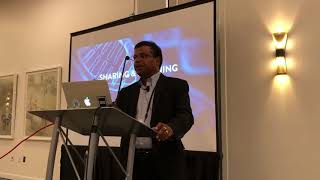
Keynote by Dr. Ravishankar (Ravi) Gundlapalli in which he links his personal journey (immigration from India, engineering career including work on hybrid vehicles and the 787 Dreamliner, a PhD in fluid mechanics) to a broader philosophy about time, purpose, and mentoring. He describes two near-death moments that sharpened his sense of mission, explains his company Mentor Cloud and his book (Art of Mentoring), and defines mentoring as "legacy that meets ambition" — a mix of sharing wisdom, building personal boards of mentors, and balancing success (consumption) with significance (contribution). He illustrates mentoring impact with a concrete mentee story (visually impaired student who reached MIT and became a CEO) and closes by urging listeners to leave a legacy.
Chapters
Good evening, everyone. Good evening. This is very quiet.
I need to connect this hdmi, so Andrew is going to help me with this. So, first of all, I'm truly honored to be here today. And I did not know that the 26 April evening will be spent like this. And that's how my entire life is. I don't plan for things. Things just happen. Just last week, I had the opportunity to spend some time with Vern. Vern Hamish, the founder of eao, who shared stories about his father.
And interestingly, here I am in Arizona at the celebration of Mr. Ben Brooks, who happens to be the founder of EO Arizona. Again, you talking about your father. So things happen in my life. You know, I think the universe is too powerful for us to plan, and I kind of figured that out. I share some of my stories here.
Curve turned off.
There we go.
It's coming back on.
All right, so I don't live here. I live in Silicon Valley, and I'm the founder CEO of a company called Mentor Cloud. And we recently opened an office in Phoenix. And it's really hot. I got tanned so quickly.
Every time I come, I'm getting more and more tanned. But I love Phoenix. You know, back in October, I came along with my family to Grand Canyon and happened to meet Harry Clark. I think some of you may know Harry Clark. And he seduced me, you know, to come to Phoenix. And we have an office in presence here.
So as I was preparing for this, I actually came across this quote, because I actually live by this, because my dad passed away 18 years ago, but I don't think he has gone anywhere. You know, when I was here and he was in India, I would call him once a week and say, hi, how are you doing? And that's it. Between the weekend calls, I was not even thinking about him because I had my. You know, I have PhD and lots of other things going on, but now I find myself thinking about him almost on an everyday basis. Like you mentioned, Chris. So I saw this quote and I thought, I want to share it. Because our dead are never dead to us until we have fully forgotten about them. And this is a very interesting quote, George Eliot's quote. And one of my passions is just like, how I remember my dad. I hope my children and future generations will really never die. And I will talk more about it so very quickly. My background from India came to the US about 25 years ago. Like she said, I'm an engineer. I learned how to build ships, even though in Phoenix, there is no ocean here. So but at least, you know, it's a very complicated thing that moves. And then I got into hybrid cars. I have an engineering pattern in hybrid vehicles. I developed some of the very early concepts of Prius and other hybrid vehicles. Then I said, cars are too big. I went even smaller. I worked on semiconductor chips and then said, it's too small, let me work on something big. I went back to work on the 787 Dreamliner. I did the supply chain planning for it. How many of you have been on a Dreamliner? Very few. Everybody else, please plan a vacation. Whenever the Dreamliner flies, just be on it and think about me. I had something to do with it. It's a plane that does not get you jet lag. It's not made of aluminium, it's made of composites and it's beautiful. Do you agree? It's an experience. It's really a dream liner. So I spent all my time in engineering and supply chain. I have a PhD in fluid mechanics. So I always say it's all about the flow. Whenever flow stops, you know, flow of blood, we die, flow of money, economy dies and flow of products, you know. So I said, what if I take that and apply to flow of wisdom? And that got me interviews. I didn't know it was, it was such a cool idea, but then Forbes and Harvard Business Review kind of wrote about it. So I said, oh, there's something here. So I started a company, Mentor Cloud, and recently published my book. I brought some copies. I hope some of you will get a chance to pick it up. And there is one person in my life that is, that is in all my demos, all my virtual demos. The moment I start my audio zoom call, my dog is with me. So.
And you know, I believe like you said, whether you are alive physically or alive in the hearts and minds of other people, I truly believe it's a blessing. And I look at time as a God given gift because again, I did not suddenly come up with this. I went through experiences because you are looking at someone who is kind of living his third life. So my story, when I was one month before being born and my mom's doctor says, you know, the baby, something is wrong, we have to abort him or her. But they didn't know, right? India, we didn't have sort of, you know, to find the, find the sex of the child. And so my mom was ready to get operated.
Because they said, otherwise, your life is in danger. And my hand comes from nowhere. And she says, surgery in our family doesn't exist. We are all about natural births. So in a matter of 15 minutes, my mom, you know, she moves out of the hospital and a month later, I just came out just fine. So that was interesting. That was an opportunity. And in February 2009, I went to India and I gave a keynote about igniting the genius within. And just like all of us, I sat in a plane, the plane almost took off. And then the plane that was actually the helicopter that carried the President of India was landing. So in a matter of two seconds, we missed a very horrible tragedy. And so while we were all thanking God and saying, oh my God, we got saved, I kind of said, my God, I got saved again. That means I have a job, you know, at work. If you don't get fired, that means there is a project we have to finish. Because I truly believe when I come to Phoenix from Silicon Valley, I'm not here watching movies or going up the camelback. I have work to do. And that's how I view our time on the planet. We came here, we have a project. Now, unfortunately, nobody gives us the project plan. When you're a CEO or VP of marketing, there is something you do, but on the planet we don't know. So it's up to us to figure that out. Why are we here? You know, we're not here to just eat and drink and consume and just one day vanish. We are here for a purpose. That's why we all, we all look different, we all act different, we all speak different because we all have different jobs. So that, so I said it's a message. So now I'm involved in construction of hospitals in rural India because no child should, you know, his or her destiny should not be decided by a bad doctor. So we've got to change that and the experience of that life changing moment. Because I said if that accident did happen, then of course I wouldn't be here today. But who would the media write about? You know, media writes about the president regardless. But if this happened in India, they would obviously write about the president who died, not the 149 others that were in the plane. So I walked away from that event saying, I better do something, I better have a long obituary. You know, I read your dad's obituary this morning and it was just very fascinating. And in fact, Stanford MBA has their first project. Write your own obituary. Because you want people to write about you. You want people to miss you. So I said, I want the world to miss me. That's why I have a big vision. I started the company and it's called Mentor Cloud. So as a person who lives and breathes mentoring, you know, to be here to talk about a mentorship award ceremony, it's truly serendipity. It's what Universe has planned. I didn't call her. I didn't even know her before I went to Toronto. So I'm, you know, truly blessed. It's a calling. And in my book, you will see, because I'm an engineer, I'm not a learning and development or HR person. So I kind of define mentoring in a very simple way. It's about sharing a body of knowledge that we have acquired with people that we care about. It's not sitting standing on the street and shouting what you know, but it is sharing with an intent to see the other person grow. And today you are celebrating this annual mentorship awards because of the sharing that happened over the last one year. And I do work with ypo, so our company's technology is used by YPO and also eo, so EO Arizona will be rolling it out as well. So you will see.
You will see my work when you start using your technology platform at some point later in the year. So I'm really honored to work with YPO, folks. I've been to all of the GLCs, and I must say, EOGs is a lot more fun. So I won't tell YPO, guys, you know, get some music, get some more energy.
And then from the minty side, it's nothing but learning what you need to know from the people you trust. So for me, mentorship is sharing and learning. And this kind of is the fundamental essence of my book, of all my talks. Last night, I was giving an Art of Mentoring workshop where you're actually teaching people how to be a good mentor, how to be a good mentee. Because in college, we are taught to be independent. You know, like, my daughter is taking, you know, advanced calculus class, and she's struggling. She can't get a mentor and ask for help. She has to learn, right? So the idea of seeking help is not taught. How do you find a mentor? How do you engage with him or her? How do you maintain the relationship? So because that skill is such an important thing. When I started this, all the typical Silicon Valley VC said, ravi, you should go back to Boeing. You know, if you do a supply chain software or a gaming software, we'll invest in you. Why mentoring software? But then when I did my research, you know, Steve Jobs had a mentor. You know, Mark Zuckerberg had a mentor. Warren Buffett had a Mentor. So I said something is wrong when all the successful people are talking about mentorship. Why is it that the investment community doesn't appreciate it? So I took the plunge and it wasn't easy. But today I'm laughing and everybody else is like, oh, I wish you participated.
So I want to share a story because you know, the two near death experiences kind of taught me the value of time, taught me the value of life. But this story, you know, I met a young man, 18 year old.
You know, just before that accident, that flight accident that we missed. He happens to be visually challenged. And after my talk, just like this, he walks up to me and says, sir, I want to study science and math. But India doesn't allow visually challenged people to study science and math. We had some old British rule, you know.
When UK left us, they left a lot of bad stuff. This is one of one such rule. So he said, I want to prove myself, so can you help me getting to mit? I'm like, do you even know what MIT is? And I said, it's going to be very, very cold to walk even for a normal human being is tough. So anyway, so I wanted to really test his so called grit and how determined he is. So I slipped my address when I was staying in India and next day he shows up. How many of you have been to India? Today you have Uber, today you have gps. This was several years ago. I don't know how he showed up in some remote corner of a city, you know, eighth floor of apartments. He came in and he said, sir, I'm serious about it. So to cut a long story short, I started mentoring him and he has got me to MIT 2015. He graduated from MIT Sloan and now he's the CEO of his company, Balant Industries. He's doing really well, thank you. Thank God. Still, he did all the work. And all of you mentors know all we are doing is little nudging. We are reinforcing what's already there, right? We are giving them confidence, we are giving them opening our sort of horror decks and connections. So I wrote a blog and this again sort of forms the basis of how I deal with people. Many people in the world have eyesight but there is no vision. And this young man had vision but no eyesight. So he designed all his machinery and all his workers are physically handicapped people or differently abled people to say it. So it just amazes me even today how is it possible. But it is possible. It is possible to keep your eyes open and have no vision. But it's also possible to keep your eyes closed and have a fantastic vision. So that really transformed me. And until then, you know, it was all about. I had my bachelor's, I went to one of the top schools in India. Masters, PhD, funded fully. You know, I got my US citizenship as an outstanding researcher. It was success, success, success. But then I found a lot more joy when there was an element of significance. So I believe that our lives should be a good mix, success and significance. And I want to spend more time on that.
So when I work with younger people, you know, I tell them early, earlier, we're all expected to go to schools, take the SATs, right? All of us took the SATs or GREs. And you're supposed to do it. So early part should be focused on success. I tell my daughter, focus on studies, nothing else. I see success as an inward process. It's all about know, consuming. You're consuming knowledge, you're consuming resources. But significance is what I want you to at least think about is pay more attention to that towards later part of our lives. That's what I'm doing now that every, every day, you know, how much am I learning, you know, in my company, for my company, and how much am I giving? Because I see significance is all your outward actions. It's an outward process and it's a contribution process. So if there are two words to remember, it's consumption and contribution. Whether it is about the planet, whether it is about mentally, it has to be both. If our entire life, if you are consuming from the planet, it's time that we also do something for it. You know, go plant a tree and do something.
So life should be a balance of both. It cannot be unidirectional. And we as a human race thrived because of that bi directionality. Unfortunately, we don't talk about it as much as we should. So you all know you're all part of the mentorship program and you're celebrating. Have you announced the award yet? Not yet. Okay, so I don't know who the award wins. So all of you are actually winners. I think all the mentors should get a lot of replies.
Because.
What you're doing is, you know, as a mentor, you are essentially symbolizing the act of giving. You know, you could be building your own companies. So I really commend you for having a program that runs a whole year and even celebrating a mentorship award. And I also write in my book this concept called a personal board of mentors, when all our companies are board of directors. But then I have People who come in at the time of crisis and say, what do I do? I said, do you have people around you who is on your speed dial, not your girlfriend, boyfriend, and some uncle and aunt? Who are those people who you can rely on for advice on family, financial, how to be a parent, all of these aspects. So I'm a big believer in surrounding ourselves with not just one mentor for the company, but you need your own personal voice of mentors and, you know, to achieve significance. Again, all the mentors here, all the entrepreneurs here, definitely it's about giving back.
And I also define mentoring as, you know, legacy that meets ambition, because all your mentees are the mentees in the room as well, right? You're all ambitious. You want to grow your companies. You want to do something big, because the entrepreneurs are crazy people. I could be working at Boeing and I could get paid even if I don't go to work. But here we are, we say no to a salary and come and do something, because it's only entrepreneurs that change the world. It's only the crazy people that say, I want to do something. So it's an ambition that is now getting connected to legacy. So I use some of these sort of words to make mentoring simple. It's not rocket science to send a rocket to the moon. It takes a lot of energy to be a good mentor. It just requires you to be a good human being to share what you know. So, you know, I said.
Where is the best place I want to live? And I believe and I want to leave this with this thought with you. Living in the hearts and minds of millions of people is the best place to live because it's actually very economical because you don't pay any mortgage.
Right? If you live in the house, you pay mortgage, utility bills. There are no bills to pay, no mortgage to pay. But it's so easy to live. That's what I mean by legacy. And the fact that we are talking about, you know, Mr. Brooks, even after 11 years after he passed away, he's definitely living right here. He's here because in India, we believe in spirits, not. Not the things you see in, you know, white gowns and, you know, sort of scaring people. Our parents are here. They have. They have not gone anywhere. And, you know, we do believe that they will come back at some point in time. But I do believe that he's probably here listening to you, to all of you, kind of guiding you, because I feel the same way. You know, my dad, he sold insurance. He never went to school because he didn't have money. He came from a small village, so he was an entrepreneur. He said, if I stay in the village, Machalan will be in the village too. So he went to a city and, you know, from really no indication, he became the top hundred life insurance agents in the country. India is a big country, 1.2 billion people. So he taught me the power of hard work. And he was like your dad, always joking, always laughing. He didn't write a book, but I'm sure if he lived longer, he also died about 65 years old. So this is the word I would like all of you to leave of. Remember, it's all about legacy. And you think about it as you go around, your businesses, your lives. Are we doing enough to leave something behind? And, you know, this was a tweet. I want to. I want to leave it on a more funny note. I tweet regularly and I kind of said one day, I was thinking, if you. If you are a consumer or a receiver, the only person who will miss you is the UPS driver or the Amazon people, right? They come back, they put this horrible sticker on your door saying, come back. And I hate it. But if you are a giver, the entire neighborhood, the entire world will miss you. They'll miss you. And I think Mr. Brooks was a giver. That's why we. That's why we all miss him today. That's why we are actually having an award named after him. And it's. It's just simply incredible for me to be here as the person author of Art of Mentoring and Mentoring. If you ask my wife, she'll say, don't use the word mentoring in my house because I talk about it so much elsewhere, right? So it's really indeed an honor to be speaking at this award ceremony. I congratulate all the mentors. You know, it's not about the winning. It's about the playing, right? It's about participating. It's about taking that initiative to see someone else grow and the joy I get when I see my mentees. And the one I talked about is just phenomenal. It doesn't come from a new Tesla or a new iPhone X. This just makes you feel so good that you are breathing and living and somebody else is better because of you. So with that, thank you so much for your time.
More from Dr.

Essentials of an Entrepreneur by Dr. Velumani Arokiaswamy, Founder of Thyrocare

Skills & Traits for Better Employability | Amritkaal Mentors – An Initiative by MentorCloud

What Leaders Look for First-Time Job Candidates | Amritkaal Mentors – An Initiative by MentorCloud

How to Innovate and Lead Wisely in Today’s World with Navi Radjou - An Initiative by MentorCloud

Crafting Your Academic Journey with Dr. Manish Kothari - – An Initiative by MentorCloud



Advaitha Jagruti: Awakening The Spirit Of Adi Shankara In Indian Youth | Dr. Ravishankar Gundlapalli

Testimonial | Sanjeev Sharan | Catalyzing Growth From Within | MentorCloud Mastermind

How to Make a Mentee Feel Comfortable #mentorcloud #mentoring #coaching #wisdom #experience

Testimonial | Kellie Teal-Guess | Catalyzing Growth From Within | MentorCloud Mastermind