Dr. Ravi Gundlapalli (founder & CEO of Mentor Cloud, author of The Art of Mentoring) contrasts mentoring and coaching: mentoring transfers experiential wisdom while coaching elicits an individual’s innate genius through questioning. He illustrates that coaches need not be former practitioners and shares a parenting guideline: be 75% coach and 25% mentor. The talk uses personal experience, examples, and practical advice.
Chapters
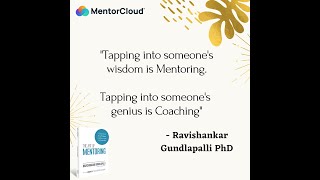
Hi there. Happy New Year and wishing you a safe, healthy, happy and prosperous 2021. Thank you for listening. I'm Ravi Gunlapalli, founder and CEO of Mentor Cloud and author of the book the Art of Mentoring. I want to start by answering a question that I get almost in every one of my keynotes. That is what is mentoring versus coaching? In my 20 years I've had the privilege to be a mentor, to be a coach, as well as to be mentored and to be coached. So my definition to what mentoring is and what coaching is is this. Tapping into somebody's wisdom is mentoring. Tapping into somebody's genius is coaching. Let me expand on that. Mentoring is about transferring a body of knowledge and wisdom from one human being to another. So when I am mentoring someone, I am actually bringing to the conversation my experiential wisdom to help my mentees understand what I have gone through, what are some of the lessons that I have learned so that they can then implement in whatever context that they are in. So mentorship is about tapping into somebody's wisdom. When it comes to coaching, I defined it as tapping into somebody's genius. When I'm coaching someone, I am not there to share my story or my experiences, but I am there to ask insightful questions, thought provoking questions so that my coachee or my client able to recognize their true skills, their true fire within. So my job as a coach is to bring out that hidden genius. Because.
Most of the times we are our own biggest limitation. It is our mind that tricks us into saying if certain thing is possible or not possible, which is what stops a lot of people from truly accomplishing their true genius.
So mentoring and coaching are on the two ends of the spectrum of a human to human interaction. On one side is transfer of wisdom. On the other side is unleashing somebody's genius. Now, a person who is a coach to a football player may not actually be a great player, but that coach knows how to bring the best out of this particular player. Similarly, I've had the privilege to work with coaches who are who have coached some of the best CEOs in the world, but they themselves have not been a CEO of a large company. What does that mean? What that means is as an executive coach, as a leadership coach, these individuals have the unique skill and a tactic to be able to bring out the genius out of the other people by asking the right questions, by helping their coaches go through an introspection process, a thought process so that they themselves identify what their true genius is and then they're able to take actions. Once that cloud of doubt is gone, once that inner genius is identified, then, you know, sky is the limit, as they say.
So let me repeat once again, mentoring is tapping into somebody's wisdom and coaching is tapping into somebody's genius. Now, I was once in Asia in Kuala Lumpur giving a talk on the art of mentoring on my book. And there was a wonderful question.
A person asked as a parent, am I supposed to be a coach or am I supposed to be a mentor?
Now, I have never been asked that question in all the keynotes I've given in four continents. And the fifth continent that I'm yet to go to is Australia and New Zealand, which I'm sure is going to happen very soon. So my answer to him was after thinking about it. Now, my previous company that I started with my wife is the Turning Point Academy, where we mentored hundreds of middle school and high school students. We helped them understand how to recognize their skills and talents, how to select courses, how to apply for colleges, how to write very compelling essays as part of college applications. And even during college, we used to work with them to make sure that they continue to discover themselves, their talents, and really flourish in their own garden.
So we have also worked with a lot of parents and, and sharing with them some of the best principles to be a great parent. So with all that experience, my answer to that individual was 75% a parent should be a coach and 25% a parent should be a mentor.
That means as a parent, we need to be a very intense observer of our children. And this goes this is true even with a leader who is observing his or her team. You want to observe and really see what are the true skills that this child is exhibiting. What are some of those activities where this child is naturally gravitating towards? And our job as leaders, as parents is to do everything to amplify that. So it's not about telling, it's about amplifying what you observe. So 75% of the time, it is best to be a coach and identify and extract the true genius that this particular individual, you know, is designed or is here to bring to the world. The other 25%, there's always a time to show and tell. Here is how you should be punctual in certain activities. Here is how you plan your work and manage your time. Here is how you respect your elders. So there are times when you need to bring your own experiential wisdom, having gone through life to transfer it to the next generation. So 75% be a coach 25% be a mentor was the response I gave. And I still believe it is perhaps the best strategy as a leader or as a parent to have this understanding as to when to observe and extract the genius of the other individual and when to tell. If you're constantly telling, if you're constantly influencing, then you are really restricting the genius of the individual. So I hope this clarifies the big question everybody has as to what is coaching versus what is mentoring. And I hope you surround yourselves with wonderful coaches who can bring out the genius out of you, and wonderful mentors who can actually help you avoid costly mistakes by sharing their own stories so you can accelerate your own development, your own learning to achieve your full God given potential. Thank you and see you again with another perspective in a few days.