What is "Ravi's Hierarchy of People"?
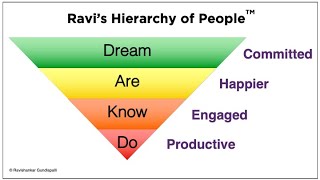
Dr. Ravi Gundlapalli (author and CEO of MentorCloud) presents a short talk on "Ravi's Hierarchy of People," a four-level model—People Do, People Know, People Are, People Dream—aimed at increasing employee engagement by treating employees as whole humans rather than only workers. He frames the problem using hedonic adaptation (people habituate to perks) and cites stagnating Gallup engagement rates (roughly 20–25% engaged over ~40 years). He contrasts his proposal with Maslow's 1943 hierarchy of needs and illustrates each level with examples (Google's "20%" program, personal anecdotes), concluding that addressing all four levels can increase productivity, engagement, happiness, and commitment.
Questions this video answers
1943
About 20–25% engaged (over ~40 years)
May 6, 2023
Chapters
Hi, good afternoon. Happy Friday. I'm so excited to have this open conversation about what's on my mind. That's why I call this playlist what's on Ravi's Mind.
Several months ago, I was driving from Santa Barbara after a conference when I had an aha moment. That aha moment was what is the right way to engage our people in the workplace or even in personal relationships.
I heard from a Grammy award winning musician about this idea of hedonic adaptation, which is a human phenomena. So today I'm going to talk about what is hedonic adaptation and how did that trigger a series of thoughts in my mind about what I call the Ravi's hierarchy of people, which was the result of that continuous thinking.
So hedonic adaptation.
Is how as human beings we settle to a new norm. Let me give you an example. So let us say that you routinely fly on economy class on an airplane and you are fairly okay with it. But then you luckily get upgraded to a business class for the first for flight. It is so exciting. You start putting all the, pressing all the buttons and you feel the cushion. You enjoy the extra orange juice that they give. Everything looks so amazing. And then over time, you know, you start to travel on business class and then it is no longer that exciting. It becomes normal. It, it is, it is now what you expect as the baseline when you travel. Now you're looking further front of the aircraft or if it is a 380, you're looking upstairs to, to the, to the, you know, the upper level of the aircraft, first class. So another example, let us say you're, you are an employee in a company that introduced a new benefit program where you have free lunch on Fridays. Everybody's excited. You go on Fridays, have a free lunch, and then after some time you tend to start thinking. Humans start trying to start thinking, oh, how wonderful if it is available on all days and then now company makes it available for all days and then after a year or two years, you get used to it. You start complaining about the food taste. And even when you go to a new workplace, you expect the company to offer free lunch.
That is what hedonic adaptation is. That how our mind always adjusts to a new norm which can be higher in terms of quality or service than the one you have always experienced. So as I was know, driving back, I felt that this may be the secret to addressing employee engagement. Because when I look at the Gallup's 40 year history of employee engagement, I look at the graph and all of these, you know, graphs and.
And my, you know, chart I, I'm going to show you is available in the article in the link. So feel free to go and kind of read more about it. The chart of employee engagement remains pretty much the same. More than 70% of the employees remain disengaged or unengaged or not engaged. There are definitions for all of this. So only small fraction of people are actually coming to work to do more than what they're expected to do. It is always between 20, 25%. Now it is a miracle how companies run with such a low number of people actually coming in to do more than what they're expected to do to. Who are people who are inspired, excited to come to work, you know, really captivated by the company's mission and they want to contribute. So those levels have remained the same. So now I'm thinking, yeah, if you don't change your approach, then obviously the outcomes will also will not change. Right. It is trying to do the same thing over over again, over and over again and expecting, you know, completely different results. The Albert Einstein has a nice word for it. Right. So then I thought maybe that's, that's why the engagement, you know, numbers have not changed over the years, almost 40 years, the line looks pretty much even a little up and down, you know, 29%, 26% engaged. So that is when I said, yeah, we have to look at people differently. If you know for sure that hedonic adaptation actually happens, that means you have to look at how we interact with people in a whole different way. So that's how I came up with four levels. Now when I was studying this, after I reached home to really pen my thoughts, I came to know about Maslow's hierarchy of needs. Now everybody talks about it, I've heard about it, but I've never actually formally sat down to sort of read and learn about it. So I went and checked out. But the first aha moment within this aha moment was that the masses hierarchy is from. From almost like 1943. It is, it's been almost 70, 80 years since it was first introduced. And it was introduced based on a theory of motivation. And I thought to myself, how much has the world changed? The whole.
We have more new countries, we are more globalized now. The whole work life has changed. There are so many companies that have disappeared, so many new companies have come. So the whole technology revolution, Internet revolution, smartphone revolution. So I said, is Maslow's hierarchy still valid? I think to some degree, yes, because people have needs and Maslow talks about Needs. But that may not be the end all. So that's why I said it's time to introduce a new hierarchy. That's where I said Ravi's hierarchy of people. If Maslow's hierarchy of needs is very non human way, I said let's have a Ravi's hierarchy of people. Now what is Ravi's hierarchy of people? First of all, it's about people. It's not about what people want or need. Okay, So I, I thought about this hierarchy should be about looking at the employee as a full human being, not just a worker. Right? So the, the example I give you is if you focus on someone that if you focus on your employees for just the work that they do, then they're no different than a photocopier. Now I've given the photocopier example many, many times. So one day photocopier is going to come and you know, hit me on my head. But really I think it's a good example. I think because a photocopier just does work. Do I care about the, you know, dreams of a photocopier and what else can it do? Or does it have a soul? It's just a worker. It's just, it's, it, it works when you plug in, it stops working when you don't plug in. That's it. As simple as that. So at the, at the bottom of this, you know, inverted pyramid again you can see it in the article is about the, what people do because we all do work because you have to make a living or we have to do something to advance our lives, you know, purpose or mission or support or family, etc. So at the bottom of the, of this, what I call, you know, the hierarchy is people do. So but if you just stop it, stop, if you just focus on people do, let's say as managers and leaders, then you look at what your people are doing and you provide them training, you provide them tools, you provide them resources, you provide them extra staff members and you do all of these things to make them very productive. So if you focus on what people do, then they become productive when they're given enough learning, growth and support, resources. But if they become too productive and if all they do is do more, more, more work, which is good for you as an organization and as a leader. But they get burnt out. Now I don't like the word personally burnt out because a light filament burns out a human. When this filament burns out, you're gone from the planet. You're no longer Technically alive. So I don't like the word burnt out, but that's a different topic. That's also on my mind. But you'll hear about it some other time.
So now.
What else is there about people? The second level is what I call people know. So now your people do. And then. But we all, we all of us know more than what we do, right? I'll take my example today. I run a company called my Intracloud, but I've also done a PhD in fluid mechanics, which is part of mechanical engineering. I also designed ships in my undergraduate. I'm a singer. I also read a lot of Indian scriptures and I've given talks on it. I play the violin. So there are so many things that you know that make me so I know more than what I do every day. So if a student were to come and ask me, Ravi, can you tell me your experience about doing a PhD and how you went about it, how you chose your research topic, how you interacted with your advisor? So you have a great relationship. How did you publish? How did you finally get this approved? How did you get the funding? I mean, there's so many things that happen in a PhD and I've gone through it all, but I don't use it every single day. And I kind of say sometimes that this, you know, all this wisdom in the mind is like, is like a zip file in your, in your, in your computer. Unless you unzip it, you don't know what the contents are. Similarly, unless somebody comes and talks to you, that wisdom remains trapped in it's right here. All the wisdom of doing a PhD from one of the top schools remains untapped, underutilized, until somebody comes and talks to me. So just an example of how we know we know more than what we do. If, if we do is at the bottom, then we know more than what we do. So when you start focusing on people and really say, hey, what else does this employee know? It could be anything. It could be yoga, it could be meditation, it could be mindfulness, it could be Python programming, it could be dance. Doesn't matter. They know more than what they do. And when you focus on what people know, they become very engaged. Now they know that I'm just not a photocopier. I enter the office or in this new hybrid world.
Essentially log in from my home and. And I'm working, working, working, because my company doesn't care. How much more can I do for this organization, all of the talents that I have.
So when you focus on that, they Become engaged. Now, there is a very nice case study on this at Google. It was called, you know, G to G, Googler to Googler. And there are articles on this topic. When Google asked his employees, you know, use 20% to do whatever you want, and if you have a specific talent, come and teach it. And there was a lot of engagement. People got so excited that they came in with so much energy and I believe, started teaching whatever they knew with so much enthusiasm. Now when you put people on stage, what happens is they come prepared. So they went and really prepared the presentation, prepared the slides, because nobody wants to look sort of weak when, when they are on stage, you know, being asked to present. So they become very engaged. The work becomes more than just work. So that's the second level, right? People do, people do, and people know. But is that it? Is there any. Is. Isn't there more than this? What's more than this is people are, you know.
Employees. We are parents, we are sons, daughters, neighbors, colleagues, friends, and so much more. Uncles, aunts, sisters, brothers. So there is a element of us that we are going through in our life stage that is, that makes us who we are, right? So.
When you look at someone, especially in your team, you need to stay, you need to. You need to pay attention to who they are too. If somebody has had a new child, you know, remember and you know, and, you know, make time to ask, you know, how the child is doing, if they have elderly parents, if they have, you know, recently lost their loved ones or if they have been sick recently, anything, anything is because when people come into work, whether they are working, working from home remotely or they're coming into the workspace, they are bringing their whole self. You cannot separate these things. So not every day, but once in a while, when the context arises, when you ask them, the joy that you will see in them.
If you ask them about their recent vacation or their child is just unbelievable. Their whole humanness sort of comes alive. I was at a dinner meeting very recently and I asked someone, how's your granddaughter? We could have just talked about business and the agenda of the meeting and so on, but just the joy, the excitement, and how many baby pictures that I ended up seeing, it made the whole meeting so joyful. It made it so human. We're now talking as friends, as people who. Who are looking to expand how we can do more together.
So when you focus on who people are, they become happier.
But that's not enough. Now people do. People know. People are. And then there's the fourth level. I thought of is people dream. People have dreams. You know, they want to get advanced education, they want to go to some vacation spots which may be on their so called bucket list.
They may want to learn a new skill, they may be thinking of learning a new musical instrument, or they may be thinking of starting a non profit or joining a comedy club. Whatever it is, they all have dreams. And as leaders, it is important for us to know. Now if employee doesn't want to share, that's understandable. But taking time to really understand what their dreams are and whatever you can do to help them achieve those dreams, maybe give them a new resource, maybe give them time off to go and research on that, maybe, you know, connect them to somebody who is doing that today.
So now they become more committed.
So when you focus on people, what people do and give them the resources, they become very productive. When you also recognize what they know and give them opportunities to share that with others as mentors, as experts, they become more engaged in the workplace. Right? And the third, when you also ask them care as to who they are and what life stage they are in, they become happier. Because that's all human. We always seek to be happy. We don't need reasons to be happy, but we just love to be happy. Who wants to be sad, right? So we become happier when those aspects of our overall human life is asked. Now some people may choose to be private. That's not what I'm referring to. But in general.
Focusing on or paying attention to who they are and what they're going through, it could be good or bad. We all have ups, we all have downs, doesn't matter. But just showing that you care, showing that you're there, it makes them happier, makes them happier in the workplace. And the last is if you, if you focus on what, what their dreams are and you know, help them to achieve that, whether in this work environment or in some other department or in a whole new company, doesn't matter, right? They become more committed. You know, I've, I have many, many stories where some people were asked to leave after a certain time and they don't because they become committed to the company that takes care of them, that focuses on helping them achieve their dreams, cares for who they are and the life stage they are in, recognizes what they know and also provides all the resources for them to do their work well. That's what I mean. Engaging the human behind the employee. Don't just engage the employee. So this is my theory. If you just focus on engaging the employee, giving them more benefits, more money, more balloons, more cakes, more awards, not enough. Because of what I started this interaction with, because of hedonic adaptation. It is human. It is human. So we can't get rid of that basic innate humanness, which is getting used to something and then making it the new norm. And so engaging the human behind the employee means you focus on all four these levels. So that's what I wanted to share today. Please add your comments, and I expect to do these things in a live session when you all can ask me live questions. But I'm going to leave the comment section open, so feel free to add your questions and comments. And I look forward to seeing you all on my next session when I'll share what's on my mind. Thank you. Ravi Gundlapalli signing off, author, the Art of Mentoring and founder and CEO of Mentor Cloud have a wonderful weekend.
More from Dr.

Essentials of an Entrepreneur by Dr. Velumani Arokiaswamy, Founder of Thyrocare

Skills & Traits for Better Employability | Amritkaal Mentors – An Initiative by MentorCloud

What Leaders Look for First-Time Job Candidates | Amritkaal Mentors – An Initiative by MentorCloud

How to Innovate and Lead Wisely in Today’s World with Navi Radjou - An Initiative by MentorCloud

Crafting Your Academic Journey with Dr. Manish Kothari - – An Initiative by MentorCloud



Advaitha Jagruti: Awakening The Spirit Of Adi Shankara In Indian Youth | Dr. Ravishankar Gundlapalli

Testimonial | Sanjeev Sharan | Catalyzing Growth From Within | MentorCloud Mastermind

How to Make a Mentee Feel Comfortable #mentorcloud #mentoring #coaching #wisdom #experience

Testimonial | Kellie Teal-Guess | Catalyzing Growth From Within | MentorCloud Mastermind