Wisdom sharing beyond borders - Leveraging the power of mentorship to accelerate growth.
Hedley Lawson and Dr. Ravi Gundlapalli discuss Mentor Cloud, a platform connecting mentors and mentees across borders to share knowledge and accelerate growth. Ravi contrasts learning 3.0, human-to-human mentorship, with traditional classroom and online learning, and presents frameworks like FAST and the i3 rhythm to structure mentoring relationships.
Questions this video answers
September 21, 2020.
Dr. Ravi Gundlapalli — Founder & CEO of Mentor Cloud.
The Art of Mentoring.
Mentor Cloud (cloud-based mentoring platform).
Chapters
Good morning everyone. And good day, I should say, wherever you might be. Welcome to this very interesting Global Leaders webinar today as part of our overall platform at ierg. Wisdom Sharing beyond the Borders Leveraging the Power of Mentorship to Accelerate Global Growth during the post pandemic COVID 19 pandemic.
I'm your moderator today. My name is Hedley Lawson. I'm the Global Managing Partner at Align Growth Partners and have been a member of IERG for several years.
To remind everybody, IARG is a unique global organization of internationalists with diverse experiences that enable its membership to connect, network, collaborate, to identify opportunities and learn from each other, to accelerate commerce and to make the world a better place.
In the webinar series, there's a forum provided for our members that brings in qualified experts in the continuously evolving thinking and action on matters relating to international business and cultural competency and today's is one of those exceptional examples of that. Our speakers have an international stage to connect with all of us and to provide further exposure to their platform as a part of ierg.
Just a reminder, there are other webinars and meetings coming up for the balance of August and September and here is a calendar of those events and Ruth kindly sends out reminders to each of you so that you can go ahead and register for those. And as you'll see, there's a variety of chapter meetings coming up along with several webinars coming up in early September.
Today's speaker is Dr. Ravi Shankar Gunlapalle. He's the founder and CEO of Mentor Cloud, a cloud based mentoring platform for people within companies and professional communities to share and learn from one another. And I think that says it quite succinctly because it's an extraordinary platform and I think you'll find it very interesting, very illuminating. Today.
Ravi is a globally recognized thought leader on mentoring and learning and is the author of the book the Art of Mentoring.
His presentation you'll learn.
That the world of free movement, of wisdom, leveraging the power of technology and proven framework of mentorship, defining mentorship as a crusted human to human interaction, Ravi will share how such connections and sharing of wisdom and human values transcends geographical boundaries and will give hope and build resilience among people and catalyze rapid and sustainable economic growth globally. And I might also add the growth of individuals who use Mentor Cloud, both the mentors and the mentees. So with that I will thank you and I will turn it over to Ravi.
Rocky, we're not hearing you.
We're not hearing you Ravi.
Good Morning and good evening to everyone. Headley, thank you so much for your kind introduction. And, Ruth, thank you for inviting me to your group, the International Executive Resources Group. And it's really an honor to be speaking to all of you today. And I hope you can see my screen now.
Perfectly.
Awesome. All right, so what I'm going to spend the next few minutes with you is to share my vision for the world I'm envisioning. I'm envisioning a world where there are no boundaries for wisdom. And I'll be speaking to you about that. And especially as we go through this pandemic and then come out of it, I want us to be stronger, more resilient, and more united than ever before. And the metaphor I use is instead of a honeybee, because honeybee is actually known to be a good example of how to take the good from everywhere and then just move on. So in our heritage, we always say a true learner should be like a honeybee. You know, don't sting anyone, but always get the best from from every flower that you come across or every human being you come across. So really honored to be. To be speaking with you. And we will leave enough time for a conversation and question and answers.
So I want to start with a personal mentoring story. As someone who has now dedicated my life and my time and to really expand the possibilities for individuals around the world, I believe in the power of mentorship, and I've also written a book about it. But you all may want to know, how did this all happen? So I have a story of my own. Who you see in the. In the picture here is one of my earliest mentees, Srikanth, who is visually challenged from birth. I happened to run into him at a conference in India, and he approached me and said, sir, can you help me to get into MIT in the United States? I was in India at that time. I actually traveled there to give this talk. And it was a very bold, audacious goal that he had that really got me interested, because being in Silicon Valley, very rarely do I find people come up to me and say, sir, can you help me get into mit? So it was audacious enough that I started to learn more about him. And long story short, I started mentoring him. And over the next couple of years, he got admitted into MIT and he graduated from Sloan School in 2015, and now running a very successful green products company in India. So that taught me a very important lesson that the difference between sight and vision, you know, just having an eyesight is not enough. We Also have to have a vision. And here is a man who may not be able to see, like, you know, some of us, but he has an incredible vision. And that's why I learned that very important lesson for myself is that I want to lead my life with a very strong vision of what I want to do, what I want to be known for, and what kind of legacy I want to leave in my life.
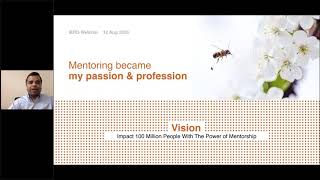
And so from that experience and many other incidents that happened around that time, mentoring has now become my passion. And with the launch of Mentor Cloud, the company that Headley talked about, it's a technology platform that connects mentors and mentees around the world. Mentoring also became my profession, and my vision that I wake up every morning is to impact 100 million people with the power of mentorship.
All right, how do I define mentorship? Now? I don't come from the human resources background. I have a background in fluid mechanics. I have a PhD from the University of Michigan and then spent almost 12 years in automotive, high tech, and aerospace and defense industries looking at the supply chain of products. So without coming from the HR background, when I first started thinking about it, what was I doing as a mentor or in the role of a mentee? And I saw the mentorship is a sharing and learning interaction. So mentoring is sharing what you know with the people you care about. So it's not sharing on the social media without wondering, without worrying about who is going to actually access that content. Mentoring is a relationship where you are sharing your knowledge with someone that you really care about, someone you like to see sort of develop and grow.
On the other side, mentoring is also learning what you need to from the people you trust. Now, we all have things to learn, but mentorship is learning from those that you trust and admire and are willing to accept that insight and then take an action so that your own career or startup or life can get better. So I've defined mentorship in my book as a sharing and learning interaction. And I truly believe that all of our lives, our work and our teams will be a lot more joyful. Our life will be a lot more meaningful when there is a mix of sharing and learning. That is why mentorship is a two way street. Two individuals learning from each other, empowering one another, and at the end of the relationship, both people should be much better than when they started. So sharing and learning is what mentorship means to me. And today, everywhere I go or whenever I speak, I'm trying to inspire and motivate people so that any communities that they are in, they're actively sharing and learning to make everyone better.
Now, if you look at how learning has evolved, one of the traditional ways of learning is what I call it classroom learning. It is one size fits all. There's a professor and then everyone else is sitting in the class and learning. I call it sort of the learning 1.0.
If you look at the last 15, 20 years, just to scale that, we have seen.
A arrival of online learning platforms which I call learning 2.0. So you're sitting at home and you're watching these classes from the convenience.
Of your office space or home. But now the interesting thing is in both these cases, there is no opportunity to build a strong relationship. Of course, when you're in school, you can know your professor or you can know your instructor, but when it comes to online learning, there's really no opportunity to really get a very personalized experience. So what I define as learning 3.0, now this is not new. I did not invent this. This is how we have developed as a human race where we learn from each other. I like to call it the learning 3.0, where we are learning from each other. I define that as the human to human learning. If you recall from my description of the presentation, I said define mentorship as a human to human interaction. So how do we maximize this power of mentorship that brings people together, that they can share and learn from one another? Now, when you put the right people together and that's where the magic is, who has the wisdom that you are, who has the wisdom that you're looking for? And who are the people in the world that could be impacted that could benefit from this wisdom?
Now, there are four key advantages from this human to human learning framework. Number one, you have access to knowledge from somebody's direct experience. It's not what they learned. You're able to get knowledge from what they experienced. So experiential knowledge is extremely powerful and it may not be available in any written form. So the only way is to extract that experiential wisdom is through conversation, is through connecting people. So first, advantage of power of human to human learning is access to knowledge from direct experience. And second, when I'm working with my mentor or when I'm working with my mentee, the conversation is very personalized.
Which may not be possible when I'm watching a YouTube video or which may not be possible when I'm sitting in a classroom because the professor has to meet the needs of everybody in the classroom. And the video is basically done once, watched a million times, whereas In a conversation.
The situation is sort of personalized to what I'm looking for. When I'm reviewing my sales plan, when I'm trying to figure out how to raise my next series of funding or how to apply for colleges or how to get promoted in the next two years and what should I be doing in my career in all those situations? A conversation with an expert or a mentor is going to happen in the context of my situation. So that's the second advantage. And the third is there will be an opportunity for new possibilities to emerge. Now, when Hedy and I first met, we did not know about this webinar. We did not know about what we could do together. But it was a conversation. And conversations lead to new possibilities that wouldn't happen with a video or may not happen in a classroom. But when you're working with a mentor, something new can happen. And that's where the mentor's horizons and the mentee's possibilities can both be expanded as a result of that. And I'm sure if I ask you to reflect on those kind of conversations, you will remember those times when your relationship sort of blossomed and new possibilities started to emerge because both have the intent to trust and also to care in each other. And the last is relationships.
Whether it is a community or in a company, we want to make sure that our people form strong relationships. And when you engage people in a mentor, mentee relationship, it also builds a long term engagement. And I'm still in touch with my mentors from 15, 20 years ago and some of my mentees still send me updates because it builds a strong human bond. So my entire career now having spent in supply chain world, is to really focus on how do I maximize this power of human to human learning in a way that transcends geographical boundaries.
I will also use the word wisdom. And what I mean by wisdom is knowledge in context. It's knowledge from direct experience and knowledge in context. So you can look at data, you can look at information, you can look at knowledge. And the next higher level is wisdom. When to when to apply a specific concept in what situation is what, what wisdom is, which is what all of us have from all the experiences that we have gone through in our lifetime.
Now, one of my mentors, one of my gurus, like they say in India, has told me very early on about the importance of flow. Now interestingly, I have a PhD in fluid mechanics, so I understand how to optimize flow. And I've also spent several years in supply chain where I looked at how to Optimize the flow of products because we know when the flow of products stop in any supply chain, it can be a huge disruption in availability of products. So there are three scenarios that you know, he told me, Ravi, when the flow of blood stops, our human body suffers. And we all know that when the flow of money stops, it happened in US economy and global economy, many, many times the economy suffers. We all know that because economy is measured by the overall output, the gross domestic product. It's a GDP is the number of transactions that we are having. Now if all banks start stop to loan money or make money available, then we know how economy can suffer. My premise is when the flow of wisdom stops in a company, the company will suffer because it creates silos, it creates the wheel to be reinvented. Because in an organization of thousand, ten thousand, one hundred thousand employees, there's lots of wisdom already available. Call it institutional wisdom, call it tribal wisdom, but it exists. The company runs because people know certain aspects about the particular domain. Now if you don't let that flow freely to others, the up and coming leaders, sort of rising stars, that's when the company can suffer because then you're not being competitive, you're not leveraging the true strength of your sort of what they call the collective wisdom. So just as a metaphor is it's all about the flow. And whether within a company or in the entire world at large, as leaders, our mission now should be how do I ensure the sports flow of wisdom. Now you can see a fluid mechanics person speaking or you could probably hear the supply chain executive in me talking about the flow. Now again using the same supply chain metaphor, those who have knowledge, whether it is sales and marketing, design, thinking, innovation, manufacturing, whatever the area is, I call it the supply and the, you know, young leaders. You know, it could be new employees, it could be people who are taking on new responsibilities, or it could be new entrepreneurs, I like to call them as those who need that wisdom as demand. And what we can do in this, in this, using technology, is make sure that these two sides have no problem finding each other. And that's exactly what we are trying to do at Mentor Cloud is make sure these two sides get to discover each other quickly and there's no time lost. Because in companies when you are paying your employees, the last thing you want is an employee spending a lot of time searching for something that already exists. And so what, what I talk about is this idea that wisdom should flow beyond boundaries. Now how did I, how does this fit into an actual economic model? Is few Years ago, I stumbled upon this excellent project called Open Borders called Disruptive Idea. And I believe a world of free movement would be $78 trillion richer. Now here's an interesting. I don't know how some of you can read it or not. I'm going to read it. A hundred dollar bill is lying on the ground. An economist walks past it. A friend asks the economist, did you see the money there? The economist replies, I thought I saw something, but I must have imagined it. If there had been hundred dollars on the ground, someone would have picked it up. Now Here we have $78 trillion lying on the ground. So everybody thinks it's a fantasy. Now this is a real article in the economist magazine.
From 2017 and it just was very fascinating. What is the idea of open borders? The idea of open borders is that people are able to move and work in any place in the world that most values their labor and talents. Now those of you can go online, you can Google and read about open borders. This is a fascinating concept. Now the problem is because the upside is so huge, everybody thinks it's too good to be true. So all the open borders projects have remained within the halls of research at Harvard, at a lot of think tanks in Washington D.C. is really unfortunate. Now why can't we realize this opportunity that we have in front of us? That an engineer in India or Australia can work in any part of the world where those skills are most valued and utilized, that's not possible.
And the reason is, is this even possible today? And in the world we live in right now, this concept of a world without borders is impossible to be realized. In fact, as humanity over the last 50 years, we have drawn more boundaries, we have built more walls, trying to restrict people from moving. So I have no hope, at least in my lifetime, I hope in the future, you know, we start to work as one. Because way back when, five, 10,000 years ago, there were no borders. I come from India and scientists from all over the world just traveled to India to study. India had many universities almost 8,000 years ago. So I don't know when that world will ever come back again. So the idea of open borders is very hard to imagine. But I didn't want to, you know, be that economist who just walks past it. I said, what about free movement for wisdom? Fine. People cannot travel anywhere because of the visas and passports and everything and all the politics that goes behind it. What if we create a free movement for wisdom? And if there is one key takeaway, this is what I want you to remember from this Conversation today. That's my vision. What I mean by that, people are able to learn from any expert, you know, on the open borders. It's about people are able to move and work, but people in, in my, in my world where I'm, I am sort of, you know, prophesying this idea of free movement for wisdom. People are able to learn from any experts in the world who are trustworthy. So we know that expertise is real and they can be trusted and it is good for the world. Okay? And they have the wisdom that I am seeking. So that's what I mean by free movement for wisdom is I have, for example, today a mentee in Nigeria. Nigeria. I've never been there. My mentee has never come to America and they don't know if that happened, that we'll meet. However, I'm able to share with him how to form an advisory board, how to put a pitch deck together, and so many other entrepreneurial aspects. Similarly, I have a mentee in Cuba. Now we all know all the geopolitical aspects around it, but still doesn't stop us from discussing entrepreneurship. He's trying to create an E learning institute in Cuba to empower people there. And I'm able to share, sitting in Silicon Valley like that. I have many stories of entrepreneurs in India and entrepreneurs in Asia that I'm able to work with. That is what I mean by. Our wisdom need not be constrained by the boundaries we draw because of politics and other factors.
That world is already being built right now. And this graph here, you know, I always joke that this is not my flight plan. I didn't travel to all these places. This is not my flights. This is actually.
World without boundaries for wisdom happening right now on mentor cloud where people in one part of the world sharing their wisdom with entrepreneurs, young women, professionals, students, early career employees, retired employees in other parts of the world. So we have completely broken the barriers. And the key is how do you bring the right people together? How do we provide them the tools and how do we provide them the guidance so they can share and learn from each other?
So.
When I founded Mentor Cloud with this idea of a free movement for wisdom, I wanted to call it Mentor cloud. Now people thought, oh, it's a cloud based software. Now it is a cloud based software. But I was not thinking about Amazon or any other cloud infrastructure. I was actually referring to the real cloud. If you look at the real cloud, it's actually an excellent metaphor for a cycle of something good that's happening. Because if the cloud didn't exist, then we would all be sitting on the beach and boiling salt water and drinking it, because we all need water to survive. Now the cloud creates that, it evaporates, forms a cloud, moves wherever it needs to and then showers. So that's the metaphor I had is how do we get the best of the best insights from all over the world, from doctors, scientists, inventors, engineers, manufacturers, whoever put it in some sort of cloud repository in a way that's trusted, that's secure, that's sort of proven, curated, etc. And then make it available to mentees or the learners anywhere in the world. And these that are learning and growing today eventually can again become.
Mentors for themselves. And that's how the cycle continues. And if you go back, this is what is happening in the human evolution for tens of thousands of years. So I believe that mentorship is a fantastic proven way for transferring wisdom at scale beyond boundaries.
So what are the benefits when I'm envisioning this world of open borders for wisdom? If you look in the corporate sector, I believe, and we are seeing it today, that the skills of employees can grow faster. Especially with companies opening up offshore facilities, or companies in India, Australia opening up their facilities in the US it does not matter. We can now equalize.
The skills of your people by connecting them intelligently. Now what that does, it increases productivity. There are no silos. And you can make your organization extremely competitive because you are now tapping and leveraging the collective wisdom, not just wisdom, in one pocket of your organization.
If you look at entrepreneurial ecosystems, the examples I gave you, entrepreneurs that I am personally mentoring, and the number of ecosystems that we support, we again, we can create a lot of economic and community, community development when you create this open borders for wisdom.
So my point is open borders, the way the economists have studied it could create $78 trillion additional GDP for the world. But with open borders for wisdom, even if we achieve 0.001% of that, I think we would have made a huge leap in overall welfare and economic development and helping tens of millions of people achieve their full potential. So 78 trillion is awesome, but we don't have to. Even if we get a small percent of that with this open borders for wisdom idea, which already is underway, implemented and growing every day, then I think that can be a huge impact in the world.
So when I look at this human to human connection, I wanted to share a fast framework that I talk about is fine. We all agree now, by now, the last 20 minutes, you agree with me that human to human learning is important and it has value. We talked about it. But how do we implement within an organization to build resilience, especially in this pandemic situation? Because most people right now there are a lot of statistics that are saying people are feeling lonely. It's not easy to be in your house for four or five months at a stretch with your family around you and with just doing work from morning 7 o' clock till evening 7 o'.
Clock.
So there is a sense of isolation. We need to create a way that your people are getting connected with others who can give them hope and these employees can become resilient.
When this pandemic is defeated and we all get back to work, that we are able to become stronger. So this people to people connection, in my perspective can happen in multiple ways. For example, I call it the fast start. So if you have new hires in your organization, you can connect them with certain type of people.
Who can help them with onboarding and understanding of the culture. Then if you have rising stars, the people that show a lot of promise to become the future leaders, we can think of a Fast Forward kind program and I'll talk about value of each of this. And then when you have high potential, then you want to think about how do I fast track them to become the future leaders and then how do I create a framework, what I call fast check. Now, when I say fast start, these are the people that have recently joined your organization. And how do I create return on investment? By making the time to value as fast as possible.
So how we invite the sort of mentors, experts into this particular program and what kind of guidance you give them is very different when compared to Fast Forward. Here we are looking at skills development, we're looking at career development. So here we are looking at higher engagement because you don't want people to get bored because they're just sitting on one area of competence. But you can really engage them by expanding their own career opportunities within the organization. And then you have what I call the fast track. So these are high potential. These are the top 20, 30% of your organization that are keeping everything intact. And the last thing you want is to lose them. So by providing visibility to senior executives, by offering coaching, perhaps with coaches from the outside, sometimes even mentors from the outside, you can give them more visibility. And the return on investment here is being able to retain them and not lose them to competition.
And the last thing which is, which is my favorite is more recently I've been thinking, why do I go to my mentor? Because I'm not going to a class Right. I'm not going to your professor to say, teach me everything you want. I need to know about, for example, online marketing, because with the education that I have, with the experience that I have, I have a sense of what online marketing is. I can watch a few YouTube videos, I can take some learning, I have a good sense of it. But when I do go to someone, I believe that a lot of times it's for a second opinion to understand, hey, this is what I'm thinking. What do you think? And I'm expect, I'm really looking forward for some very precise guidance from someone who has been there, done that. So mentorship is also in many situations, it is a situation of a second opinion. And this can increase productivity. Let's say I'm working on a very important proposal and I have my all my pricing figured out, but I just want to talk to an expert and see, hey, does this make sense to you? Are there anything that I'm missing? Are there any blind spots? What am I doing? I'm getting some expert advice as well as an opinion about the path that I'm taking. So the FAST framework has been very.
Welcomingly received. When you work with organizations, when they say, yeah, human to human is fine, we believe it. Ravi, this is the right thing to do. Yes. How do I implement it? There is a rhythm to implement this in organization, to create rapid growth and also help people move from isolation to being inspired about what your organization is all about and then being able to create impact. I call it the i3 phenomena. Isolation to inspiration to impact, which is what we would like all our people to go through as we come out of the pandemic.
So I truly believe that we need to inspire our people to share what they know. You know, 50 years ago, people, whatever you knew, sort of made you who you are. At that time, you got your job because what you knew. And today it's about being known, sharing what you know so that people know who you actually are. That's why the networks like LinkedIn have become so popular, because people want to tell the world their background. And if you look at Medium and all the other.
Platforms. So we need to inspire our people that their strength, that they can become stronger in the organization, they can be more recognized and they can be on track to become the future leaders when they can share what they know and create a pipeline of talent behind them. And we also need to motivate them because we don't know everything. So we also need to motivate them to pick up new skills and Expand possibilities because growth always happens at the edge. And by encouraging them to figure out what are one or two aspects that you can learn from somebody. Let's say if you're in finance, you talk to somebody in engineering. You know, we have, we have seen in some of our implementation that people that otherwise wouldn't, wouldn't have the opportunity to have a conversation, are having a conversation. And that's what I mean by growth happening at the edge. Somebody in finance talking to somebody in marketing. Not because there is a project that they are in, they're just having a conversation. And I, I highly, highly encourage everyone on the call today that are watching or even the recording later is, you know, do a quick reflection every week as to have you been in a conversation with someone that you, that you don't work with on a regular basis. If you are not having such conversations, then you are, you are, you know, majorly limiting, your, limiting new possibilities.
And just talking to people that you're working with on a regular day with your own project becomes very focused. But at least once a week, maybe once in two weeks, find someone on LinkedIn, find someone in your organization that does not, that you don't work with on a regular basis and just experience the extemporaneous power, the power of what they call serendipitous conversation, and you see what possibilities sort of open up. You may, you may learn about a new book, you may learn about a new movie, you may learn about a new TED Talk, or you may learn about a new opportunity. Nobody knows. In fact, my next book I'm writing is called Second Guessing. Most people limit their possibilities by second guessing. Using your past to make a plan for the future, not the smartest thing to do, but using other people's past, you know, is really the smartest thing to do. That way you can avoid certain pitfalls. And of course you'll have new obstacles, especially when you expand new possibilities. When you start something new something, some of the new problem will arise, but at least you don't have to repeat the problems that other people have sort of have gone through. So in closing, inspire your people to share what they know and motivate them to learn new skills and expand their possibilities. Now, what are you actually advising them or inspiring them? In fact, in my Art of Mentoring keynote, which is a whole new talk that they give, is how to be a mentor and how to find a mentor. And all of us should have these two individuals in our lives. That is how I started the talk by saying sharing and learning is what makes Our life joyful. There are some instances when we share and we feel good. It makes us feel sort of, I would say, meaningful, important. And somebody you know, told me once what mentoring means to me is growing fruit on other people's trees. When I see my mentees flourish as doctors, engineers, entrepreneurs, it just gives me so much joy because ultimately, I am lighting somebody else's life. Likewise, when I'm learning something new and I'm able to do something new that I've never done before, that just expands my own possibilities. So I highly encourage all of you who are leaders in your organizations to catalyze this mentoring culture. And mentoring, again, I defined as sharing and learning. It's simple. It doesn't require a lot of engineering. It's going back to our human roots. It's how do we share and learn from each other. And I really hope that in all your organizations that there are no boundaries when it comes to wisdom. So with that, thank you for the time today.
And I'm open for a conversation with Headley. If he has any questions he would like to ask me. And Ruth, if there are any questions from the audience, I'm happy to address.
Robbie. I hope everybody's found this to be extremely rewarding because quite honestly.
When you first hear about it, you think of things at a very high level. But that when you understand this at a visceral level, you truly understand. When you talk about.
Going from isolation to inspiration to impact. I mean, those are three very powerful words in the whole scope of this. And as we think of ourselves at ierg, we are a cohort of former executives on a global basis. You know, most everyone has spent considerable time in other countries and lived in other countries and so forth. And I always, when I've gone through this with you on several occasions and spoken to you, I think of different ways mentor cloud in particular could be utilized and what value it brings to organizations. And I think IERG would be one of those organizations that, in terms of the kinds of things that we can do through our many years of service, is to pass along our knowledge, know how expertise to others who are going up in the world today. What. What have you found, Ravi, to be organizations that have, that have expressed to you the most interest so far.
Especially in this pandemic. You know.
More and more organizations are feeling that.
There is a need to bring people together, whether it is scientists working on a specific cure, for example, COVID 19 pandemic. Whether these are innovators that are all over the world but don't have a way to leverage each other's expertise. We are seeing the company's desire to bring people together, especially when they're not together in the same building. You know, we live in a very virtual environment right now. So the role of a chief people officer has become front and center for the first time. You know, normally it's a cost center. You know, it's about recruitment, it's about compliance. But now suddenly it becomes the core backbone of the organization because you don't see your people regularly and everybody is sitting in front of a computer. So it's a whole new challenge for companies to engage their people, to keep them connected to the company's mission and make sure that they are also connected among themselves, to feel that unity, to feel that sense of community. And so we are seeing interest from technology companies, hospitality companies, scientific sort of research companies, medical device companies. They're all the banks, they're all thinking, how do we provide a new meaning to our employees? We are doing one project in a European country where all the banks, employees and all the sort of their leading customers are now acting as mentors to mentor entrepreneurs in the country. We are doing one in Ecuador, where employees are not only mentoring inside, but they are also mentoring in their community. So people are finding new ways to leverage this idea that by connecting, by sharing, everybody benefits.
I think that's so true, especially when you think of individuals today. So many people are focused more on their particular silo or function. And the concept of having a mentor could be, for example, a person who is in the field of finance and wants to learn more about.
Marketing, or wants to learn more about operations or wants to learn more. From a human resources perspective, people in human resources seem today so narrowly focused on HR getting their HR certificates, but having a mentor in one of the other areas of the executive suite to help them broaden their expertise and better prepare them to move up in the organization and take on executive leadership positions with knowledge and know how to do so. So I see so many different applications for mentor cloud and the whole concept of mentors and mentees. Are we. Have we seen any questions so far? Ruth?
Yes, we've got a question in from Dan and it is this. Have you been able to derive any metrics to convince entities of the need to accelerate participation in mentoring?
Yes. Lots of anecdotes, lots of roi. When we work with customers, we do an extensive ROI analysis. How much time saved from enhanced productivity? How are your attrition numbers changing? Because somebody feels more connected with the organization and very unlikely to leave. How Are they become more productive? And also, you know, when you are working with experts internally you don't have to spend time on external training. So there is a direct sort of savings of cost. So we see stories of direct ROI, sometimes 10 to 20 times the investment they make and also a lot of personal stories. One of my favorites is we have, we have a mentee in Egypt who never imagined that she will be able to learn from someone in Australia and someone in England. And she works for a very large with hundred thousand plus employees. And in her testimonial she said, I never knew I worked for such a small company now. So being able to connect with other experts who otherwise are not accessible. So this, this kind of thinking creates accessibility. Otherwise it's very rare that I would go to an SVP and say or senior vice president or even my CXO email them and say I want to talk to you. Because we don't know if they're ready, if they're available. So the platform, what it does is it creates the conversation between two willing parties. I am here because I see value in sharing and this is my availability. I'm here because I want to learn. So then we have the way to match them. So by bringing the people who are willing, then we create an incredible amount of magic. People getting promoted, people seeing new possibilities.
People changing their sort of main line. Because sometimes what happens in companies is the so called talent mobility. If the company doesn't encourage mobility internally, then what is the employee going to do? They're going to find a similar interest outside. So with this we are finding that executives are able to find the future talent in a conversation because otherwise they would just meet the people in their own group. So lots of anecdotes of personal sort of value creation as well as value creation for the organization.
Thank you. If anybody else has questions for Ravi, please type them into the question chat area and I'll read those out loud for you. And here we go. Here's another one from Craig. How do IERG members work with mentor cloud to generate income as individual mentors?
Excellent. So we actually have a couple of platforms where as mentors, as advisors, you can actually register on our community and you can actually say, you know, I'm available, I'm an, I'm a financial expert or I'm expert in the marketing or whatever your skill is. And you can offer your time for free or you can also offer your time for a particular fee, you know, free versus fee. And then we have a community of founders who can say, oh I would love to talk to you. They can book a session with you and if it's a paid session, they can pay you. And.
Whatever the mentee or the founder pays, a percentage of it goes to you directly and the personage goes towards the infrastructure. So we are launching such, what we call a B2C platform where your expertise can be unleashed. And we're also launching something in Australia actually where the executives are saying I want to offer my time, but whatever income I make from this, I want to give it to a charity. So we're also creating this three party arrangement where an executive offers time, a mentee pays for their time and gets value. So both, both human beings win. But the outcome of the, of the transaction is actually benefiting a charity. So lots of possibilities and we can definitely through Ruth and Headley, just let me know and I'm happy to find the right sort of fit for you.
Thanks. And here's a question from Nina. Is the mentor cloud good for small companies, say 30 people or less and would it be available for use by educational institutions?
Yeah, 30 people is a small company. I mean it's because we have a matching algorithm. So the right use case for our technology platform is for large organizations. We say at least 1,000 plus employees, but you have a specific need, you can write to me and I can share some insights and I'm also offering my book today and we'll talk about that in a minute. So definitely for 13, maybe it's too small because algorithm doesn't have enough data to match people. But if you're trying to automate certain tools, we can make something available.
And so we can take that offline. It's too small for us, I mean for the platform itself. And there may be other ways you can implement the same thought process without a full technology platform with such a small sort of population. To your second question, education institutions, some of our customers are universities and alumni networks and even Alumni Network is such an untapped sort of repository for experiential knowledge. Because at least in America, most universities, education institutions have looked at their alumni as what I call an ATM machine. I have some endowment drive going on. That's when they remember the alumni. Either some student calls you or they send you an envelope. And I have been teaching them saying don't do that. Engage me for what I have learned in my career since leaving college and all the experience that I have and invite me to be a mentor, to be a speaker, to be a guest lecturer, whatever it is, engage me that way and then Obviously, when there is a need, I'm happy to contribute. So we have such use cases where education institutions are tapping into the sort of the wisdom reserve of their alumni. Just one more example is we also have one university where the senior students are mentoring juniors and then the juniors are mentoring freshmen. So there are instances where you can create this interaction in multiple ways to achieve perfect objective. Is it to increase the employability of your outgoing class when you engage with an alumni, or do you want to increase the retention of your freshman class? Because first year can be very, very challenging if you're coming from high school under the care of your parents and suddenly you are in a big campus. A lot of colleges see attrition, you know, but, you know, this particular university said, I want to address it and I want to connect them with other mentors who are seniors so they can, they can get help on how to select classes or how to deal with stress or how to make friends, how to join clubs. All of this.
If I may add something there, Nina. And great. Correct me if I'm wrong, Ravi. I understand that perhaps a company of 30 employees may be too small to use the application within the scope of their business. But let's take for example, a small company in the United States that wishes to source products from another country. And I think back to Jurgen Turner's virtual presentation about a month ago in terms of working with different cultures and the very simple things to some of the more complex. And so for those people working in that small company to have a mentor who could be from IERG if IERG use the platform to work with different companies to help them prepare themselves for those unique challenges where they may not have the expertise within the company, but to offer those services that could possibly be something to accommodate. I don't want to expand the reach of mentor cloud beyond what it may have capability for, Ravi. But I think for an organization like IERG to offer its mentoring services to a variety of companies both helps them and may help create a more robust membership within our organization. And those companies would be working with us through a revenue model where there would be some fee for the IERG members who were mentors to those people in other countries as well. So I would give some thought to that also.
Yeah, excellent point, Hedley. In fact, we have some situations where, you know, for example, especially small mentoring and leadership development companies, what they are doing is they're creating spaces within mentor cloud for their corporate clients. So they may be small, but each of them could be working with 20 leaders in one of their customer accounts, whether it's coaching them, mentoring them, etc. So there may be many possibilities. Once you expand beyond your 30, 40 people within the organization and you bring people from the outside, that's a whole new possibility of, you know, engaging your sort of. Sort of corporate customer or even engaging external coaching. That's an excellent point.
So any other questions, Ruth, that you see?
Yes, we have one final question, and this is from Craig. Does Mentor Cloud charge a fee on the charity option you mentioned?
Yeah, so we have to look at economic models and basically there are costs involved in the platform maintenance, hosting, and all of that. So we do take a small fee out of whatever money is being transacted. So this is a new.
Client we're going to launch next month. So looking into it, definitely we want to make sure as much of the dollars go to charity. But yes, there will be some fee that go into the maintenance and making this platform available.
Thanks, Ravi. That was the final question, Hedley.
Perfect. If I may, before.
Ravi, were there any other things, Any other things that you wanted to.
Yeah, so I want to give away my book for all the. All those that took their valuable time on a Wednesday morning to listen to me. And again.
One of the things I tell my mentees is to become extraordinary, you have to do the little extra. Otherwise you just become ordinary. There are thousands of people that had the opportunity to listen to someone. Nobody knows who Ravi is or I wouldn't know when I'm going to a talk.
I always don't want to second guess. And sometimes if I can make the time, I make the time. That's how I've been able to go all over the world as a speaker, have so many sort of success in my career. So I want to thank all of you who said, let's go listen to this guy who see what he has to say. And that's the openness. An open mind can create so many possibilities. So thank you for taking the time. And my book is a giveaway for all of you. And I also want you to reflect on it because it's not enough to have experience. You know, one of my. One of my friends said the experience is valuable only if you take time to reflect on it. Otherwise you're making the same dish over and over again and it's tasting exactly the same every time. So he told me, people say experience is great, but it is great only if you reflect on it. So I would like you to reflect on the talk today. So at least you have something for the hour that you spent with me today. You have something that you can hold on to and something that you're going to change from now on based on one or two insights that you learned today. So go to YourTakeaways.com claim and the code is what you see on the screen and I think Ruth can also put it on the chat window. It's the 6G 8G NV and once you enter the passcode there are three simple questions that it asks you to reflect on and then you can download a free copy of my book. That's my gift to you beyond whatever I could share today. And thank you all and make mentoring part of your life in yourself as well as for your organizations that you are working with or that you are guiding. And please stay safe and let's all hope and pray that this pandemic is defeated and we restore normalcy in the world in a whole new world. And that will make the world a better place for all. Thank you all.
Thank you. Ravi. This was an excellent presentation. It's invaluable to us and we can't thank you enough for taking time from your already extremely busy schedule to visit with us today. Ruth, any last words?
Nope, that's it. Thank you very much everyone and we look forward to seeing what our next webinar next month.
Thank you. Thank you so much Ruth for all the logistics. It worked out beautifully and we are on the.at 10 o'. Clock.
Awesome. Thank you so much everybody. Have a great day.
More from Dr.

Essentials of an Entrepreneur by Dr. Velumani Arokiaswamy, Founder of Thyrocare

Skills & Traits for Better Employability | Amritkaal Mentors – An Initiative by MentorCloud

What Leaders Look for First-Time Job Candidates | Amritkaal Mentors – An Initiative by MentorCloud

How to Innovate and Lead Wisely in Today’s World with Navi Radjou - An Initiative by MentorCloud

Crafting Your Academic Journey with Dr. Manish Kothari - – An Initiative by MentorCloud



Advaitha Jagruti: Awakening The Spirit Of Adi Shankara In Indian Youth | Dr. Ravishankar Gundlapalli

Testimonial | Sanjeev Sharan | Catalyzing Growth From Within | MentorCloud Mastermind

How to Make a Mentee Feel Comfortable #mentorcloud #mentoring #coaching #wisdom #experience

Testimonial | Kellie Teal-Guess | Catalyzing Growth From Within | MentorCloud Mastermind