Are You Connected?
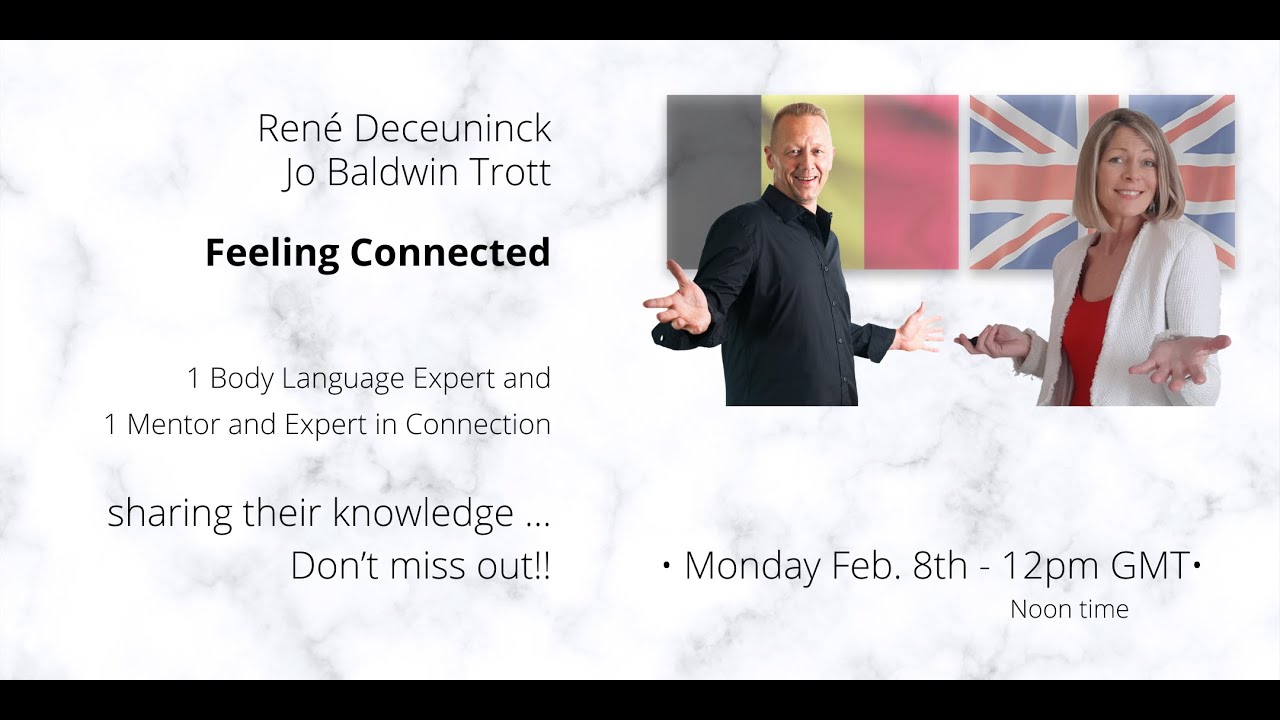
Rene Deceuninck hosts a panel with Jo Ball-Wintrott, Maria, and Kelly on what real connection looks like beyond words. They share tools like eye-dominance tests and silence to spot when someone is speaking from their authentic self versus a borrowed persona, and discuss how voice and body language reveal emotional truth.
Chapters
Jo, you want to start? Introduce yourself.
Sure, yeah, thank you Rene Deceuninck, thank you very much for having me on this call today, really excited to be here. Feeling connected is my bag really, in fact I should get a bag with feeling connected, that would be a good brand. Yeah, so no, it's really amazing. I connected with Rene only a few months ago and then immediately felt connected to you. So it's a— this word is going to be a bit overdone today, but yeah, I'm really glad to be here. It's very much a big part of my work, feeling connected, because I really feel, and through my own experience, which I'll share a bit later on, that we need to feel connected with ourselves first. And then we can start connecting with people that we meet and people that we want to relate to and our clients. So I live in Hove, East Sussex. I am a mentor and a publisher. I've just got a new book out which I promise you I won't keep plugging, just the once, Being Fine: The Other F Word. It's for men and men's mental health, and it's supporting men who have struggles and are keeping them in. So So very much communication and helping people to really own their story, but also move on from it, is very much part of my bag. So very thrilled to connect with you, Renee, because you are like the outside in and I'm the inside out. I think we kind of, we cover all the bases. Good morning, Maria.
Hi, Maria.
Hello everyone.
So myself, my name is Rene Deceuninck. I was born and raised in Belgium in Knokke. They call it the black diamond. Nobody knows what I'm talking about, I guess. Where are you from?
I'm from, whoops, I'm from Bruges originally, but I live in Wadegem since 14 years. But I was born and raised in Bruges.
Okay, look at that. So So I've been in this business for 25 years now. And it's only the last 5 years that it really went high, high, high. I travel the world with body language. So what I teach is body language, is nonverbal communication. And I just got back from Tehran, from Thailand, from Australia, got stuck for 5 months in Australia, get back, go back to London, had an apartment in Oxford. We started recording because of Corona. You know, we have to make money somewhere along the line. And now everything is online, is available online as well, the course. But I've been doing this for 25 years now, and it's an amazing journey. And the only thing that I would like to share is that, um, is that body language is based on feelings. We all have, uh, the spoken word, the written word, which is based on grammar. And a lot of things then, communication is based on grammar. Body language is based on feelings. And that's where I met Jo. Like you said, Jo, like you mentioned before, we met like a couple months ago. That's where I found like, hey, wow. And Jo as well, she says, oh, we maybe, yeah, we can have a match and merge our forces and do something about it. And we're here we are today.
So, and thanks to Maria because Maria introduced us.
Yeah, exactly. She did put us in contact, right?
She did.
Yeah, it's all her fault.
Oh, so connecting is, is, is one thing. However, it's how you connect. It's not what you say, it's how you say it. Will you agree, Jo?
Absolutely. Yeah.
So, um, do you have any insights that you say, let's start with this, start with that, or—
well, it has to come back to before that, doesn't it? Um, BC, before connecting, because the voice and the feelings— so, you know, very much the voice is part of my bag. This is why it's wonderful to do this with everything, Rene Deceuninck. But the voice really represents how we're feeling, who we are, and how connected we are with ourselves. I'm going to share something secret. It's not really secret, but I used to whisper I used to have this tiny weeny little mini voice, and I feel that there's a lot of us that— and I did— had a voice that really didn't represent what was really— I was really capable of, or what I am here to do. But this voice, I'd given it to someone else, and that's a whole fascinating topic. So I'd ask you yourself, I'd ask you to first of all um, just listen to your voice that little bit more and think, is this really my voice? Does this really sound like the real me? And I've done a lot of voice workshops. I've done singing, you know. I've created a band when I was age 40. One on my 40 to-do things list at age 40 was to create my own little pop band. You're never too old. So I really wanted to connect with my voice and value my true voice. I realized I'd given it to someone else, realized who that person was, did the work on that, and now I have no problem. If you ask me to sing now, I'd probably sing. I don't, you know, I've got that connection with my voice and it sounds like me. And I think sadly, uh, you can lose your voice, you can change your voice, and, um, and therefore you're not really expressing your true self. Sadly, it's not that easy. I know Maria's work is a little bit about this too. It's about very much connecting with the soul. That's why, again, I was excited to do this with you, Renee, because obviously all of that comes down to feelings, how you feel about yourself, how you feel about your place in the world. When we feel that that is there completely, it's concrete, it's solid within us, we can own that and then we can express that. So yeah, that would be my best tip. Whose voice do you use? And I even know, I can now even work out when I'm talking in a voice with the values or constraints of someone else, not me. I've worked out the connection in this, and I'd love to ask you about this, Rene Deceuninck, because you know all about this scientific stuff side of it, that I've worked out that actually this is a different voice that I'm using. I'm speaking in. It's my mother's, or my sister's, or whatever, my ex-husband's. But we do, and it's not my true voice. And it's my mission, is to talk with my true voice and be completely mindful of it, constantly aware, constantly conscious of just talking from my voice and saying what I feel from here. And yeah.
Yeah, so true. That's just true. So you work from the inside out, right? Now, when you're speaking to me, I will look at you and say, is this— is there a congruency between what you say and how you move? And what I mean about moving is your eyes, your head, your hands. It's not that easy on a Zoom call to see the hands. And then, I mean, I have to move a bit backwards. And, but it is a fact that what I see says an awful lot about you. And if, if you know that we have a right brain and a left brain— and, and please, for those who are joining, please take notes— you got the left brain and the right brain. And the right brain is the emotional brain. The left brain is the rational brain. It's connected diagonally with your eyes. So your left brain, your rational brain, is connected with your right eye. So your rational eye is your right eye. Your right eye is rational. And I ask people to remember this in terms of Rolls-Royce, the car. When you think about Rolls-Royce, the logo of Rolls-Royce is RR. If you remember Rolls-Royce, you know, you will remember that your right eye is your rational eye. Your left eye, on the other hand, is your emotional eye. Now, if you go into a big meeting and you have to take decisions It's always good to find out in what state you are. Are you in an emotional state or in a rational state? And how do you do that? In fact, by spreading the arms like this. I don't know if that's okay, like this, right? And you put your hands like this together, one hand on the other, and make sure you got like a little hole in the middle, right? So you spread your arms and then you look with both eyes through that little hole. And you focus on a certain spot. Now close one eye, and if you still see it, that's your dominant eye. Now you can't cheat and move your arms, you have to keep them in the same direction, but you have to look through the hole in the middle, right, and focus on one spot. Does that work? And if you see it with your right eye— oh, with both eyes open, you see it, and then you close your left eye and you still see it with your right eye— at that very moment, your right eye is your dominant eye in this moment. If it's your left eye, your left eye is the dominant eye in the moment. That means if you go to a very important meeting and you have to take a decision about a couple of millions and you don't know which state you are, do the test in your car, wherever you are, in the toilet. And find out. Because if you're in an emotional state, you might take a decision based on emotions, and you can change that state into a rational state. Somebody said something in the chat.
Maria is saying her left eye is definitely dominant. Yeah, that doesn't surprise me.
Yeah. Rene Deceuninck, can we ask questions in between, or should we put them on the chat or afterwards? Absolutely. Yeah.
Yeah, go ahead.
How can we make the switch? Because this is an exercise I once heard already, and I recognize that once again, it's my right eye that is dominant. And I was wondering, how can I make the switch? It's then all about the mindset?
All about the mindset, yeah. You can switch it in a split second, but if you're not aware of it, you will take decisions based on your state you're in. That makes sense. So if you don't do the test, you'll take a decision based on the state you're in at that very moment. But if you do the test and you find out, oh, I'm in an emotional state, I have to take a rational decision. I better think twice before I take the decision, right?
Yeah, it depends, it depends what you're doing, is it? But with the business meeting you want to have, yeah. I mean, I, I'm going to be devil's advocate, Rene Deceuninck. You might regret this, invite me on. But you know, I personally, I feel we spent too much using the left side of the brain and our right eye. So I'm, I'm gonna just throw this one out here. And most, a lot of my mentoring work is with politicians and female politicians. And I would say actually too many of them, and I am being judgmental here, I'm afraid, but too many of them are actually spending too much time using their right eye, left brain, and actually aren't engaging with their emotions. And then they'll get, they'll get onto a Zoom call like this and they'll talk in a voice that's very business-like and they'll talk very robotly and they will, and they will just, they will just spiel off their speech that they've prepared and they're not talking from the heart. And I think this is a big problem with management and also with politics. I think it's a fantastic, you know, you know, it's a really good topic to explore. But I would argue that actually, unless you are, you know, if it's about the millions, then totally. I mean, I just would, I would be really happy if we saw more emotion and compassion rock up in leadership. I think it needs to be across the board. But people need to know that, right? And I expect there are most, a lot of people, leaders, and especially politicians that are constantly using their right eye then when they do that. I bet it was all the right eye.
Exactly. I mean, I spent a lot of time in London and in, in, in environments where there's a lot of lawyers and there's a lot of investors and there's a lot of— and these people do that constantly. But why is that too? Don't get me wrong, they do it also to protect themselves, right? No emotions allowed, so to say. I mean, it's just that happens, right?
Well, that's, that's part of us switching off and not showing up fully as a human to a meeting.
Exactly.
And this is the sad state, isn't it? That actually, and I think that in a way there's Zoom time and what we're doing now is actually a brilliant leveler because we're all the same. You could be the CEO, Ros could be the CEO, and we're all just a little square box on a screen. Um, but yeah, it's interesting.
So when— and then when, when I would continue this is that your right eye is your rational eye connected with your left brain, the other way around. When we communicate, I would try to connect the correct brain with the correct brain. That means I would speak Chinese to a Chinese, I would speak Japanese to Japanese. And what we often do is that a Chinese is speaking to a Japanese and they don't understand each other. What I mean about that, I will look at you and show my left eye and look into your right eye. That means I will connect the wrong brains with each other. If I look with my left eye into your left eye, I would connect my right brain with your right brain and we would speak the same language. And the outcome of the statements or questions that you have will be completely different. If that makes sense.
So you're saying you want to use the same eye? So yeah, can you just clarify?
If I would want to connect my right brain, my emotional brain, with your right brain, your emotional brain, I would look with my left eye into your left eye.
Look directly?
Yeah, okay.
That would connect the right brain with the right brain, and the other way around. Rational things, I would turn a little bit around that way and look with my right eye. I'm exaggerating right now, right? But I would put my right eye into your right eye in order to connect the left brain with the left brain. Now, all of that said, all of that being said, is that when you say something to me and you look in a certain way, a certain direction, that's connected to the same system. If you look to the left, which— because the— from the eye forward, the ear, the body is left, is emotional. So if you would say something to me rational and you will look left, there's no congruency. The other way around as well. If I would ask you an emotional question and you will look to the right, ask— answering the question, there's a non-congruency. Now there's two things that could happen. Either you're lying, or you're so busy that you have to make a construction of something emotional. Right. Yeah, that is, that is the tricky part. Now, how can you find out somebody's lying to you? And don't look for lies now all the time, but it's if you have too many red flags in a row. If I ask 10 different questions and I've got 9 red flags, it might be you're lying to me. And maybe not a black lie, maybe a gray lie or a white lie. Just to protect yourself. All depends on the conversation, if that makes sense.
Yeah, no, totally. Go on, Maria. Hi.
Hello.
Hey, this is great. Hi, Rene Deceuninck. Good morning. This is amazing. Can I ask about giggling and laughing and how that punctuates conversation as well?
Because I think that's very significant in disguising and masking how I'm really presenting myself.
Yeah, of course. So what would be the question, Maria?
So when I hear somebody giggling and laughing a lot, when I hear and see somebody peppering and punctuating what they've just said with a laugh, —with a giggle. I feel that that's incongruent to what they've just said. For me, that feels like they've just negated, or they're not quite sure about what they've just said. What's your take on that? It's adding something else.
It's another body response though.
Yeah, so either they are covering something, and then you will have a fake smile. Yeah. When you read body language. Besides body language, there's also your gut feeling. And somebody that doesn't know anything about body language, they also have the gut feeling. And how many times in your life does that happen? You meet somebody and you say something, you ask something, and they answer your question and you go like, yeah, something's wrong here, right? That's your gut feeling. You don't have to know nothing about body language to feel that. But then when you got that feeling and you study a little bit of body language, you might find out if it's a fake laugh or not. And people, you can immediately take them out, like when there's no wrinkles around the eyes and the mouth, fake laugh. And when people like, ha ha ha, or they laugh like generally, that is a whole difference, right? So the next question that you could ask is based on the answer that you get. But what happens, for example, people who are in the investment world, they will always ask questions. They will never do the talking. And by asking questions, they get so much information, and they can work with that information. They can, based on the story that you are telling, they can look for the next question based on the information they get from you. In the meantime, they can read your body language. In the meantime, they can have that gut feeling of, yeah, this is good, or something is going wrong here. So asking questions gives you so much opportunities to analyze somebody and the content that they share with you.
That's so true, because people can prepare their speeches and their content and their presentation. I mean, I personally prefer that kind of way of, like we're doing today really, rather than the formatted and the formulaic, because it's more real, isn't it? I guess you, because people do prepare themselves, they prepare their speeches, and it all comes off by rote, doesn't it? It's all just that monosyllables, you know, not monosyllabic, but that kind of, you know, practiced voice. But it's very solid, isn't it? It's very still, isn't it? I've noticed with speakers that when speakers are presenting and they've practiced it to death almost, they'll just sit there dead still and they'll talk about their works because they're not engaged with what they're saying. True, true. And that's really off-putting, isn't it? Because you just think, oh, I might as well be listening to a tape.
Yeah, and we didn't prepare anything. That was my first question. Hey, Joe, did you prepare something? No, me neither. Oh, these are the best conversations ever, just to go with the flow and, and share your knowledge, because that's what it is. I'm at— I assume you're many years in this as well, uh, Joe. I've been in this business for 25 years now. Wouldn't it be sad to not know what you're talking about?
Absolutely. Yeah, I've been in mentoring for 20 years now. But I'd argue I've always been a mentor. You know, I was giving advice to my teenage friends at 13, and I'm mentoring them in a way. I think if you're a mentor and someone who is all about connection, you don't just suddenly flick the switch. It just, you just, uh, it's always there, really.
And to go into the deeper thing is that, um, what you think about is what you attract is not just a funny quote. I mean, think about something, and within a But in a short period of time, things are happening. I remember the story with Deepak Chopra and Wayne Dyer. There was 4 ways to order strawberry ice cream, they said. And what, 4 ways to order strawberry ice cream? He said, yeah, the first one is you get out of your chair, you go to the shop, you buy it, you have it, you eat it, done. The second way is to send your children out, right? Hey, get me some strawberry ice cream. Now the third way is a more intriguing way when somebody is tapping on your shoulder and says, hey, is this your strawberry ice cream? You go like, huh? And you can't wait to get home to talk about it with everybody. Do you know what happened today? I thought about something, and within a split second, somebody was asking me, hey, is this yours? And that happens all the time. You think about somebody the whole day through. They live on the other side of the country. You didn't hear from them for 5 years, and all of a sudden they call you and say, hey, huh? I was thinking about you the whole day through. And that is when you send out an energy. Now the fourth way to order strawberry ice cream is when you manifest it, that when you do it in a conscious way. Because what happens, you think about strawberry ice cream and somebody says, hey, is this your— this is, this is not programmed, this is just unconscious, right? But unconscious, subconscious, if you think about it. But when you manifest it and you're like, hey, Wouldn't it be great to— I had that experience to speak in Thailand, to speak in Iran, to speak in— and, and all of a sudden there was a colleague of mine from Sydney, Pat Massetti, short Italian guy, very energetic, and we missed each other for 23 years. And I saw on Facebook he was in London and I was in London. I said, hey Pat, where are you? He says, Rene, it's been 23 years. I say, I know, where are you? There. Okay. And we They catch up for coffee, and I had in my mind I wanted to speak in Iran for so many years, in Tehran. And then you say, why in Tehran? I mean, I love the Persian culture. It's an amazing culture. The food is amazing. Anyway, and he says to me, Rene, would you like to speak in Iran? And I said, excuse me, this has been on my bucket list for many, many years. He says, let me call a friend, a friend of mine. And he calls a friend of his And he says, uh, yeah, I've got a very good friend of mine right sitting right in front of me, and he could actually come to Tehran and speak about body language and this and this. And he says, just a minute, is this Rene Deceuninck? And I said, excuse me, give me that phone. So I had that guy on the phone. I said, hey, Sepher, is this you? He says, yeah. And we met at a Business Mastery with Tony Robbins many years before in Amsterdam. And that is also the power of networking, but also the power of putting it out there I would love to do XYZ. You manifest it, and then all of a sudden, in an indirect way, people come on your path, they pass your path, they go like, wow, what is this? But that is energy, that is frequency, that is putting it out there. Ask for it. Like in the Bible— I'm not really a Bible person, and all my respect— but asking you shall receive is not really something only in the Bible. It's, it's for real. What do you think about that, Jo?
I totally agree. And what we're talking about is connection that we can't see. We're talking about the invisible connection. And actually, the whole, the whole situation right now— we're not really going to go down that road because we don't need to talk about that right now— but the whole, um, what I almost see as a joyful connect, joyful point up to this is that we're all feeling more connected than ever. We are all— you and I first connected when you weren't even in this country, and we're easily connecting, um, through technology. We're using this technology which has its pluses and minuses, um, but actually what we're doing is more than that. We're not just connecting on Zoom today, you know. Kelly, you and I have never met before, but we are now energetically connecting. And part of my work, and I do this with the clients— in fact, yesterday I had a client I give Reiki, and Reiki is just connection through energy with healing. And I, I can do that. I've done that with clients the other side of the world. I can send them healing because we are all fundamentally connected. All we need is the intent. And I think I shared this with you, Renee. I'm sure I did. But 6 months ago, I was talking to someone about mentoring and how I really want to up my game and I feel like I want to mentor coaches. I'm being called to mentor coaches that are looking after the masses, because the coaches are looking after the masses at the moment, need someone to look after them too. And I have done enough spiritual work and enough experience on my soul journey, and I feel that's my calling in this lifetime, to look after them. And I made a joke, I'd like to, I'd like to mentor Tony Robbins. I think he'd benefit from my mentoring services. I'll give him a call after this. Popped up in my library. I mean, honestly, and it's only because Maria went randomly, or not, to an event and happened to meet you there. You then obviously, which what you said resonated with her, and then she kindly put us together. That was 3 months after the first time I've ever really talked about Tony Robbins in my life. I've, I've followed Tony for you know, decades since day one almost, um, and admired him on many different levels. But, you know, so all these things have come together. You might not have anything to do with me connected to Tony Robbins, but the, but the joy is that actually the, the, the point is that this has happened. And it just instills in me that absolutely we can intend, but we also must do, because obviously a lot of the book The Secret and visualization It's all well and good to lie in your bed and dream of, dream of, you know, owning your house one day rather than renting, but you can't just lie there and do that. You've got to create the intention and then do. Action is required because otherwise there's no momentum, and you need to take the momentum. And first of all, you need to start aligning yourself, and that can be quite a challenge too.
Go for it, Maria.
That's so exciting. That's really exciting, Jo, and also Tony's son as well, I think, that you mentioned.
Yeah, so I know someone who— and then at the same time Tony's son popped up on my radar. That's right, because— yeah, yeah, not literally, like he didn't call me or anything, but someone who I know, someone I know knows him. And then someone else, an American, very popular TV presenter. We've been in touch and she might be in one of my next books, and she knows Tony as well. Anyway, it all might not come to anything, it doesn't actually matter. The point is what you're saying, is that it's all connected. I'd just like to say hi to Mariam, lovely to have you join us. Beautiful pictures just popped up. Hi Mariam.
All right, so what he says is so true. A lot of coaches are coaching other people, but who coaches them, right? I mean, I compare it with like everybody is emptying their bucket in your big bucket, but where do you go with your big bucket, right? And there are systems for that, that's for sure. But when you mention Tony, that's, that's so true. He has also men, people mentoring him. Um, I've been his personal security for 2 years. Followed the guy everywhere. And what happens is that it is, it is, um, when you see somebody on a stage having that success and, and be able to talk to, like, let's say Germany was 30,000 people in the room, in Moscow we had 26,000 people in the room, London last time was 12,000 or 13,000. And, and when you're on a stage having all that energy coming your way as being the speaker, it is, it is quite energetic. Um, It's sucking all the energy out of you as well. You know, when you're done after 4 days, you're literally done. I mean, there's systems to cope with that. I mean, I have these systems as well, but being the security so many years ago, I saw certain things. People say, hey, does he really do what he says? He does it. He walks the talk. And if you would ask other security guys, I mean, we're not really talking a lot about it because we we keep that a little bit inside of us. But what happens is that when you're on a stage, and I don't know how many of you are on stages, but when you're on stage, you really have to protect yourself from energies that you really don't need at all. And in terms of body language, you can handle that in certain ways by standing in a certain way and then saying certain things in a certain way. Absolutely, absolutely.
It's really important, especially right now. You know, and I know Maria certainly works with you know, just facing a lot of the energy that's around at the moment. And it's very important that you, you, um, you, you gain that connection with people and you allow that connection to exist, but it's a one-way street of, of positivity and light. Um, and, you know, and I think it's really important to, uh, to kind of allow people to know you're present but just hold yourself back because there is a lot of negativity now than ever. There's always negativity, but you know, the people that sadly do find life negative, you know, a lot of them are really going down that road. And that's quite a challenge, isn't it, as a speaker on a stage, because you want to really be present. And people can tell if you're holding back. They can tell, right? Your body language must be different.
Absolutely, absolutely. You have to go all the way. You have to go— like, before going on stage, there's a trampoline, and you jump on the trampoline for a minute, 2 minutes, just to get in that flow. I even had Joseph McClendon one time, so we had to open up the curtains, right, being backstage, and he was jumping upside down and he says, yeah, open up, and we open up the curtains and he jumped literally from the trampoline on stage and everybody said, what the heck is going on? That's an energy. You create that energy and once you're in that stream, once you're in, in on that ongoing energy, nothing can stop you, nothing can stop you, just keep going, keep going. And before going on stage, for example, what happens a lot, and I do that too, is that we go into meditation and we ask the universe, give me the power, give me the information, use me as the messenger. And it's not about me, it's about these people in the room. Use me with, with all of your forces. Use my body, my brain, and let it flow through me so that people get the right, correct information at the right time. And, and sometimes that happens. I mean, sometimes I say things and I say like, where did that come from? And that's the most beautiful proof that ask and you shall receive. And then people get the information, and then you leave and you go like, yes, we did it again. And it's not about you as a speaker, it's about the audience to get the right, correct information. And when you do that, you get the audience also focused and mesmerized. They go like, wow, this is, this is amazing information. And again, it's not about the speaker. The speaker is just the messenger. That's all it is. You have to own the stage, that's for sure, but you're only the messenger that has a message for somebody. When I look at, for example, when I listen to Wayne Dyer saying one time, he says, uh, I'm not a human being having a spiritual experience, I'm rather a spiritual being having a human experience. And then when you, when you listen to that, you go like, what the heck, that is so true, that is so true.
Definitely. And I think there's a different voice. We can, we can hear the different voice. We can hear that complete sincerity. And it's almost like there's, there's other layers that we couldn't even define. And, and I think, you know, body language, it's all authentic, but there, there's another voice that we can tap into. And that's what has the most power. And it just, it resonates. I believe a lot in tonality. And all the rest of it. And I think, you know, you can hear someone that is completely just in their flow. Like you say, it's a bit like Reiki actually. Reiki is very much, you know, it comes through you and you allow it to flow out. And that is what you're doing, isn't it? That's what you're doing, Tony's doing, is coming through and you're just allowing it to— right, you are just the vessel really. And people can hear that because then the ego isn't involved. Well, it is involved, but it's just there. The ego isn't— it's when, when people are talking with more of the ego and it becomes about the 'I' and not the, not the 'you.' Um, that's a really interesting different dynamic, isn't it?
Yeah. But to get back to the body language, for example, of reading body language, I had a meeting with a lady that I was going to coach in London. I'm talking about more than a year ago. And, um, we went very deep, and all of a sudden I said, 'You have to stop lying to me.' And she says, what? I said, each question I ask you is based on an emotion, either an emotional emotion or a rational emotion. And each time I ask you an emotional question, you look in the wrong way. What the heck is going on? And she started crying. I said, why are you crying? She says, yes, I've been lying to you because I want to protect myself. I said, how on earth do you want me to help you if you lie to me, this is a waste of your time, my time, and especially your money. And she says, yeah, that's true. I said, let's start all over again if you want to. If you say this is it, this is it, I'll give you your money back, don't worry about it. She said, no, no, no, stay, stay, I'm going to be open, honest, I'm going to tell you things as they are. And then from that moment forward, when I asked her an emotion question, she answered with an emotional answer or an answer that really made sense. And from that point forward The coaching session went amazing. I never had that experience before, that somebody was lying to me. I mean, sometimes they'll a little lie or white lie, whatever, and I'm gonna say, stop lying to me. But that intense moment that I had that one time was like, wow. And it is true, you can read body language by where the eyes are going— left, up, right, up, horizontal, or down. Um, I had a lady in Brussels and I asked her a couple of questions, and she answered my questions completely correctly, but so slow. Oh my God. And she was looking that way down, right? So left for her, right for us. And that is when you're busy with internal dialogue. You know, you're answering a question, but hey, my husband is going late tonight. I have to get the kids from school. I have to cook. I have to do this. The dishwasher broke down. Oh my God. And the plumber's coming by, and I have a phone call to make, and you know, I mean, I know I'm a man, right? And as far as I know, you are all women joining this call where you are juggling a thousand things at the same time, right? And when that happens, when you are in a coaching session and the coach is asking you a question, you might look down and say, oh yes, yeah, that's true. What I would like to say, and what happens is that people are answering your question but so slowly, and they're looking down left for them, right for us. And you go like— and I smashed my hand on the table at that very moment. I mean, I'm always interrupting patterns. That's one way to do it. And I smashed the flat of my hand, like bang, on the table. And she was like, what are you doing? I said, can I have your full attention, please? And she was like, oh, sorry, sorry, sorry. I said, what were you thinking about? And she says, how do you know? I said, who's the coach in here? And she says, yeah, yeah, I was busy with this, thinking about that. I said, yeah, let's focus for the last at least 15 minutes and then think about whatever you want. She says, okay. And yeah, it's reading body language, the eyes, the brain, it's all connected. Some people say, yeah, body language, I don't really believe in it. Believe it or not, after 25 years, I've been reading so many body languages, right? The politicians, with lawyers, with all kinds of people. And it's amazing what you read.
It's amazing. Well, politicians, obviously we're seeing a lot of them at the moment, and I think, gosh, you know, we need to do one. So I asked you this the other day, what do you think, folks? I think a goggle box where we watch Rene watching all the politicians, and you can like be talking about us about how, you know, how they're clearly lying, how they clearly don't mean a word they say. I think it would be amazing. Maria?
Yeah, I just love what, what you've just said, Rene Deceuninck. I, I can sense everything that you've said. I can sense that with, with the person. If they're thinking about the shopping, I can even pick up what they're thinking about— all the, the dogs, the husband, the this, the kids, the da da da da da. And I can sense that they're not— a person, for example, isn't really connected to what they're saying, or they're just speaking in general terms. They're not speaking about their own experience or their saying what they think that I want them to say and all of that. Now, I really love that as a coach you're allowed to say, hey, stop lying to me. I wish that I could. I think it's an act of disrespect, you will tell me, to do that generally, because I'm not going to be a very popular person if whenever I'm listening to somebody, for example, I go that doesn't feel quite right, or to challenge somebody. Like, I've learned not to, but I think I would love to, in all the situations, just even for a day, to play with, um, not quite connecting to what you're saying to me. Or are there really good ways of saying, I'm really interested in what you're saying and I'm not feeling what you're saying, for example?
Yeah, there's many ways to do it. There's many ways to ask questions, many ways to approach somebody, many ways to You can do it in a very rude way, and you could do it in a very polite way. You can do it in a very neutral way, positive way, negative way. It all depends on the situation, who you're talking to, and what's the environment where you are. I remember very— I'm gonna share a story, a long story, but very, very short about Andy Harrington. Andy Harrington is a public speaker, and he wrote a book. And why can I mention this? Because it's in his book. It's public, so there's nothing to hide. And he was so in love with his wife that she went through depression, got hospitalized for it. And he was back home watching a promotion about Tony Robbins coming to London, and for him that was the only hope to save his wife. I'm not going to exaggerate here, but it was in a very bad situation. So he went to the hospital, took his wife, and says— and they said, you can't do this. And he says, watch me, I'll show you. And he took his wife anyway, and he went, and they went to UPW where Tony Tony all of a sudden said from stage, hey, how many of you have challenges in life? Now, Annie bought the most expensive tickets and sat in the front row, and he took the arm of his wife and put it in the air, and she went, what are you doing? And he says, well, don't you? And Tony saw it and he came down the stage and he says, well, can I ask you a question? What is your challenge? And she said, I don't have any challenges at all. And asked the question a couple times, and Andy couldn't hold himself anymore. He says, listen, we go through this and this and this challenge, depression, this and that, and he said, okay, that's amazing, awesome. Um, can I ask you a personal question? Now you have to realize there's 7,000 people in the room at that very moment. There's 6 cameras on our face on big huge screens, you know, these big video screens. So she's in the picture completely. And Tony asked the question, he says, can I ask you a personal question? She says, yeah, you sure I can ask you a personal question? He says, yeah, yeah, when was the last time you came? And she went like, what? Because that is not really a question you ask to a lady you don't know. And all of these cameras on her face, and it was complete silence in the room. Can you imagine 7,000, 8,000 people in a room, complete silence? And at that very moment He pushed her shoulder with his thumb and he said, "Lady, you are healed." And what happens is that when you do that— don't get me wrong, don't ask everybody now that same question— but the thing is that when you shock somebody and you say something in that very moment, the brain will accept for real. So when you shock somebody, that brain opens up for a split second, only a split second. What you say in that very moment, in that split second, your brain will accept as the truth. And then by pushing his thumb on his shoulder, right, you're anchoring it. So each time something happens to her shoulder or somebody touches her shoulder, she's getting that anger. I'm healed. I am not ill. And she never went back to the depression, by the way. They did follow up on it, and it never ever— she never went back. And this is a true story. Now again, Maria, you have to watch the, the situation. Who are you talking to? Is this allowed to do? If— be very careful what you do. But shocking people is one way to do it. Yeah, I know it's a bit— I'd love to—
yeah, I'd love to talk to you more about that because I, I've decided, and I created many, many years ago go to just not challenge people actually at all and to just hold a very loving, kind space instead. But what you're saying, I'm finding very, very, very exciting actually, because I'm naturally very playful and cheeky. So may I, may I?
It's refocusing the brain. Let's say you and I have a conversation, right? You and Maria, me, we have conversation about certain subject. And then Jo comes in between and she says, hey, Renee, can I remind you tomorrow this, and after that this and this and this. Okay, are you okay with that? Okay, no worries, Joe. And then I'll turn back to you, Maria. Hey, what were we talking about? How many times does that happen during one day? A couple of times. When you're in a conversation with somebody and somebody interrupts you, that means they're gonna cut your focus. And when you've got the focus, you have to refocus afterwards. And that doesn't— that's not always easy to do that. And that happens on a daily basis.
So you could do it by saying, well, oh, what you, uh, what'd you have for tea last night, Maria? When you're with a client, you can say, what'd you have for tea last night? And they'll go, what, um, uh, I don't know, um, spaghetti. And you go, okay, yeah, of course. So, um, so right, so tell me about what's happening for you. Yeah. And so I use this in the police. We used to use this in the police when I was interviewing suspects. So, I was a police officer for 9 years, and we used to use this with people that we absolutely categorically know were lying, were guilty as they should be charged, and we would just divert them, just completely take them off track, and then talk about something random, and then bring them back on, and then they've forgotten their spiel, and unless they're really good, which some were, It would always work. It's really good, really good.
I learned from police officers as well is that they will ask you certain questions, right? And they're going to divide the whole story in 10 pieces. Then they ask me as an expert in body language, can you come and analyze the conversation? Because we're not allowed in the room with the suspects. And so what happens is that we sit in a separate room., and we watch only the video, not the audio. So it's just images. And each time we see an image that is not really correct, we take note of it. Now we put back the audio on it afterwards, and then we look like, hey, what has been said in that very moment? And if there's no congruency, we might say, hey, red flag, another red flag, another red flag. And then we go back to the police officers and they say, you know what you do? You bring back the story to the suspect not from 1 to 10, but from 10 to 1, by asking questions. And then we're going to reanalyze the video, and that's when they mess up or they don't mess up. That was what I learned from the police. That was a very interesting—
very interesting. You work it backwards from 10 back to 1.
So you've gone up the way, and then you bring back the same, that same story to the suspect by asking to represent rewinding it, which is actually more of a challenge.
Can I just say about the thing you started with, Rene, at the beginning about there are some people that ask lots and lots of questions and they're basically screening me. So I know an individual who only ever asks questions, but so it's very much a guarded, I feel, very controlled by that person when they do that.
And I feel that I'm being interrogated and read.
And it's like the poker strategy of the, the person doesn't give away anything about himself, so he doesn't join in, but it's just asking the question. So I, I love that you mentioned that.
And I can sense if I'm being screened and if I'm being, if I'm being had that done to me.
There's a lot of coaches like that actually. It's very just, you know, one question after another after another. Alpha coaches, I call them, that they just actually, they want to control the situation and dominate. And so by constantly putting you on the hop, yeah, it's not pleasant actually, you know, on a level we just don't feel comfortable with it.
Sorry, Rene. Yeah, there's ways to do it, you know. You can ask a question and then make an assumption, ask another question and make an assumption. Or make an assumption and ask a question. And it all depends on which questions you ask. I will always ask open questions. The open questions are the 6 W's and H. That means the why, where, when, who, which, etc., etc. And then how— the H stands for how. So when you ask these open questions, people will come up with a story. I had an investigation with Lance Armstrong Rene Deceuninck, you know, the cyclist, right? I have it on video where the interviewer says, 'How come you got involved in—' and then he gives an answer and the interviewer doesn't say anything. And then in that moment of silence, the most stupid things are told. He says, 'Why did you get involved in this situation?' and he gives him an answer. The interviewer says nothing, asks nothing. And then Lance says, because blah, blah, blah, blah, blah. And these are the most dumbest things you say in that very moment of silence because you can't handle silence. Nobody loves silence. If you know upfront that you can use silence to get information or extra information, that's an amazing tool.
For interviewing, it's very powerful.
Yeah. The only thing to watch out for is to not exaggerate, do it very subtle. As you mentioned, Jo, Some coaches do that, you know, question and question, ask question, ask question. You get very uncomfortable with it, but you have to, you have to feel this. It's like you feel it and you ask a question. If you feel like, hmm, I shouldn't ask another question, I make— maybe I'll make an assumption and finish with another question. Like, people say, why do you do this? I don't know. I know you don't know, but suppose you would know, what would it be? What would it be? These are NLP techniques, right?. And then that's, yeah, I remember Tony in London. He flew in from India, all the way from India. I think it was a National Achievers Congress. And there was a lady in the room and he said, he walked down from stage down the aisle and he pointed at the lady, "Lady, can I ask you a question?" And she said, "Oh wow, yes, like Tony Robbins, oh my God." And he said, 'Please stand up.' Give the lady a microphone. And he says, 'Lady, why are you here?' And she said, 'Wow, I'm so excited! I was looking forward to see you. Now I'm speaking to you. Isn't that amazing? I'm so excited.' He says, 'That's amazing. That's okay, but why are you here?' And she says, 'Well, I just answered your question because—' After 5, 6 times, 'Why are you here?' She broke in two pieces. She says, if I don't hear tonight what I want to hear, I'll commit suicide anyway. And that is a real story. It's National Achievers, I think, 2016 in London, in, uh, Excel London. And I was there. I mean, this is a real story. And then he did certain things, he, I need to, to, to encounter it. My whole— the story about this is— my point is that if you ask enough questions, people come up with the truth. It will come up. And don't hesitate, don't be worried, don't worry about it. What I do is that I know you don't know, I really understand you. I feel— felt— found, right? You know that system? What I found out is that I feel the same as you. And I felt that.
Ever used that? Yeah, sounds like empathy. Yeah.
Now, can you explain, Rene?
So, I feel what you feel. I felt the same time, the same thing. And what I found out is XYZ. Feel, felt, found. What I do at that very moment, I level with you. In your brain, it will go like, wow, somebody like me. Oh yeah, yeah, but we level. So I feel, I can feel you. Yeah, I felt the same way, but what I found is, right, and you can use that in all kinds of ways, but the basic thing is, the basic way to say it is, hey, why I don't know. Suppose you would know. I know you don't know, and I really agree, and I, I understand you, but suppose you would know, what would it be? And you say, I really don't know. I know you really don't know, but hey, you just keep why, why, why, and before you know it, bang. But you have to be disciplined to keep the silence as much as you can.
Yeah, the power of silence.
Yeah. So Rene, when you just said that last statement, you raised your right eyebrow. You have to be— and then you raised your right arm. Discipline. So is that that you were looking for the word? Were you being rational?
Can you, can you show yourself, please?
Yeah, I'm going to answer your question immediately. I'm an ex-army boy, right?
I joined— you know I love you, don't you? Yeah, I know.
I was in the army for 7 years. I was in the armed forces in Germany and Belgium for 7 years. I was in the Navy. I jumped out of airplanes. I flew airplanes. I've been an ex-pilot, etc., etc. And I have a certain discipline in life. And sometimes when I want to accentuate things, I go like, huh, uh-huh, okay. So I use my, my expressions. But then on the other hand, you are reading body language, so I have to, have to be aware, right? That was—
that's pot and kettle, pot and kettle.
No, I'm, I'm really excited. I'm genuinely interested because I know that when I am looking, um, and seeking in the ether for the words, like I'm asking spirit, give me the words, I haven't found them yet.
So that, that for me was just really interesting. Were you then in that case looking in a logical way for what other word 'How do I explain this?' I was really just asking from that point of view. Often you're moving your, that side, your left shoulder forward when you're speaking emotionally. Oh, I love this! We're coming in, interrogating the body language. Are you aware of that? Is that what is going on for you? I'm just learning what you're saying.
What we are reading as If you start knowing how body language works and you start understanding that body language is based on feelings and body language is based on, on all kinds of reactions, interactions, and if you, if you start reading it, you will find out that the body never lies. It never lies.
I agree, I agree. Are genuine.
There's only 3 people you have to watch out for, and those 3 people, the first category of people is the people who are using a lot of drugs and alcohol and medicine because they change the state of the body by using drugs and medicine or alcohol. So that body language might not be really correct. The second type of people are people who are professional actors. They can act and you won't find out. The third type of people are narcissists, pathological liars. They can change their body in such a way you will never find out what happens. These are the 3 types of people that's really hard to read body language. I can honestly almost read every type, but once I have to deal with a pathological liar, a narcissist, or somebody who is into alcohol or medicine, it's not that easy. But that's the most beautiful proof that body language is based on feelings. So whatever you see, what, how I move, the way I move, what I say is based on feelings, how I feel, what I say, how I say it, uh, the people that surround yourself. I mean, I was in, um, in so many different, uh, um, events and ending up backstage with Brian Tracy, with Jack Canfield, with Jack Robbins, with Tony Robbins, with Joseph MacLendon, with Les Brown, name it. I mean, I probably ended up backstage with them. Robert Kiyosaki, Richard Branson in Bangkok, Thailand. I mean, and then you find out that some way, in some way, you're going to act differently. You don't have to because these are also just human beings, right? But sometimes because you're in the neighborhood of somebody very important, and in the beginning for me that was like, oh my God, I better behave because, you know, but then in the end it's just the same, right? You have a different knowledge about certain things and different insights about certain things, but then you start behaving like normal. I mean, Just be you. People ask me all the time, hey, what does my body language tell you? I'm like, you don't want to know, right? Never change for anybody or anything. Just be you in the most natural form as it is, because your body will never lie. And even though if people don't know anything about body language, their subconscious and their gut feeling will absorb the signals. Because it's a frequency, but an energy on a certain frequency, if that makes sense.
Yeah, totally. And also, we can, we can connect. So say you are meeting your, your hero, whatever that is, um, if you are guarded and you are a bit kind of coy and you are in awe, your body language will close down a bit. You'll be a little bit nervous, and I'll pick up on that. And then what happens is you lose that lovely moment. I feel like there's a lovely when you meet someone. So say Tony Robbins rocked up now, and you know, and we would just— if any of us suddenly go, "Oh, it's Tony Robbins, look, I'm leaning back," you know, you kind of— and actually the other thing that I think happens, and it's not just people that we see as a kind of someone who we aspire to be or whatever, we just, um, we see as our gurus, but also I think just, just talking to people on Zoom Zoom as well. I think it's really important just to be fully present and just allow that to, you know, whoever they are, whatever they are, because the minute you change, they'll change. And that's sadly when we lose that real magic moment of true connection, I think. You know, and I, so I went, when I was a trainee police officer at college, randomly ended up going to the top college of the UK to because all the other colleges were full. And all my friends wouldn't get in the queue with all the top brass with all the numbers— all men obviously— but with the numbers on their shoulders. They wouldn't get in the queue with them until they'd had their breakfast. I was like, bugger that, they're just people, they poo and wee like we do. So I got in the queue with them and I was like— and that actually was one of the best learning parts of learning that I learned from that whole bloody training, to be honest. Because I learned the value of just showing up as myself. And I'm not very tall, I'm only 5'4", I had short red hair at the time— thank God, never again— but, you know, bright red hair I dyed red. Anyway, and I rocked up and I just like— and I got contacts. And talking to those people, because I was showing up as me, they then didn't have to rise into their uniform, they were just wearing it. I could talk about for hours. But anyway, they didn't have to rise into it, they were just present, and we connected on a different level. And a couple of people like, oh my God, I can't believe she spoke to ACC Grange. Like, it's just a person, it's a person doing a job. And so, so true, really, really important, um, that we do this with any of our connections, any meetings, anything, um, even if you feel like you want to judge someone and you see someone like, you know, on Zoom at the moment, Maria's got a plant coming out of her head, which is rather lovely actually. But I'm just picking on you, Maria, but obviously some people have random things behind them, like that make no sense. I'm kidding. It's only because I know you, sweet. I'm just assuming on you. But you know, and it's very easy to judge and make assumptions and then change your body language, change your connection with them. And it's really important we don't because, you know, it's really actually very challenging for everyone to show up as themselves on Zoom when they might have just left their 4-year-old having a tantrum, you know, trying to scream the house down. Who knows what they're dealing with? So I'd just like to finish on that point.
This is so true, Jo. For me, what I learned really is that the basics— I'm okay, you're okay— this is— I always used to feel quite small towards people, has to do with my red hair long, long, long time ago, and also a bit the culture and the way of educating. Rene will probably recognize what are the people going to say, what are they going to think, what your parents say, shh, just— but what I learned so strongly the last years in my personal growing process is just basically I'm okay, you're okay. And what I also say is everybody is born naked, And this is so true, but people forget it so often. And I learned how powerful this is, just to accept who you are, who the person is, even if it is, as you said, like some people think, oh my God, it's God. It's also a person that is born naked, just like you and me. True. So true.
I love that. I love that, Kelly.
Also, it's Keith Cunningham. Keith Cunningham is one of the speakers on Business Mastery. With Tony. And Keith Cunningham is a very tall guy. He must be in 60s, I guess, early 70s. And he's an amazing guy. And I wanted to have a picture with him. I mean, I'm talking about almost 7, 8 years ago, and it didn't work out. You know what? It's because you're not ready for it. Afterwards, I went to another business mastery with Tony, and because I was a fixed piece of furniture in the organization, because I'm working with Success Resources, working with Tony, working with etc., etc. now. And I went again to Amsterdam and I ended up backstage with— not backstage, it was in the room with Keith Cunningham. He says, how you doing, buddy? I said, good, good, good, what about you? He said, yeah, yeah, yeah. So what's with Brian Tracy? He says, how is Brian doing? I said, well, he's not, not that good. He's in a wheelchair, he can't move anymore, all these spines are fixed. And he says, what the heck? And that was the start of a conversation about— I think we were speaking for an hour And finally ending up having a picture with Keith Cunningham. These are one of the icons in accountancy all over the planet. They are really icons, icons. And, uh, but it is amazing when you, when you act normal— I mean, and define normal, uh, but when you act normal, people will have a chat with you. Don't worry about it. But you don't exaggerate. I mean, I had the same conversation then later on with a with Jack Canfield from The Secret, with all kinds of speakers. And then it's just be you and then don't exaggerate. And I mean, yeah, okay.
I have a really big theory about why most people are not able to be themselves, because they don't actually know who that is, asides from all the conditioning. That's, that's another aside, um, which I'd love to talk to you about. But what I'd like to say with the be normal and what you were saying, Kelly, about we're 'all born naked' is that when I was, when I was in my teens, I was in a spiritual education where we were taught that everybody is a soul in a human body, and we were trained to speak to the soul. So the meaning of the word namaste is 'I bow down to the light, you're the divinity within you, as I do myself.' So, so we were just taught to look at the forehead and to speak to the light of the person. And that's— that has always served me very, very well, because although it was a spiritual cult that had lots of not good things about it, this was a very beautiful aspect that was for me a remembrance of who I really am. And so it erased all of that anxiety about talking to somebody else, or somebody is— because something that I know is that I am connected to everybody else. And everybody hurts and everybody cries. And sooner or later, that person I'm in front of will go through that emotion that I may be.
So I, I always have this vision of, well, I'm a human being, but we're all in that human boat together, and it's okay, and everything's okay. So for me, that's what allows me to be actually naked and to be really here, because I, I know that that's whatever I've been through, you may be through, you may go through at some point, because we're all being human, we're all on this human journey.
So beautifully said, yes, yes.
So we're about 10 minutes past 1, we've been chatting for an hour.
We could keep on talking, listening.
Yeah, lots to talk about, lots to talk about. Can I share my dream before we go? Yeah. I have a dream.
I have a dream. So I have a dream to serve and work in India because I feel the heartbeat and the call of India very, very strongly. And I also would love Rene to have a session, facilitate a session of my brand of soul mentoring and sensing and all that with you, and just play and just see what happens with that.
Yeah, I'd love that.
Yeah, I'll, uh, you afterwards. So what was I saying? Okay, uh, you would like to add to the conversation, to this session, that you say, hey, um, I would leave like that message, I would like to leave this.
And then, yeah, so, so a lot of, um, my messaging that I'm receiving and, and I'm needing to share right now is that I'd ask everyone who watches this and you guys here today, to really consider whether they are really allowing themselves to be in their own space, connecting with their true selves, and actually allowing the opportunity of what is happening now to open up to them. Because there is so much opportunity, and there's, there's even more opportunity to connect with your soulful spirit and do what you're here to do on a soulful level. And I'm talking about dharma and talking about purpose. So I'd ask you to connect and give yourself— whether it's a walk in the park or just give yourself a day— well, actually, what do I feel like I'm really here to do? Connect with that part of you that's talking to you. Listen to it, let it sit, and allow that to exist. And let it open yourself, because there's a lot of opportunity now. There's a lot of incredible light coming into the world that is challenging the darkness that is here too. And it may be time for you to do something different. If you'd like some help with that, then get in touch because I would obviously love to help you on your journey.
Yeah, so Jo, if you say let's get in touch, where can people find you?
Yeah, just put my name in, Jo Ball-Wintrott. My website is jo-ball-wintrott.com. All my social media is my name, and My books are proper books, but on Amazon, if you'd like to go to Amazon and put my name in, you will see all my books. And one of them is just coming out, which Maria is also an author of too.
Awesome, awesome. Great. Also, at the end of the recording, I'll mention your name and your information. Myself, the last thing I would like to give away is, is, hey, just be yourself, because body language is never gonna lie. Act as normal as you can and be as genuine as you can. And, and, you know, make your life a masterpiece. That's the only thing I can add to it. You can find me also on my name, rene-deceuninck.com. That's it. And you'll find a lot of information where you can contact me, where you can find me. There's also a YouTube channel, Pinterest channel. There's all kinds of channels. I had in 2018 the question by backstage with Gary Vee, Gary Vaynerchuk. I don't know if I ever— he says, uh, how many platforms are you on? I said, why? He says, if you're not on 10 different platforms at least 10 different platforms, you don't have a reason of existence in this industry. I said, that's it. Okay, I'm on 24 different platforms. He said, well, you can't find me, you have a problem with your Wi-Fi, period. So information at the end of the session, uh, this is recorded, so it's going to be available on YouTube as well. And, uh, I would say, hey, have an amazing, uh, life, have an amazing time. I hope you enjoyed this session.
Absolutely. Yeah, Jo, and brilliant. Thank you, Rene Deceuninck. It's been great. Thank you, Maria, and it was masterful. And also Ros for joining us.
Yeah, yeah, thank you very much. Was very interesting. Take care, guys.
Want to connect afterwards, please do so, no worries, with Jo or with me.
All right, I'd love to. Thank you. Bye.
Nice to meet you, Kelly. Yeah, I will— would you mind to connect? Absolutely. Are you on LinkedIn?
Yeah. Wonderful. But what I would like to finish with is what you said. Sometimes you feel something. It's so funny. I was yesterday evening in the bathroom and I don't know why, but on, on Sunday evening, I'm not checking social media or so, but I felt like I have to look at LinkedIn and I looked at it and I just saw this popping up, this masterclass. And I was like, okay, this is something I'm going to put in my agenda anyway. I felt so strongly I have to do this.
Yeah, I'm so thankful for— yeah, that's great. It's all just go with your gut, just go with your feelings.
Crazy sometimes how things happen.
There's no question. Yeah, no coincidences. Yeah.
More from Rene


What are ... The Silent Language of Connection and the Hidden Power of Non-Verbal Cues?








