Body Language Podcast with Zena Krogedal from "American Dream Makers"
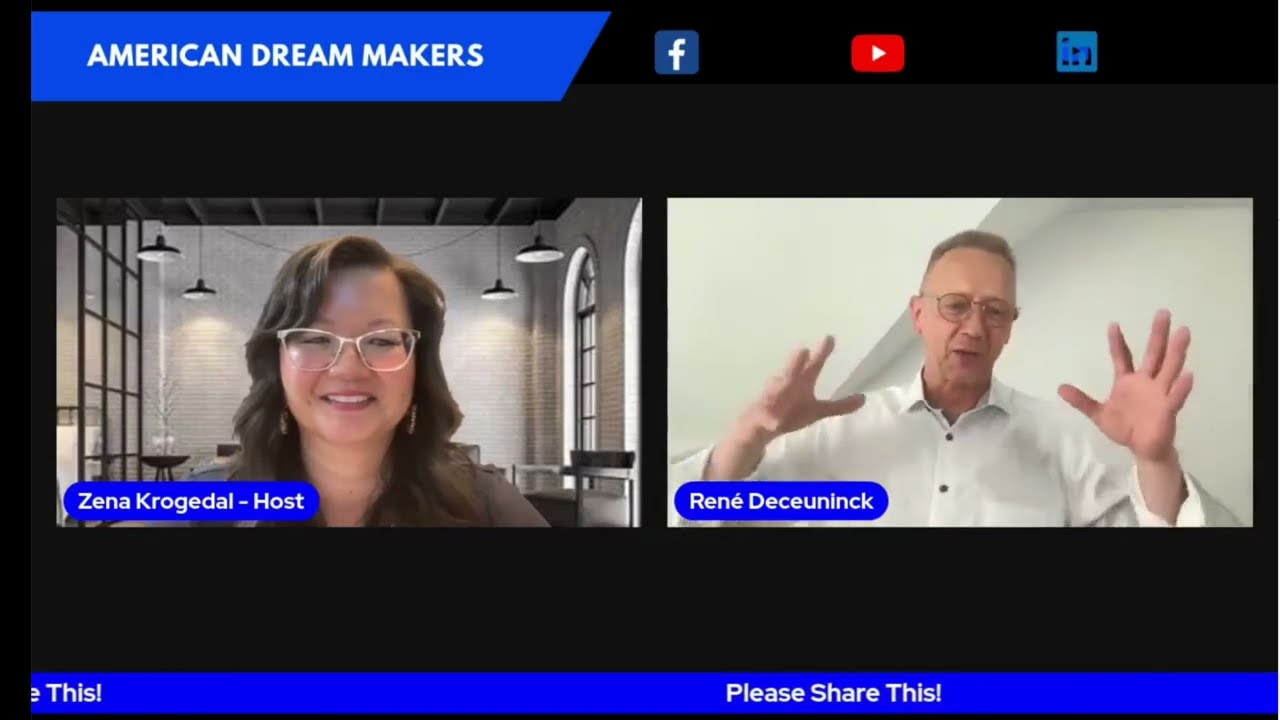
Rene Deceuninck, a body language expert who worked as Tony Robbins' bodyguard, explains how 55% of communication happens through body language, not words. He teaches how to spot lies through eye gaze and micro-expressions, and shares how posture can shift your mood and help fight depression.
Chapters
Hi, it is Zena Krogodahl, your American Dream Makers host. Good morning to you. It is a fabulous day. I have a wonderful guest with me this morning. Cannot wait to bring him on the platform here, but first let me play my intro video and we will get started. Hello, hello, hello! It is Zina Kroganow, your American Dream Makers host, and I believe the American dream belongs to all of us. And not only can you achieve it, but you can go beyond. Today I have a wonderful, extraordinary guest. This is Rene Deceuninck. And I'm just afraid I'm going to not do his last name correctly. So I'm going to refrain. But Rene is an international speaker trainer sharing the secrets, knowledge, and benefits of nonverbal communication. He is the expert and he is a bestselling author. So without further ado, I'm going to bring Rene on. Rene, good morning here in America. Good evening there in England. That's where you're at in England, correct?
I'm in England. Exactly. Yeah. I'm in the UK.
The UK.
Yeah.
Awesome. Well, Rene wrote this book called, I'm going to try to get this on the screen here, Body Language. You guys, if you do not have this book, you need to get this book. It is so full of so much information. Rene, I also love that it's not just reading. You have us doing exercises in it. So it's very practical as well. So cool. Okay, so cool. So tell us a little bit about yourself, Rene. Just love to hear about who you are and how you got to become the body language expert.
Um, I'm just trying to, to forward the record. Um, if you— but can you bear with me one second? Just, uh, I want to share this. Um, all right, it's on my— all right, here we go, running. So who am I? Where do I come from? I was born in Belgium, in, uh, in the land of chocolate, as they call it. However, chocolate comes from Africa, but they call Belgium the land of chocolate, right? And, um, and that was in 1965, uh, that's a while ago. And, uh, I went to school, was bullied in school like crazy, um, didn't like it at all, went crying home at night, didn't go didn't want to go in the morning. And then when I turned 17, I was going to prove myself to the world that I was good for something because everybody was saying, hey, you're good for nothing, you're not going to make it, et cetera, et cetera, et cetera. And we all have people like that in our lives. They bully us or they don't believe in you or they say nasty things to you. I had like a bunch of them. I was like a daily shower of negativity and I was so fed up with it. I said, I'm going to prove myself to the world. I'm going to do it. Now, there was a little bit of a wrong attitude because you don't have to prove yourself to the world at all. There's only one person you have to prove yourself to is yourself, right? So, but in that time I was not wiser than that. And then what happened is that I said, I'm going to join the Navy. So I joined the Navy and everybody said, you're not going to make it. This is not for you. Come on, man, can you be pleased where you are? And I got in and they said, wow, you're lucky. And I said, no, not really. I mean, and then there was a vacancy for a sergeant, for an officer, to become an officer, an engineer, and then building bridges and roads.. And I was like, yeah, that might be something for me. And I applied and everybody again showered negativity and I applied and got in anyway and I became an engineer in building roads and bridges and stuff. And again, people would say, hey, you are so lucky. And I said, well, there's no luck attached to it. And by the way, my story is in the book as well. And so what happened is that I did that for a couple of years and then all of a sudden I saw people jumping out of airplanes and I said, wow, that is something. This is me, this is, and I love adventure, right? And applied and people said, oh, don't do that. They're going to drop you in war zone and you're going to get killed. And you know, all these paratroops and stuff. And I said, well, I don't know. Let's see what happens. And I applied and I got in. And then I was sitting on my heiny one day watching the pilot because in these big, huge Hercules, I don't know if people that are listening or watching this know that type of aircraft, Hercules C-130. There's no doors in it. And you can literally see the pilot and the navigator. And I was like, wow, wouldn't that be something for me? And I applied and now back home, you know, Rene, you have to study for that. That is not your cup of tea. You're not gonna make it. And I was like, wow. And what they actually did, they fueled me so well with their negativity. I said, you know what? I will prove it. I can do it and I will. And before I knew it, I was flying an aircraft and I was like, whoa. And then again, they said, you're lucky. Now that was the beginning of my career. And after 7 years in the forces, I said, you know, it was a fun time, I had a good time, and I left and I became a truck driver. And I wanted to discover Europe from behind the screen of a truck, a lorry, a truck. I don't know how you call it in the US, but it's amazing, these big long things. I loved it. You know what? You're in your 20s, you're full of energy, you go like, yeah, and I'm driving a big thing like that, you know.. And then that was fun for a couple of years, 4 years. And then I was thinking like, hey, but this is not life. This is not life as I imagine it for the rest of my days. And that's why today I have lots and lots of respect for truck drivers. I mean, they go through hell today and I do respect them a lot. But then in 1995, I bought my very first book from Tony Robbins and it was called Notes from a Friend, a very tiny book. You can read it in less than 2 hours.. And I was like, wow, that's my guy. I mean, I love that dude. It's crazy. I'm going to work one day with him. I promise you it's going to happen. And everybody back home said again, Rene, you are— this is not going to work for you. Who do you think you are? He's a multibillionaire. He lives in the US. Who do you think you are? He's going to make time for you in little pretty little Belgium. I said, I don't know. Let's see what happens. And then fast forward now is that I ended up working with Tony and today I represent Tony in terms of preview sessions for Tony Robbins for Success Resources in Singapore. And, and been around the world, um, and people said, well, you're lucky. And I don't think luck is attached to that. It's just being persistent, having a dream, and then work it, you know. Because if you know what you do and why you do it, but you don't put a plan to it, it's going to be a fantasy, it's going to be a nightmare after a while, right? So, and that's a little bit of my story.
Yeah, that's pretty— that is pretty amazing. What a background. Wow. And you are adventurous. That is, uh, pretty— I mean, you went from, you know, I guess just having this just ambition to, to have adventures. So you're like, I'm going to be a truck driver, so, so that you could drive across Europe. And what awesome adventures you must have had driving across Europe. And then you decided— you read a book with Tony Robbins and you're like, yeah, I'm gonna meet this guy someday. That's so cool. But I, I, I appreciate that you you put in there that you had some friends who were naysayers. They were not necessarily saying, yeah, that's cool, I can't wait till you meet, uh, Tony Robbins one day. So how did you overcome such negativity when you've got the majority of the people in your, I guess, uh, court or green room, whatever you want to call it, telling you messages like it's not going to happen? How did you overcome that?
Um, that is the mentality. It's an attitude, and it's an attitude of watch me, I'll show you. And by the way, fuck you. I want to keep this polite here, right? But, uh, the main thing is watch me, I'll show you. Um, because when you go through a lot of, uh, adversity, a lot of, uh, negativity, well, we have the intent, we have, uh, like that, that feeling going into our survival mode. We want to survive, we want to fight. Right? You got the fight, flight, or freeze mode. And whenever I was attacked by something, I went into a fight mode. And it's the survival brain, the lizard brain, or the whatever brain you want to call it, is the oldest brain in our head. And 80% of people today live in the survival mode, right? You can see it in the big cities. There's so many homeless people. They live in survival mode. My survival mode was like when people say you can't do it, it was like, watch me, I'll show you. And by the way, you know, and that was something that they didn't realize. And me at the time neither, that what they did with me, they were fueling me with the right fuel to go where I wanted to go, right? And adversity or negativity for me, that was, yeah, I was like, thank you, I want more of that. Give it to me, bring it on, bring it on. I was like, what? I said, yeah, because that really motivated me. Like, I'll show you. Today I don't need that anymore. I mean, I have enough motivation and enough education, so I don't need it anymore. But the thing is, it's— yeah, because there's a lot of people out there, they have so many beautiful dreams, but they're not motivated. After a while they quit. And I said, why would you quit? Come on, keep going, keep going. And let people be negative against you. Let them pull you down. Make sure it becomes a fuel and not a fuel for going down or being in terms of anxiety and You know, make sure it pushes you up. And that's what Tony explains as well. And I teach that as well, is the pull and the push, right? Can be pulled, it can be pushed. And, uh, uh, what would I say? Like, can I share your story? A real story?
Yes, yes, please do.
Okay, about that, it is— I dreamed of one day collaborating with, with Tony, right? He's my mentor. And has been my mentor for many years. And what happened is, and there's other speakers who are very well, very good as well, you know, it's not because of Tony, it's just my example. And what happened is that I went to my very first Unleash the Power Within in London in the UK. I had an amazing time. In the beginning I was like, what the heck is wrong with these people? They're dancing and they're shouting and they're singing and they're so excited. And I was like, I'm in the wrong place. This is not really making sense to me. But after half an hour, an hour, I was as crazy as all of them., and we had a crazy, beautiful, awesome time. And then when going back to Belgium, they had a group called the YES group, and they did follow up on people who went to Unleash Power with Tony. And, uh, every month they would come together to keep the momentum high. All right, and I went to one of them, and there was a Portuguese guy doing the presentation. And after the presentation, he said, uh, did you learn something? We ended up in the lounge at the hotel. I said, well, a little bit, not really, because we're in the same industry. He says, wow. He says, can I ask you a personal question? I said, well, you can ask me anything. He says, how many years— and this is a very, very— I mean, how many years have you been smoking? And I said, what? And he was right. That day I didn't smoke because I didn't want to smell tobacco. Like, when people smell you're a smoker, your credit goes down in Belgium. And, um, and that was a hard day for me not smoking. But I mean Were you cranky? Please?
Were you cranky?
Yeah, a little bit. So what happened is that he says, how long have you been trying to quit? I said, well, I've been trying to quit for quite a while, but it seems to be not to be working for me. And I guess the one up there has a different plan with me, so I'll probably be a smoker for the rest of my days. And he says, that's the biggest, the biggest BS I ever heard in my life. I said, oh, so you got something, you got a plan, or you got something? He said, listen, your story in the armed forces, is this true? I said, yeah. He says, can you prove this? I said, yeah. He says, I'm looking for somebody like you, and there's 8 people on the planet who have that opportunity, only 8 on the whole planet, and we're 7 today. We're looking for somebody like you. Now my next question would be, what is it? Right? And I said, yeah, awesome, but what is it? And he says, well, I can't tell you, it is for non-smokers only. And I went like, oh my God, you know. To come back to how does that fuel you, it fueled me like crazy. My dream was so big and I did not know what it was, and he had something, and I could feel it in my stomach, he had something special. So I went home, drove home. I didn't know what it was. Smoked like a chimney. And, uh, I was so nervous. And it took me 3 months. And after 3 months, I called him back and I said, hey Ricardo, Rene from Belgium, uh, I quit smoking. And I did cold turkey like this. I threw it away. I said, this is it, I'm done. I want to know what he has. And he said to me, I don't believe you. I said, what? I said, listen up, buddy, when I take a decision, there's no way back. And he said, okay, I I'll believe you. I'll send you an email. Respond to the email, and if it's okay, we'll see what happens then. I said, okay. And I was going to ask him, what do you have? And he pulled the phone down. I said, nah, tried to call him back, didn't pick up his phone. I said, okay, forget it. Now, 14 days later, it took him 14 days to send that email. I was so nervous. I wanted to know what he had, right? And it was an email with the subject, application for personal bodyguard Tony Robbins. And I was like, what? So I was like, nah, that's not true. This is not— this is nonsense. It can't be. He's making fun of me. Or I call him, he says, yeah, it is, it is, it definitely is. Fill in the paperwork, send it back, let's see what happens. And 14 days later, I was on the road with Tony. And it's amazing how certain things can push you or pull you or whatever you want to call it. But that dream pulled me so hard, like a magnet. Quitting smoking was like this. I didn't have to think about it anymore. But what is the moral behind the story is very simple. If I can do it, anybody can do that.
That, that, yeah, yeah. I'm gonna say that, that's amazing. Just so inspirational.
Wow.
And your background, you, you served in the armed forces in Belgium.
Yeah.
Wow. And for how long were you serving there?
I started in '83 and left in '91. Yeah, 7 years. Wow.
Wow.
It was a good time.
It was a good time. So what did you do? What did you do? Well, maybe you can't tell me everything you did in the armed forces, but what did you do that led up to where this guy was offering you a basically bodyguard security position?
Um, in the armed forces, um, I was, uh, I was in a sergeant, first sergeant, and then first sergeant major. So we handled people. And he asked me a couple of questions: can you handle weapons? Can you handle knives? Can you handle people? Can you handle, uh, situations that are very tense? Right? Some people, uh, go crazy. What would you do? How would you react? How would you— and as a, as a a sergeant, sergeant major, or whatever, you, you learn how to handle things like that. You learn how to handle people. And, um, yeah, wow. But, uh, yeah, that's, that's—
go ahead, go ahead, keep going.
The crowd that goes to Tony Robbins most of the time, there's not really— they're not really issues, you know, minor issues, that is.
Um, yeah, well, that would make sense because Tony Robbins is a high-caliber human being who, who probably attracts people who are, um, you know, of that nature, or at least somebody who wants to attain that, uh, same mentality. So like you were saying earlier, your mental status, your mental state, uh, has so much to do, uh, with, with where you're going and who— and the people that, that you end up attracting in, in your life. So Tell us about what it was like being Tony Robbins' bodyguard security. I know you said it was, there wasn't a lot, but being around him for the time that you had must have been a very, very interesting experience.
It was super interesting. You know, when people say to you, like many, many years ago when I started, he said, if you want to learn from your mentor, get as close as possible. Never did I think I would end up that close. And the energy and the vibration that you receive from a person like that is amazing. Is amazing. I remember one time we were— he was backstage and got the stage backstage, and then you have the space where they have the pallets and all kinds of forklift things and where the cars come by. It's a very— it's behind, behind, behind. And all of a sudden we hear his voice, "Security!" You know his voice, right? We were like, "Uh-oh, something is going on." So we ran to the back and he was leaning on a pile of pallets and he says, "That was the only way to get all of you together here is just shout out security." And then it was my very first time I really had a decent chat with the guy. And we ended up the conversation like, hey, give me a hug, man. And the moment he came closer, I could literally feel that energy, that vibration. It is immense. I have no words for that. And that is the most beautiful proof that somebody like Mr. Robbins, as I call him, he is phenomenal. He's so into what he does. I mean, people say, is he always like that? I said, all the time, 24/7. In it full-time. And, uh, yeah, it's amazing. It was a beautiful time serving with him.
That's awesome. Is this where you ended up becoming the body language expert, or was this just a conglomerate?
No, I did that long before. Yeah, yeah, yeah, I've been in the industry now for 27 years.
27? Wow, 27 years. And so you've been studying body languages Uh, since how old were you then? You've been doing—
1995. I was, uh, I started when I was 29, 30. Wow.
Okay.
I'm not 57. Oh yeah.
Did you go get training for that, or was this just something as you observed?
Not in the beginning. Not in the beginning. In the beginning was pretty, pretty, uh, basic and simple. And then all of a sudden one of my friends came along who's also in the coaching industry, and it says, Renee, Renee, you have to come with us, we're going to a body language seminar. I said, leave me the heck alone, man. Body language, come on, that's just for hippies. And he says, Rene, you have to come with us. And I said, no, I'm not going. You guys go, you come back and tell me what the experience was like. And they went, uh, they were going to go on their own, and one came back and says, Rene, you are coming whether you like it or not. And he forced me. So, so I went along with them, and that was the best decision ever because today is my bread and butter. And it was the most beautiful experience that I had. I mean, I was nailed to my chair. I was listening to the guy who explained all of these things, how the brain works, how is that connected with your body, the feelings. I mean, it's amazing how nonverbal communication plays such a major role in communication in general. It's fascinating, super fascinating.
Well, tell us more about that, the body language the communication, it seems to me that when you say, you can say and verbalize things, but it is your nonverbal, your body language that says more than the words speak. Is that correct?
Yeah, it's true. So first of all, there's a professor in the 1950s, he said, Professor Albert Mehrabian, he said 7% in communication is words, only 7% is words. Wow. 38 is tonality. So tonality, what I mean, I can go up and down, I can like quiet and loud. I can, you know, can you imagine we are speaking to each other like, this is going to be very exciting, in the same tone. That doesn't work. You notice tonality is 38% and 55% of all communication is nonverbal, is not nonverbal, is body language. So body language and tonality together, we call that the nonverbal communication, which is 93% of all communication. So when you think about that, that is— and then when you think about it, it's super important. And besides that, 80% of society doesn't use it. That's the most craziest part. So if you know that 93% of all communication is non-verbal, why wouldn't you study it? I mean, even, even if you would study the basics, you would already be far ahead of a lot of people. And in terms of body language, is that, for example, if I speak to you, I would use words. So what happens from my conscious to your conscious, you would absorb the words right now. My body language and my tonality, nobody— I mean, when I ask the question, how many of you pay attention to your tonality when you are talking to somebody? How many of you pay attention to your body language when you talk to somebody? 99% of the time it's a no. I said, why? Why don't you pay attention to tonality and to your body language? Because it's subconscious. We don't think about it. So my 7% in words towards you, yeah, 93% goes subconsciously, the nonverbal. That means the tonality and the body language. Now consciously, we will transfer 40 bits of data per second. Subconsciously, we'll transfer 40 million bits of data per second, a million times more. So that information, words consciously, and then subconscious, the nonverbal, will be processed in your brain and come back to me with an answer based on what I told you or asked you or made my statement. So that's why it's so important to realize the quote that says your outside world is in fact a reflection of yourself. That's so true. Because you express yourself with your body language, with your tonality, with your words. It's being processed and it comes back to you based on what you send out. Right. Does that make sense? So it's super important to, first of all, if you ask a question, to make sure that the question really makes sense because you're going to get an answer based on your question.
Okay.
I was with the Dalai Lama in 2006, and what I take away from that is that he said, could you please act normal? It's already crazy enough out there. Because there was an interviewer— it's not to me, but he said that in general— there was an interviewer asking him a question, and Dalai Lama started laughing. He says, why are you laughing? Says the interviewer. He says, you are asking me question and you already know the answer. But you want to hear it from me, right? And the guy went like, okay, that is keep it simple. Keep it whatever you ask or whatever you make as a statement, make sure it really makes sense. And people say, why do I always get the same stupid answers? Why do I always get the same stupid people approaching me? Why do I always— well, watch out what you put out there because that's what's coming back to you, right?
Wow. Yeah, that's great.
And in terms of body language, which is— how should I say— when I speak to you, my body language will add up, right? So it's so super important as well to make sure to pay attention to your own body language, to read body language. And once you can do that, you can then start moderating conversations with body language. And that is— that's a different game. That's a— yeah, a whole different game.
And I can see that this is— this learning this and becoming an expert takes more than just a session with you.
I can teach the basics. I can teach, uh, how shall I say, like a 2-day training, but then it's practice, practice, practice as much as you can.
And, and that— and this brings up, you know, the— our younger generation, um, like my children when they were in high school, you know, the cell phones and the texting. And I remember, you know, many times that their peers would only want to text each other or whatever you call it, Snapchat and that sort of thing. And when there was a conflict, I would tell my kids both, you need to pick up the phone and you need to call your friend and you need to meet up with them to talk this out. This is not going to get resolved over texting. And I knew enough because via texting you're losing a huge percentage, but I didn't realize how big of a percentage of that conversation happens. And so many miscommunications can really occur when you're just texting each other, uh, you know, if you're not having that conversation. So true.
So true. Yeah.
So our young generation really needs to probably get out and really interact more. I think, um, you know, that there's that challenge, challenge for sure.
So I think, I think technology, because if I read, if I read like I'm reading this now, American Dream Makers, you can, you can make America back to, to where it used to be, like big and massive and amazing. But you need to work on that and you need to work on, I mean, AI. Everybody is now into AI. I mean, and AI is amazing. I had a conversation with Mo Gawdat. Mo Gawdat is the ex-CEO from Google. He's, um, he wrote a book, Scary Smart. And I was with him in Amsterdam and he said, it's here and it's here to stay. It's not going to leave. Right. So AI is here and it's not going to leave. And you better learn how it works and how you handle it. But make sure to keep the human part as well. Make sure to communicate with people in a human way, not through a phone or text like you just mentioned. Right. And if you do that, you'll build back a society that will be big and, and, and huge and, and, and amazing to live in, right? And if you can use body language, like for example, my partner, I, I will say, hey, listen, in terms of body language, when you do this, this is your result, this is what I would do. And, and, and we, we talk about that stuff, right? And that's so important to talk about openly about things. I'm not going to keep my body language as a secret to me. I will share it. And then go like, people like, oh wow, so I— if I do this, that will happen? I say absolutely. And when somebody is looking in a certain direction, that means this and this and this. And if they look in the different direction, that would mean this. And oh wow, I didn't pay attention to that. I said yeah. So yeah, society can become big, huge, amazing to live in, but communication over Snapchat is not going to make it. Not only over Snapchat.
Right, right. And I hear what you're saying, that there's just certain things that you've got to pay attention to cues. And so learning that can absolutely excel how you do business with each other or how you resolve conflicts. So can you give us maybe a story or some examples of where that certainly would be the case to have success in either a business interaction or resolving conflict?
I was doing a coaching session in London with a lady, and the lady said to me upfront, she says, "Can I meet you? I have some issues in my life, and I would really like to share that with you and see how you would handle this." From time to time I do something beyond body language. And I said, well, and I know her and I said, well, yeah, sure. So I met up in London and she started sharing. So I said, yeah, share. What do you have? What is the issue? What is the story? And after less than a minute, I said, stop. And she looked at me like, what? I said, yeah, stop, stop lying to me. She says, what? I say, you're lying to me. She said, how do you know? I said, listen, who's the coach in here? I've been doing this for so many— I mean, at that time, 2 decades and a half, uh, it's now 27, it's going to be 28 soon. The thing is, when somebody is looking in a certain direction, right, like left is a memory, right is a construction. So if I ask you the question, how is 'How was your trip to Egypt last year? Because I'm going this year, I would like to have some information.' And you share that, like, a couple of weeks ago you went to Egypt. 'Could you please share me some of the things to do and the don'ts in Egypt?' And they would go like, 'Well—' And now I'm looking to my right, which is probably left on the computer or on the screen. I look to my right, that means I'm making a construction of something I had to remember. Which is a red flag. It's not a lie, but it's a red flag. Okay, and then I would ask you another question and you would do the same again. It was another red flag. Then I would ask you a rational question, right? And you would look to the right and make a construction of something rational that would be completely correct. So left and right is not wrong and right. Left and right depends on the question and on the answer. So you have an emotional and you have a rational. So Cynthia said that the other time, the other day, this is my left, right? So you use the— this is my left. So left is emotional. Whatever you think about, questions will be, oh yeah, oh, I remember that. That's true. Left. If you look to the right, right, you're making a construction. If I ask you, how is the agenda for next week? And you look, oh wow, the agenda. Yeah, that will be completely correct. So, and that, and that lady, she started crying. I said, why would you cry? She says, well, yeah, yeah, I've been lying a little bit, you know, gray lies. I said, no worries, let's rewind, start all over again. And if you lie again, I will stop the session. It's a waste of your time. It's a waste of my time and it's a waste of your money. So please be honest with me. From that point forward, I guarantee you, Zina, the conversation went like, boom, it was amazing. Yeah. Wow, I bet.
I mean, to call somebody out you know, on a lie and not having to use a polygrapher. That is a skill. I— that is an amazing skill for sure. So I can, I can absolutely see why you had successes, uh, in your careers because of it. That's, that's amazing. Amazing. So, uh, tell us a little bit more of, um, what you— what made you decide, uh, to no longer work with Tony Robbins as his bodyguard and then go into your own business? What, what was that inspiration and what, what drove you to do—
doing that? Okay, so I was already in business when I joined them, so— and, and I was pretty busy in my business, and I joined them because I didn't want to let that opportunity go by. Because he's been my mentor for so long. And I said, you know what, I'm gonna take the opportunity and I'm gonna do it. But after 2 years, I took the decision to leave because life goes on, right? And that was an amazing experience. But after 2 years, I took a decision myself and I say, hey, listen, thank you so much for the opportunity. Thank you. And he says, oh, shut up. Thank you for serving me. Thank you for serving my wife because we did bodyguard stuff for her as well. I mean, which is pretty obvious. And we had an amazing time. Also for Joseph McClendon and, and then the organization. And, and it was an amazing time, an amazing environment. But somewhere along the line, life goes on, right? And then I took the decision myself. There was nothing really happening. I was like, you know what, it's time to leave, it's time to go. And, uh, yeah, I made beautiful friends there as well in the security detail. Was, uh, yeah, pretty cool guys.
Your assignment for the season was done with Tony Robbins, and it was time for you to go on and live the purpose that was in your heart. Yeah.
Plus that created also opportunities in a sense that I've been following the guys from Success Resources in Singapore around the world. And the lady who runs the company, I know her pretty well. We're very dear friends today. I chased her everywhere and I wanted to become a speaker on board of the biggest company event organizer on the planet. And where do you go? Well, you go to the source, right? So I started following her for at least a year, and I remember it like it was yesterday. We're in Earl's Court in London, and she was there, and I came into the reception room, and she's, oh, my Belgian friend, how are you doing? I said, do you have time for a cup of coffee? She says, yeah, of course. And, uh, we started chatting, and I said, uh, can I ask you a personal question? She says, yeah. I said, are we in business or not? And she looked at me like, what? I said, I'm sick and tired of chasing you, honestly. She says, no. I said, yeah, I've been in this environment for so many years, and I would love to do business with you guys, and terms and conditions, I talk about it later, but am I in or not? And yeah, bless her, I love that lady so much. And she said, don't move. And she came back with her PA, and she says, you know, take Rene's information, he's our new speaker on board. I said, what? She says, you still want it, right? I said, yeah, absolutely. So that was an opportunity that came out of me serving Tony in the first place. And then before I knew it, I was sharing Tony's content as a trainer and representing him. And I was like, wow, I couldn't believe it myself. But then I think it's also my motivation was so high, my energy was so high. And a lot of people don't understand or don't know this, but I sometimes slept in my car. I drove to certain events, slept in my car because it was either a hotel room or gas in the car, right? I had to choose. And when you live in situations like that, people say, you are nuts, man. Why don't you give up? I said, what? Give up? That's not in my vocabulary. I'm sorry. I'm going to get there anyway. And nowadays they call that, yeah, but seriously, you got lucky, right? And go like, yeah, I got lucky. And then, and then they say, are you making fun of us? I say, yeah, a little bit.
Yeah, right, because it has nothing to do with luck. It was at all, at all. No, it was your, it was your mindset, your determination, and you, you knew you had a bigger purpose than the, than, uh, that you— well, I guess what I would say, you knew the consequences of giving up was not going to be a great result. Other people, there were other people who needed to benefit from what you were doing. And so I really applaud you and thank you for your determination and your perseverance, because what you're doing is making such a change and a transformation in people's lives. And if you gave up, we wouldn't have this gift. So Thank you so much for your service all along your life. I mean, I, I'm listening to you and you have an amazing servant's heart. You— it's not about Rene Deceuninck. Deceuninck. Yeah, I was close.
Yeah, but it was about me at all. There's nothing to do with me at all. I'm I remember Tony saying when he went to deliver his first basket in terms of, and I call that around Christmas, that's a special day in America, Thanksgiving. So yeah, for Thanksgiving he went to families who were poor with a basket of food and with a small letter in it, and they said, who are you? Well, I got that, I'm just a delivery boy, and he gave the food to the people And I said, just a delivery boy? From who? It doesn't matter, I'm just a delivery boy. And, and that's what I think in my terms as well. I'm just a delivery boy. I mean, I'm getting messages, it's my, it's my purpose, it's my mission. And then I got a big vision, and I, I— what I— the only role I play is being the delivery boy and, and serve humanity. And hopefully they will use it, uh, because that's another thing, you know, you can jump from seminar and seminar seminar, but if you never apply it that's the worst investments you can make, right? Applied knowledge is priceless. You have to apply it. But then this is something you don't have in your hand, and the only thing you do is like, hey, let's keep doing what we're doing. And yeah, and we've got results as well, you know, a lot of results. I got trainers in Belgium, we got a couple of trainers in different countries who are collaborating and they spreading the word as well.
And yeah. That's great. So you're basically spread throughout the world. It's not— oh yeah, yeah. So how many countries have you been, been to? A lot.
I, I think I, I published on my website 43 plus. Wow. Uh, which is probably, it's probably more than that, but it's— yeah, I've been around the planet and I just got back from Dallas and not just, I mean, in the month of May I was in Dallas, had an amazing time in Dallas. And then pretty soon we're gonna leave for Dubai. And then, yeah, the Middle East is amazing too. I was in Australia, got stuck in Australia for 5 months, had a beautiful time in Australia because of the COVID There was no planes coming back, right? And so I stayed there for 5 months, but it's a beautiful continent, Australia. And then, yeah, the US, Middle East, a lot in Europe, from high quality to basically the lowest quality you can imagine. I was in certain cities, I was like, whoa, just a minute. I'm not going to mention any names because it's not important. But it's, yeah, I went through the mill, as they call it.
And so with all your travels, is body language a universal language or is it different language in other countries?
It is a universal language until a certain, uh, extent, in the sense that we all have two arms, two legs, a head, and a body, right? And we all have a brain and a left eye and right eye. We all have that similar thing all over the planet. Wherever you go, it's the same, right? There's different colors, there's different— but that's the same. The body language, the universal language all over the planet. There is one thing to respect though, and it is cultural differences. Cultural differences, what I mean about that, I always give an example in terms of if you go to Bangladesh and you do like this thumbs up, for us thumbs up, it's good, it's okay, or you wanna go in a certain direction with a car, so you put your thumb out. If you do that in Bangladesh, it's very offensive. People get very offended and you better don't do that in Bangladesh. And I was explaining that in Iran, I was in Iran as well. In Tehran. And it was a lady, she raised her hand and she said, "Sir, can I ask something? Can I add something to this?" I said, "Yeah, sure." She says, "In Iran too, if you stick your thumb up, it's very offensive." So these are cultural differences that we have to pay attention to. But otherwise, body language is a global language for sure, for sure.
That's great. So does your book go into the difference or is that kind of an advanced course? Oh, it's in the book as well.
I mean, the hand gestures are in the book. And the only advice I can give to people, and especially now it's the holiday season, is that if you go to another country, ask the locals for the dos and the don'ts. I did that too when I was in certain countries. I said, what is the do— what are the dos and the don'ts? Well, don't talk about religion, don't talk about politics, don't talk about this and this and this. You'll be served like a king. And I said, okay, good to know.. And in certain countries there are no dos and don'ts. You just go ahead. In other countries, in Thailand, I mean, I was in Bangkok doing a session and I said, are there any dos and don'ts here? Because I use that myself as well. And the lady said, well, what do you mean? I said, well, I'm a little bit of a product of Gary Vee, Tony Robbins, Grant Cardone. You know, we use the F word from time to time. She's, oh, don't do that here in Thailand. You're going to end up in jail. I said, okay. So the dos and the don'ts are very important. In terms of your language, your body language, your posture, your gesture, you have to pay attention to certain countries to not do certain things for sure.
Very interesting. That's very interesting. And I can really appreciate that because I grew up Vietnamese American. And so the dichotomy of having two cultures, you know, my parents were very traditional Vietnamese bringing, you know, because that's where they came from and then growing up in the United States. So there were things that I didn't know manner-wise that in the American culture, you know, because I wasn't— my parents didn't know it, they didn't teach me. But I mean, for instance, like when I got married and my kids were little and they were eating, my mother-in-law had made a comment to my kids, "Hey, you guys need to eat with your mouth closed. You are making a lot of noise. That's really rude." And for me, I thought, what? They're making noise to me. I tuned it out because it was so normal, because in my family when we eat, it's slurping. And in fact, if you weren't making noise, it meant that, you know, you weren't enjoying your food, you know. So anyway, that was, uh, just kind of interesting eye-opener for me. But when you're talking, when you're speaking and you're going to these countries, uh, that you have to really pay attention because like you said, just even that simple thumbs up, because we Americans, we do that a lot. Thumbs up. Yeah. You know, but in another country, that could be, I guess it could end up posing a real problem for yourself.
Another one, for example, if you do this, if you're in a speech, you're talking, you're a public speaker, you're on stage, and the podium is right in front of you and you want to accentuate something. Okay, listen, I have something very special, very important to share with you guys. Listen very carefully. Now look at my hand. What do you see? O. So 666, that's the number of the beast, the devil. Ah, in a lot of countries, this is the sign of the devil.
I see. Wow.
If you say in that specific country, listen, you better don't do that., right? Then pointing out with your finger, very dominant, very arrogant, very— sometimes you have to, right? If I remember Joseph McClendon, who was collaborating with Tony Robbins on stage, when Joseph says something to 12,000 people, he has to do it like this. That has nothing to do with being arrogant or dominant, because he wants to make his point into a crowd of 12,000 people, right? But if you're in a one-on-one and you do like this, it's very not done. Right, if you want to accentuate something in a, in a, in a correct way, you have your, your index finger and your thumb, you put them together and as flat as possible, and then you go like, listen, I got something very special to share with you.
This is very interesting.
That's in the book as well. These are the differences that you have, like, in Tunisia. And if you, even if you do it like this right? There's no fingers up, there's just like this. If you do that in Tunisia or in France, it's super aggressive as well, super not done. Wow.
Yeah, that is so interesting. Definitely, I'm, I'm definitely really excited to read through this book and, and get all the ins and outs, and because that, that's fascinating. So I've got a question. What, with all the years of 27 years Has there been anybody that was really hard to read, like you couldn't really tell exactly what they were, I guess, what they were meaning? I mean, were they so stoic emotionally or I don't, you know, were they just hard to read?
Yeah, I had them. And especially in the beginning, there's 3 types of people that are pretty difficult to read their body language. Let's generalize. I have a couple of examples, but people who are professional actors. So they act and it's their, it's their profession. So when they are speaking to you, you never know if the— if it's, if it's right or if it's like made up, right? If it's them or made up. Professional actors can do that tremendously. They are trained to do that. The second type of people is people who are are influencing their body with, for example, with drugs or with medicine or alcohol or tobacco or whatever. So they change the state of the body because body language is based on feelings. Body language is actually not a language. Body language is based on feelings. How you feel will make you produce a certain body language. Okay, if you're sad, what happens? You go like this. If you're excited, you go like this. Right, you go— there's always, there's always a body language attached to you, how you feel. But if you change your feeling by using narcotics or, or alcohol or whatever you want to call it, or I got people who are using a lot of medicine, uh, they change the state of their body. So it's not easy. I know how to do it. I know, and I can, and I know the tricks how to do it, but it's, it's, uh, it's not easy. The third type of people are people who believe in their own lies. So they, for example, narcissists, they believe in their own lies. So the body doesn't really express reality because if you believe what you say, your body will accept it. If you say something that is not correct, your body language will tell it too. Your body language will speak differently. While you were saying A, your body will say B. But when you start believing in your lies, your words will be saying A and your body will say A as well, right? So narcissists, especially narcissists, they believe in their own stuff. And these are very, yeah, people hard to read body language for sure. You know, there's little tips and tricks in the micro expressions that will make the difference.
But okay, that's very interesting. And so as I'm hearing you speak, I It just resonates that the mind-body connection is huge. You know, so because what you're saying is what you believe, your body's going to follow. True. And your actions are going to follow. So with that, let's say, you know, somebody's really battling depression, really feeling like they're down and low. And so their body expression is, you know, hunched over and down. Can, can you then, when you change how you react, even though you're not feeling— you're not feeling happy, you're feeling depressed— but can you even change the mechanism and, and help heal yourself by changing how you respond in your body language? I'm just curious.
Um, that's possible, but first of all, you have to know what's the grade in percentage of the depression, because the depression is a chemical reaction in the brain. And I found out the hard way, not through me, but somebody who had depression. And I said, depression, come on, man, I will kick your butt, right? Depression. And I went to see a psychiatrist and I said, depression, what is depression? He says, Rene, I wouldn't laugh with that. I wouldn't make fun of it. I said, what do you mean? He says, a depression is something that is really existing. It's a chemical reaction in the brain that causes people to be in that depression. I said, wow. So it depends on the, the, the, how heavy is that person in a depression? Yeah. Sometimes medication is the only solution, right? I've been living on homeopathics and oils and herbs my whole life. Been raised like that. Never took one piece of medication in 57 years. But the thing is, um, you can change somebody's body state of mind by listening to certain podcasts or YouTube videos, by eating certain food, drinking certain liquids. You can change your body structure. For example, it is well known that raw green plants have the same structure as blood. Right, so raw green plants is called chlorophyll, and in blood is called hemoglobin, the substance. But the structure and physics is the same. That's why when you are feeling down and not feeling good and you might go into depression, eat a lot of raw green food. And this is not a joke, and this is— I'm not, I mean, making any promotion for any company or any This is reality. It's green and raw food. Even Rawlins, he had a lady who went through a period of cancer and stuff, and he says, what do you have to lose? And she says, I got nothing to lose. And she— and he says, okay, would you like to follow my instructions? Right? And she was going to die in 14 days, 3 weeks, according to the doctors. And she started to change her diet completely on raw food, and most, most of it green. And water, still water. And today she's still living, and that's the most beautiful proof that— and a lot of things are going on in the mind as well. It's not only based on food, but it is a mixture of who do you surround yourself with. For example, are you surrounding yourself with depressed people? Well, no wonder you'll stay depressed, right? If you surround yourself with the people— I jump out of bed in the morning, I'm like, yes, I go like, and people, some of my friends, you are insane. I said, yeah, love it. And you go like, how do you do that? I said, I don't know, that's me. I love my life, you know, like, oh wow, so much energy. But if I would stay long enough around people who are depressed, I'll become depressed as well. I mean, Jim Rohn used to say that, watch the 5 people you surround yourself with because that's who you become. Right? So change your circle, change your friends, change your food, your diet, change a lot of things, and change your body language. And sometimes you have to force yourself as well. But the more you force it— I mean, if you're in a deep, deep, deep depression, go and see a medical, uh, somebody who is professional in this area. Don't— I'm not the doctor, right? I can't give you advice. That is not— it's not up to me to give that advice. But body language, your posture, your expressions will change your mindset for sure. That's true. It will change, but it will take time. And people today, more than ever, they want a quick fix. They want to heal yesterday, and it doesn't work like that, right? It takes time. But if you change your posture, if you change your gestures, if you change your micro expressions, if you change your friends, if you change your food, if you change you'll be blown away by the change in your life in general. I lost so many friends, and then I'm thinking, like, were they really my friends? Because I changed my direction in life, and some of them followed, and some of them, yeah, I didn't see them anymore. I said, okay, that's good. I know that nature will purify itself in a very natural way all the time. I don't know if that makes sense, but nature will always purify itself in a very natural way. And that's true for human beings, that's true for everything.
Wow, thank you so much. Yeah, thank you so much for that insight. It— and I'm really glad that you went into depth with that because, uh, so many people are suffering with depression and, you know, and sometimes they feel like they're at a loss. They just don't know what to do. And so thank you so much for sharing that deep insight, because that was certainly shared in a way that not everybody has heard, you know. So, so I really appreciate that.
What I would like to add to that— sorry, Zina, can I? Or what I would like to add to that is that people don't have any People who are into a depression— let me put it like this, let's keep it positive— people who are in a depression, if they would have a dream to look forward to, that would already be a big game changer. A lot of people who are in depression don't have a dream to look forward to. The moment you have a dream to look forward to, and it could be something very small, it doesn't have to be a big house and a big car and whatever, it can be something very small But when you have something to look forward to and can create a plan, you will get into action because you want to get there. And before you know it, the depression will lower itself. Dream. I mean, Rudy Ruttiger. I don't know if you've ever heard about the guy Rudy. There's a movie, it's an American movie, and it's called Rudy. It's from 1994 or something. It's about football, American football. And he says dreams are the things that make life tolerable. If you have a dream, you know, when you— I mean, can you dream about— can you think about a dream of yours and you're like, look at you smile, you're smiling now. When you think about a dream, you're like, oh yeah, right? You can't be depressed about the dream, right? So Having that dream, having something to look forward to. There was a McConaughey, I can't remember his first name, the Matthew McConaughey. He has one of his beautiful speeches that he gave. He has, I have something to look up to, something to look forward to, and something to— I can't remember. It's on YouTube for those who are watching now. Go on YouTube, Matthew McConaughey speech. That was, I think it was for a star he won for Best Actor or Best whatever. And it's so amazing how he says it. He says, I got something to look up to. Oh, okay. Somebody to look up to, something to look forward to, and somebody to chase. Oh yeah, that was what he said. And it's amazing. I'm not going to reveal it here. Go and have a look at it. It's that, and that is sometimes missing with people who are going through depression. They don't have something to look up to. Something to work towards or something to chase, they don't have it. And that might be when you are in a depression. And if there's somebody watching or looking at it and you are in a depression, make sure to have something to look forward to, something you can develop, something you can dream about. And that is— yeah. Yeah.
And I like that, something, someone to look up to as well, because that is so important, having somebody that you admire, just like you did with Tony Robbins. You admired him, you looked up to him, and it kept you motivated. And then you actually got to meet him and not only just meet him, but you got to work with him and run along his side and glean from him. So you never know what doors of opportunities come when you're able to, like you said, just have somebody to look up to, something to look forward to, and then something to chase. Some sort of dream to chase, some— something. That's— that is— that's beautiful. Thank you so much again for bringing that. What a— this hour went by so fast, Rene. I just cannot believe it. Now, if somebody wants to get a hold of you, uh, is it— this is your website? Yeah, right? Is that the best way to go on the website?
The best way. Yeah. And, and the email, then there's a contact page. Just send me a message. Hey Rene, I saw this, uh, this podcast with, with Zina. Can we have a chat, or can we have a word, or can I send you an email, or whatever? Get in contact, and, uh, I always listen to people. And if I don't reply immediately, I reply within 24, 24 hours. Um, also through Instagram, LinkedIn, Twitter, Facebook, whatever. I mean, I'm on, I think, 24, 27 platforms. So if you don't find me, it's because you have a problem with your Wi-Fi. That's all.
That's I said I was— so, so you're easy to find is what you're saying?
Yeah, I'm easy to find. Google my name, you'll find me anyway, and connect through all kinds of social media. I'll, I'll respond to it immediately, uh, and, and if it's not immediately, it's going to be within 24 hours for sure, because I'm pretty busy, busy bee.
You are a busy bee. So this, this book, everybody, I'm trying to get this in the screen, and where can they get this book, Rene, on your website as well?
Yeah, to go to the website and then slash and they write book, B-O-O-K, uh, you will be redirected to the book.
Now if somebody wants to sign up to be trained by you, is that also on your website? Is that—
yeah, so there's slash training. It's very simple, it's always my name slash and then something. So the training, there's also an online training, so you have a lifetime— when you sign up, it's a lifetime access 24/7 wherever you are, doesn't matter. For the moment, I have a limited promotion in mentorship, exclusive mentorship. It's very— I mean, till the end of July, because after July I don't have any time anymore. And it's very limited and the price is very low. But I want people to really absorb that information and use it and get results from it because the book The online training, whatever people follow, it's immediately applicable. It's immediately giving results. And that's what people want today. They want something in human language. When can I use it on the spot? And you'll get the results. I've got people calling me today. Hey, Rene, I applied this and this and this, man, and it's working. I said, yeah, that's the whole purpose. But yeah, yeah. If you go to ReneDeceuninck.com, then there's all kinds of opportunities. Also USA, people can book me in the US.
So, okay, yeah, awesome. So then this, the special that you have going on, is it a one-on-one with you or is it a group coaching? What, what is it? It's one-on-one. It's one— wow, a one-on-one.
Okay, well, £745 something-ish. Yeah. Wow, that's a deal.
That's a— to, to have one-on-one with you. Okay, you guys, take it, take up this, uh, offer because that— he is a busy guy and if he that's almost like giving it away because your time is precious. So that is so cool, Renee. Really appreciate your generosity. And again, I appreciate your servant's heart. You are a servant leader and you are doing great things impacting many lives. So keep up the good fight, my friend. You are an amazing, inspiring person. I'm gonna say goodbye to you for now. Thank you again so much for taking time out for us today. You are definitely an American Dream Maker. I know you're not American, but you're helping Americans to have the dream come true and you're making it come, you know, everybody's dreams come true throughout the world, not even just America.
I can't wait to be back in the US. I just go back, but I want to go back because it's too beautiful. Too beautiful. Yeah. Yeah.
Yeah. Well, next time you're back, if you're close to Arizona, let me know. Cause I'd love to, I'd love to see you in person. So, All right, well, go ahead.
And thank you for having me, Zena. I really appreciate that. Really appreciate it.
My honor. Totally my honor. All right, well, we will say goodbye for now.
So you take care.
Thank you guys for tuning in today. What an amazing, amazing day. Um, thank you so much for being here and really appreciate you. If you found this message to be of great value. Please be sure to share this out. This is— Rene Deceuninck has so much, uh, wisdom. So please be sure to share this out on your platforms and get his message out and sign up with him. So I'm gonna say goodbye and have a wonderful day.
More from Rene


What are ... The Silent Language of Connection and the Hidden Power of Non-Verbal Cues?








