Brain Hacking Master Mind
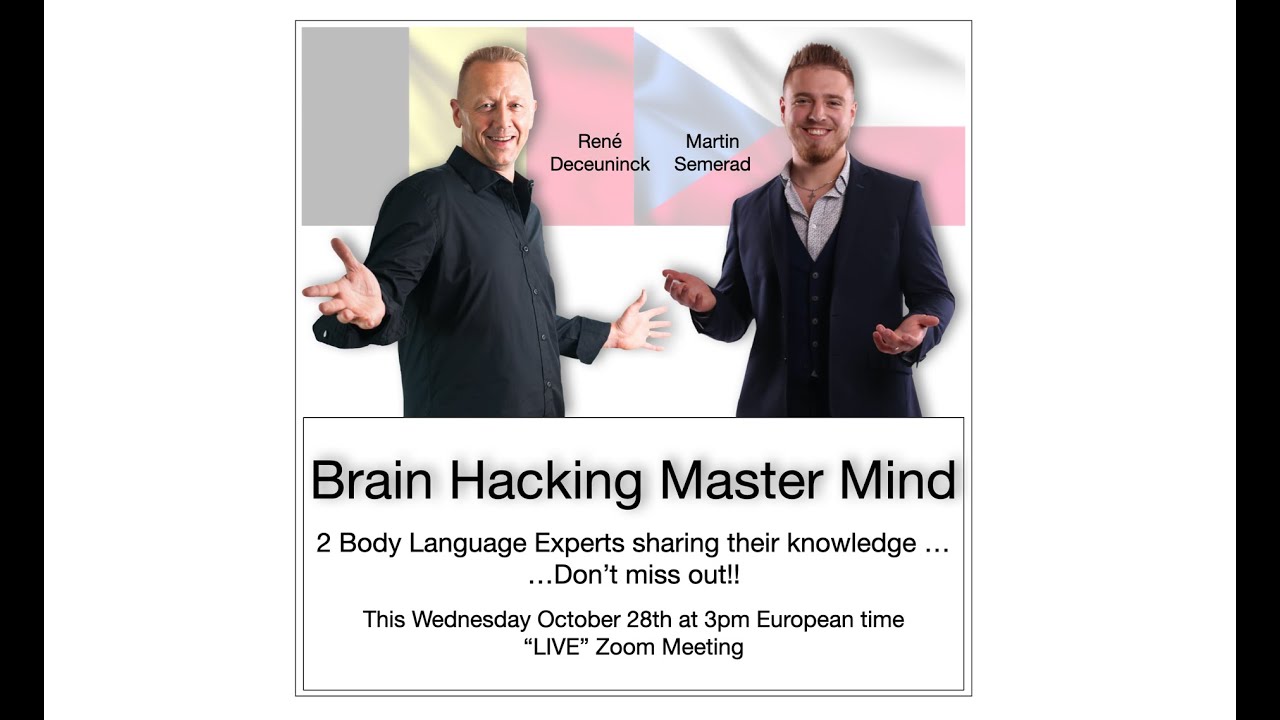
Rene Deceuninck leads a mastermind group with Martin Samoura on body language, public speaking, and trust-building. They demonstrate mirroring, eye contact, foot positioning, and micro-expressions, plus breathing techniques and presentation rituals for business and relationships.
Chapters
Recording now. Those who don't want to be in the picture, please, be in it anyway. It's going to be amazing. And yeah, I got stuck in Australia and then I was in fact flying, how should I say, I was flying to Iran, from Iran back to London, London to Melbourne, and they asked me from Success Resources, would you go back to Iran for Tony? I said, yeah, I'll come back, you can go back to Iran, no worries. But then they called me from Dubai, the organizers, don't come to Iran because corona hit so bad here. Now we would love you not to come because it's not worth it. They're gonna let you in, but they're not gonna let you out. Yeah, I said okay, no worries. So I flew directly to Melbourne to do some speaking in Sydney, and then all of a sudden no more flights, no more airplanes, no more nothing. And I said, wow. So I got stuck for 5 months, but then we did some road trips, you know, the Great Ocean Road, and then saw kangaroos and koalas and didn't see any crocodiles. I did see some snakes and spiders and stuff. It was amazing. Yeah, and then beautiful, the beautiful scenery in Australia is that you have to go. I can't explain, it's so beautiful. It's different, even it smells even different. It's, um, yeah. And then I got back and I said, you know what, I'm going to do the filming for the online training in London, went back to Oxford where I had all my stuff and then came back to Belgium to visit family after almost a year being separated. So that's a bit the story right now in Belgium and hopefully pretty soon back in the UK. But then, you know, with the corona. What about you, Martin? You're in Czechia right now?
Yeah, yeah, I'm in Czechia right now. I've been in London in March I had to, yeah, return back to Czechia because we lost our job in there and just had to get back here because—
I'm coming, I'm coming. Karen, could you mute yourself, please?
I've got to leave, I'm sorry.
Yeah, please, if you can mute yourself, that would be great.
Yeah, I'm gonna leave anyway, so no worries, no worries.
Have an amazing day.
Yeah, I'll catch you.
Record it anyway, so don't worry about it. Okay, take care. Yeah, Martin, sorry for the interruption.
No worries, it's all right. Yeah, so we just came back here to Czech Republic and we're not sure whether we will be coming back to London again. Just want to do some workshops over there, maybe next year, over next year or so. Just coming there to visit, visit, and probably not living anymore.
Pretty expensive, London.
Yeah, it is. It's quite a lot expensive.
So, and I'm curious, I mean, we're two colleagues, we were a bit in the same area, and people are joining us for body language. To have some information, I guess. I mean, how do you— I mean, if I can ask you, if you allow me, how did you get into body language?
Well, I'm in body language for quite a long time now. I'm still pretty young, and I've been in body language for like 7 years now. I think that when I was 14, around 14 years old, I find out there is something more behind communication. I don't know how, maybe in television, maybe I read it somewhere. And I just was so curious what is that that is affecting communication otherwise than just words. So I started to dig in and find out there is something like non-verbal communication, like the gestures can mean something, the facial expressions can mean something. And when— because I was very young, so I forced my parents to buy me the first book on body language. It was by James Bourke.
Okay.
I read that book like 4 times and that's my start. I really fell in love with that when I find out that it's actually that important. There was quite a long period, maybe like 3 years, I've been just studying about it, not very much using it, but after that time I find out that I can deal with people quite well. I can achieve the communication, like, goals that I set pretty easily and not like the other people. So I started to think about that and make the extra effort to find out why is that. And that's my journey to get into the body language, like, seriously. And when I moved to London, so 3 years ago, I believe, I put my knowledge and my skill to test, and it worked. I find job in like first 14 hours living in London. Yeah, yeah, it was amazing journey. And then I found this life coach, I'm still working with him, and he helped me to create like the— to start communicating this body language thing with the world. And that made me what I am now.
Oh wow, wow, that's amazing, man. That's an amazing story. I mean, I think you're pretty young, right? I mean, but it doesn't— that doesn't mean anything. I mean, it's— it's— when once you master your knowledge, I guess it doesn't matter what age you have. I have a bigger problem with people who are 19 saying they're a life coach. What do they know about life? Body language is a real science, isn't it?
Yeah, yeah.
It's like how do you— if you want to know how a car works, you know, you have the engine and the engine exists of this and this and this, and if you do this, this happens. And I mean, it's body language, it's a bit too black and white, but it's almost the same thing, isn't it? Yeah, I started my journey in 1995. I'm going to spare you the details before that. But in 1995, I took a decision to start a business in the personal development area, and I had everything in my so-called supermarket, like NLP, and I got body language, and I got health and wealth, and you know, name it, I probably had it. However, the only thing I didn't have was customers. And somebody said to me, hey, you have to have a niche. And I went, yeah, sure. And I went home and I said, what's a niche? I mean, I learned it the hard way. Yeah, I was not really educated in the industry, and, um, so, but one thing after another, past— okay, came by, and then, yeah, finally I remembered myself as a kid, always watching people, uh, always observing people. And then in the army, the same thing. Joined 7 years in the army, armed forces, uh, had an amazing time there as well, but also observing as well. And then finally I had You know, I was questioning what is it, that red line, that red fine line in your life that comes back all the time. I mean, some people said, how do you end up with body language? When I look back, you know, you got that first period of your life in between 1 and 12 years old where you accept everything, you know, whatever they say. Oh yeah, is that true? Oh wow, awesome. And why this and why that? You got a million questions. And for those who have kids, you will admit that that's the way it goes. You know, your kids have millions of questions. And you give them answers and they're like fish, you know, they eat it, they love it. But once they turn 12, 13, 14, that changes tremendously. And we call that puberty, right?
Yeah.
Some of them go through it, some don't, but— and in that period of time, we don't expect or accept nothing anymore. It's like, whatever you say, it's not. What do you know? And sometimes that goes very far with your own kids. I mean, I've got 4 kids. Tell me all about it. I mean, and what happens is that you experience life from a completely different perspective. And then once you turn 22, 23, 24, depends on who you are, what you, how you're raised, you start becoming an adult and say, hey, and I don't know about you, Martin, but I experienced in that first period, I call it the first installation of software on the hardware, And then you got a second period of software on the hardware, and then life starts. And all of a sudden I said, yeah, body language, man. And then all of a sudden that started working and I started experiencing it. I mean, you know, and also doing some things with people that I'm gonna test this, I have to test it if it's working. And then you test it, oh shit, it's working. Do you have any examples like that?
Yeah, of course, of course. I get like plenty of them. Some of them I'm not even sure if I can share them to hurt some other people that are involved in it.
All adults.
Oh yeah, yeah, yeah. But I definitely try to like— what does it take, for example, to gain someone's trust to that level that they will tell me their secrets? I worked on that for some time. I think it took me a month to get that secret out to that person, and I used like everything I knew about the communication, about body language and all that bonding. So it's more of those secret ones, and then I said it in one interview as well, but it was a great example. It's like a year and a half ago when we were with my wife in a pub in London. We really wanted one couch that was over there and some old man was sitting there and so I was thinking how to get that couch and he dropped something so I helped him to pick it up and he left. It was alright. I thought that the table and couch is mine so I sit on that couch and I saw a huge bald guy coming to that sofa where I was sitting. I was, what am I gonna do right now? So it was like, okay, I can't back up. I have to come up with an idea how to get, how to get that sofa. So the program in my mind ran, okay, so I have to have a confident body language, I can't step back, and so I like went to that fight. And when he came to me, he was like a head taller than I am. And so I was experiencing everything as I believed it is necessary to win that situation, and it actually helped. It worked. It turned out he is a Russian person who came to London because it's better life there, and we end up talking for like 5 minutes. And when he saw that I'm not afraid of him, I'm not backing, backing down. So he completely changed his behavior. He dropped this intimidating body language and he was all friendly. So that's the huge experience I had, the power of body language, when I actually didn't believe that that much, but the body language did its job properly.
Yeah, so would you agree that when you use body language, I mean, for those who are attending right now, This is very important. If you produce a certain body language, you're producing a certain energy as well, I guess, and then you send it out. What I learned in the past is that these are, you know, numbers. Numbers are very, you know, just numbers. It can be more, can be less. But I learned that 40 bits of data has been transferred in the conscious mind, what happens in the moment. So the taste and the hearing, the seeing, and then the touching is 40 bits of data per second is being transferred from one person to another. Whereas, whereas the nonverbal communication, which including intonation, body language, the whole thing, is 40 bits— 40 million bits of data per second, which is a million times more. And that started me thinking like, hey, this is an energy on a certain frequency that you produce and project, and then that is processed and the other person comes back to you. And, and, and somebody said to me, yeah, that's why the outside world is in fact a reflection of yourself. And I said, wow, this makes sense. I mean, because you produce and you send it out and it comes back. Why are you surprised? I mean, if you're angry, angry will come back.
Yeah, it's a great principle.
Yeah, I mean, so, uh, what should I— what can I ask you? Did you, did you, did you have any experience, like life experience, in an audience that you say, hey, I had an experience I will remember for the rest of my days?
You mean like while public speaking or?
Yeah, like in public speaking, like you're invited to go to speak on a stage and there's like a room with, I don't know, 5 people or 1,000 people, doesn't matter, but where you had like an interaction with somebody?
I have only a positive one. It was my first speech in Prague. It was like the manager team in a company I used to work for. And it went really great. I was preparing quite a lot for that speech because I've been nervous. Obviously, it was my first speech. So, but they were so supportive that I will remember that for the rest of my days, I think, because not because of the bad interaction, but because of the good interaction. They were really like great people to support me on that journey. Even if I didn't admit that it was my first speech, they were supportive anyway. So I will probably remember that.
Yeah, yeah. So Jennifer is asking, I'm curious if there is only one thing we can learn from body language for business, what would that be? That's a good question. For business, what would that be? One thing. You can learn a thousand things, but one thing. I don't know, what would your advice be?
I know, I mean, biggest one thing is facial expressions. It's It's a great tool, especially in business. It's a very comprehensive one, quite a difficult one, I think, but it's very valuable once you master that.
You mean the micro expressions?
Yeah, micro expressions, facial expressions at all. The micro expressions are like even more advanced than—
What I learned from business, for example, is that so we have a right brain and left brain. And the right brain is connected with the left eye and the rest of the body, right? You would agree, right? And then the left brain, so the right brain, the left brain is connected with your right eye and the rest of the body. So the right eye is your rational eye, your left brain is your rational brain, right? So what I learned is, and it's working all the time, is that when I speak with people about business and we are talking about emotional things, I will slightly turn to the right and show my left part of my body and look with my left eye in their left eye. And why is that? Is that because if you look with your left eye into the left eye, you're in fact connecting the right brain with the right brain of the other person. And that's about emotional things. And when it is about business and agendas and stuff, I would turn slightly to the left and show my right side of my body and look with my right eye into their right eye, which is connecting the left brain with the left brain. And what I experience is that the results, the outcome, is completely different because you're connecting the correct brain with the correct brain. You're talking about rational things to somebody who is listening in a rational way, and then emotional, emotional. And, and how did I remember that? I mean, I love cars. I don't know if you love cars, but I love cars a lot. I mean, in love with Aston Martin lately. But, but what I mean is that— how shall I say this— is that Rolls-Royce, the logo of Rolls-Royce is RR. So your right eye is your rational eye, and the rest is history. You know, right, right, right, rational, Rolls-Royce, and then left.
It's a great mnemotechnic.
So if you remember Rolls-Royce, the rest is history. And that's what I learned. I mean, Jennifer, is that an answer to your question? Would that be— maybe, yeah, confirm on the chat. So a question from, from Deep. Hi Deep.
Yeah, that was great. Thank you.
All right, so Deep is asking, how can we gain greater trust or connection in our more intimate relationships using body language.
I'm just making notes, which is why I keep looking down, by the way.
Yeah, no worries, no worries, no worries. This is good. I mean, I love it like this, people having questions. I mean, and is there anybody like Nikki, Mitra, Alan, if you have questions, please shoot. We're here to learn, and even me, I'm still learning. Simone as well, Jennifer, if you have more questions, please shoot. Yeah, how can we gain greater trust on connection in our intimate relationships using Body language. Yeah, good question.
Yeah, it's a good question. People ask me.
Do you have an answer or?
No, no, you go first.
Okay. What I would advise, my advice would be is that be yourself. I've got a lot of people saying, hey, you can fake it until you make it. That's true. I even posted a while ago Angela Merkel, from Germany. I don't know what her position is called. It's not president, but she has a hybrid position in Germany.
Angela Merkel, prime minister, something like that, maybe prime minister, yeah, or counselor.
In fact, but she's always standing like this, always, always. So there was a picture on the internet, I just copy-pasted it and put on top. Stop, stop playing with super glue. I mean, she's always like that. The thing is You can fake it until you make it, but in the long term, you're lying to yourself and the other, and that could create a bomb that explodes, and you can't, you can't repair things anymore afterwards. So what I have people say, what body language should I use? I said, none. Be you.
Yeah, and, and post about it as well. On Instagram, I posted about that. You have to be yourself, you have to be genuine in your expressions, because when you're faking something, it can't work. People will feel it.
And it can work. I mean, um, a gift from Zoom.
What's that?
Running out of time, we're promoting 40-minute limit. No, no way, not interested. Um, what happens is that when, when, when— if the one— and I'm talking about intimate relationships— If the one is not accepting for what you are, who you are, how you look, that's their problem. That's how I look at it. If I am naked with a woman and she doesn't love me because I have two long toes and I have this and I have a belly and I have this and I have that, which is not true by the way, but I don't have that neither. Listen, if they don't love that and your relationship is based on that, get rid of the relationship, I would say. Yeah, that's my advice. I mean, and body language is the same. I mean, you can fake it and play some show in the beginning, but be aware that you can't continue doing this. Does that make sense?
Definitely.
And people are— yeah, go ahead, go ahead.
Yeah, I'd say that it's completely like You can't forget about being genuine, but also thinking about what to get to the other person. I mean, be aware who the person standing in front of you is. Give them full attention that you can give them. I'm teaching in my courses that you have to direct all your body to that person that is standing in front of you, because if I will be sitting like this and talking to you over my shoulder, you feel that something is missing, that I'm not paying you as much attention as I could. Yeah, so I say pay 100% attention to the person who you want to get trust of, and you will experience changes in that relationship because your attention will not be shattered by anything else.
I saw that in one of your posts when one foot is pointing away. That means the person wants to leave in that direction where the foot is pointing to, even though your body is faced to the person. If your foot is pointing away, that means you're not fully attentive. You're not 100% there. Yeah.
Right?
I think that was one of your posts, right?
Yeah, yeah, it was. I experienced that maybe like 4 years ago when I was at home recovering from my injury and 2 of my friends came to visit me. And they were secretly involved with each other and they didn't want anyone to know it. But when they were sitting like opposite each other, it was like triangle. It was me, her, and him.
Yeah.
And their bodies were to me, like directed to me, and their toes and feet were to each other. And that was the first clue I got that there's something going on between them and As I said at the beginning, that month took me to get from him that they are actually together.
So, and for people who are having a hard time looking at somebody in the eyes, for example, if you say you want full contact— you want not full contact, you want full attention. What I mean about the eyes is that if you're not really safe and secure looking somebody in the eyes look into the third eye and they will have the impression you're looking in their eyes. And you can test it, test it with somebody and look really to the third eye. If you don't have a problem looking in somebody's eyes, that's a different thing. But if you really— if you say, I'm not feeling comfortable, blah blah blah, third eye, they will always have the impression that you look in their eyes.
Yeah, exactly.
Yeah. Simone What are good hands to have in client meetings, speaking, and such? I feel like this often shows my insecurity. I often use the position of the feet to see if a date is interested. Okay, the first part, what are good hands to have, what do you mean, how to hold your hands? Is that what you mean, Simone?
Yes, exactly. I often feel like I start like doodling with my hands and, you know, like these insecure movements. And that kind of takes away from what I'm trying to say. Yeah, so how do I have like calm hands while speaking and that kind of stuff?
Yeah, I think that—
what would your advice be, Martin? Yeah, go ahead.
Calm hands are those ones that are not moving when they don't need to.
Yeah, I mean, when you have your hands like this or thumbs in or thumbs out, or most of the time I would hold my hands like this, one on top of the other and done. And as a position of being calm, being at ease, not nervous, no anxiety, no, I mean, yeah, holding your hands like this. And if you have to present, do a presentation of something, hold a pen in your hand or a clicker or whatever, something that you have. If you look at the weather presentation on telly, most of them have a clicker in their hand. And do you know they don't click? There's somebody else clicking for them, but they have to have something in their hands so it doesn't look—
so they feel better. It's also comfortable for them to hold something. When you're presenting and you hold the pen in your hand, it's like soothing you. You can play with it, so the excessive energy goes to that pen and not to some useless movements that Onur is telling. That you are nervous.
And I'm going to add something. 25 years ago, they said that the exact same thing. Hold a pen in your hand, and if you don't— if you forgot something in your speech, drop the pen and then look for it. It will give you time to think what you should talk about.
That's awesome.
Oh my God, that's amazing advice. So Simone, and for your hands, and then I often use the position of the feet to see if a date is interested Could you explain that some more?
Yeah, because actually the thing about the feet, I have a background as a dancer, so body language is something that's very important to me and that I always use. So whenever I'm approaching a person and I'm interested, I've always used their feet to see if the interest is there as well. And also if we're on a date and I'm not sure about the chemistry, I always go to see the feet and I know if the feet are pointing away, then Yeah, we don't have to order dessert.
I do hope you don't focus on the feet only.
No, I don't. I also look in their eyes. Just every now and again.
It's too tempting.
I mean, and if you want to check how is your date doing, touch them. Like accidentally touch them. They used to say that you have to touch them while you are sitting to to touch with the knees, and when they like back up, back down, I don't know how to say it properly in English, but when they will stay and touch, when they will stay in touch, it means they are into you, and when they will like go away, it means they are not very much into you.
Oh, look at that.
Thank you.
I'll have to remember that.
I didn't know that. Yeah.
Is there anybody else? Deep says, I must remember to check my day's feed. Yeah. So is there anybody else that has a question? Please shoot. Nikki, if you have a question. Jennifer, I found another question. Alan. Maybe if it would be good to ask a question and we're not that many people here. I don't know how many people We are 9 people, so minus 2 is 7. Is there something that you say body language for me is important in that area in my life? And if you want to answer the question, please unmute yourself, otherwise I can't hear you. Is there anybody that says, yeah, for me body language is important because— tak tak tak tak.
Nobody?
Nikki? Yeah, go ahead, Nikki.
You're good.
I have to unmute you. You're muted.
I'm on mute myself. Thank you. Because I'm in sales, so body language is extremely important.
Okay, and how would you— what are you paying attention to in your sales?
Um, in terms of body language, it's about how they receive me. I always look at them straight in the face because that's in the eyes, because it's a direct thing. I always mirror what they're doing as well, and it doesn't necessarily have to be in the poses that I do— they do as well. It's the way they speak and the language that they speak as well, so that you mirror everything that they're doing to make them feel more comfortable with you so that then you've got their attention. And I agree with the thing about when somebody looks away, that is definitely, you haven't got their— you're not going to get a sale then. You're definitely not going to get a sale then. But it's when they're into you and you understand, you've got that almost like tunnel vision, that's when you know you've got the sale, so to speak.
Yeah, yeah, yeah, that mirroring thing is very important. That's one of the things that we teach as well, and Martin, I guess you teach that as well. The mirroring, taking, copy-pasting someone's posture and then copy-pasting again, again and again, and before they change, you change. If they copy-paste you, you got a connection. And that is a certain way of doing it. Yeah, Nikki does a very good—
Drinking a cup of tea. When you've got a drink in your hand and you both drink at the same time, you've got a connection.
We're connected. Yeah.
I will join you, I want to be connected too.
It all gets connected. Yeah, I've got a question from, from Jennifer. When you are speaking on stage, what's the best way to engage your audience with your body language? That's a good one. Martin, do you have anything you want to share or How to engage? I mean, I know I can talk about this for 24 hours.
Yeah, yeah, it's pretty easy to talk about it, but picking the right information to share, it's a bit difficult. But I think that again, being genuine is very important because when you are, for example, observing Gary Vaynerchuk speaking on stage, he's not very good with the body language and yet he is getting all attention of people. He's hiding his hands in the pockets, he's crossing his arms, and I would never recommend people to do that, and yet somehow he is still getting that attention. So I think that having this strong personality charm is very important, and it's not coming without any training, without confidence, without knowing exactly who you are and what you are bringing. Into that presentation.
Yeah, exactly. I mean, what I would add is that know what you're talking about. Um, you're in body language for many years. I'm in it for the last 25 years in this industry. I mean, we do know what we're talking about. Um, but if you know what you're talking about, if somebody would call you, can you do presentations in 5 minutes from now? Yeah, sure, born ready, you know. And that is a very important, very important thing to do is master your stuff. And then the second thing I would add is that how can you get attention of the people is asking questions. I used to say, who among you? And then I've got somebody said to me, no, no, no, this is wrong. You have to say, how many of you? I mean, to have the full attention of the room. That was a mistake I used to make for many years. Who among you? You can answer my question, and then you got 1 or 2 people. And if you have 1,000 people in the room, you say, how many of you? I mean, you see like 300, 400 people raising their hands when you have a couple thousand in the room. And that's a huge difference, is asking questions. And which questions? Open questions. The why, what, where, who, we, you know, people can't answer your questions with a yes or no. They have to come up with a story. And when they come up with a story, and storytelling is selling. I mean, there was Shimoni Deep. Do you remember what Shimoni said? Make them cry and they'll buy.
I do that all the time.
I mean, what the heck, doesn't matter. But to be honest with you, Jennifer, to how what would you do to engage your audience is ask questions, and questions related to your topic. Sometimes you can ask them questions that have nothing to do with your topic, but then the aim of that question should be waking up these people. I mean, I used to do a lot of presentations for Tony, and one of the questions was, how many of you love surprises? Raise your hand and say yes. And everybody raised their hand and said yes. And I said, bullshit. And they were like, what? And that— why do I say bullshit? Is to, is to show that shock effect, you know, to say, hey, bang, this is not working. And they go like, what? What is he— what is he talking about? I say, you love the surprises you like. The other surprises you call problems. Is that right? And everybody said, oh yeah, yeah. So how do you— to come back to your question, Jennifer, is when you're speaking from stage, which question— how do you engage your audience? Make sure you're well prepared. Make sure that you prepare upfront. And before going on stage, what I do, I meditate. I don't know if there's anybody that can relate to this. I mean, Mitra, you, you can really say, hey, yes, this is a good way to do it, or would you have different advice on this?
To having some kind of ritual, I think it's important. For— I believe that for me it's meditation as well. It really helps me to calm down, but I know people who, for example, are doing handstands before they go to do something that's challenging for them. I used to be one of these people as well until I found meditation. So having some kind of ritual that is charging you with energy, with confidence, it's important to have and perform it every single time you need to be confident.
Yeah. Now the kind of meditation I do is breathing exercises. Mitra, you, you do know a lot about this, right? Mitra, if you want to engage, feel free.
Yeah, yeah, no, absolutely. I think, I think some quick mindfulness tips are really, really good because I remember in my younger days I would say, I am, I feel, I do, I love, I speak, I see, and I know. So I'll just go through one by one. I am, I feel, I do, I love, I speak, I see, and I know. These are the 7 chakras. And, um, and that will just channel me. The, the, the energy would just go around and I'm just in the zone and bring the precedent. And I will talk like, boy, there was no tomorrow.
Yeah.
But there are some small, um, phrases people use, which we call mantras, which can, you know, keep you in the zone. Or yes, breathing, you know, you can make a pattern, um, or, you know, look at your own third eye and see you are right here, right now, and you can take on this world. And so yeah, meditation, absolutely.
Yeah, yeah. But I went, I went to, um, I visited a lot of temples, Hindu temples, Buddhist temples. I mean, I've been around the planet. My experience with monks is that they said the first thing they learn in school in order to become a monk is for 2 years learning how to breathe. Because Martin, you would agree with me that there's so many things that have an influence on your body language, and it's that body language that attracts the correct people towards you or pushes them away from you.
Yeah.
And yeah, what I learned is that also breathing— if you're angry, your breathing is different. If you have fun, your breathing is different. If you if you're crying, your breathing is different. And going on stage, I learned from Tony as well, is to do some power moves. So you have your meditation, some power moves, and then you go on stage and go, and everybody, what? But then, yeah.
So, uh, simple one, you know, when we're anxious, we breathe through our chest.
You'll see it.
But if you want to immediately relax yourself you do a belly breathe, you know, just breathe into the belly. Yeah, there's a very scientific reason to it. You know, when, when, when a child is born, the child is attached to the mother through, through the cord and, um, and it breathes through that. See, all of a sudden, you— if you see a little child who's always happy, breathes through the tummy. But as we grow up, we start breathing through our chest because we're always on the edge. And the more we— so that's called shallow breathing, and that's how the shallow thinking. But when you're calm, you breathe in your belly, and immediately you'll calm down. Immediately. And that's the child effect of it. You will never see a child breathing through their chest. They're always breathing through their belly.
That's so correct. I learned that from my mom. She used to sing in the opera. And I love, yeah, I don't know if you guys love opera, but I love it a lot. I mean, I love AC/DC too, you know, don't worry. But I used to watch Pavarotti and Plácido Domingo and all these opera singers, and you can literally see them, Mitra, they're so correct, you can see them breathing through the belly. All these opera singers are breathing through the belly, they're so correct. And it has an influence on your state, and it's that state that will produce a certain body language.
Also, when you're breathing to your chest, you are getting nervous, and when you are getting nervous, your immune system is dropping on its efficiency. So it means that when you are breathing to your chest, you are sick more often and your thinking is not that clear as it should be. So there's a reason why to learn also breathe with your belly.
Yeah, um, I'm driving. What were the chakra affirmations again? John Harrison. Uh, John Harrison, I would like to introduce you to Mitra, who is a specialist in, in mantra and chakra and mantra and things. I mean, Mitra, does that— that's correct what I'm saying?
Yeah, I've put, I've put the chants down, down, uh, under his question.
Okay, awesome. Uh, guys, if, if, if you want to download this chat, on the right side, if you click on the bottom of the screen chat and you click on it, you'll see that on the right side there's a chat box, and in that chat box there's 3 dots on the bottom. If you click on that, you will save the chat for you. So if you say, oh, I want to, I want to keep that information, um, click on the 3 dots and, and save it for you for later use. Um, Martin, if there's one advice that you would give to someone in this group, because we're going to record this, we're going to put it on social media as well. If there's one advice that you would give as a, as a body language expert, what would it be?
Be present and look at people around you and feel people around you and react to what you see, what, what you see, what you feel. And not what you think that you see, what you feel. Like, being actually present is, I think, very important for being a good communicator and also being good with body language, because when you are reacting to what you think you see, it's a problem. There are a lot of misunderstandings are happening there. So you have to, like, get rid of that middle step of thinking and seeing, reacting. Observing, you see that the person is nervous, and it's better to start working with that information right away and not to start thinking why he can be nervous, because there is no chance you can find it out. You can't see what's in his head. You just can't figure it out. So work with the information you can see right away.
Yeah, yeah, exactly, exactly. It's a very important one. I would add, ask questions to define who they are. And so I use it for basic characters, not more than that. I mean, there's millions of studies about it. The 4 basic characters is somebody's a team player or a solo player, they are extrovert, introvert, or emotional and/or rational. And when having that or asking these questions, I can find out if, say, for example, if I'm talking to a rational person who is a solo player and very calm and soft in the way they speak, what I would do is level to that level of being speaking the same language, if that makes sense. So if I would say I'm a red one and I'm talking to a green one, I would talk green language and not my red language. And what happens in the end when you leave, that person will say, oh wow, that's the first person who understands me. Also, depending on the situation, I mean, in a relationship you have to be you, right? But if you're in business and you level, right, and you can even have chats even in a relationship, if you, if you level, you can have a chat about it with your, with your spouse or with your husband or wife, whatever. Hey, You know, do you know what I just did? I was leveling. You know how that works? I really want to be on your level. I want to know how you think. Because so many people don't level in relationships. They don't level. They all me, me, me, I, I, I, and the rest, yeah, that's for tomorrow. And tomorrow never comes. We all know that. So I would add that being so important, be present, be in the moment. Hiya.
Just another one of these sheets please, horizontal grain.
That's your previous today I think. John, can you mute yourself please?
You can mute him, you can mute him from your right here.
You should be able to mute it, right?
Yeah.
Participants.
Go to more and then.
Yeah. John.
Yeah, it's gone.
Oh, it's gone, it's gone. Yeah, sorry, John, you were something, uh, saying something about a certain place. Anyway, but what I would say is that, I mean, find out who they are, level, level by, uh, what Nikki said is, is about mirroring. That's also a way of leveling. Uh, ask questions, make sure you're speaking the same language. And if, if you're in a relationship and you really want to have that very important high-level and end-level relationship, have chats about it. I mean, don't be shy. It's your partner, for God's sake. If you can't have these conversations with your partner, get rid of that part, I would say.
That's right.
Anyway, don't get rid of your partner right now because I said so, but yeah, that's what I would Well, my advice would be as well, and follow what you said. I don't know if, sorry, I'm driving, then I'm feeling, oh, Mitra, thank you for sharing that. Okay, thank you, Rene Deceuninck. Okay, Martin, you're in business, right? Yeah. Yeah, because as I see it, it's 10 minutes to 4. I would like to ask, is there anybody else, sorry, and welcome, by the way, is there anybody else that has a question for Martin or for me? Bring it on, don't be shy, and remember to unmute yourself. I think we have a question moving.
I was, I was feeling into a question that was just coming to me, which was just like, how can you feel a sense of someone's being like genuine with you or not? Or like, can you pick up signs of on other people, like how— I don't know, like I'm just thinking like if something's off. I know intuitively we might pick that up anyway, but just curious.
So to find out if somebody is genuine with you?
Yeah.
Yeah.
Or if there's an authentic connection happening or something.
Yeah, Martin?
Yeah, I think that like the metaphysical one is that you feel it's right. But more analytical approach is that their words are matching their body language. When there is a congruency of that person, when you feel that he is saying and he is doing exactly the same thing, that person is genuine and it's worth to be with that person. But when he's saying "I love you" and he's not saying it with his body, with his nonverbal communication, which in this case, for example, is about 90% or maybe more, that person is fake and he's not genuine with you. So be aware of the differences and the same things, you know, between nonverbal and verbal communication.
It's like if they would say, I love you.
Yeah, exactly. Or I love you.
Yeah. What I would suggest is that Again, I'm always asking questions. Um, when people are answering your question, an emotional question with an emotional answer, but they look the wrong way, for me that's a red flag. I mean, if you look to the right, that is a construction of something. Looking to the left, in general, it's far more specific, but in general, if they look to the left, it's a memory to sort of remember something. So if you ask an emotional question which is connected to memory and they ask— and they answer you with a rational answer, a construction, for me that's a red flag. And that's for me also the beginning of more than one question, because you can't base your analysis on one question, one answer. Because sometimes you ask, hey, how was your trip to Egypt? And you got so much on your head that day and you're trying to make construction, although you went So it's not always 100%. Would you agree, Martin?
Yeah, yeah, definitely. Like long-term observations.
Yeah.
And so when people look to the right and they answer your question, they're making a construction to the left. And if you have 6, 7 questions and 7, 7, 6, 6, 7— am I— I'm not this length, by the way. 6, 7, uh, red flags. That means watch out, because the rest of the conversation you'll pay attention to the body language as well, to the feet. I mean, and start with the feet always, because the body parts, the further away from the brain, are less controllable. So yeah, and I mean, if that makes sense, the way people are looking. I've got somebody, a lady in Brussels, she asked me for some coaching. I said, okay, what's going on, what's up? And she started talking, and I asked her a question, and she looked like this way down, which is an internal dialogue. And she answered my question so slowly that I knew she was thinking about other stuff. You know, my husband is going to be late, I have to pick up the kids from school, and I have to make dinner, and television is broke, and I have to call the plumber, and it goes on and on. I mean, ladies, the difference between men and ladies Read Venus and Mars, you'll find out ladies can do a million things where a man can do one thing. I mean, there's some men can do more than one thing, I mean, but I mean, and, and they're thinking about— and that lady, she was actually doing this, and I smashed my hand on the table like bang, and she went, whoa, what are you doing? I said, I'm waking you up, what are you thinking about? And she says, how do you know? I say, who's the coach inside here? But she was thinking, and she admitted she was thinking about a thousand things Answering my question, they're very slow. So if you are talking to somebody and they look left down for you, right down, right, they're busy with internal dialogue. That machine is running, the computer is running, and they will answer your question, however, on a very slow tempo.
Just to add, I mean, this is so interesting, both of you, both of you together. Fantastic. When you started, Rene, you talked about the energy. Energy field as well, and, and, and how we exhibit energy. And just coming back to the, um, something else can be tried as well. And you look at the, from the spiritual point of view. So if you go and meet someone and if you start being skeptical or judging right from the start, that negative energy will exhibit as well. So if he goes to somebody from the feeling of love and openness, they will instantly catch it. But if you're on your guard, you know, it's a non-verbal signal that goes on. So same as the chakra system, you know, we vibrate a certain energy level. Every chakra vibrates at different energy levels. So if you're coming from the heart, it's 419 Hz frequency. So if you want to relate to the connection of love and you start with the thinking, oh, he's gonna cheat on me, oh, he's bloody doing something else in the corner, then it's, it's the start itself has broken it. You just jump into it, and, and if the other person is not to the mark, it will, it will happen one way or the other. So yeah, just to complement Rene and Martin's theory.
But awesome, man, awesome. Thank you for that. That's, that's really important. That's valuable information. Thank you, Mitra. Um, Martin, we'll have to, uh, wrap it up a bit. Um, we're almost an hour, uh, here online on the Zoom. Martin, if, if, if people would like to find you and, and, and learn from you, how, how can they find you?
Probably the best way to find me is on Instagram, which is semerat/martin. And this is my main platform. I have all my courses posted there, all the information I'm posting. I am primarily posting it on Instagram, so I can send a link to that chat if you want to. Yeah, that would be great. Yeah, yeah, yeah, that's the main way how to find me.
Please share, share the link in Instagram. So most of your information will be found on your Instagram profile, and then people can take it from there and get in contact with you, right?
Exactly, yeah.
Awesome, awesome. You have a website too?
Sure, sure, it's martinsamoura.com.
What do you want? Easy peasy. All right, if you want to learn from Martin, please go ahead and find him on Instagram and on on his website. And for me, it's the same thing. I don't know if everybody heard it, but in the beginning from the presentation— and I see Stojan Novakovic, he says, thank you guys, sorry for coming late, I hope there will be full video. There will be a full video for those who are still here. There's a full video, I'm gonna put it online later on. Context and situation, most important in my opinion. Exactly, man. So correct. So what I— where can you find me? On my website, rene-deceuninck.com. It's the same as yours, Martin. And then Gary Vee one day said, how many platforms should you be on in this industry? At least 10. Said, don't worry, I'm on 24 different platforms. So if you can't find me, you definitely have a problem with your Wi-Fi. So if you want to know more about what I'm doing, what I can offer you. There's online training, there's offline training, there's all one-on-ones. There's, I mean, check my website, you'll find out. And hey, Martin, thank you so much for joining. I really appreciate that. Thank you very much for having me. Yeah, no worries. I mean, I feel great to me to have at least a chat with a fellow speaker in the same industry. I mean, the same field. Yeah, always. Yeah., and who knows, in the future we'll do it again, but a bit more specific into body language. What do you think, Martin? Would that be—
it would be great. Yeah, I really enjoyed that, so we can do it again.
Awesome. Hey guys, thank you so much for joining us. Um, I'm gonna share my website too. Um, and if you find— if you can't find me, if you can't log in, whatever, Google my name, you'll find it. There it is. So for those who want to save the chat, click on the three dots. It's yours then. And for those who want to take contact with Martina or with me, please feel free. Don't call us in the middle of the night to say you can't sleep.
Never would that anyway.
Never know what could happen.
No, you call Mitra for that.
Awesome. OK. Guys, thank you for joining. It was an amazing afternoon, 1-hour Zoom, and I really look forward to see all of you in our next Zoom. And yeah, thank you for being here.
It's really great. Thank you very much for coming, everybody.
Thank you, guys.
Appreciate you.
Thank you so much.
Thank you.
Bye-bye.
Thanks very much. Thank you.
More from Rene


What are ... The Silent Language of Connection and the Hidden Power of Non-Verbal Cues?








