How do you build an Online Training including the right Body Language?
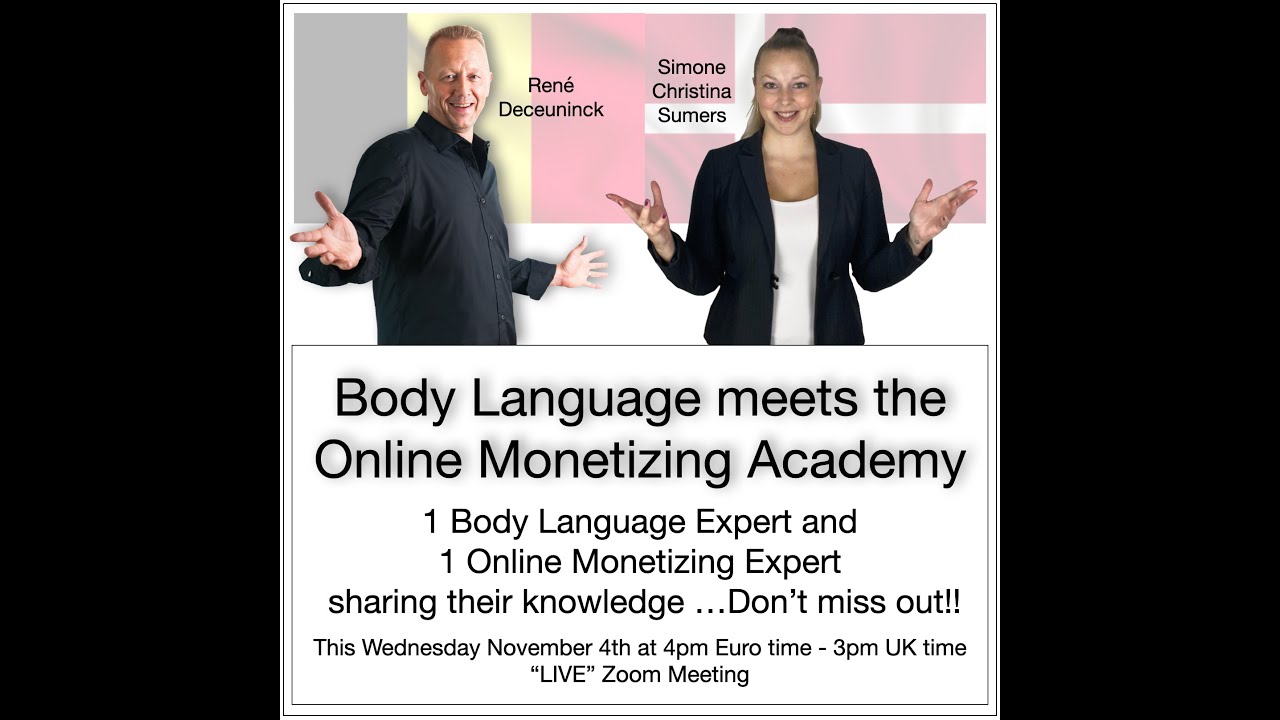
Body-language expert Rene Deceuninck and business coach Simone explain how to build and sell online courses. They recommend a simple setup (smartphone, cheap lights, microphone), stress selling before you build, and detail body-language tips for camera: eye contact, open hands, natural posture. Simone uses Kajabi for hosting and Zoom for live Q&A.
Chapters
Well, Simone and I had a chat about doing a webinar about either body language and then the online trainings, because today more than ever online is the main thing. This is recorded, so we're gonna put this on YouTube and the other channels, Facebook, and Maybe Simone, if you would like to introduce yourself first. Who are you? What do you do? Maybe Janet and Mitra do know you already, but we're going to publish this, so a lot of people will not know you. And it's very important for people to know who you are, what you do, why you do it, etc., etc. So up to you, Simone.
Yes, thank you so much. So my name is Simone and I am I'm a certified life and business coach, and I am an online business coach because I help you take your business online and to the next level. In a world like this where there's constant lockdown and everything has to be online because we can't meet up, if you haven't already made the shift to go online, it's a perfect time to do so. Especially, I see a lot of coaches and a lot of my clients that have this, they keep coming to me and say, Simone, I keep telling my clients the same thing over and over again. So instead of wasting your time, sorry to say, repeating yourself to your clients one-on-one, then you might as well take all of that information and put it into a really great online course. Because that way, you can say it once recorded and share it out to a lot of people. And that way, the time that you actually do have with your client is so much more valuable and potent. Because that way the client has already been through the basic works and then you can help them get way further than you could if you're just working one-on-one. And also a lot of people are not ready for the big commitment and the big change that it entails to work with a coach one-on-one. Whereas if it's an online course, you can just kind of dip your toe a little bit and figure out, is this for me? Is this not for me? So there's a lot of great options with going online. But most of all, Yes, it takes time to create the online course, but it will help you create so much more freedom and money in your business. Because let's say you write a book, you can sell that for like $20, $30 per book. But if you create an online course, it actually takes less time and less effort, but you can sell them for hundreds or thousands of dollars instead. And, and also it's an easy thing to upsell with some coaching hours or an extra online course or something around it. So if you haven't already implemented the online side of your business yet, I highly advise you to do so, and there's no better time than right now where the world is in and out of lockdown.
Exactly, exactly. And I've done it as well, so I'm very excited about it.
Yeah.
So my name is Rene Deceuninck. I'm from Belgium originally, living in London and traveling the world with my body language company. What we do is that we teach the secrets, the knowledge, and benefits of body language worldwide. I've been working with Tony Robbins, I've been working with, you know, the bigger names, Les Brown and Robert Kiyosaki, Jack Canfield, Brian Tracy, since the last 25 years now. And doing this, traveling the world, due to the pandemic that came up, I had to go through a mind shift. And what happened in February, I was in Iran, from Iran traveled back to London, London, Oxford, Oxford. I went back to Iran and I got the message, hey, don't go because they're going to let you in, but they're never going to let you out because of the pandemic. Beautiful country, by the way, don't get any different. I mean, I love that country a lot. The people are amazing, the food is amazing. I mean, what they tell you in, in, in the media is, is rubbish. But anyway, and then I went straight to, to Australia, and the purpose was to do 3, uh, 6 previews for Tony, Tony Robbins, in, uh, in 2 in Brisbane, 2 in Sydney, and 2 in Melbourne. And what happened due to the pandemic as well over there, they got— everything got cancelled. And luckily enough, I had friends over there and some close friends that really took took very good care of me, but I got there, I got stuck for 5 months. If you can say stuck because it was not really stuck. We had a great time. But yeah, and that was for me a mind shift. I had some chats with fellow speakers and say, Rene, you got an amazing niche. Why don't you put it online? I said, yeah, yeah, sure, sure, online. And I was like, oh my God, I'm going to do that. So I started thinking, how can I do this? Do I know some people? And I do know some people. You know, I've been teaching in Oxford, Oxford Business College, Brookes University in Oxford. I got enough, my network is big enough, but I said, you know what? And finally, long story short, ended up with the photographer that did all the shoots from my body language book. And I said, Alex, what do you think? And he said, okay, let's just do it. And we did the filming. And if you say, is it complicated? It's not really complicated. It's, I think it's rather taking the decision to do it and then finally do it, because once you did it You go like, wow, I should have done that far more earlier, you know. But it's making that leap of faith. I call that leap of faith, that step that like, hey, I'm gonna do it.
Yeah.
And now I'm, you know, I'm not different. I'm a human being just like anybody else. I'm like, yeah, I have to do it. Yeah, yeah, yeah. And then postponing it and postponing it until the moment you did it and you go like, wow. So yeah, but in that process, it's an amazing process of the filming itself, the body language, because I teach body language body language, but then you have to watch out your own body language in front of a camera. And that's what it's all about today. But maybe you can give some advice, Simone, about how to do that. Maybe more the more technical part because it's body language, but also the technical, the platform, what you use, how you use it. Maybe you can give some information about that.
Yeah. So I use the platform Kajabi for for everything in my business, to be honest. For me, it's a perfect platform because it's my landing page, it's my sales page, it's my sales funnel. I have my payment system in there. I even have email systems, the automated emails that go out. I have everything in there so that I don't need to be spread out across like 20 different platforms like I used to be. I used to have a homepage there and then a payment system here and then a shop there. And it was, It was a mess. And Kajabi is just amazing because you can have all the online courses there. You can have your freebies, you can have opt-ins, you have all these kinds of amazing things. And most of all, it helps you automate as much as possible. And it actually helps you often create a lot of the text. So you just have to add in what product it is, what does it do, who are you? Because for me, that's like, we actually just talked about this.
When you're a business owner and an online business owner, you write so much text.
There's your homepage, there's the emails, there's the social media, and sometimes you're just sick and tired of writing. I know I am.
So having that delivered to me from Kajabi makes it worth even more than it already is. Because first of all, yes, I have my entire online course automated in there.
I don't have to do anything. Every Monday, new content drops and they get emails and status updates and everything. But, but that everything is gathered in there and that it helps me create these emails.
Oh my Lord.
Yeah, that's amazing. I really appreciate it and enjoy it. And then I have Zoom on the side where I have my weekly Q&A calls with my students or my clients. And to be honest, that's all I need. I have my— yes. And then I have Calendly, obviously, to book calls. So with Calendly, Zoom, and Kajabi, I'm good to go. So yeah, it's amazing.
I'm super, super excited about Kajabi. And in the beginning it was like, should I, shouldn't I, should I, shouldn't I? Because there's a price attached to it as well. But if you organize it well, you got that back in less than 2, 3 months, you got the money back. And it's, yeah, it's, you know, once I signed up, once I started making these things, are creating these things. I was like, wow, super excited. I work with Wix for my website, and then on Wix, if they click on certain things, they get redirected to the same system, Calendly. Or for those who don't know Calendly, Calendly is an automated agenda and it works perfect.
Yes.
Across time zones even, which is so important in a time like this.
Oh yeah.
Yeah.
And then Kajabi as well. If they click on get this, grab that, grab your bonuses or whatever, they get redirected to the system of Kajabi. But what I learned about body language in terms of— try and correct me if I'm wrong— that is, that is very important to people. Say, yeah, but Kajal, uh, body language. Oh my goodness, body language, body language. Um, that's the most beautiful proof you don't have to be perfect to do Zooms and recordings. Uh, the, the, the body language that is, is, is, is only for life, or when you see somebody Really, for real, but that's not true in online courses and trainings and Zooms. Your body language is so important to really watch out what you do, how you do it. Yeah, the only advice I can give is that be you. People ask me, what should I do? I said nothing. Be you, be natural, make sure you're well prepared, don't fake it, right? Because by faking, you create a certain energy and you send it out on a certain frequency, it gets into this brain of that person in the conscious and subconscious. It gets processed because body language goes through the subconscious. It's a nonverbal, goes through the subconscious. There's 40 million bits of data that you transfer through the subconscious. Conscious, only 40 bits of data. So, and that gets processed and it goes back to you, right? But if you do that in front of a camera like we are sitting here, if I'm telling you this like this with my hands open, right, open hands, right? Now you're paying attention, don't you?
Exactly. I'm like, wait, I'm listening.
Can you imagine I would do it like this?
Yeah.
Listen, you have to do this. It has to be very dominant, very arrogant, very— and sometimes you need to do it, you know, but body language is so important in online Zoom meetings and Skype meetings and whatever meetings. But are there any technical things, Simone, that you would like to give us as advice?
Yes.
Somebody, for example, that says, "I want to do some recordings. I'm on Kajabi, but I'm not having the budget for a professional camera. I don't have the budget for the lights. I don't have the budget for this and this and this." What would your advice be, Simone? You are the expert in that field.
Yes, thank you. Actually, you don't need a lot, and this is the best part, because a lot of people get so overwhelmed with, "Oh my God, I need this, and I need to know how to do this," but you don't. If you have an iPhone or a newer phone that is less than 2 or 3 years old, then the camera on your phone is more than good enough to record whatever you need. And yes, light is one of the most important things, but I have 2 lights here. They were €60. I mean, that's not a huge expense. And if you don't have that, you can just take all the lights you have in your home like these. And place them around you so that you have light coming from different angles. But actually, the most important thing that I often see, which, yeah, I hope you'll agree, you want to make sure you have eye contact with your camera because I see a lot of people coming onto Zoom like this and then they're talking to you or they're sitting in this dark room and you can barely see them. And that's just, that's not good. You want to make sure you have your camera at eye level. So you're looking Exactly. So you're looking into the camera instead of looking up or down because you don't want to be like, hello, either.
So my most important, very most important tip is eye level with your camera.
It can be your phone, it can be your computer, whichever it is. Like, it doesn't have to be that fancy. Just start recording. Then you need your light and preferably if you can, use a microphone or use your earphones to make sure that the sound is good, because sound is the most important thing here. If they can hear you amazingly, you're all good. You're good to go. And it's not that complicated. If you can film yourself on your phone, you can create an online course. It's filming it and then you can go into— you don't even have to go to an editing program. You can actually go within your Picture app and edit out the beginning and the end so that you have, so that, you know, the whole press record, that that is removed and you just have your welcome to my online course, blah, blah, blah, blah, blah. And then I will see you next week. Cut. You don't need to do more. Then you just upload it to Kajabi and you're ready to go. I'm telling you, even like my grandfather would be able to do that. He would be able to take his phone, record himself, Edit out beginning, end, upload to Kajabi, done. So it's not that bad and you don't need that many things. And that's what I'm here to tell everyone because there's this huge myth that, oh, then I need a ring light and then I need these lights and I need a professional camera and I need this microphone on top of the camera. No, you just need to get started.
You need to get started. Put up your phone, have some light, speak into the phone and get started.
And actually, I see a lot of people getting the ring light and only the ring light, which is actually really bad as well because you're not here to be a makeup artist. You're not here to only show your face. We're here to show what, what we're seeing on the screen here. You want to be able to see your hands. So say I only had light on my face and you weren't able to see the rest of the room. That would make it kind of weird and like it would take away from my authority as an expert because I'm taking away from my stage presence, let's just call it that. So you want to make sure you have light that lights your entire body and room and not just your face.
So what would you say about the background? Is that important too?
Yes, oh yes, please always have a very calm background. If you have just a white wall or like you do, white wall and roll up, and they're perfect and you're set to go. You don't want to have all kinds of colors and posters and kids running around and these things. And I also advise against using the Zoom backgrounds because they're not perfect. A lot of hand movements gets lost within the filter. So And that's really important because we're here to talk body language.
So we don't want to remove the body language by having a background that's going to ruin that.
So if you have a white wall in your house, that's a perfect place to go and film.
And for some people, I actually had a client, she was sitting down in her kitchen recording it because that was the only place she had uninterrupted white wall. So she recorded an entire online course sitting, I think she was actually, it was where her dining room table was, I think. So she had to remove the dining room table and then sit there on the floor because there were paintings and kids' drawings on the top of the wall. So she was sitting there with her phone and then she had this small microphone that she had to hold. But you know what?
She created an amazing course in less than a week and it sold I don't even know.
I think it sold almost 30 times in the first couple of weeks.
So her investment, both in my coaching and in Kajabi, it was earned back so quickly. It was such a no-brainer. So it's all about really going for it and doing what you want to do. And as soon as you commit to creating the online course, I'm telling you, you will find all the solutions to the problems that you think you have.
Yeah, exactly. That you think you have is a very good expression. I mean, When people say, yeah, but how do you do it? How do you go from where you— from where did you come from? I mean, you're doing this in life, this in life, this and this, and you've been speaking with these people and from these stages in these countries. And then how do you do it? I said, it's the same as your online course. And I think you're going to agree on that one is that you get started.
Yes.
You get started. And I compare, like I asked the question like, hey, we're in a huge building here. And I would like you to ask to draw down the complete electrical system of this building. Could you do that? And they go like, no, I can't. I said, okay, if I would ask you to switch on the light, would you be able to do that?
Yeah.
And so, yeah, of course. I said, don't look for the system, how it works. Switch it on and get started. And then you'll find out, like you just mentioned, you'll find out later.
I mean, exactly.
You know what, if it's too perfect people will say, "Oh, oh, hmm." It's so true. You don't have to mess up all the time, but you have to make sure it makes sense what you do. But don't be too perfect because people will say, "Oh, somebody like me, wow, exciting." If you're too perfect—
Exactly, no one wants the perfect. It's actually so true because I remember my days. I've been a teacher for 14 years, and as soon as I made my first mistake, in my class with my new students, it's like everyone calmed down and they were able to trust me and believe what I told them. So, so every single time I got new students, I would purposely actually make a mistake in my first class with them because I know that's when their boundaries would go down and they would actually be susceptible to what I'm telling them because I'm not trying to be here and pretend like I'm perfect because I'm not. No one is. And to be honest, perfect is boring. So you want to create a course that shows who you are. And if you put on this perfect facade and pretend everything has to be amazing, then you're just ruining it for yourself because people are here to see you. They're not buying a course, they're buying a solution and they're buying your solution. So if you don't show them who you are, then you're not going to sell.
So that's a good one.
Yeah, exactly. Yeah.
I mean, Yeah, go ahead. Go ahead, Simone. I'm gonna say something, Micho. Go ahead first, Simone.
I mean, yeah, my business mentor, I think he's one of the most quirky guys I've ever experienced and met, and I love it.
It's so odd because you think of a business coach and mentor, you'd think like, oh, he's probably wearing a suit and he's like very uptight and he knows his numbers. I'm telling you, he knows his numbers, but he's in flip-flops. And then he talks about, yeah, and then I went surfing in Fiji.
And then he bought like 5 new surfboards and brought home and, and he's very quirky and that's what makes it exciting.
He came from a bartending background and started doing YouTube videos and all of a sudden he was this huge sensation and huge companies came to him and wanted him to do videos for them. And now he has this business course that he generates tens of millions of dollars a year with. So Be who you are, people are gonna love that and enjoy that.
And yeah, Mitra, what I was going to say, I love your background, but if you make trainings, don't use it.
Exactly.
If you're doing a meeting, don't worry about it. What I would give away in terms of body language in recording is that, so Make sure you've got like half of your body just above your belly, I would say, and then the rest on the screen so you can literally use your hand and express yourself. What is even better is it when you stand up. The energy is different when you stand up when you teach the course in front of the camera. Now, not everybody is, is feeling well with this or good with this, uh, and it's not easy. Especially speaking in front of a camera is— I mean, doing this now for years, but I remember the first time I spoke in front of a camera.
Yeah, I know, I know.
And that's what I always tell my students, my clients: get started. I mean, get started because it's gonna be so scary the first time and the second time, but then third time it's not as scary. Fourth time it's like, meh. I guess this is kind of fun. And then fifth time you're like, ooh, let's do it again.
So one of my advices as well, like record the bloopers. They're so amazing.
They're amazing.
I know.
The things that go wrong, film them too.
Yeah.
And save them for somewhere later. You know, you never know.
I actually had a client do that. She's creating an Instagram reel with it. And it's so funny. She's like, she's a meditation guide and she's very down to earth and very like, this is me. Me and then she's like talking and then all of a sudden she's like burping and then she starts laughing at herself and then there's that, wait, do I have something in my teeth? And if you like cut out enough of those, it's hilarious and it makes for a great Instagram reel and TikTok and all of that. And yeah, it just, it shows who you are and your true self and that you're just a human being like everyone else.
And like I said, people get attracted to the quirks Like, that is what makes you you and what makes you interesting and why they would find you.
What you could do though, Simone, is add some small details in terms of body language. For example, what I would give away is that your right brain is connected with your left eye, right?
Yeah.
And your left brain is connected with your right eye.
Yeah.
Now, the left brain is your rational brain. So your right eye is your rational brain too. Your right eye is your rational eye. And how do you remember that is that think about Rolls-Royce, the car Rolls-Royce. The logo of Rolls-Royce is RR, the logo, the thing on the car. So I always say to people, remember Rolls-Royce for the rest of your days and you'll remember that your right eye is your rational eye. Then it's very pretty obvious that your left eye is your emotional eye, right? Now if you know that, Why would you, why would you use this and how would you use it is that if you want to connect with the right, with your right brain, with the other right brain of that person, look with your left eye into their left eye. Yeah, when you look with your left eye into their left eye, in fact, it goes from my right brain to my left eye to their left eye to their right brain, and the outcome of your message will be completely different. Yeah, but then people say, how do you do that in front of camera? I said, that's very easy, very easy peasy. What you do, if you want to look with your left eye in the left eye of another person through the camera, you turn a little bit slightly to the right like this. What are you doing is you're showing the left part of your body. I'm a little bit exaggerating here. Don't exaggerate, don't fake it, because people will see it if you fake it. But if you turn a little bit to the right and you look like this, and I look with my left eye into the camera, your left eye will immediately adapt to it.
Yeah.
And your right brain will open up and my message will hit your right brain. The outcome of all of this will be complete different outcome. Ever had that feeling like, man, I'm talking to that person and I don't— they don't get it. Why don't they get in my message? Because you're connecting with the wrong energy at the wrong frequency at the wrong level. What I mean about that is that if you talk about emotional things, rational things, you turn a little bit to the left. Right eye, right eye, that means left brain, left brain. But if you do like this, left, and you talk about rational things, that creates a conflict. Yeah, and that's why people sometimes say, I don't get it. Yeah, right. So this is an amazing— I mean, a great tip, I guess. If you're in front of camera and you're talking about emotional things, then slightly to the right and show the left part of you and look left. Yeah, rational, turn to the left and make sure the right part of your body is facing the camera and speak like that. Your message will hit the brain of the— of the correct brain of that person who you're talking to through the camera. And then you use your hands. I'm using my hands constantly because the small thing that we have here called the screen, you know, you have to use it fully. The only thing I would like to add though, Simone, about the background is make sure there's no mirrors in the background.
Oh my God, yes.
Yeah, that can make for some nice hats.
There was one guy in a suit and a shirt and a tie and a suit, nicely dressed, and the mirror in the back, he was wearing shorts. I mean, I don't think it was underwear, but shorts. I said, oh my goodness. Yeah, make sure the mirror.
Yeah, I mean, that is the dream, but you don't want to show that part of the dream to the world. I want to make sure— I call it the Zoom mullet. So I'm wearing my Calvin Klein blazer on top, and then I'm wearing my sports leggings on the bottom because no one can see them and they're really comfortable.
Yeah, yeah, just before there's no mirror in the back. And in terms of the body language, this is, uh, yeah, left, left, right, right. If you do that, works tremendously. Uh, to watch out as well is if people ask me, can I fake it until I make it? Of course you can. But I have a question. Did you ever have a conversation with somebody and you don't know nothing about body language and you say like, yeah, my gut feeling says something, yeah, I don't know, that person is not really— yeah, not my cup of tea. Ever had that experience, that experience or the feeling? And it's because the person is doing things that are not natural. Yeah, they might even be lying, but you don't know nothing about body language, so you don't find out. But your gut feeling says, and that's what faking as well. If you fake it too much, the other person will say, oh, that doesn't feel good, even in front of a camera.
Yeah.
So can you fake it until you make it? Yes, but be very aware of the fact that people might have that feeling, that gut feeling, that is not really good.
Yeah, exactly.
And the only thing to do there is to really make sure you're well prepared. We've got Angela Merkel from Germany is always like this. Whenever you see her on a picture, she's always like this, like this, always like this. If you wear your hands like this, that means you're very confident, you know what you're talking about, you have an answer ready for every single freaking question that you get. But if you fake it too much, you know, like this for example, people will have fun with you. There's a— what the heck is going wrong with that guy? And I actually know people who came to my seminars and they're like, Yes, I'm gonna say— I said stop doing this. I mean, this doesn't make sense. I mean, but if you're well prepared and you know what you're talking about and you got an answer ready for every question because you're well prepared, you might even do it without knowing it like this because it's a normal gesture that comes from the body because the body will never lie.
That's so true. Yeah, yeah. Would it be good to—
Monica?
Yeah. Go ahead.
I think it's really interesting, the thing you say about right and left eye, because what I always tell my clients to do is you need, obviously need some theories and some facts and something, but you want to add a story to it because people don't remember stats. If I tell you statistics about how many courses were created this year and how much they earned, what the click-through rate was, I'm telling you, you're not going to remember any of it. But if I tell you a story about it, then you're more likely to remember the story. So always tell them to have the facts and then follow it up with a story. So which side would you recommend for the fact side and which side should they present for the story side of the—
Let me ask you a question. Where did you go? Where did you go on holiday last year?
I didn't go.
Is there a special destination where you once went to outside of the country where you live?
Oh yes, yeah, I'm madly obsessed with Club La Santa. Everyone who knows me knows, like, if I could, I would just live there 24/7. Where?
Where was that?
Club La Santa, it's on Lanzarote, the Canary Islands of Spain.
I'm gonna interrupt you right now immediately. When you said it, you looked that way.
I did.
Yeah, watch the recording. You looked that way, that means you remember it. Yeah, you said, oh, and I said this is completely correct because it's, it's a memory.
Yeah, right.
If, if I would ask you, how is the agenda for next week? What would, would it like, what would it be like, your agenda? What are you doing on Monday, on Tuesday? Do you have any Or do you really have to create it? Still have to create it?
Or—
I have no idea.
Um, I have a million meetings and lives and interviews and—
Now your eyes are going like this.
Yeah, I'm like, I'm trying to figure out what I have. Um, that's next week's problem. No, um, no, actually we're launching our Sommi Education.
Yeah, if I would ask the people, hey, Um, what's— what is the agenda like for next week? Which is a rational question. They would like— they would look that way. Yeah, for the— for me as a person, right, because my right eye is my rational eye, is also made for construction. Yeah, whereas my left part of my body is my emotional part, is for memory. Yeah, right. And, and what was your question again? I mean, I don't know what I'm You had a question about—
Exactly. So yeah, so first I want my clients to present the theory, the statistics, or whatever they need to— the client, the— yeah, the client, of the client to know, and then followed up with a story that helps them remember. So which side for the theory and which side for story?
To my right side. My right side for the theory, for the rational things. I would say, hey, and if, as you can see, my body is still pointing towards you, however, more my right side. Yeah, right, for the theory, for the rational things, for the— and I would say, hey, listen, tomorrow we got a seminar, we're going to start at 9 AM sharp. Before that, we're going to do this. There's been coffee and whatever, and then we're going to have an hour and a half of this, we're going to do this, and we're going to— and I'll turn around and turn my left to my left, show my left part of my body and said, you know what, and, and the story about— you know the story, and then you go to into your story. So right, rational, rational things, theory, showing your left part, looking with the left eye in the camera. And with that camera, I mean, I don't do it anymore, but when I do recordings again, the camera, I have that little, uh, like Post-it with a red arrow on it Yes.
Yeah.
And I'm putting it here, right there. And then I know I have to watch that arrow or a red dot or whatever.
Yeah.
This is, this is help. This used to help me. I don't do it anymore, but that used to help me to realize, hey, I have to watch that red dot because when I watch that red dot, I'm looking into the camera.
Yes.
And this is actually a really great point for, because when you're recording your course, if you prerecorded then you definitely, you need to make sure you look into the camera and you're not watching yourself on the screen because people are going to be able to see that. If you're on a Zoom call and you can see people, of course you want to read their body language and their reaction. But when you're recording and it's only you, you want to make sure that you highlight where the camera is so you look into it. For me, I have a green light right next to my camera. So for me, when I'm recording on my computer, I always know This is where I'm looking. Hello, my name is Simone. I'm your online business coach. But when you're recording on your phone, this is a mistake I very often see because you have your camera on the top, but you're seeing yourself here. So I see people talking like this and then blah, blah, blah, blah, blah, blah, blah. Yeah. And so, so look into your camera while you're recording your online course. And yeah, like I said, eye level and then engage because you're here to engage with people and you're not going to do that looking like this, especially if you're recording from your computer. And the bigger the screen, often the bigger the distance to the camera will be. And I actually really often see that if you have a huge screen and you have a Zoom call with like a lot of people and then people are like, yeah, and then I want to talk about and we are learning today because they're looking at everyone on the bottom.
But the camera's up here.
So do something to highlight where the camera is. If it's a sticky note or a light or whatever it is, just look into the camera as much as you can. And then, yeah.
So Mitra, can I ask you a question?
On the beach? Please.
Can you hear me okay?
Yeah, perfectly. If there would be one thing that you would like to know from Simone or from me? If there would be one thing or two things, what would it be?
Well, I think both of your work is really unique and special. And, you know, for creating the— let's go to Simone first— for creating the courses, if somebody is thinking of creating courses, yeah, do they need Before they come to you, do they need to have a budget? Do they, do they need to think, oh, should I have this much budget before coming to you and talking about my course? Or they can just brainstorm with you?
Yes, and that's actually a really great question because my most important role as your coach is to make sure you spend as little money as possible throughout this process, because I know exactly what you need and I'm telling you this is what you need and you don't need more than that. And it's very important for me to actually that you sell your course before you create it, because you never want to create a course that no one wants to buy. I've seen this again and again where people spent 9 months and so much money on Kajabi, on lights, on microphone, on everything, on cameras. And they create this huge course, like, let's say, this 36-weeks change-your-life-completely online course, and no one wants to buy it. So you need to market test first. By actually selling your course before it's ready or before you created it. And that way you don't need a budget because like I said, you sell your course before you actually create it. So you sell your first spot before you buy your lights, before you buy a microphone, before you sign up to Kajabi. Kajabi, you actually— I have a link so you can sign up and get 28 days for free. That way you have 1 month before you get your first bill. That means you have an entire month of selling your online course. Before you actually have to pay for that, because your biggest investment will be Kajabi. So it's my most important role to make sure that there are no expenses before you start having income come in, aside from my fee. So yes, you'll need lights, maybe a microphone, and you'll need Kajabi. And at one point you may need Zoom as well. Those are your only expenses. So you don't need a huge budget going in. And this is where a lot of people go wrong. They're like, oh, I need to save up. No, you don't. You need to start promoting because we're creating an online course to sell it.
It's not supposed to be this huge investment.
It's supposed to be something that you sell in your business. So by selling it before you create it, you eliminate the, the, the need for saving up.
Yeah, yeah, that's a really good point for, for potential people like myself or anybody who's listening, is that you can handhold the process and, you know, they can— yeah, thank you.
Yeah, you're welcome.
Rene Deceuninck, I have a, I have a question from you. All right, you know, I, I have no body language myself when I am at the Zoom, you know, I just probably sit like that. I, I probably hardly move even. Yeah, but it's so interesting, you know, when people record their online courses, should they, should they practice before coming onto the camera? Should they practice in the mirror? Or, you know, how do they go about— or, or can you, can people get in touch with you to have a little refresher or a course? Or, or, or can you guide them how to present themselves with their body language when they're—
yeah, absolutely. Um, first things first, be yourself when you're on camera. Um, you're sitting like this now, you're attentive, you're listening, and you want to know what it's all about, and, and that's a completely normal way of sitting. But if you want to do a— if you want to record your own course, for example, yes, I do coaching in that area, and how to move, how to move your hands, how to move your body I have even people who do their courses, that they're recording, and I'm on the spot there. Like in London, I was, I was in London with a recording, and I said, okay, stop, stop recording. When you move, do this with your hand, do that, and you know, and then you got a completely different outcome. But as we said already in the beginning, get started. Don't pay too much attention to, is my body language good? Is Because when you know what you're talking about, you don't have to change anything because you will be very natural. And that is the main thing, is to be natural in front of the camera, is to be you. I was in Brussels one day and I was with a presentation for Tony Robbins, and somebody asked me, hey Rene Deceuninck, what does my body language tell you? And I whispered in his ear, You don't want to know. And this is not always switched on, you know. It's, it's, um, it will— you would go crazy. So be natural. Um, of course, if you want some guidance, of course I will be happy and privileged and honored to, to do that. Um, and on my website, it's just my name as you can see in the thing there, ReneDeceuninck.com. You got /academy. There's like a couple of things, uh, that will show you what you can choose from. A trainer course, master trainer course, also a workshop. You go for 1 hour and 90 minutes. It's up to you. The only thing we do— the prices that you see on that page are prices where I get started from. Um, the thing is, if you say, hey, this is too expensive for me, I'm not going to do it, call me anyway or send me an email anyway, um, things like that. But What I would say is that yes, there are courses online available. I've got my own online course as well on Kajabi. And as Simone already said, there's an opt-in page. And what is an opt-in page? An opt-in page is where you get the basic information. On my opt-in page, for example, is grab your 3 bonuses, the 3 reasons why blah blah blah, and then get your 10 power moves PDF downloaded. And then get your extra $300 voucher. Write your name, email, and click. What happens is that you get redirected to the landing page where you get all this, and this extra information, what's the course all about. And then you can click again to eventually listen to the videos or watch the videos, um, listen to what has been said, uh, click on your 10 power moves that you can download and grab that code that you have to enter when you click on the checkout page and you enter— it's called a coupon code. Yeah, coupon code. You put it in and note the system automatically will change the price. So we got that code, you put it in, changes the price, fill in your information, you get your bank card done and you're in. I don't know what you, Simone, but you're in for life when you sign up with me. You sign up once and you're in for life. That means you only sign up once and then you can study when you want, where you want, how much you want, the topics that you want. The only thing you need is a device and some Wi-Fi. And if you don't have any Wi-Fi, you go to the night shop called the Bucket of Wi-Fi. No, I'm kidding. But the thing is that yes, I do guidance. Yes, we do some online things as well. And yes, if you're more interested in the online course, of of course, I can only encourage that, if that's an answer to your question, Michio. All right.
Thank you. Thank you both of you.
Janet, can I ask you a question? Can you unmute yourself, Janet?
Yeah, I suppose that would help, wouldn't it?
If there would be— 2 questions that you would have, one for Simone and one for me. What would the questions be?
For Simone, how do you know when it's the right time for your course, when you have enough of a following that your course will be successful?
It's never the right time.
First of all, it will never, ever, ever be the right time. I'm sorry to say. There will always be something.
You will have a sick uncle, you'll be overwhelmed, you'll have period cramps, you'll feel overwhelmed with social media or there's election going on. So you're like, oh, it will just get lost in social media. There's never a right time. You just need to get started and you need to get started today because life is never going to change. If you don't make the decision to do it today, it's like I say, dieting. People that say, oh, I'll start on Monday.
Are you? Are you starting Monday? No, you're not.
So the best advice I can do is to get started today. The first thing you need to do is figure out which topic am I going to do my first course on. And once you figure out what's my first topic, then you can set the outline. What is it going to be about? Because you want to make sure you sell a solution. People are buying a solution. You don't go to a personal trainer because you want to be sweating and in pain and agony 3 hours a week, but you go because you want to gain muscle strength or you want to lose weight or something like that. So, so what is the solution that you can provide? Figure out how can you put that into a couple of steps, then you start advertising and then you're already out there, then you're already doing it. And social media has never been more important than it is right now because so many people on lockdown at home. So you can't have the regular face-to-face bonding. So get it out there on social media and keep talking about it. And what I see a lot of people say is like, oh, but I'm talking about it all the time. And like, are you really? Has everyone seen it? Because most of the things that you're doing online, only— what is it, 5 to 20% of your following will actually see it. So if you want to make sure that everyone sees it, you need to keep talking about it. And you might be sick and tired of hearing yourself say this, But a lot of people won't have heard it because you're not repeating yourself. Let's say today I'm super busy. Let's say I don't have time to be on social media. So if you send out a live today on why you should join your online course, I would miss it because I'm not on social media today. But then tomorrow when I'm back, you'd be like, oh, I already did it. I'm done now.
No, you're not.
You need to keep going every single day, multiple times a day, preferably, because no one is online at the same time. So what I actually do is I rotate my content to make sure that it gets as much following as possible. So what I post on, let's say, Instagram Monday, I will post on Facebook Tuesday and then LinkedIn Wednesday and whatever Thursday, because that way it's the same content, but I rotate it. And that way there's a bigger chance that people will actually see it. So yes, I'm posting on all pages every day, but I rotate the content because let's say I have this amazing post on Instagram Monday, but it's Election Day, so no one is checking Instagram.
Then Tuesday I put it on Facebook and then there's a new opportunity to find it.
And then, oh, Tuesday the results come in.
So again, no one is on Facebook this day, but then Wednesday it's on LinkedIn and then they're like, okay, the election is over.
Let's see what the world is doing. And then they see what I posted. So you want to keep putting it out there. Just keep going. There's never a right time. It's all about the mindset because you will never be ready until you decide that you are ready and until you just start doing it. It's just like a marathon. You don't want to think about every single step that you're having to run because that would be overwhelming. Then no one would run a marathon. When you're in a marathon, it's— I haven't actually run one, so I don't know.
I don't like running, but from what I hear, it's very painful. And it's very hard. So you only focus on your next step.
You only focus on the next meter. You only focus on the next breath. You're not focusing on 20 miles from now. You're focusing on right now. What can I do now? What can I do today? And the same goes for online course creation. What can you do today to get you started, to get you that one step closer tomorrow? And then tomorrow, what step can you then take tomorrow to get you that step poster. And this is how you build your business.
And please get started because I know, especially you and everyone else watching this, has so much knowledge and wisdom to share that can really help this world.
So please do get started. Yeah. And if you're still overwhelmed, I'd love to help you. I have my online course coming up on the 16th of November, the Online Monetizing Academy, where I Throughout 8 weeks, take you through exactly what you need to know to create an online course and to sell it and to streamline it and nothing more. And this is super important. I'm not here to overwhelm you with stupid information that is never going to be important to you. I'm not going to sit there and talk about all these like weird ClickFunnels and everything because you need to get started. So I'm telling you, how do you plan? How do you create and how do you sell your course? And especially we start selling before we actually record the course because we want the money coming in before you have money coming out. So I take you through everything you need to know. And most importantly as well, because in these online times, it's so easy to just get lost in a bunch of videos and you don't have the accountability. So I help you also create a sense of community around your online course launches so that you do have— You are really good at that.
Thank you so much, Janet. Yes.
And that's so important for me because You want to make sure that people don't just like, oh, I bought the course, now I have the solution in my life.
No, you don't. You don't lose 20 pounds by just signing up with a PT.
You lose 20 pounds by doing the work. So that's why I drop a new module each Monday. And then every Thursday we have a live Q&A call where I touch base with you. I see how you're doing. We have questions. I take out a few examples so that we can learn from each other. Because this is so important. We're in this together as a group, and there are people here with you. You're not alone. You're learning together, and you can learn so much from each other's examples. Because let's say one of the, the clients has a bunch of questions that the other one would never have thought of, and the answers from all of these questions will help the other client so much. But because they never knew to ask them, they would never have gotten that help and that advice if they weren't on this Q&A call. So that's why it's very important for me that every single week there's new material that they can work with. And then a couple of days later, we have the live Q&A call to go through everything. Because also that keeps you accountable, because if you know, okay, Monday I get my material, Thursday we have the call, I need to go through it so that I can ask my questions. And also you have like, I don't know, 30 other people in the group and you want to be sure that you're not the only one who didn't do the work. So yeah, so, so for me, it's very important that you learn everything you need to know. And I promise you everything you need to know. You don't even know, you don't even need to know what topic you want to create your course on. I'll even help you with that. So just sign up to my Online Monetizing Academy and we'll create your course. And once you're done, you'll have the skills to create all the courses you could ever dream of because don't just create one, you want to create many.
All right, Janet, would you have a question about body language or—
I do, I do.
You should be scared now.
So you talked to— you gave us a lot of tips about, um, looking to the right for emotion, looking for the left for the logic, things like that, um, and a lot of tips about, um, between both of you about lighting and cameras and things. But how do you use those tips without seeming stiff? Do you just practice a lot in front of the camera until looking to the right, looking to the left becomes natural, or is there another solution?
In life, everybody is looking for a quick fix. Everybody wants things that happened yesterday. And for certain things it's possible, for other things it's impossible. Impossible. I mean, it's about how do you make children? You practice, practice, practice, practice, practice. And the more you practice, the better you become. Would that be correct? Sure. With things in life, it's the same thing. When you start riding a bike as a kid, you practice, practice, practice until you become so good You know, it's the same with driving the car. I mean, let me give you the story about a car, is that when I was a little kid, was 14 years old, I was watching a Ferrari driving by and I was like, wow, I can drive that too. And at that very moment, I am unconscious incompetent. The day I got in that car to start driving, how to learn how to drive the car, I I was like, gosh, this is worse than learning to play the piano. I mean, and at that very moment, you're conscious incompetent. But then the very first time you're driving that car on your own for the very first time, alone in the car, and there's a crossroad, and you said, oh my goodness, I have to put on the indicator, I have to declutch, I have to do this, I have to do that, and you're very conscious competent.
In.
That makes sense. Then 25 to 30 years later, you're on the phone, no seatbelt, too fast, drinking coffee, talking to your neighbor, and driving the car at the same time. You shouldn't do it, but you do it anyway.
It's because eating some ravioli, it's because I'm so—
it's such an automated system. You've been doing it for so long You have been practicing so much, it becomes a habit, it becomes a second skin. And it's the same with body language. People give up somewhere halfway and they say, nah, this is not for me. I said, how did you— how is this— what did you do with this?
How did you do—
I said, of course it's not for you. I mean, so many people give up halfway in a lot of things, by the way.
And why?
It needs practice. Practice, practice, practice. People say, you, where you are today, you are so lucky. I don't even answer that question anymore because I was not lucky. There's no luck attached to it, to success in life. And then, by the way, define success, right? Define success. What is success? Success is the difference for different people.
Absolutely.
So there's a never-ending road for me. But how did I get there is by being persistent, about never giving up and practice, practice, practice, practice. There were moments in my life that I say body language, you know what, done. And half an hour later I said, nah, you're not done. Come on, man, get on. How do you do that is that again, I will encourage you to do for the two topics, for Simone's topic about monetizing your knowledge in an online course and following body language, and Mitra, for you as well, I would say Follow both of us on Facebook, on Twitter, on Instagram, on LinkedIn, on Pinterest, on all these platforms. I was with Gary Vee in 2018 backstage, and he said if you're not on 10 different platforms in this industry, you don't have a reason of existing, existing in this industry. 10 different platforms, and I'm on 24. So yeah, I know, but all over the planet, that is. But the thing is that make sure that you are out there. Simone mentioned it as well. Consistency, I mean, it's everything. Post on Monday, on Monday evening, on Tuesday morning, on Tuesday midday, Tuesday evening. I mean, 2, 3 times a day. And if you say, how do you do that?
Just do it.
Yeah, but how? You open up your computer and start.
It's life.
Is happening for those who are really putting action to it. If you put action to stuff, if you put action into it and work smart rather than hard, but if you put action to it, if you, if you work on this and you say, wow, the other people there in front of the television, they're having a little wine and a little cheese, enjoying life, and they go on holidays, blah blah blah, and I'm working on my training. Of course, but you are doing things they don't want to do. However, later you're going to be able to do things they're going to ask themselves, how did they do that? And the only difference is that you will be paying the price to get there, right? And if you pay that, if you're ready to pay the price— I'm not talking about money— if you're taking it, if you're ready to take, to pay the price to get where you want to get, you're going to get there anyway. Work hard, work smart, and just go with it. And, and yeah, and in terms of the body language, I would say Practice, practice, practice. Mitra, Janet, and even Simone, I mean, practice as much as you can. Uh, follow Simone, follow me. And if you say, uh, I'm not ready to sign up for the course yet because the money, um, let me tell you this: if you invest in a course and it's a course that you need— and I'm not talking about Simone's or mine, I'm talking about courses in general— if you say, this course, I need this but I don't have the money, invest anyway. Why do I say you this? You're gonna get that money back within a very short period of time if you invest. I was asked to speak in Thailand, and I went to Thailand, and I had to pay for my own trip. I had to pay for my plane, I had to pay for my hotel, I have to pay for every single bit. And I was even not being paid for speaking from stage. Whatever I sold from stage, I had to leave a commission with the organizer. The The other side of the penny is that they organized everything. They did put thousands of people in the room. I didn't have to do anything. And for me, paying that plane ticket and my hotel and not being paid from stage was an investment. And that is called entrepreneur thinking. If you're not ready for entrepreneur thinking, please look for a nice, safe, secure job, as Robert Kiyosaki would say it. And make sure you do your 8 hours and in the evening go home like everybody else. I mean, 80% of society. But if you're really out there like, hey, I have good knowledge, I have something special, I want to put it online— bless you— and I want to put it online, just do it. Just do it. But in terms of the body language, I have lots of tips and tricks. We're online on all kinds of channels. If you type my name on Google and you can't find me, it's because you got a problem with your Wi-Fi. That's my only advice. If you say, I'm ready to invest in Simone's course or mine course, sign up and go for it. You'll get your money back within a very short period of time if you apply what is in the course, of course.
Yes, very important. Yeah.
Because we can show you what to do, but it's up for you to actually do the work.
Yeah.
Simone, is there any final, uh, thing that you would like to say? Because I think we are 1 hour on the air now. Um, is there anything that you would like to leave for the people watching this video and for Janet and Mitra as well?
For me, the most important thing is that you just get started.
Figure out what do you want to create your course on. Get started, get started today because like I said, Monday never comes. And I know that with the lockdowns and the madness that's going on, online courses are going to be even more important than ever. And actually, it's going to be so important that Forbes magazine predicts that by the year 2025, the online course industry is going to be $1 billion a day. So if you haven't already created your online course, You want to start creating now because the industry is just going to explode and it's going to be amazing. And this will take both your life and your business to the next level.
So get started and get started today and listen to what Rene says and what I say and we'll get you there.
Now, so one final thought I will give away is that make sure to be natural, make sure to have open hands Make sure, and Simone said it as well, is look straight in the eyes of somebody. If you're not, and then in real life, not in front of camera, in real life, if you're not confident by looking somebody in the eyes, look into the third eye. You'll be confident and they will have the impression you're looking into their eyes. Janet, I'm watching you like that, but it is true. Look into the third eye and they'll have the impression you're looking straight in their eyes. Uh, and, and Be you, but make sure to be well prepared and do know what you're doing. Realize that, hey, I'm doing this. Make sure you're structured. And like Simone says, just get started. Yes, that's the advice I'm gonna give as well. Hey, if I'm— I don't think we have to share our information in the chat, but we're gonna upload this video, put it on social media, social, YouTube, etc., etc., and our information will be there anyway. Simone, I guess that's Is that a good thing for you as well?
Perfect.
Yeah, let's do it like this. And in the meantime, is there any final thing that you guys would like to say, Janet or Mitra?
No, thank you. Thank you for a great session. And I'm sure lots of people will benefit from, from this talk. Thank you.
More than welcome, Mitra.
Thank you.
Great information today.
Awesome. All right. Okay. Thank you guys for joining us. The people watching in the— how do you say that? In the recording session?
No, in the replay.
The replay. I never heard that before. So for those people who are watching the replay, enjoy it. I hope you enjoyed it and let's catch up soon. Our information will be somewhere in the message, and then we'll look forward to see you there as well. Simone, thank you so much. Janet, thank you. Take care.
Bye.
Thank you.
More from Rene


What are ... The Silent Language of Connection and the Hidden Power of Non-Verbal Cues?








