How do you communicate during a pandemic?
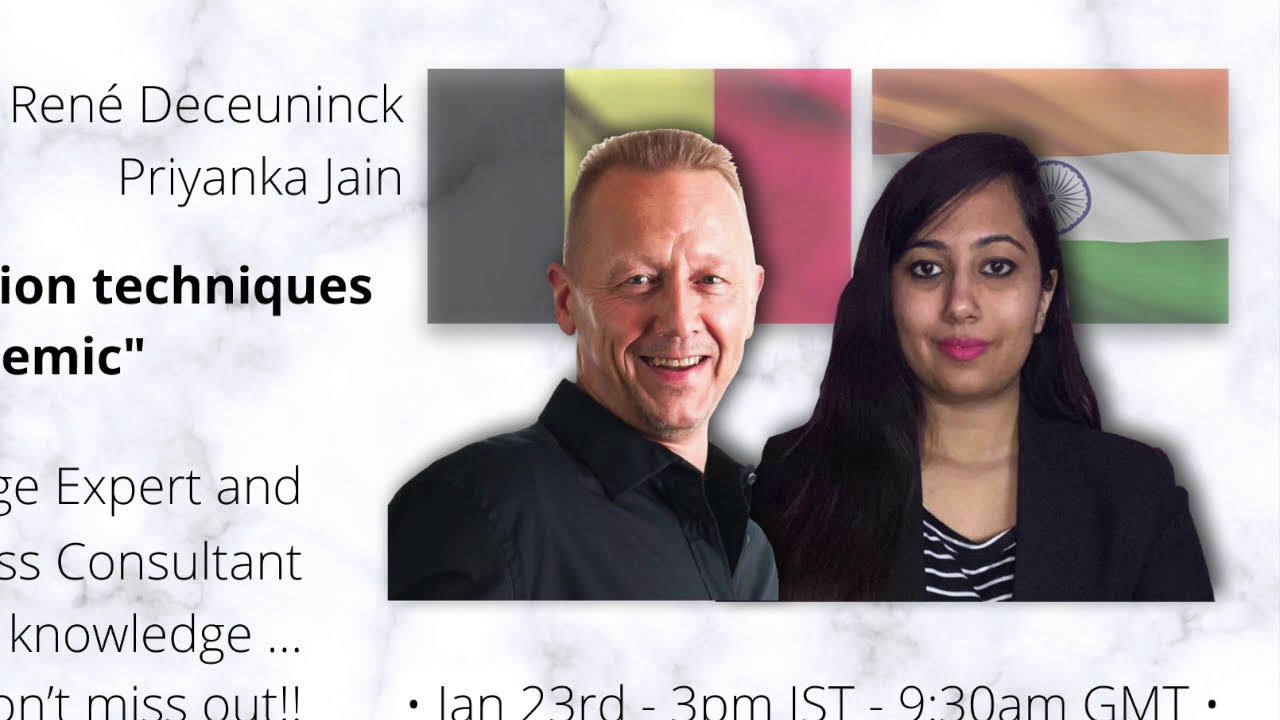
Rene Deceuninck and Priyanka explore how masks and distance changed communication during COVID. They cover the 93% non-verbal communication ratio, mirroring techniques to build rapport, and how breathing and posture affect emotional state. The session includes a silent-movie exercise and cultural tips for adapting gestures across countries.
Chapters
Not many institutions, and we have delivered a very, uh, around 20+ institutions with a webinar on personality development, body language, sales skills. And we are also working with some digital marketing agencies right now. So I think it's a win-win situation for both of us.
Yeah.
And slowly and steady, this, uh, relations come to this way. Yeah. Yeah, and then after, we have decided to just have a webinar, uh, open webinar for all of us on, uh, communication techniques during a pandemic, so that everyone should get some knowledge and tips and tricks from the international coach and trainer. Yeah, that's it.
Yeah, so indeed, I met Priyanka in Oxford Business College when delivering— I was delivering a Yeah, you might say speech about body language. It was about an hour. And then from one thing came another, and finally you're representing me in India, Priyanka. So I'm very grateful to have that connection with you. I was introduced in a lot of universities already and companies a bit everywhere, and it's been an amazing journey so far. The only thing holding me back from coming to India is that UK is so bad for the moment in terms of the COVID That they don't allow us in any country. I mean, there's not one country that says, "UK, welcome, welcome," you know, because it's so bad over here. However, taking good care of my health and traveling the world, used to travel a lot, as you mentioned. I was in Thailand and Iran and United States, traveled all over the Middle East, Qatar, Dubai, Abu Dhabi. I've been a bit everywhere and finally got into Australia. And got stuck there for 5 months. Got in February. I was going to travel to Iran, but then they refused me to get into the country because of the COVID-19. They said, they're going to let you in, but they're never going to let you out. And I said, okay, this is it. Travel directly to Australia. But then upon arrival, they kept me there for 5 months because of the fact there was just no flights. I mean, and I could grab a flight with Qatar Airways, and behind my back they closed the door. And I said, wow, because they went in complete lockdown in Australia at that time. So I was lucky to be able to grab that plane and then got back to London, Oxford, started filming the courses online. And yeah, and in the meantime, we did some, some beautiful webinars with universities all over India as well. That's why Priyanka and me, we're having this session in fact today. I was in Mumbai, in New Delhi, in Pune, and all all of these beautiful Bangalore and all these beautiful cities and regions. So yeah, it's an amazing journey so far. But, um, about the pandemic, how is India coping with the pandemic? I heard things are going much better. Is that true?
Yeah, yeah, recently things are going much better. India has launched vaccine, so try it. It's approved vaccine now, so people will, will get the vaccine soon. Yeah, yeah, yeah.
So, and how do you communicate in terms of, of, um, like the pandemic and communication in terms of you're on the street, you're in the shop, how do you communicate? Did you experience something that you say, hey, I changed my way of communication due to the fact I have to wear that mask? I have to— is there anything, Priyanka, you're gonna— you can add to this? Or before I get started, because I want to know how it's— and how it's happening in India, how you experience it.
Yeah, we are, we are taking so much protections. We are using masks, we are using hand gloves, we are using sanitizer, and we are maintaining a safe distance to one people to another people so that we can be safe from our end. So yeah, definitely when we buy, when we go to a shop to buy anything, so definitely we keep in mind that we have to maintain a safe distance of, and we must have, uh, I mean, there is a rule that you have to wear a mask. While you are driving, you have to wear a mask. If you are moving on the road, you have to wear a mask.
So yeah, these, these are the things that have come up due to the COVID Now, are there certain things that you use in terms of your communication differently now?
Uh, I, I can't say that I am friendly with this because, uh, sometimes by with wearing a mask, you cannot communicate because, uh, your gestures helps us to have a part of your communication. So, uh, in, uh, while wearing a mask, your gestures, your face expressions, your lip-sync will hide, um, yeah. So, and your hand expressions also, because sometimes you, you cannot shake hands with the people if you like them, or you cannot, uh, like tap on your, on the back of the people. So these are the things that has made some difference due to the corona. People are more cautious about the things.
Yeah, this is, this is curious because, you know, in the '20s and the '30s, 1920, 1930, and we both were not there yet. I mean, it's too far away, but there was the silent movies. Remember the silent movies? So if I'm clicking here and there is because people are entering the room, so I'm allowing them into the room. If you say, what is he doing? Yeah, but anyway, but In the '20s and the '30s, there was a silent movie. And what happened, in fact, is that when people were watching the movie, they clearly understood what was happening because the only thing that happened was a piano playing or some music playing. And the actors had to really perform so well so people understood what they were doing and what they wanted to say because they couldn't because there was no sound. There was only the piano, the music. Now we did a test. We did this test with a movie. Could I ask people when you join to mute please so we don't have the background noise? Thank you for that, really appreciate that. And take some water from time to time, super important to stay hydrated. Take some notes as much as you can. Now what happens is that we did a test and the test was like a movie nowadays but put the sound down and put some piano on the background. And I guarantee you, you will not understand the movie at all. Actors don't act anymore as they used to act in the '20s and the '30s because they are supported by their voice. And it's so important to maybe practice with one day, or tomorrow, or today, or tonight, it doesn't matter when. When you go out, practice the silent movie gestures, like use your hands, use your head like this, right? Do all the things you can. To make, to keep your message out, to get your message out there that people clearly understand what you mean, right? And think about these old movies, the silent movies. Maybe you can use it as an example for yourself. Watch one and say, how, oh, they do it like this, they do it like that. Maybe I can copy paste that and use it when I go shopping and see what happens. It might be a very funny experience, right? So that is the first thing, a test that you can do. The second thing, Priyanka, I would like to give away to the people here is that body language is based on feelings. How you feel is how you will project your message. That makes sense, right? So we will produce a certain feeling, how we feel. We feel good, we feel excited, we feel sad, we feel bad. What happens when that happens? Your shoulders go down, your head go down, and you get less oxygen to your lungs. That means your thinking will change as well. The more oxygen that goes to your head, right, the more excited you'll be. So head up, shoulders up, shoulders backwards, and like, and breathe well. You get so much oxygen to your brain, you'll get so excited. And people will say, hey, how can you be so excited in these times? And you say, because I can. It doesn't matter if you're excited or sad. It's not going to change anything. The only thing that will change is you as a person. We did some, some investigations here in the UK. People are— so the mental health in the UK is so low, and it's because people watch telly, they listen to the radio, and they get so influenced by all these negative signs, and these little seeds in their head and they go, ah, a little by little they go down, down, down, and the excitement is going away. Now, if you get lots of extra oxygen into your brain, your thinking will start changing, and your body language is based on your thinking. Would you agree? It's based on your feeling, and based on that feeling, you will project a certain body language send it out in a form of a certain energy on a certain frequency. Now what happens in communication is that when you communicate with somebody, you're transferring bits of data from one brain to another brain. That means from the conscious to the conscious and from the subconscious to the subconscious. Now what happens when you do that from conscious to conscious— by the way, conscious is what happens in the moment something you taste, something you hear, something you say, something you touch. Things are happening in the moment is the conscious. So what happens in the conscious is that you transfer words from one person to another person. Words is conscious. It's a sound, it's a frequency, it's a certain energy. And you transfer 40 bits of data per second when you do that. 40 bits of data per second. Now what happens when you do that? You also have a certain body language. Look at my hands, look at my, my expressions that I use, like this, like this, like this. I'm like I'm using my hands a lot, right? And I'm not an Italian, by the way, because Italians do that a lot. But anyway, I have a joke about this. I'm gonna say that a bit later. I'm gonna tell you later. But what happens is that when you transfer a message from brain to brain, you do that conscious, words, 40 bits of data per second. Now subconscious, you transfer the nonverbal and you transfer 40 million bits of data per second subconsciously. That means the non-verbal consists of two things: intonation and body language. Intonation is 38%, body language 55%, along the studies of Albert Mehrabian, was a professor out of Iran, and that is science. This is scientifically based. So 38% intonation, 55% is body language. That means that 93% of all communication will be transferred through the subconscious mind. Now what happens when that happens is that the conscious mind will absorb the verbal and absorb through the subconscious, the nonverbal will process it and come back to you. That's why it's said that the outside world is in fact a reflection of yourself. Ever heard that quote? If you have questions, by the way, Dear participants, please ask your questions in the chat. I will be gladly answering them a little bit later, so make sure to put your questions there. And there's not such a thing as a dumb question, right? Every question is very interesting. It's only an answer that could be very dumb, but a dumb question doesn't exist, right? So, hey, but the joke was in India, they will say, "Where's the food?" In Italy, you will say like, "What the heck?" So when an Italian goes to an Indian restaurant and he doesn't find the food, he will go like, "What the heck?" And the Indian person will say, "The food is over there, and watch your language." Body language. Anyway, so Would it make sense to you that if you go to a shop, let's say you have some grocery shopping and you go to shop and you create a positive feeling, that positive feeling will create a certain body language and it will be processed and be sent out to the person you're speaking to? Could it make sense that the outside world is a reflection of you, that they will respond in a very positive way as well? Would that make sense? So if you go to shop and you go to pay and people look at you and you look at the big smile at them, chances that they will smile back to you is 99% because people will copy-paste you. So would body language be important? Priyanka, is there anything you would like to add, or do you have an experience like that?
Yeah, I mean, um Like when we meet some stranger or on road, might— if you help anyone, uh, and when you smile back, they give you a smile back. It's just a kind of gesture, good gesture. Uh, I have experienced that one day I was just crossing the road and there was a child, he was unable to cross the road, so I just helped her. And her mother was standing across the road, so when I take the child and I just cross the road and hand over her child to her. And then she smiled at me, and then I smiled back. So then, uh, till then they haven't heard, uh, utter any word. But, uh, when I say thanks or welcome, she said like, uh, you are a very great person, you help my daughter. So it's a, it's a kind of gesture. Yeah, it's kind of give and take relation. Or, uh, I mean, uh, I can add like, it's not like you think and then you speak, it's unintentional. It's a kind of on the spot, like within a second you thank— you give her a thanks, then other person will give you a welcome. So it's a kind of give and take.
Yeah, yeah, absolutely, absolutely. So people copy-paste you when you have a certain gesture. Um, there's Eric— Milton Erickson. Milton Erickson was a psychologist, psychiatrist, and he had a practice in mental health and much more than that, that is. And when a patient came into his office and the patient went like, oh doctor, I feel so bad, I feel so sad, what's going on with me? Dr. Milton Erickson would go the same way. He was like, oh my God, I understand you, please have a seat, let's have a look what is happening with you. And in the brain of that person, it went like, oh, somebody like me, and they would level. Now the outcome of that visit for that patient was completely different. He was completely leveled with the doctor. The doctor could ask anything and the patient would answer it with whatever he had to answer. And that is called leveling. If you copy-paste certain body language from people you're communicating with and you do that on a consistent basis, and before they change their posture, you change, they might even copy-paste you. That's called mirroring. Mirroring and matching. Let me explain you this. And first of all, why would I explain that to you? It is a fact, if you level with the person you're speaking to, your results will be different. Now the first thing you can do is mirroring, right? So what happens is that somebody is sitting with the arms crossed and you cross your arms the same way. Now maybe they will change like this with their hand on their head. You copy-paste them too. Now they might change like this, copy-paste them again, and they might go back to this, copy-paste them again. Now watch my thumb. When thumbs are out, there's a positive energy. However, this is, right, body language on the next level. Now what happens before you— before they change, all of a sudden you change again. If they copy-paste your posture, you got a connection on a higher level. Try this. Now there's one specific thing to watch out for: if it doesn't work, stop doing it. Because if they find out you're copy-pasting them, your conversation is over. Your credibility is done, finished. So if you try and it's not working, stop doing it. And start doing it the next day and the next day and the next day until you get so familiar with it that, and all of a sudden it will happen and you will be leveled, you will be connected on a different level, on a high level. And people say, hey, in the brain they're not aware of it, it's not conscious, it's subconscious. The subconscious mind will say, oh wow, somebody like me, and the only thing they did is copy-pasting you because you initiated it. So make sense? That is leveling, one way of leveling. Now the certain— the, the second way of leveling is to ask questions. Now asking questions is super important. How come that there's billionaires and millionaires on this planet? Millionaires and billionaires will always ask questions and never do the talking. They will speak for a little bit, but then ask questions, question after question and question after question. And why is that? If they ask a question, they are in charge of the conversation. The one who is talking is never in charge of the conversation, never ever. The one who is asking questions is. Which questions should you ask? You might say, well, the open questions, the questions that start with why, where, when, who, which, how. Open questions. When you start your question with these W's and H's, people have to come up with a story. They can't answer you yes or no. If I would ask you, hey, how was your trip to Egypt last year? You can't say yes. Doesn't make sense. It doesn't make sense. So you have to come up with a story, and it's that story that gives you so much information as the one moderating the conversation. So people, if you are in a conversation, stop talking, ask questions. You get so much information you can work with. Now, when you ask the question and they come up with a story, you can read their body language. It'll give you time, it gives you space to read the body language, to find out if they're lying to you, yes or no. And it's very easy to do that. After 25 years in a split second. In a split second, I can read a liar or the truth, right? Now don't change your posture now because I can see all of you. But hey, but what I want to say is that it gives you so much time to read the body language, to discover a lie or the truth, to prepare your next question, right? Because based on the answer that you get, you can prepare your next question. Now What is the first question? The best question ever? Why? Why are you doing what you're doing? Or why do you say this? Or why are you going on holiday? And people might say, I don't know. And that happens a lot when you ask a question and people say, I don't know. The second best question on this planet is, suppose you would know, what would it be? Now don't literally copy-paste me now, but if somebody said, if you ask a question, hey, um, why are you going to school? Or why, why do you have that job that you're doing? I said, I don't know. Well, I do know that you don't know. Hey, amazing answer. But hey, suppose you would know, what would it be? And you're like, huh? Because when you ask that second best question, suppose you would know, you activate the brain. And people have to come up with an answer. So if you ask questions and people say, I don't know, go to the next question. Hey, I do know you don't know. And what besides that, suppose you would know, what would it be? And people will come up with an answer that makes sense, believe it or not. And if they say 3 times in a row, I don't know, you can still say, I do know, you know, I understand you don't know, you know, I really understand you, but hey, for one second, suppose you would know, what would it be? If after the fourth or the fifth time they still don't know, please stop it because it's not going to work out, right? You don't have to exaggerate. People have to still love you in the end. But the thing is, there's another— some person admitting— oh yeah, everybody is there. So sorry, there's people joining in, tuning in. So make sure you have some water, drink some water, take some notes. Remember So ask questions. Which questions? Open questions. Best thing to do ever. Open questions. Get some answers, some stories. Work with these stories, prepare your next question, and you'll see at the end of the conversation, the person will leave and say, wow, this is the first person that understands me. And the only thing you did was asking questions. Remember? Ask questions. Is there anybody that has a question right now? Please put it in the chat. Make sure it's an open question. No, no, I'm kidding. So make sure you put your questions in the chat. We're gonna answer your questions very soon. And think about some questions you might have because I'm gonna ask one or two people live, like, hey, do you have a question? So if you have a question, please ask me or Priyanka for some answers. Hey, but that is another way of leveling is ask questions, ask questions. Now the third way of leveling is to define who are these people you're talking to. And one thing to define is that who is their character. And how can you find out is by asking again questions. Now what would you like to find out is that are they extrovert people or introvert people? Are they team players are solo players? Are they emotional or are they rational? Are they calm and soft people or very active and fast people? Now, why would you find— like to find out? It's because you can level at that moment. So let's say you're talking to an extrovert, team player, active and fast person, and emotional. However, you are a very rational solo player, calm and soft person, you're the complete opposite. What will happen if you are starting the conversation? Please step out of your character and start speaking the same language. That means emotional, active and fast, team player, extrovert language. I got a test for that, it's called, it's based on DISC, D-I-S-C. To find out who, who are you in the first place. Am I an emotional person? Am I a team player? Am I a solo player? Am I a rational person? Who am I? And once you find out who you are, you can start asking questions and find out who somebody else is. Then leave your color, because it's divided in 4 basic colors. Leave your color and step into their color and start speaking the same language. And again, at the end of the conversation, they will say, oh wow, that person really understands me. And the only thing you did was leveling. Does that make sense? It's like the fighter pilot, either F-14 Tomcat in those days, you had Top Gun, and they made now Top Gun number 2, right, after 34 years. Because I've, I watched that movie so much Top Gun with, um, how is his name again? Uh, Tom Cruise. And that was 34 years ago. Why did I watch that movie so many times? Because I'm an ex-pilot from the army. That's the only way. That's the only reason. I was like so mesmerized and inspired by that movie, Top Gun. And now for 34 years now, they made a second one. So it's an amazing movie. But what happens when these fighter pilots are chasing each other? What happens is that one pilot would like to shoot the other one and they're chasing and chasing and up and down and I'm chasing and chasing. And what happens, all of a sudden that pilot will, will put the signal, the, the search and search signal on that will search for the heat signal of that other plane. So the other plane is producing a heat signal and he will look for that heat signal and it will go like doo doo doo doo doo doo. And once that heat signal and his system, his radar, is connected. It goes from titi titi titi to tit, and that's the moment the pilot, he knows he has to shoot, he has to fire. And that missile will hit the plane anyway because there's a connection, right? It's like a Chinese person talking to an Indian person. They don't understand each other. It's a different language. Does that make sense? It's like being in a room, in one corner of the room you're playing one, like BBC One, and then the other corner of the room you play another station, radio station, and put both of them on maximum volume and you're in the middle. What are you going to say? Hey, shut down one or the other because it doesn't make sense. So what you have to do in conversations, and that is so important to understand, please take note of that, is to level with the person you're speaking to. Because if you don't level with that person, your conversation might go keep on going but the result will be so low. Does it make sense? Anybody any question, please write them in the chat box. So that is, uh, how should I say, another way of leveling, right? Make sure to level, to find out who you are, to find out how somebody else is, and then speak their language, right? All right, so let's have a look at the questions here. So voters, hello Priyanka, Renee, and other participants. Nowadays, if you put the movies on only sound mode, the sound must be really good. You are able to follow the movie. Yeah, that's correct. How much? Yeah, yeah. So Greg, how much do we need to care about cultural differences, suggestions, and posture? That's a very good one as well. Hey, Body language is global. We're all human beings and we all have the same system. We all have a heart, we all have two eyes, a nose, and a mouth. We have two ears, we have two feet, two hands. We are all the same. Body language is global. However, in certain cultures, certain things are just not done. The only thing I can say is that if you go to a foreign country, do some investigation on Google or on my website. I have some content there as well. Make sure to find out what is done and not done in a certain country. I know, for example, in Bangladesh, if you do this, it's very offensive. I did that in Iran and Tehran as well. I said to them, hey, if you do this in certain countries, it's very offensive. And there was a lady said, sir, can I ask you, can I say, can I say something? I said, sure. In Iran too. So by the way, I'm still learning myself. Sometimes after 25 years. But what happens in Iran too, if you do that, it's a very offensive way of saying things. So in certain cultures, there's certain things just not done. I was in Thailand, and in Thailand as well, there's certain things just not done, and you have to pay attention to it. Before my seminar, I went through the organizer. I said, hey, Romy, can I ask you a question? She says, yeah, what's going on, Rene? I said, are there certain things just not done in Thailand? And she says, what do you mean? I said this and this and this. She says, oh, don't do that, they're going to be very offended. I said, thank you for the information, but it's up to you to ask it because nobody's going to tell you. And you might even have, as a public speaker, I don't know what your profession is these days, but as a public speaker, you have to ask these questions to make sure you don't offend people, especially if you travel a lot. I travel all over the globe on a very regular basis, not now because of the COVID but normally I travel a lot. And you have to watch out what you do. I was in, uh, in, uh, in, uh, uh, Brunei. In Brunei, certain things are just not done. The Kingdom of Brunei, I don't know if you heard about it, it's a Malaysia-Singapore area. Certain things are just not done. You have to ask for it, right? So great, amazing question. Um, so how much do we care about— okay, I had this one. How we either care about or be careful of Exactly. Uh, Geeta, I have a question related to the mirroring, how to do it in a virtual meetings. Um, you can do it in a virtual meeting, no worries. If you have a one-on-one, you can copy-paste them. I have something I want to share you after I answer the questions here, but you can actually do it. If somebody says yeah, well, you could say yeah, tell me, right? You can copy-paste, no worries about that, right? But do it subtle. Do it subtle. Don't, don't, don't make fun of it because people might say, oh, they're making fun of me, right? Do it very subtle. So mirroring— I am a coach and I do Zoom meetings. How to use the coaching body language? That's a very good one, Chloe. You just have to, based on your feelings, ask certain questions. So in a Zoom meeting, it's based on body language, micro expressions, what you see in the face. When, when I would come close and go like, you see my nose? So when people do that, they might have a resistance to something you just said, right? You have to watch the micro expressions. Micro expressions are very important in a Zoom meeting. Also the hands, right? And again, I'm going to share you something after I answer these questions about left and right, but I'm going to just ask— you see these questions here— if I can answer. In Thailand, never show the soles of your feet. Yeah, great, I know, that's a good one.
All right, there is one more question, uh, from Manish. Uh, the question is, how can we generate need for customers? How can we generate needs for the customer? Like, if there's a sales— if there's a salesperson, how can that salesperson generate need for that customer to sell his product?
So find out the needs of the customer.
Yeah, how to find out? Like, how can we find out that this, this person is interested or not?
Yeah, and by asking questions, in a sense that, can I have, can I have 1 minute of your time please? No, I don't have time. I understand you don't have time. However, can I ask you 1 more question and I'll leave you? What are you guys working on as a sales team? Are we working on all kinds of things? Yes, but if there will be one thing Remember what I said? Suppose you would know. If there would be one thing that you guys are struggling with, what would it be? Well, I don't know. I know you don't know, but suppose you would know, what would it be? Oh, following up. Oh wow, how many salespeople do you have in your team? About 10. All right, how much do you lose per contract that you lose per week? Oh, about $1,000. All right, times 10 is $10,000 a week. It's half a million a year. Where can I send you the information I would like to share with you? Can I have your email address, please? Half a million a year. Is that worth sharing your email address? It is about asking questions, about also sales techniques. It's not only about body language, it's also the verbal combined with the non-verbal. So what you say is very important because it's only 7%, remember? 38% and 55% intonation, body language is 93%. So there's only 7% left in terms of words. Wouldn't that be important to know what you say and how you say it? If I sell from a stage for my next seminar, I have to sell tickets. My last question, my last, very last question is always, hey, thank you for joining me. Now one last question, ladies and gentlemen. When is the right time to take the decision right now to buy your tickets today? And people go like, right now, today. Of course, it was in the subliminal message question that I asked them. I'll say it again. Thank you for joining me, ladies and gentlemen. Now, one last question: when is the right time to take a decision right now to buy your tickets today? Did you hear what I said?. So it's so important that you use subliminal— Google it— subliminal messages, hidden messages, and that will increase your sales tremendously. If you want to know more about me or about these things, please contact me or Priyanka. You have our details. I'll share the link through an email. So email us or visit us, rene-deceuninck.com, and priyanka@rene-deceuninck.com. Send an email. But make sure it's business related, right? No spam, please. So is there any more ques— is that— does that answer the question, Bianca?
Yeah.
All right, awesome. So sales techniques in combination with your body language, your hands, but also the micro expressions during a Zoom meeting, super, super important. And if you want to attract or find out the needs of a person Ask questions, ask questions, business-related, sales-related. The example I just gave you: what are you guys working on? What is missing? What is the biggest— and I don't know, I don't know. Suppose you would know, what would it be? These are techniques, right? Anyway, if there's no more questions right now in the chat box, let's continue a little bit. We are almost an hour. Speaking for an hour almost, my time is flying. The last tip I'm going to give away from you, the, the second last, is that we have a right brain and a left brain. How many of you have a left and a right brain? All of us, I guess, right? Otherwise you would not be here. The right brain is your emotional brain, the left brain is a rational brain. Now the left brain, rational brain, is connected with your right eye. The right brain, emotional brain, is connected with your left eye. Listen very carefully now. If you speak about emotional things in life, turn your body to the right and look with your left eye in the left eye of the other person. I'm exaggerating here just to show you how to do it. Emotional questions: How was your trip to Egypt last year? Amazing, wasn't it? Oh yeah. What you do when you do that, you look like this. You in fact connect the right brain through your left eye with the left eye and the right brain. So you are speaking the right, you're connecting in the right way. Remember, a Chinese person to an Indian person, they say, "Oh, doesn't match." You have to match, you have to level. And how do you level in this way? By looking with the correct eye and the correct eye, left, left, or right, right. If I have a rational question, I will turn a bit to the left and say, hey, How is the agenda for next week? Could you, could you come up with an answer that makes sense, please? And I will look with my right eye into your right eye, so my left brain would connect with your left brain, and my outcome, my result, will be far more higher than if I would just ask you the question, if that makes sense. So if you want to know more about that, please send us some messages. I'll, I'll, uh, I'll be honored to, uh, to answer that. Last tip I'm going to give away in terms of the body language is that the body parts the further away from the brain are the less controllable. So your feet are the further away from your brain. There's nothing further than your feet, right? Besides your socks and your shoes, but your feet are the further away from the brain, so they're less controllable. So the feet will tell you so much more than anything else. If you can read the feet You can read everything. Now, a tip I'm going to give away here is that if you go to an interview, an interview for a job, or you are the interviewer, make sure to have a table with a glass top so you can see what happens under the table. That makes sense. If you go into an interview and there's a glass top table, be aware they might know a lot about body language because they want to read your feet and they want to know what's happening under the table. Because if your hands are on the table and you're rubbing your legs because you have sweaty hands, it's because you're stressed, you're nervous, maybe there's some anxiety because you're rubbing your hands over your legs. Because why would you do that? Because they're sweaty. If your foot, or one foot, or your feet are pointing away, that means you might want to leave the conversation. If that happens, I will always wrap up the conversation, hey, time is precious, we all have an agenda. Is there anything else I can let you know? Is there an agenda, or did you understand 1, 2, 3, 4? Okay, awesome. Hey, when do we see each other again? Let's put the agendas together, let's wrap it up. And they were like, wow. And then let them go because they're not attentive anyway, because their feet are telling you, I wanna leave. That makes sense. All right. Is there anybody that has one question? Because gonna have to wrap it up, it's, uh, we're a bit running over time. It's more than an hour, um, I guess. No, we're still good, I guess. It's not an hour yet, it's 45 minutes. Priyanka? Yeah, because I'm a bit confused with time here, UK and India.
And, um, yeah, it's 15 minutes left.
15 minutes left.
Okay, right.
So is there anybody that has a question Live, if you have a question, please unmute yourself and ask the question, please. And do know there's not such a thing as a dumb question, there's only dumb answers. So from my perspective, both of you have a question, right? How do you do that? Unmute.
Okay, I'm unmute. Rene Deceuninck, if some people are disabled and sitting in a wheelchair and they're not moving their foot you are more to have the body language conversation. You are more have to take more attention to other things, other parts, other parts of the— for example, I made the story, I made a filming for deaf people. They are using the finger language, so you have to As a sound man, I found out I always want to be near the people I'm recording. Yeah. And what you are telling about script makers, reporters, they are dumbasses. They are looking for their questions they made before. The questions are in the silence, always. If you look what you're telling. So I found out if you can listen you can have a conversation.
You are leveling.
The most stupid conversations nowadays I heard on the radio or the journal, the news, they are not prepared. They are not knowing what they are doing.
Yeah, that's correct. That's correct. That people—
what's— for my question, suppose you have disabled people. I have some friends, they are fantastic keynote speakers But how, for the other people here, what part is more, uh, important than when you have the, the under part is not working?
The most important thing— and thank you for your question, by the way. And Wouter is from Holland. Thank you for joining me, Wouter. Uh, we met not that long ago, but he's an amazing individual. Wouter, the answer to your question is very simple, and let me tell you a story about a man with his dog. And he's walking on the street with his dog, and his friend is approaching and he says, "Oh wow, you got a new dog?" He says, "Yeah, I got a new dog," and he's like attempting to pet him, and he says, "Your dog doesn't bite, doesn't he?" And he starts petting the dog, and the guy says, "Nah, nah, nah, nah, nah, 9 times out of 10 he will." "Hop," say the dog.
Yes.
People are not listening. If you ask a question, you have to keep the silence and look for the micro expressions, look for the answers, and make sure you listen to people. If I have a question, I will say, how are you doing today? I will zip my mouth and listen and analyze the body language if necessary, depends on the conversation, right? And then analyze it. And come with an answer. People don't listen anymore these days. That's so true. And the one thing to do is ask a question. And is it a relationship with your partner? Is it with your kids? Is it in business? Is it in school? It doesn't matter where it is because it's a global thing. People don't listen anymore. But Rene Deceuninck—
and listen, Rene, you didn't tell the clue. Because the man was— the dog was biting, but the man could tell, I didn't say it was my dog.
Yeah, maybe, right?
Awesome.
Hey, thank you for your question, mate. Love it. Is there anybody else that has a question? Anybody? Anybody has a question, please unmute yourself. Feel free, don't be shy. Anybody? Nobody? Everybody is okay? All right, awesome.
Vida, I don't have a question, but I want to thank you for such wonderful information on the body language. A wonderful session, I really enjoyed it and learned a lot. Thank you so much, Rene Deceuninck.
More than welcome, more than welcome. Really, I can't wait to get to India this year. That will happen anyway.
So, so we are planning.
Yeah, we are planning this, but don't give any dates yet. It has to be a surprise, right? Definitely.
Yeah.
So in terms of the body language, make sure— and that was an amazing question and also information from Walter as well— is that you have to listen to people and then analyze what is being said. Ask questions, open questions— the what, where, when, which, who, when, and how. And if you start your questions like that, you'll get a ton of information, right? But when you get that information, make sure to zip it, do not say one word, and to listen what people say. Now the next thing in body language is that when you have all that neuroscience information, you can then start reading body language, the signs. And you will understand them so much better. It's like a Formula 1 pilot will always have to learn how is my engine working, what is an engine, what did they do to my engine that it works so well, what is the steering thing, how does that work, what is the gearbox doing when I am on the road. That's the first thing they do is to learn about their car before they get even in the car itself. I used to be a student pilot. And we studied so much, we studied for so much, for so long before we got even in that airplane, right? And it's the same with body language. Study the neuroscience and you'll find out why people do what they do, including the stupid things they do. Sometimes people said, oh, I am so happy, so happy, my relationship, oh my goodness, so good. What are they telling you? I'm exaggerating again. They're telling the opposite. Do know that the body will never lie. The body will never lie. That's one thing to remember for the rest of your days. Your body will never lie. Okay, so what was I going to say? Something about the body never lies. All right, let me give you an example. I love health, I love vitamins, I love to be very, very excited and very energetic day in, day out. You know what? Why? I attract people. You know, birds of a feather flock together. What you express, you will attract. What you think about on a daily basis is what you attract. Does that make sense?
Right?
So what I did one day, somebody said, "Hey, you have to drink beetroot juice." I said, "Oh wow, that's amazing." So I went as I am, I started planting seeds because I want to have fresh beetroot. I didn't go to the shop, right? And they were growing and I took them out of my garden. I started juicing them. So I had a full glass of beetroot juice and it tastes not really that good, you know. I don't know if you ever drank beetroot juice, but it's not really the most yummy drink on the planet. And then, you know what, whatever, it's for your health, you you know, it's good for your blood. And I drank it in one time. Now, after 1 hour, I started getting so itchy, and I said, what's happening? I mean, and in my face and my arms and everywhere, I got so itchy. And said, this is not correct. What's happening with my body? And all of a sudden it went like, oh, beetroot. I did something my body was not used to. What happened at that time? My heart started pumping so hard because I did something that was not normal in my normal daily habits. When your heart starts pumping far more faster, what happens? Your bloodstream goes far more faster, right? What happens when that happens is that you start scratching your skin where the skin is very thin, where the blood vessels are going so fast, the stream is so you start itching. That's normal. That's why when liars tell you a lie, they start scratching themselves, because the blood— the heart is pumping so, so fast because they are doing something that doesn't make sense to the body. Does that make sense when I say the body never lies? So the heart starts pumping, the blood goes so fast, and where the skin is very thin, liars will start scratching themselves. So watch out with the beetroot, by the way, because my story is a true story. I got so itchy everywhere. But nowadays, you know, I use it in kinds of— it's the same with the turmeric, right?
I was about to ask.
Priyanka said to me, in terms of, you know, keeping your— or maybe you can tell the, the story, Priyanka, yourself, what I told you.
Yeah, I mean, people from India will well understand that turmeric milk is a very, um, good in terms of boosting immunity. So I suggest Rene to have a turmeric milk at night. So I told him the recipe, like just take a cup of milk and add some turmeric. Uh, I, I told him to add some half spoon of turmeric. So I don't know, um, where is a miscommunication happened. So he added, uh, 1 teaspoon. Like it's, uh, a very much— and it's— we just use a pinch of turmeric. So he just went to the shop market and just bought the, uh, turmeric pack. And then he showed me the video like, uh, he has made. And I was shocked, like, what the heck you have done? And then I told him, just use a pinch of turmeric in the milk.
Yeah, I had a full spoon, a full teaspoon. Yeah, I said, this is yummy, but a bit spicy, isn't it? But anyway, it didn't hurt me. But yeah, these are the things, you know, make sure when you do things to watch out how you do things and don't exaggerate. However, do it on a daily basis. It's really like reading a book. Make sure to read 15 to 20 minutes a day, however, every day, right? Don't read half a book today and next year the other half of the book, because consistency will create a certain energy and certain results. But yeah, again, back to the, the body. The body will never lie. However, there's 3 people to watch out for that are very, very hard to read their body language. And the 3 people are— the first category of people are people who are using drugs, medicine in a high level, alcohol, because they change the, the, the body. The structure of the body is changed by drugs and alcohol and medicine, and then the body language will not be according to what they say or what they think. Because they change the state. The second category of people was really sometimes hard, not always, but sometimes hard to read the body language, is people who are professional actors. They can change their body language in a split second because it's their job, right? Professional actors. Now the third category are people who are pathological liars. They believe in their own lies. And one category, subcategory, in pathological liars are narcissists. Narcissists will believe their own lies and manipulate, manipulate people so in such a way that you will believe them and say, oh my God, that person is amazing. However, they're pulling you down bit by bit, bit by bit, bit by bit, right, by being that pathological liar. So these are the 3 people that are not easy to read the body language, is like people using medicine, drugs, alcohol, the professional actors, and and pathological lies. Now maybe we could wrap it up, Priyanka. Where can people, um, I hope everybody was like well informed and, and excited about the information we shared. Um, what is the next step, Priyanka? What can people find us? Uh, would you like to—
yeah, uh, so if you have any questions, you can email us, and I would like to just add few things. Like, as we are expanding in India, so we are happy to work with institutions and organizations. And also, we are— have recent openings in terms of internships. So if anyone is interested from India in BDE and partnership and communication, then please do communicate with me.
Yeah, exactly.
You can find— yeah, and you can find every information on LinkedIn. Rene Deceuninck has a website. And if you have any questions, you can LinkedIn us, email us anytime.
Awesome, super. So indeed, if you're interested in internship, if you have a company or a university and you want to do a live webinar with us, please feel free to contact us. Please contact Priyanka, um, in India. She's going to explain all the details, give you away all the details. If you want to know where the website is, it's www.reneedeceuninck.com. .com. So myname.com. I might share it in the chat box, um, and I'm just going to write it down. Okay, here we go. Correct. And that was not correct.
Just—
I'm going to correct this. TT, right? That's the correct one. So Please connect with us through the website. Um, next thing— the next things are coming— the next upcoming things are webinars, live webinars, pre-recorded webinars. This, uh, session that we had today will be available on YouTube as well. Uh, the link will be shared later on through your email. Um, and yeah, the only thing I can say, uh, start becoming a mind-through-body reader. That means start reading body signs by reading the— but start find out what the mind is thinking by reading the body signs and actually see what's never being said. Your outcome will be so much different on such a higher level. And I would like to thank all of you for joining us. Priyanka, thank you also for helping me organizing this in India as well. It's amazing. Um, it's an amazing experience working with you. And thank you for all the participants to make your time to take this time to, to, to join us. Any last insight, Priyanka, you want to share?
It's just that we are happy to provide knowledge or to interact with people all over the world. So yeah, definitely we are looking forward to connect each of you.
Awesome. And again, for the internship, if internship, if you're interested, please contact us. It's an amazing experience as well. And for the future, for your own future, it might be a super opportunity. To, to do this. Hey, thank you so much. Um, thanks for the great session, says Greg. Uh, stay safe everyone. Hey, stay safe everyone as well. Likewise, be blessed, and I hope to see you in the near future very soon. Thank you so much. Bye-bye.
More from Rene


What are ... The Silent Language of Connection and the Hidden Power of Non-Verbal Cues?








