How to see what's not being said at MIUC Marbella Spain
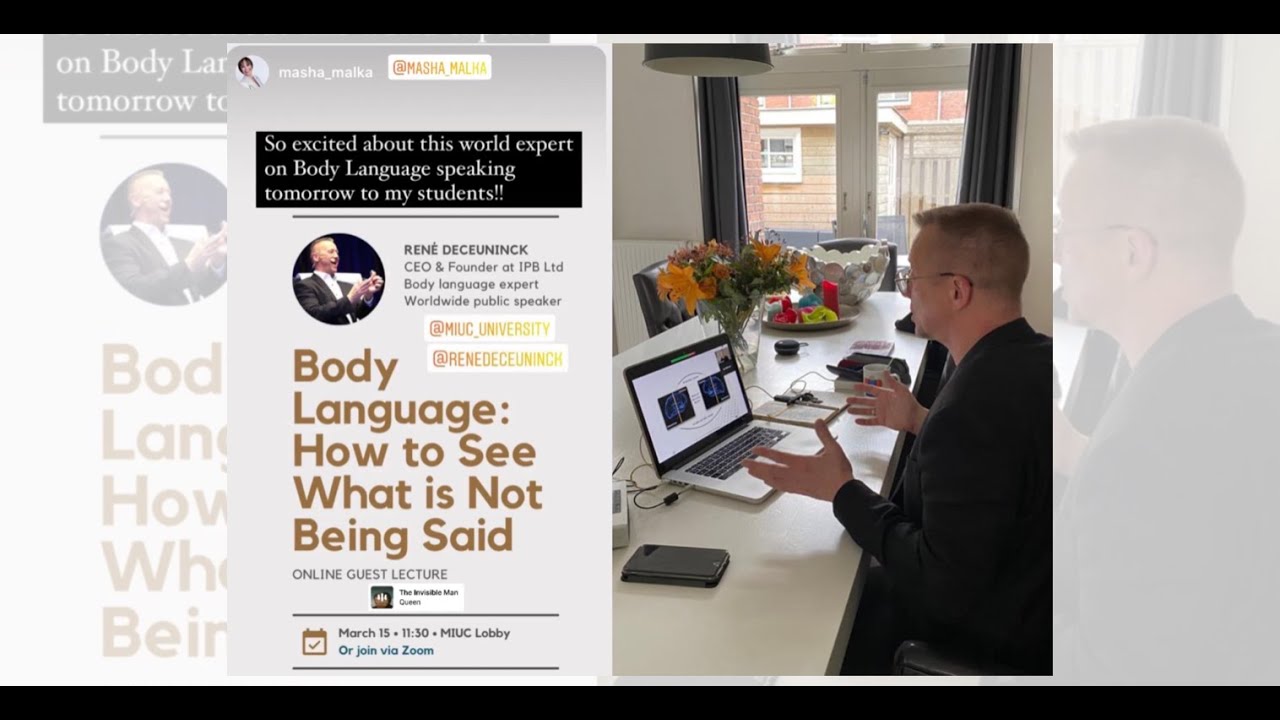
Rene Deceuninck teaches how to read body language, claiming it accounts for 93% of communication. He breaks down gestures like crossed arms and hand-to-mouth, explains eye-accessing cues tied to memory versus reasoning, and shares how a stutterer was helped in seven minutes by addressing a childhood trigger.
Chapters
Welcome everybody. Body language, the most important language on the planet, you might say. And, um, Marsha, thank you for the invite. It's a real privilege and honor to serve you, um, because body language is so important. You do have to understand that body language is 93% of all communication. And that being said, wouldn't it be important to know how it works, right? Now, first things first, um, a little introduction about myself. I was born in 1965, and this was the house of my parents. And my dad used to drive a car called a Renault Dauphine, which is a car from the '60s. And that's a— yeah, for a lot of you, and especially the students, a long time ago. But then, hey, in 1991, after 7 years, so servicing, service in the Belgian Armed Forces in Germany, I came back to that same city and that completely changed into a very posh city. Today they call it the Monaco from the north. It's called Knokke. It's in Belgium, close to the Hollandish border. And today more than ever they drive things like this, like Ferraris and Lamborghinis. It's an amazing city today. But then I took a decision in 2004 to move to the countryside, to a little village with 235 people. Most of you would call that a party, right? But that was an amazing experience, and I stayed there for 14 years. Was an amazing way of living. It was very zen, and the kind of vehicles they drive over there is also completely different, as you can see. Now, might be funny, but that's what it is. And now in 2018, I took a decision to move to London, and that was a business-based decision.. And in London, they different— they have in Hitchin, that was north from London, they have different cars as well. And now in 2019, exactly one year later, I got an opportunity to teach at a couple of institutions in Oxford, Oxford Business College, Brookes University, and it was an amazing experience. And over there, this is Oxford, over there you only use public transport, you don't need a car in fact. So just a bit, a little bit of an introduction where I come from, how I ended up here today with you guys. And it all started with me going to the Navy. Now you have to know that a lot of people didn't believe in me, and we all have these people around us, surrounding us, that say, hey, it's not for you, you're not gonna make it, if I would be you, I would not do it. We all have these people that are very negative and they pull us down instead of pushing us up, you know? And I said, you know what, watch me, I'll show you. And I joined the Navy anyway. As much as people didn't believe in me, I said, I'm gonna do it, and did it anyway. And again, it's not about me, it's not about what I did, it's about the metaphor behind it. A lot of, uh, people and on this, on this planet need this to know that whatever you have, a dream or a goal, you can get there. The only thing you have to do is believing in yourself. And that's what I did. I said, you know what, watch me, I'll show you, and got into the Navy. Now, once I was in the Navy I was thinking about, hey, wouldn't it be great to become, you know, one of these people with stars and stripes? And I was like, you know, yeah, that would be great, wouldn't it? And I went home and told my friends and I said, hey, I'm going to apply for sergeant and maybe sergeant major or lieutenant or whatever it was. And then they said, Rene Deceuninck, this is not for you, you're not going to make it because you have to study for this and you're not smart enough. And we all have people again surrounding us like that, pulling us down. And I applied anyway, and I applied and got in. I was so surprised and this was me after 1 year in Germany with my own platoon. I'm walking there behind my own platoon. It was an amazing experience as well. And about that time I was looking around me and I saw these people, these guys jumping out of airplanes with a parachute and I said, wouldn't it be great for me to do that too? Because I love adventure. And I said, you know what, I'm gonna apply. And again, people are surrounding me, hey Rene, don't do that. "You might end up in a coffin, you know, you're gonna die, you're gonna be sent to war zone and you never know what happens over there. They might shoot you, you might get into prison." I say, "You know what? Watch me, I'll show you." And the third picture here on the bottom, this is me with my first jump. And everybody said, "Wow, you're so lucky." And I said, "Yeah, kind of, right?" After a while you don't answer these statements or questions anymore because you know you're paying a price. Now once I was in an airplane, again jumping, and I was looking at the pilot, and in these huge aircrafts called Hercules C-130, there's no doors in it. And I was watching the pilot and I said, wow, wouldn't it be great to become a pilot? And I went home all excited and I said, hey, you know what, I'm going to become a pilot. And everybody says, Rene, don't do this, you're not smart enough, you have to study. And again, the same stuff came up, you know, people pulling you down. We all have them. And I say, you know what, what do I have to lose?
Nothing.
And what I did, I applied anyway. And 10 months later or a year later, I don't know it very well anymore because it's a long time ago, it's from 1988. And I applied and I got in. And this is me here as a student pilot. And I was so excited. And people again, they said, hey, but you were lucky. You're so lucky, lucky. And I said, yeah, sure, I'm lucky. And this is me here in front of the Huey, Eric Hoyes helicopter, because the end Uh, goal was becoming a helicopter pilot. And you know, the metaphor behind the whole thing is, is, is if you have a dream, if you have a goal, if you're a student, even if you're already an adult and you have certain goals and dreams and say, how, how should I do this? Can I do this? Is it for me, yes or no? Yes, it is. But you have to pay a price. You have to do whatever it takes to get there. And that's the main thing to do. So if you are here right now watching this, I mean, if you have a goal or a dream, and if you don't even have one, make sure you get one. And just go for it and don't listen to people. People will try to pull you down, don't worry about it, but that should make you stronger and say, hey, watch me, I'll show you. Now enough about me. My first book was in 1995 that I bought. It was a book from Anthony Robbins and it's called in Dutch, it's a Dutch language as you can see, Success voor het Opgraben. Now the equivalent is Notes from a Friend from Tony Robbins. It was an amazing book and it's a very tiny book. You can read it in less than 2 hours. So I read the book and I said, wow, I want to meet the guy, you know. And everybody again says, Rene, you're not going to make it. Who are you that he's going to make time for you? He's a freaking billionaire living in California. You're in Belgium. You're 3 times nothing. I say, you know what, watch me and I'll show you. And I can easily say today I collaborate with Tony on a higher level around the globe. Now the next thing is that this is just a journey, a couple of pictures of my journey. Just to let you know who I am, what I do with people like Jack Canfield. And then, and you have Jack Canfield over here. And here we got all these people like Richard Tan from, from Singapore, uh, Joseph McClendon, who works with Tony Robbins as well. And then this is with the organization of Robbins. This is in Italy in the University of Criminology. This is Birmingham. This is in collaboration with Tony in Nottingham. This is in London., and the list goes on and on and on. This is with Brian Tracy. For those who don't know, Brian Tracy is a very influential person in terms of sales techniques. He got Keith Cunningham, who is one of the speakers at Tony stages as well, about accountancy. We got Alan Kleinhans from South Africa and many, many more. This is one of my bigger things that I did in Bangkok, National Achievers. We had a couple of thousand people in the room. Listening to body language. This is in Iran. That was in August 2019 in Iran, in Tehran. Amazing country, love it like crazy. This was in 2020, in 2020 in February, and that was one of my last performances before it all got shut down through COVID-19. So I've been traveling the planet, amazing experiences, and the very, very last one was when I traveled from London to Australia and did some work there in Melbourne, Brisbane, Sydney, and got stuck for 5 months because there was no flights available. Then after 5 months, I got back, and these are the guys from Success Resources, Michael Lane and Michael Bennett, amazing people. And, um, but I got back to London, we started filming and putting our courses online as well. So this is the website. If you have any questions, any suggestions, whatever, please feel free to send me an email. Please don't call me to say things are not going good for you or whatever, or I can't sleep tonight, or— but please, any inquiry about body language, communication skills, whatever, please send me an email or contact me in whatever form on social media, etc., etc. Now, first things first, if you say, is this really true what he's saying? You know, your mouth might fall open and say, hey, is this really true? What I tell you is true for 80%. 20% you have to see from a completely different perspective. So 80% is true, what I tell you is 80% is true, 20% different perspective. Now what I'm going to happen as well is that we're going to jump from one ball to another ball. And why is that? The ball with Goldfish, the so-called normal people— and by the way, define normal people— but if you are interested in this and if you're listening to this you're not actually really normal because you're hungry. You want to know more, you need information, and you're listening to this. And that might be a game changer today for you as well if you use it, because knowledge is amazing. However, applied knowledge is priceless. So we're gonna be that one goldfish that jumps from one bowl to another bowl and have some, uh, different experience. We're gonna have some fun too. Look at the dolphin and the cow, they have some fun. Let's have some fun too. And let's get started with the first thing, is a sentence that says become a mind through body reader. And before I continue, for the students or the teachers or whoever is watching this, please take as much notes as you can. Make sure you got paper, make sure you got a pen, make sure you take notes as much as you can. And if you use this, what you wrote down, you'll see there will be a change in your life, in your way of communication anyway. So becoming mind through body reader means that if you can read the body signs, you can actually read what's going on in the mind of a person. Wouldn't that be great to know how that works? That you look at somebody and you can actually read what they're thinking. Now it takes some practice, right? It's like driving a car. When you start driving a car, you practice, practice, practice, and you become better and better and better. If you learn how to play the piano, in the beginning it's like, oh my goodness, but the more you practice, the better you become. But the more you practice body language, the better you become too. That means you will actually be able to read the mind, what's going on in the head, by reading the body signs. And then actually finally see what's never being said, right? Now the first thing I would like you to do in general in life when people ask you, how you doing, is answering with, hey, I'm unbelievable. And I know you can't do that with everybody, I know this, but if people say, how you doing, you say, unbelievable. And why is that? Basic information about body language is that Body language is based on feelings. The written word is based on grammar. The spoken word is based on grammar. All kinds of languages are based on grammar. Body language is based on feelings. So how you feel is a certain body language you will, you will produce and you will project it. Now, is that body language that will attract people towards you or push away from you? So how you feel is what you attract. Does that make sense? So if you say unbelievable, you don't lie because your body— listen very carefully— your body will never lie. Never, ever, ever. So if you feel bad and you say unbelievable, you're not lying because you can feel unbelievably bad. However, you can also feel unbelievably good. So when people say, hey, how you doing? Unbelievable. You're not lying. And because of the fact that you're not lying, your body language will be a positive one, and that will attract people towards you instead of pushing them away from you. So if I would ask you all together, how are you all doing? Oh wow, that's awesome! That's amazing! Hey, thank you for the interaction, really love it. Thank you. So I'm gonna show you something, and that's something I'm gonna show you is something that has an influence on your body language as well. And this is a very short video from the Māoris in New Zealand. The Māoris in New Zealand, when they play rugby, they are unbeatable. And why is that? Because they have a certain ritual before they start their game. I'm gonna let you watch it first, and I'll have a conversation about it afterwards. So enjoy, and after the video, we'll have a talk about it. Waiting for the French to peel off the tracksuits, the French to peel off the tracksuits, stand in front of them and receive the challenge of the haka. Well, the challenge has been received by the French. Stand by, the Rugby World Cup final. So this is a video from 2015, how the Maoris prepare themselves to, to go to battle in rugby. And what they do in fact is they put so much pressure on their body, so much pressure on their thinking that they say, we are unbeatable, we are unbeatable, we are unbeatable. And that's the same principle that Cassius Clay, Muhammad Ali, he used to use when he went to a battle in the ring, in the boxing ring. He, when he left his home, he went like, I'm the greatest, I'm the greatest, I'm the greatest, I'm the greatest. And what happened, he went into his limousine, limousine, went like, I'm the greatest, I'm the greatest, I'm great. Went to the, the room where he had to change, constantly, I'm the greatest, I'm the greatest. And once he was in the ring He kept on saying to himself, I'm the greatest, I'm the greatest. And then the bell went like ding, and he went like dang! One hit and the other one was knocked out. Why? Because he was the greatest. And that is an attitude and mentality of winning. Now again, watch out where you do that. You can't do that everywhere, but you have to adapt. I mean, you could say it internally without speaking it, uh, speaking it out loud, because hey, I'm the greatest, I'm the greatest, I'm the greatest, I'm gonna get there. 'Who do you think you are? You are going to pull me down. Watch me, I'll show you.' Things like that. And that will empower you so much that anything— you can do anything. And that is so important. If you add up the body language, you'll be surprised how the game in life will change for you as well. So what's in it for you? I don't know. But if you look at the cat and you look at the lion in the mirror, that should be— that should be you becoming you. In the near future, like, hey, watch me, I'll show you. All right, now the brain, that's where it all starts. And we all, we all have a subconscious mind and a subconscious mind. The conscious mind is what happens in the moment when you taste something, when you feel something, when you hear something, when you speak something. Whatever happens, it's conscious when it's in the moment. Whatever is not in the moment is the subconscious mind. That's the hard disk of the brain. What I mean about the hard disk of the brain is that part of the brain that works 24/7. What I mean about 24/7, I mean 24/7. Let me give you an example. If you go to bed tonight and you fall asleep, and after 5 minutes you wake up and you say, hey, wow, I do hope my heart keeps on beating when I'm sleeping. How many of you had that experience before that you wake up and you, you're like, oh, I hope it keeps on beating? I mean, and then you go like, ah, no, you know, I woke up this morning as well, so it's going to keep on being, right? And then you fall asleep and you wake up and you say, hey, I do hope I keep on breathing when I'm sleeping. And you go, yeah, but hey, I woke up this morning, so I will keep on. But nobody is asking themselves like, hey, where does that come from? And it's the subconscious mind that takes care of that system, of that whole system that is still working while you're sleeping. Now let me explain a little bit about the conscious and the subconscious related to body language. And people say, yeah, body language, but it's complicated, it's not for me, oh my God, if it works like that, nah, I don't know. Do know that nonverbal communication is 93% of all communication. So if you know how to use your nonverbal, again, life will never be the same again. Now when a little boy is in the street and he sees a Ferrari coming by, that little boy will say, oh, I could drive that too. And with all my respect for the females in the room, but most of the boys do that, you know. Females are not really into these things, I mean, one in a million. But little boy, oh, I could drive that. And in fact, when you think about it, they're unconscious incompetent. What I mean about that, if you listen to body language or see body language for the very first time, like today for example, if this is your very first time watching a presentation about body language, you might say, I can do that, nah, walk in the park, piece of cake. But in fact, when you think about it, you're unconscious incompetent. Because it comes a day that you start doing it and you go like, oh, this looks more complicated than I thought. That little boy that saw the Ferrari gets in a car for the very first time behind a steering wheel and says, oh my goodness, this is worse than start playing to learn how to play the piano. You know, you have these, these 3 things in the bottom, the pedal, and they have the indicator, they have the clutch, and you have this, you have that. Oh my goodness, I will probably not be able to do this, drive a car. And in fact, what happens is that they become conscious incompetent. They are conscious of the fact, like, um, this is complicated. Now, when you learn it, it's the same with body language. When you start learning how it works You might then discover how it feels like to become conscious competent. Competent, conscious competent. That's like driving that car for the very first time with your driver's license on your own, and you arrive at the roundabout and you say, hey, indicator, I have to do this, I have to change gear. And it's an automated system, not yet, but a little by little. After 25 years though, you're driving the car, you're on your phone, you have a cup of coffee, no seatbelt, too fast. I mean, we've all been there. You shouldn't be doing it, but you do it anyway. And the driving on its own is such a habit, it's like a second skin, right? And for— I mean, you do it automatically. And that's the same with body language. Today I can tell you, if we would have a conversation less than a minute, I will discover this, this, and this, tell you this and this and this, and make an analysis within less than a second— less than a minute, right? That's the moment you become very unconscious competent. Does that make sense? Does that make sense?
Yes.
All right, just checking if you're still there, right? I mean, how are you all doing?
Unbelievable. Super.
All right, now this is for one brain, from unconscious incompetent towards unconscious competent. Now what happens when two brains are communicating? Because the body signs is one part, but that's just the end of body language. The beginning is that how does it all work up there, up here in your brain? And what happens is that again, we have the conscious mind and the subconscious mind, yeah. And when we communicate in a conscious way, so that means in the moment, speaking, the listening, the tasting, the touching is conscious in the moment. What will happen when that happens is that we transfer 40 bits of data per second. So when I'm speaking to you right now, I am transferring 40 bits of data per second. Now my body language, you can't see that much. However, I've got my micro expressions and I've got my hands, right? That is a part of body language and part of the non-verbal. Also, my intonation is a part of the non-verbal. Can you imagine I was invited and start speaking, good afternoon everybody, so I'm so happy to see you here today. We're gonna have a lot of fun today, and you're not gonna— if I would do that, you'll fall asleep within 5 minutes, even less. So intonation is so important as well. So the nonverbal is in fact 55% of body language, 38% of intonation, and that happens in a transfer, transferring through the subconscious mind. So we're going to transfer through the subconscious mind, from my subconscious mind to yours, We're going to transfer 40 million bits of data per second. So wouldn't that be interesting to know how all of this works? 40 million bits of data per second instead of 40 bits. 1 million times more. Now the third part in that whole process is the reticular activating system, is that little search, search engine in your brain. Like we have search engine optimization, is something that you apply to a website to get in Google on a higher ranking, right? Well, we have that too in our brain. It's a search engine. So whatever you think about, your brain will look for it. Think about, like, let's say— let me give you a different example. So for example, you drive a Volkswagen and all of a sudden you take a decision, I'm going to buy a BMW. So you go to the BMW shop and you have a conversation about it. You come to, to, towards the end of the conversation, you make a deal. And you go back into your car, you drive on the highway or the subway or whatever way, and the only thing you can see is BMWs. The only thing you see around you is BMWs, the same brand, the color. You go like, how does that happen? Ever had that experience? I mean, you think about something and then all of a sudden you see it everywhere. And that is the same thing with with the reticular activating system in your brain, right? That search engine will look for what you think about. It goes even further than that. When you synchronize with a thought, it will come your way. Don't even need that reticular activating system for that. It's a synchronization of a thought. Another example, if I would think about somebody, let's say you're thinking about somebody, you are thinking about somebody, the whole day through. They live on the other side of the country and you didn't hear them for at least 5 years, but you can't stop thinking about them. And what happens all of a sudden in the evening? Who's on the phone? The phone goes off. Who's on the phone? That person. It's called synchronization. So that reticular activating system is such an amazing system, and we all have it. So watch out what you focus on, because what you focus on is what you get on a daily basis. If you focus on things going bad, you'll get more of that. If things— if you focus on things going very well, you will get more of that too. So where focus goes, energy flows. Always remember that for the rest of your days. The reticular activating system, right? So now, how does body language work in the first place? You have to discover who you are in the first place. Who are you? I mean, if I would ask you that question, who are you, could you come up with an answer that makes sense? Now what you see here on this slide is a test, and we got the red, the yellow, the green, and the blue color. Now the red people are the very active people. The yellow people are also very active, however more social. Green people are very into systems, and the blue people are more financial people, the people who are like very fast, very introvert. And if you see on the left, you can see this on the left side, you have all of these words right? And then there's a cross. And I ask people always like, hey, draw a circle around the cross with the word that resonates the most with you, right? And at the end, we cut— we count all the crosses together and we'll find out which color you are. Are you more of a red one, a yellow one? And you're never ever 100% a certain color. It's like 80% or 70%, but there's a dominant color. And if, for example, your dominant color would be red right? You at least know that you have that, that you're that type of person. And why would you need to know this? When you meet somebody, you're gonna ask questions. I mean, a lot of people only do the talking, but change that game. From tomorrow, today forward, tomorrow forward, if you meet somebody, start asking questions. Hey, how you doing? And then you might say, unbelievable, but they know— they don't know about that. But hey, how are you doing? I'm good, fine, thank you. Hey, what's up today? What do you got? What are you up to? All right, and how was the weekend? Ask questions. You know what will happen? You'll find out by using a certain system who they are. Are they red, yellow, green, or blue? Let me show you this slide, and that might make it far more clear. If you are in this red circle, you're an extrovert, a team player, an emotional person, and a very active and fast person. And by asking questions you find out that the other person is, for example, a green person, an introvert instead of an extrovert, a solo player instead of a team player, a rational person instead of an emotional person, and a rather calm and soft person instead of an active fast. But what you have to do to get the most out of that conversation is to level. And what I mean about level is to start speaking their language. That means green language. So you're going to step out of your red language, start speaking green language, and that's one way of leveling. I know this sounds a little bit complicated. That's why I said in the beginning, if you have a question— I mean, if you have anything that you say, this is bothering my mind, how does that work, can you explain it again— absolutely. In the end, I will show you where you can find me on all the social media, and also it's cool with, um, You can ask questions to the teachers, but if you have any questions about that, please feel free to contact me. Now the next thing I want to show you is that in body language is that we have a brain. We have a left brain and a right brain. Now the right brain— and in this Zoom it might be the other way around— but my right brain is here. That's my emotional brain. My left brain is my rational brain. So what will I do If I have a question, I will show my right—
left—
I will— my left eye with an emotional question towards the person and look at their left eye. And why is that? My left eye is connected with my right brain diagonally, and the other way around, right? So my right brain is connected with my left eye, my left brain is connected with my right eye, right ear, the rest of my body. So if I have an emotional question I will turn slightly to the right, show my left part of my body, and look my left eye into your left eye. And why is that? I want my right brain to connect with your right brain. It's like a Chinese speaking to a Chinese, they understand each other. If I would look with my right eye into your left eye, it's like a Chinese speaking to Japanese, they don't under— understand each other. So For example, I have a rational question: How is the agenda for next week? I will look with my right eye into your right eye. In other words, what happens, I will connect my left brain with your left brain and they will speak the same language. The outcome and the end of the story will be so much higher. Does that make sense? It's communication on a higher level. So again, Your right eye is your rational eye. And how do you remember that? Think about Rolls-Royce. Rolls-Royce, the logo of Rolls-Royce is RR. And if you remember Rolls-Royce, right, rational, the rest is history. If I have an emotional question, hey, how was your trip to Egypt last year? I will slightly turn to the right, look with my left eye into your left eye, and ask the question, how was your trip to Egypt last year? I'm interested. I would like to go next year as well. Are there any tips and tricks? Could you share this with me? And I will look with my left eye into your left eye, so my right brain will connect with your right brain. I will communicate on a completely different level, and the outcome will be far more higher. Again, it's practice, practice, practice. And again, if you have questions, please, please reach out. I will be privileged, honored, and happy to explain it far more in depth. The last part I want to explain to you in this, in this whole section of where one is looking and the eyes and the brains is that when I ask you a question and you look right up, that means rational, means a construction. That would be a very correct thing to do if I ask you a rational question. So again, the same question, how is the agenda for next week? And you're like, oh, I was thinking— that would be completely right because you are making a construction of something. If I ask you, how was your trip? Again, the same question, uh, to Egypt last year. Oh wow, that went amazing. So I'm looking left up, which is a memory, a memory connected to the emotional part of the brain. A rational connected to the brain, the rational brain. So look at a construction— sorry, a construction connected with the rational part of the brain. So does that make sense? Now if you would say, uh, if I would ask you the question, hey, 'How was your trip to Egypt?' And you will look up right, that means you're making a construction. For me, an emotional answer given in the way of a rational answer, for me that's a red flag. That would be, 'Oh, something is not right here.' I would ask you the next question and the next question and the next question. And the more I see that you're looking in the wrong way answering my questions, the more questions I have, the more answers I have. If I have 6, 7 red flags For me, that's the end. I will ask you, hey, there is something that I don't get from you. Something is not right. Could you, could you explain me something? This and this and this and this. Because you might have to deal with somebody who's lying. I'm explaining something to you, what I can analyze in less than a minute if you're lying, yes or no. But that is 25 years of practice. You can do that too, you know that. You just ask questions, as I mentioned a bit earlier. Why, where, when, which, who? When you ask these open questions, people have to come with a story. And once they bring their story, the way they look and what they say, if there's a non-congruency, that's a red flag. And then the way they look up this way or that way will make a difference as well. Okay, how are you all doing? Are you still there all? Is it not too boring? All right, there's a lot of information in a very short period of time. But, um, how do you analyze body language now? Well, we're going to start with when you can see somebody. And what I mean about that, when you can see somebody, right, you can't hear them, you can't speak to them, but you can see them. How do you analyze body language? The first thing you're going to do is you analyze the feet first. Why the feet first? Because when you analyze the feet first, these are the part— the body parts the further away from the brain.. So the less controllable. So the feet will tell you so much more than all the rest of the body. That makes sense. So from the feet we go up to the legs, the hands, the arms, the body, and the head. Now the second way to analyze body language is that when you can listen, when you can hear something. So you're sitting in a restaurant and you overhear a conversation. What you could do— and it's always fun, I love it— not, not today because restaurants are closed and stuff, But in real time, when restaurants are open and you're sitting somewhere, or not even in a restaurant, somewhere waiting on a bus stop, or— and you can listen. The one thing I do always is analyze the way— who are they, right? Which color do they— which color are they? Red, yellow, green, or blue? And how do I do that? I'm just listening, listening. And then I think like, hey, are they rational or emotional? Are they active and fast or calm and slow? Are they extrovert or introvert? The next question: are they solo players or team players? And when you can make that analysis already, right, you can then define either red, dominant color red, they're not 100% red, or yellow, green, or blue. And it might turn out that you have a conversation with them one way or the other. You don't know, you don't even have a conversation, or you can have a conversation, but when that conversation starts You already know who they are by listening and by watching, and then you can level again. Now, the third way of reading body language is by asking questions. And when you can speak to somebody, when you can speak to somebody, you use the 6 W's. That means the 6 W's: why, where, when, who, which, etc., etc. And then you can make assumptions. You make an assumption and you finish it with a question, and then you read the body language. All right, now body language is influenced on a daily basis. As I mentioned in the very beginning, your body language is based on feelings. Remember that? Do you remember all that? Is based on feelings, right?
Yeah, yeah.
All right, so How you feel is gonna produce a certain body language. Now we all had that experience that you leave the house, you have to go to your work, or you leave the house, you have to go on a trip, and when leaving the house, you close the door and you realize like, "Oh no, the keys are on the inside," and you can't get back into the house because the keys are on the inside. You close the door and you say, "Oh." That will change your body language. Now I have a 7-second video here I would like to ask you, hey, enjoy and I'll, I'll come back to you. Ever had that experience? I mean, you leave the house, now that guy is on the moon, right? Um, if that happens to you, your body language is influenced the whole day through. You're going to think about the house, the keys, the house, the keys, the house, the keys, and you're going to go— you're going to be stressed, you're going to have some stress and anxiety, and you know, the whole day through you'll be very, very stressed out. This is an influence on body language. Your body language will then produce a certain body language that will attract or push people away from you. Makes sense. So the next one is also rather funny video. It's when Obama went to Downing Street in London and he shook hands with a police officer, and then the Prime Minister reached out, but he said, nah. Have a look. Here they are arriving at Number 10, and look at this, lucky policeman gets to shake hands with the President of the United States. Oh, and here comes the Prime Minister.
No.
Would you agree that that situation had a very huge, big influence on that police officer, right? So your body language at that very moment, being influenced by a situation, will again attract or push people away from you. It will raise your confidence or put it down. It will create all kinds of situations that you want or don't want, right? So, so important. Now We are going to the part now of the body language a bit, a couple of situations, postures, gestures. Now if you give somebody a hand, I mean, I don't know how it works in Spain for now, but here in Amsterdam right now, but in the UK as well, they give the elbow or the fist or whatever. But when you shake hands with somebody, make sure you don't crush their hands so they are ready for emergency in hospital. Yeah, like you see the picture on the right, that happens an awful lot. And when that happens This is a sign for you that you say, hey, this is a very dominant person. They want to dominate the conversation. It's even sometimes very arrogant if you do that. But make sure you don't do it neither, right? Now the opposite is the fishy hand. Ever had a fishy hand from somebody? They give you a hand, it's like, it feels like a fish, and you go like, ah, yuck, right? But do make sure you don't do it yourself neither, right? Now a straightforward handshake, straightforward handshake, like this one, right, on the right bottom. And what have— what I mean about that is that straightforward, and make sure when you do that you squeeze the hand for 50 to 60%, not more than that. And that's a firm, straightforward handshake. Now, one handshake we never ever, ever, ever apply anymore is what the Roman— in the Roman Empire did, is that they shook hands this way, the photo in the bottom, in the middle, that they were checking each other for hidden arms. I don't think you check people now, nowadays, for hidden arms, I guess, but that's something that was in those days a normal thing to do. So next is, uh, the handshake, the dominant handshake. When somebody has the upper hand, like in this picture, that means that person is dominant, is dominating the conversation, dominating the situation. Uh, even though they don't know nothing about body language, that might be the case. Now if the person on the other hand says, uh, I'm, I'm going to dominate the conversation, they might put their hand on top of yours. And like I said before, they might not know anything about body language, but the thing happens— the thing that happens is that it, on an unconscious way, subconsciously, they want to dominate. They will put their hand on top of it. Now the one who is dominating in the first place will dominate in the end, and let me show you why. As you can see in this picture, I am dominating, right, with my upper hand. She is putting her hand on top, and I put my last piece of hand on her shoulder. Now you might say this is a bit childish, isn't it? But I guarantee you, politicians do that on a daily basis. They play that game on a daily basis just to prove the camera that they are dominating the conversation, that they are far more important than the other person. Again, a bit childish when you think about it, but for them it's super important. Politicians play that game on a daily basis. So we're almost at 3/4 of the presentation. Is there anybody that had already a question? Anybody? Or do you say let's finish it first and then have some Q&A?
Please. I think better at the end. At the end?
Yeah, let's have a Q&A at the end. No worries. I hope everybody is taking notes, writing things down. Um, yeah. Okay, let's continue this. Now this one is mirroring and matching. What you see here is that the two people in this picture, in the first, second, third, and fourth picture, they all have the same position. What they are doing is that they copy-paste the posture of that other person. As you can see in the first one, this is a copy-paste. This is a mirror here as well. In the second, there's a mirror. They copy. And why would they do that, you might ask? Well, as I told you, you have to level with the colors. You ask questions. If you find out you're red and you're speaking to green, you step out of your red color and you start speaking green language. That is a way of leveling. When you leave that conversation, the person will say, wow, that's the first person understands me. And the only thing you did was leveling, speaking the same language. Now, mirroring, matching, as you see it in these pictures, is that you're going to copy-paste the posture of the other person. When they change their posture, you change too, the same way. In fact, you're re-copy-pasting them. When they change again, you change again, recopy-paste them, and you do it 4-5 times in a row. Now, after 4-5 times in a row, before they change their posture, you change. And if it works, they will copy-paste you unconsciously. And that is a— this is a leveling of a complete high, high, high level of communication. What I mean about the— if they copy-paste you and they're not aware of it, they're connected to you on a high level. Now watch out to do this in a very subtle way. I mean, you can, you can try it, you can train it, you can, you can exercise it, have some fun with it. But in real life, when you go for a billion-dollar deal, for example, and you're mirroring matching and it doesn't work, and the other way, the other person finds out you're playing a game with mirroring matching you might lose the deal. So if you find out in real life when you use it, you have some more, some better results, and it's not working right away, stop doing it, right? And try it again the day after and the day after. And the more you do it, the better you become. Always watch out to do it in a very subtle way so they don't find out. And if it's not working, don't worry, tomorrow comes along as well. Oh, mirroring, matching. You copy-paste somebody 5, 6 times. When they change their posture, when— before they change, you change. And when they copy-paste you, you got a connection of a higher level, right? Now, pointing out something can be very arrogant and dominant, as you see in this picture. Pointing out something like this can be very arrogant and dominant. However, It might be needed in certain ways, in certain situations. You might have to do it like this. I used to be in the army for 7 years in a row in the Belgian Armed Forces in Germany, and I sometimes had to use this way of pointing out something, right? Now people, politicians especially, and then public speakers, for example, they might accentuate something like this. But in fact, in certain countries, when you do that, you're saying to the other person, you are a zero, you're a nil. Right, so watch out to not use it when you want to accentuate something. And I'm going a little bit too fast for my own good, right? Here we go. The third picture is then what you have, your thumb and your index finger together and as flat as possible. And then you say, hey, listen, I have a very important detail to say to you, to share with you. Listen, what I'm going to share today with you is like— and then you do it like this. Can you see this? Like this, right? Index finger and thumb to get it as flat as possible. When you do this, if you do that in Tunisia, for example, you're saying the other person, you are a zero. And you don't want to do that because after all, right, pointing out with a finger, very arrogant, very dominant. But I know a person, a very special— he's very special and very dear to me as fellow speaker, also collaborating with Tony Robbins. And when he's on a stage and there's 15, 30, 40,000 people in the room, sometimes you have to do it like this, right? Just to make your point, right? His name is Joseph McClendon. I don't know if you ever heard about the guy, but he has a finger that is much longer than mine. But anyway, but he does it all the time. This is just to empower his words. So it's always in the content. You have to see in the context, sorry, and you have to apply it whenever it's necessary. If it's not necessary, please use the third picture like this, right? Let's move on. Now, the form of a roof. We all know Angela Merkel from Germany, and if you don't, please Google her name. You will see that Angela Merkel is always standing like this. Now, the form of a roof, that means a posture of a roof, the hands like this, means that you're very, very confident. You know what you're talking about, and whenever there's a question, you have an answer ready. You're very well prepared. People who are explaining something like this, like I'm doing right now, now they know what they're talking about. They're very well prepared, answer ready for every single question, have an answer ready. They're prepared. Now watch out, I explain this to a lot of people to do this. Don't fake it until you make it. I had a guy in real estate and he was, um, on a video and he was like exaggerating, exaggerating. And I said to the guy, please don't never ever do that again, right? This is exaggerated. People on the other side watching on the screen what's happening, they might say, what kind of clown is that, right? Because you're exaggerating. So faking until you're making it, I wouldn't do it if I would be you. So pay attention to that. Whenever you see thumbs, it's a positive energy. The posture on its own is a different meaning, but whenever you see thumbs— and that's the main thing I want to explain to you here in these 3 pictures— is that a thumb is a positive sign. Again, watch out in which country you're doing it. And if you're not sure, if you go to a country like, hey, what should I do or shouldn't do? Because I have, for example, I travel the world. I mean, I always go in the country and I ask some people, hey, what are the dos and don'ts in this country? Right, for example, in Russia there's certain things you shouldn't do, be doing, and if you do do them, you end up in jail. I have a fellow speaker, he ended up in jail by doing certain things, and he says, wow, he got a warning, they released him. However, watch out, the same in other countries. Thailand, amazing country, an Asian country, so good, the food is good, people are amazing, but there's a military system in place. So if you do certain things that you shouldn't be doing, you might end up in trouble, right? So if you go to a different country, a foreign country, always ask for the dos and the don'ts when you go there. If it's needed, that is. So this is thumbs, is positive energy. Now when somebody is looking this way towards you, they are actually seducing you. And what I mean about that is that, as you can see, the left part of the neck is connected with the right brain. There's a right brain is connected with the left eye, the left ear, the left part of the neck, the left part of the body. So when somebody is like holding their head a little bit like this, showing the left part of the neck and looking a little bit forward like this. This is a form of seducing. I wouldn't say practice it, but hey, if you feel like, feel free, right? I don't want to initiate anything here, but this is a way of seducing. The left part of the neck is the— and by the way, the neck is the most vulnerable place of your body because everybody goes from the brain to the rest of your body through your neck. It is known that when you break your neck, you die., right? So all these things that go through that part here, this is the most vulnerable place of your body. So what happens when somebody shows the most vulnerable place of their body? That means that they might, 80%, might be seducing. All right, now this picture is a cowboy style picture. The guy is holding his belt, right? And he's saying, "Hey, I am John Wayne, I'm the cowboy, I'm in charge here." right? That's what he is telling. Now, as you can see, both ladies have their arms crossed. And why is that? They create that barrier because in their mind it goes like, hey buddy, with everybody but not with me, right? And this is a way of not having a conversation as a male towards a female. This is a cowboy style way of communicating. And most female, to be honest, 95-99% of the female won't accept this kind of way of communicating. On the contrary, they will cross their arms and create that barrier. This one is a way of saying, hey, I'm possessive. The guy here says, hey, this is my lady on the left with the blonde hair, uh, this is mine, right? Holding her arm subconsciously and in a positive way. It's not always negative, it's a positive way of possessing. Hey, this is mine, right? This is my wife, this is my lady. On the right side, you see the lady having her hand on the chest of the guy saying, hey, this is mine, don't even think about it. And this is a picture you see a lot in football magazine when the lady is holding her hand on the chest of the man, and this is in fact saying, hey, this is mine. Also in a positive way, it's not a negative way, it's a positive way. This posture is saying an awful lot about the conversation on its own. As you can see, the guy is holding the arm of the lady. The lady is very neutral. However, the guy's foot, one foot, is pointing away. What you could read from that body language is that holding your arm and saying, hey, we're going to wrap up the conversation, because his foot is pointing away, so he wants to leave the conversation. I'm going to wrap up the conversation, you'll listen very carefully, and then he will leave the conversation anyway because his foot is pointing away in the direction the person wants to leave. Does that make sense? Now, if that happens to you and you see somebody in a conversation, they don't even touch you, but there's one foot pointing away, they're not listening to you. They're not listening to you attentively. They're not listening to you 100%. When you see one foot pointing away, that means that you might have to wrap up the conversation and say, listen, uh, how do we end up this conversation? Can I have the agenda? What's up? How can we meet again? Because we know time is running and you do it in a very polite way. But when you see a foot pointing away, you can even ask the question, hey, are we good in time? Is this okay? Can we continue, or is there anything else on the agenda? Do we have still enough time to talk about it? When you see a foot pointing away, that means that the person wants to leave the conversation. Now, these two ladies have a lack of confidence. And why? When you attach yourself to something, and especially in this case, they attach their own hand to their own arm and they go up, up, up, up. The higher it goes, the less confident they are. So when you're waiting somewhere on the bus station, the doctor's office, or whatever, you know, when the arm goes up, the higher lack of confidence. So we're almost there. This is the cycle of life. We all get born, become a toddler, teenager, young adult. We arrive in the, in the zone of our maximum results in life. We're the most productive. And then finally we go through midlife, aging, elderly home, and where we all end up is that we die. I mean, this is our life. I mean, whatever you do with it is up to you. But sometimes we have to realize that it doesn't matter where you are, if you're a young adult, a teenager, a kid, or a midlifer. It doesn't— it does matter though to realize where you are, and if you need to restart your life all over again, to just do it. To go back to basics. A lot of marriages would be saved if they would go back to basics. Why did we start with each other? Why, right? And in life is the same thing. When things don't work out, go back to basics. Now, this is a life cycle of you and your business or your life in general. Now, there's one thing to— how I want to explain this to you is that, and you might ask me, hey, where does body language come in here? Well, it comes in anyway because body language will be the game changer of your life. You might go back to where you started and implement body language into whatever you do. And this is an example of Apple. We all know Apple, the computer builder. Apple was born in 1976. Now Apple became a young adult in '85. He— Apple was in the zone of maximization and maturity of the of their company. And in 1990, they were like making it. It was like amazing. They had sales crazy. Everybody was crazy about Apple. And that was the zone of maximization maturity. Now, they went through their midlife in 1997, and they understood that if they want— if they wanted to survive in this economy, they had to do something. And then in 1998, the first iMac was made. And then it went iPod, iPhone, iPad. And the shift from '97 to '98 was a huge shift for Apple. And they start all over again. They started all over again from the beginning, from the basics, but with a different product. That's the same for you. It's exact same for you. If you say, I'm not really on the right track, I want to change my life, I want to do something with it, go back to basics, add some ingredients, maybe some body language, I don't know. And then start all over again. And that's how I did it myself, by the way. In 1995, I took that decision to leave everything and start my own company and say, hey, I'm gonna do it. And it didn't work out all the time. I had some bad days and good days. We had some days with no money, days with money. And now we're 25 years later, it's a different story now. But hey, that's how it goes. So where are you, and where is your business, or where is your life, right? You can ask that question. Get re-energized and reborn. Now I'm going to wrap up this presentation. I have some tips and tricks— I mean, I've got 2 tips and tricks. Uh, the first one, you already know that— start reading body language from the bottom with the feet and then go up. And why is that? The feet are the body parts further away from the brain, so the less controllable. The second tip is that if you are going to an interview or you are the interviewer Make sure to have a glass-top table so you can see what's happening under the table. And I mean with the feet, the hands. Sometimes people go like this and then they wash their hands on their legs. We call that hand washing on the legs. Why would somebody wash their hands on their legs? Because they're sweating. Why are they sweating? Because they're stressed or they have a form of anxiety. Why do they have anxiety or stress? These are questions you can ask when you can look underneath the table, what's happening under the table. So if you're going to an interview as a student and there's a glass-top table, you might think like, hey, they know about body language, right? You better watch out what you do. And if you are the interviewer and you know about body language, please use glass-top table so you can see what happens on the table, right? All right, we're here.
Q&A.
I'm gonna stop talking now. It's up to you guys. Anybody, any questions?
Rene mentioned the folding of the arms as being defensive. What if it's a family habit and the family have always done it and the children copied, etc.? When does the family habits become into change between natural body language?
But the first question is, why would you change it? That's the first question. Is there a necessity to change it? Maybe it's not necessary. I mean, body language is something personal, and what I mean about personal is that what is, what is the outcome that you want if you change body language?
And that wasn't my question, actually. My question was how to read somebody when it's just family habits as opposed to actually their body language, as opposed to they've trained within the family over the years that the family You know, just like the Italians more use their hands than perhaps the British do, so therefore I know you mentioned the different nationalities, but even if we're so multi-racial today, the fact is within that they could be British but raised by Italian background, so their hands could be more clean. So for example, you know, as I said, somebody crossing their hands is just a natural process for them across their body as opposed to body language. How can you differentiate the two?
The main thing to do is ask questions. If you are, if you are talking to somebody who does that, you must, you might have, you might ask questions, and questions about normal things, about hobbies, about your work, about family, about all kinds of things. You don't specifically ask questions about their body language, but by asking questions You might even guide them towards opening up their arms by asking certain questions, because speaking to somebody with a closed posture is not that easy, and especially not in, in, in whatever you want to accomplish with it. But what I mean about cultures are cultures. I have people from Italy, from Spain, from Greece, but also from India. I've got people from all over the planet, and the first thing I always do is respect their culture. And if they have a certain way of standing, and if it's crossing your arms, it's crossing the arms. I know a lot of people with arms crossed and they're very comfortable. It doesn't mean they are having a barrier towards you, right? Remember 80/20. Okay, does that, does that make sense? I mean, is that answering your question? And if it's not answering your question, please tell me.
Yeah.
I always respect the cultures. And, um, because a culture thing is a culture thing, you can't change it. I know I'll travel, and even if you're in London, you got every single nationalities in London. So I always ask questions, uh, hey, where are you from? What's up?
What are you doing?
Oh my God, how is work going? How's family? And by the answers I get, I find out eventually I can even find out which country they're from. I had a lady in London, there was a seminar, and I said, hey, where are you from? And she said, I'm from the Netherlands. I said, I'm from Belgium. So we continued in Flemish— and not in Flemish, in Dutch. And I had a feeling, like I said, hey, where are you from originally? She said, from Iran. I said, wow, that's amazing. But I know in Iran there's different things you shouldn't be doing and the things you should do, right? But there's nothing wrong with asking questions.
And the other thing I wanted to ask you— I'm sorry, I'm asking my questions— but the other one was, um, maybe, you know, my husband's interested in body language, and I often put my hand in front of my mouth as a habit when I'm speaking, and he tells me frequently, 'Don't put your hand in front of your mouth, people don't trust you,' and he knows I'm saying the truth. So how does that work out? Is that because it's individualistic? Rene, can we see you in this section?
So, and you're holding your hand in front of your mouth, right?
Yeah, often when I speak is a habit. Yeah, differentiate with somebody because people put their hands in front of the mouth when they're lying, but when it, you know, as I say, it gets back to when it's a habit.
Yeah, when you hold in that, what you're saying is true. When people hold their hands in front of the mouth, it might be a case of a lie. Now you said you accentuated it. It's not a lie, I'm telling the truth. It might also be a feeling of being uncomfortable in that particular conversation.
No, I can confirm this.
It's not that she's uncomfortable, she just does it as a habit. It might be a habit, just a habit of doing it.
Conversation, she's putting her hand in front of her mouth.
I often say, look, try not to do that because people perceive you as not telling the truth, right? So it might also— it might also— you can also return— I, I don't know your age, and please you don't have to share it, but it might go back to your youth. Might something have to do with your teeth, for example? If you had something I mean, have something in your mouth with your teeth that went wrong, whatever. And each time something you want to say to somebody and you want to cover your mouth because you don't want people to see your teeth, right? It might go from very— I mean, from a very young age, we had a stutterer. You know what a stutterer is?
Yeah.
And he stuttered for 35 years and cured him in 7 minutes. And the only thing we did, we went back to childhood. And what we will find out, the guy was 2 years old and he was watching a series on cartoon series on television. And the cartoon series, the cartoon, that character was a stutterer. And, and mom and dad, dad was an alcoholic and mom always got beaten up by dad. And, and each time that almost happened, he came in between mom and dad and started stuttering. He was copy-pasting the cartoon character. Now, not realizing that that was not really a good thing to do, and he kept on stuttering and stuttering, and he stuttered the rest of his days. 35 years later, he had a, had a question: how can I stop stuttering? What we did, we went back in time and found out what actually happened. And in a split second, we said, hey, You are this, you are that. And then there's a coaching session that goes on, uh, that, that is involved in this. And before we knew it, in 7 minutes, he didn't stutter anymore. Now, how holding your hand in front of your mouth— it might be something, might have to do something with your past, if that makes sense. What, what you read in these books about body language is you might prepare for a lie or say a lie or just said a lie, that is assuming that is 70, 80%, because to be frankly honest, body language is not a scientific proven science, right? But we do know by communicating in a certain way and using a certain body language, we get certain results, and that's based on this, right? But it's not, I mean, it's in so many different, we are so many, we are human beings, right? And nobody is the same. We all have different ways of thinking, different ways of being. If, if they say we have a cure for a certain disease and it's going to work on everybody, that's the biggest crap I ever heard in my life, because everybody is different. Everybody's body reacts differently to certain things in life, right?
So Can we see you now?
Excuse me?
Can we see you for the Q&A section? Can we look at you?
I didn't really understand what you said.
I wanted to see you. We would like to see you, to see your face.
I really don't get what you say. Oh, on the live thing here? Stop sharing?
I wanted to say that if I can see you on the video instead of the presentation for the Q&A section.
You can see me?
Yes.
Okay, okay, okay, right. No, I'm not gonna stop sharing. But, um, yeah, it's, it's all, uh, so relative, you know. People say, yeah, when I see this, it's this, when I see that, is that. When somebody is like doing like this in their jacket, it might be a discomfort, emotional discomfort, but it might also be it's too hot. If it's too hot, it's too hot, you know.
No, no, no, we would like to see you in real, your real face. Just now we want to see you in the camera, in the video, not the presentation.
Okay, okay, well, let—
okay, okay, okay, um, I just have one last question. Yeah, a lot of the students here, they're graduating, so they're going to be doing interviews for their jobs. So what is— what would you say is the best way for them to establish rapport is the person that is doing an interview, because you can't really ask too many questions. They're being asked questions. The best way for them to use the body language to establish their rapport—
There's a lot of background noise there, but if I do understand what you're asking is that what should a student do during an interview, right?
Yes.
Yeah, the first thing a student should do is be themselves. Be themselves is the first thing. The second thing is to be prepared in terms of the content, to know what they're talking about. If you would ask me, would you go on a stage right now, in a minute from now, and do a presentation without slides or keynote or whatever? Yes. I would go immediately because I know my content. And for a student, it's the same. They should know why they go to the interview, what are they going to say in the interview, what they should be prepared. The next thing to do if they go into the interview is, before they go into a room, is to do some breathing exercises. And why breathing exercises? Breathing exercises will calm you down. They will give you enough oxygen so your brain is very clear about why you're gonna— why you go into the interview, what are you gonna say, why are you gonna say what you say, because your brain needs to be clear. So the more oxygen going to your brain, the better. So you can do some exercise, some breathing exercises. Breathe in, keep it 10 seconds, release it 10 seconds. Breathe in, take seconds, keep it 10 seconds, breathe out 10 seconds. Do that a couple of times, 5, 6 times. You can do that in the toilets, you can do that everywhere where nobody is seeing you. And then you go into the interview, you're relaxed, you got enough oxygen in the brain, and you know what you're going to talk about. And the rest is pretty obvious, is be you. Never ever fake it, because you're going to produce a certain body language that will, um, give a different reaction and maybe sometimes a completely wrong reaction.
So any more questions?
Can I just confirm, uh, when you're talking to somebody, if they look up to the right or if they look up to the left, what's the difference?
Which one is— and then perhaps mine.
When, when you look up— let me find that slide if I'll share you that. Oh, it's gone. Um, all right, yeah, I'm gonna have it here. So here, share.
Here we go.
I'm going back to that slide. I think you can see it again, right? You can see the slides now, right? This is the picture. Can you see this?
Yeah.
So when I look at you When I look at that slide, the right for that person is in fact, uh, looking left. Construction. Because when you look at somebody, when they look left, that's actually right for them. Does that make sense? If, if, if I would look at you and you will look to the left, for me, that is right for you. It's the right side for you. Does that make sense? Right. So if you look to the left side, for you left, that will be right for me. And left for you is memory, right for you is construction. So this is you looking to the right side here. Can you see this? Can you see this? Somebody there? Yeah, yeah. And you're looking here to the left, which is a memory, which is an emotional thing. You look to the right, construction, which is a rational thing. But for me, it's going to be the other way around because I'm looking at you. But I always have to think and hope he's looking to the right, his right, so that's a construction. Does that answer your question?
All right. I just would like to add that it's really very great American series about body language. Maybe you see them. It's Lie to Me.
Lie to Me, yeah.
This is—
yeah, yeah, it's, it's an amazing series, but it's a bit commercialized, you know, because, you know, real experience. Yeah, yeah, well, it's amazing series, that's for sure, that's for sure. I agree on that. So, um, if there's no more questions, uh, I've got one more slide left. And that's the one. Um, if there's anything I can help you with, if there's anything you want to follow, uh, the best way to follow me is on LinkedIn. Um, I'm on Facebook, on Instagram, on Twitter, on Pinterest, and all of these channels. I'm on 24 different platforms all over the planet. But if you want to really have a communication or conversation, if you have some questions, please link with me on LinkedIn. That's the best way to do it.
More from Rene


What are ... The Silent Language of Connection and the Hidden Power of Non-Verbal Cues?








