Problem vs Solution in Business Growth
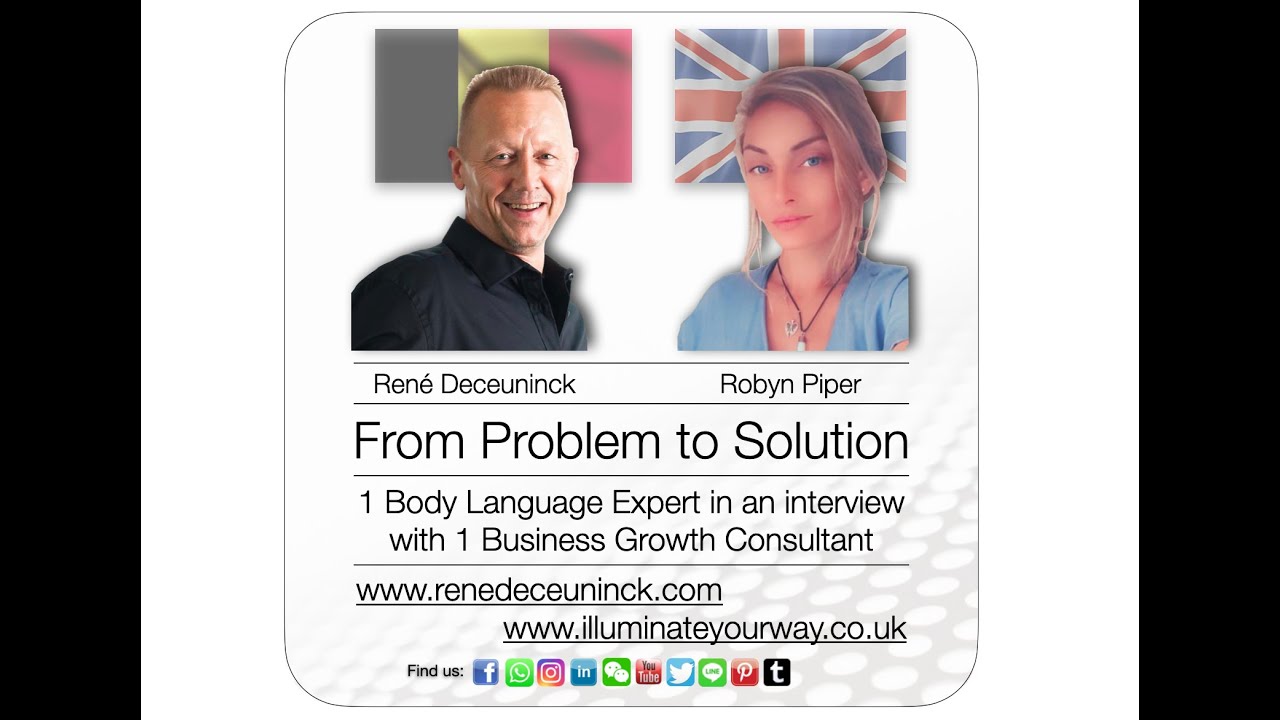
Robin Piper, a business growth coach, shares how she shifted from performing arts to entrepreneurship after becoming a single mother. She emphasizes that 93% of communication is non-verbal, and walks through how she redesigned a snow-bike for remote snowy areas, turning a logistics problem into a product now used by governments and private companies.
Chapters
I run to the moon, I walk on the sea. He is totally wild for you.
Hi everyone, Rene Deceuninck from IPB Ltd in London, the Institute for Personal Development and Body Language. Now, in terms of business, I have the opportunity to interview Miss Robin Piper. She is into business growth. Now tell me, Robin, How did you end up in business and business growth in the first place? Can you share that with me, please?
Well, as a matter of fact, Rene Deceuninck, it started when I was a child upon my first job. I think I must have worked it about a week, and then I kind of decided, you know, or realized that it wasn't my thing. I couldn't work for someone else. I had all of my other ideas and I enjoyed doing other things. Yeah, but I kind of grew up thinking that I was, I was going to be doomed. Yeah, because I was kind of conditioned to think that I wasn't good enough in that respect. Yeah. So I guess that's where the growth also comes into it.
So was that at the age of 13, 14, 15? 13.
13.
All right. So what happened afterwards then during that realization? Something happened as well, right? You shared something earlier with me that changed your life completely at the age of 16, right?
Yeah, I became a mum, became a family. And then when I turned 18, I decided that the family kind of setup didn't align with my values, and I knew I had some burning desire inside of me, and so I wanted to go back to college. So I did. I left the relationship and kind of became a single mom. I went back to college and studied my passion, which was performing arts and like musical theatre. Okay, so yeah, I did that for a few years. Uh, still with me, I carried this belief in inside that I, I had something inside of me, but I, I didn't believe, yeah, like 100%. But I always journaled.
And all right, so you went through that, so you might call it college for art, for music and stuff. But then you continued your journey, you went to study again.
Yes.
How did you— where did you study then? Or what did you study?
So I then— well, I wanted to study musical theatre still at university, but that didn't happen. And I ended up being late for no reason of my own. But I was forced to look on my local university site at what was closing, and the first one there was Business Entrepreneurship. And I did kind of think to myself, hang on a minute, I could be chasing this dream of, you know, being on stage and never actually become somewhere, like go somewhere or become something. So I thought I'd give it a go. I sent in a letter. And later spoke with the course leader and got an unconditional offer. And that's where the light bulb switched on.
The light bulb of being an entrepreneur, being in business. And finally, after you might say 7, 8 years finding out that business in fact is your thing, first of all, but also you have a lot of experience in being a single mom. Studying while being a single mom. And then, so you have like a message out there as well for single moms that don't really see the light, but there is light at the end of the tunnel.
Absolutely.
Would you agree with that?
Absolutely.
Yeah.
But I realized that it's important that you must know what you want, and it's the same in business as well.
Yeah, you've got to know what you want, what you want and why you want it, right?
Yeah. And you know what the benefit is of actually delivering that out there. And when you, when you're able to deliver that, then obviously that's what kind of makes business work.
That's amazing. So how important, because I mean, the Zoom is about, or this webinar is about business, business growth, but in terms of communication, are there certain things in communication that you say this is very important in communication? Because it's all about relationships, isn't it?
Yeah, so I found that communication is everything. Would you agree?
Yeah, absolutely, absolutely. So in terms of, for example, in communication, my niche is body language, as we know. In business, if you don't know how to communicate, you're missing out. And what I mean about communication is leveling, so speaking the same language, right? Leveling. And what I found out is that when you have a question, you ask a question to somebody, an emotional question or a rational question, they will look in a certain way. They will look up, left, or right, and that is attached to your brain. Your right brain is your emotional brain. Your left brain is your rational brain. And when people answer your question and they look, for example, right up, right? That might be they're making the construction of something. And if they should have a memory about certain questions that you're asking and they look that way, you might have a conflict or a red flag that goes up like, "Hey, is this true?" And then rephrase your question in a different way. And I think in communication in business is one of the most important things, how you communicate with people. And body language is 55% of all communication. Nonverbal is including intonation, is 93%. 7% is only words. So it's very important to know that. When you communicate that, for example, verbal, which is conscious. What is conscious? You know, what you face, what you see, what you hear, what you touch is consciousness in the moment.
Yeah.
You'll transfer 40 bits of data per second. Subconsciously, you transfer the nonverbal, that means body language and intonation, which is 93%. Instead of 40 bits of data, you transfer 40 million bits of data.
Wow.
So would you reckon that's important in business to understand how to communicate, right? So how would you, Robyn, tell me, how would you implement body language from the point of view in the content that you share in business growth? How would you implement that? Like managers going home being stressed out, I mean, tell me.
Yeah, so in a workplace, it's very easy for employers, employees to get stressed and really feel the weight of the load of their shift, of whatever it is that they might be doing. And ultimately, if they're not consciously aware of how they're carrying themselves, their tone of voice, how the message is ultimately coming across to this other person, then that could ultimately make their, their day better or worse. But if they're consciously aware of how they're saying something, how they're coming across, then ultimately they can step into this role of leadership and coming from a place of inspiring. Because, you know, everyone in the workplace does deal with these difficult situations. However, how we handle them on a consistent basis is ultimately, especially when we're superior to, you know, our colleagues, then it's important to be that role model, not just stepping into a manager, you know, and just being, oh, I'm manager. You've still got to lead by example and kind of be an inspiration to be able to extract the best kind of outcome. And yeah, I would agree, Rene, that that does start with body language.
So, Robyn, would you agree that innovating your business is super important or your company might even die?
Absolutely.
And would you have like some insights or information that you can share with the people watching this?
Yeah, absolutely. So for instance, I was working with international university students and we had a project coming in where there was a big problem out in New Vascoula, including snow and things. Now we already know that there's certain types of transportation to get around to different places, but there's still businesses that need to operate, such as the government, the electric companies. Yeah, yeah. You know, that need to get to places that's quite dangerous or that's difficult to reach.
Yeah, yeah.
So that was a massive problem. So we really looked around the innovation of that, what was already on the market, what they were using, and found that they were generally using foot. They drive to the best point and then they'd go by foot and they'd be carrying a load of gear and, you know, it's quite dangerous. Yeah, yeah. So we looked around the innovation of a snow bike and really making that lightweight and solving this problem with a snowmobile. And when we looked around the innovation of that, we found that that was very, very doable. And a couple of months later, the same team that innovated this snow bike, and they had it with wheels, they had it with— so you could detaching things, it was all, it was incredible and the government now use that and that is used across a variety of different work settings that needs to get across even ice lakes so it just, you know, in that case there wasn't a business but what I'm saying is by seeing that there's a problem you ultimately come up with a solution that will benefit other people. So when you innovate around that, then, you know.
And suppose if there was a business, they would profit from it, right?
Sorry?
If there would be a business, they would have profit from it, right?
Oh, absolutely, yeah. Because if they'd have just been using— well, no, actually, they were using some snow bikes, But the problem was that they had to dig them out because in certain areas— so yeah, that was it. So they take all the gear on the back of the snow bike and they would ultimately get stuck in some places because of the weight, because of the snow, because they don't know what is underneath the snow as well because it's so deep. So ultimately they looked around this whole redesigning thing and ultimately became a new business and they developed a a whole new product.
So finally, you might say if they would have been in business, they would profit from it, the local people would profit from it, right? And the whole society, in fact, would have been profit from it. So in terms of business growth, you might say that was a successful business growth, right?
Absolutely, because it wasn't just businesses. They found that they had a bigger market because there were people that were interested in sports, that like quad bikes, that like snow biking. And there was one other function to it, but I can't remember what that was now. But it was a great innovation. Obviously, you don't see it over in England because we don't have a lot of snow, but indeed they're doing really well.
But the same system, like innovating businesses, improving businesses with a gain as a result for all parties, like win-win-win. You can actually do that with any business, wouldn't you agree?
Absolutely.
Okay, I've got a final question, Rowan. If I would ask you, who is your ideal client? Who would that be?
Businesses.
Businesses, right? Business owners.
Small, large, it doesn't matter. If there's a problem, there's a solution. It's just down to what methodologies, what tactics that you use. And ultimately, if you're running a company and you've got all of your employees, all of them employees that you've got, have got their own jobs. To complete. They've got their own stresses and tasks, but ultimately when you've got somebody kind of external, they can come in, take on that responsibility. Their sole job is finding out that key information that you need for your company to grow, and that can be internally and externally as well. So looking at, you know, if your employees are not particularly motivated, then they're not achieving as well as you know that they can. Yeah, there's going to be factors of that. And because I've come from a coaching background as well, I'm able to really work with that internal mechanism so that we can push more, um, sales or more positive phone calls, that we're attracting more customers, or maybe we're just keeping more loyal customers because we're listening to their needs. Communicating with them. And then that's where obviously the external part of the research comes in. And, you know, that's basically what— yeah.
So where can people find you?
Uh, so people can find me on illuminateyourway.co.uk.
Illuminateyourway.co.uk. We're going to share that information at the end of the video. So if you would like to get in contact with, uh, Robin, please click on these links So I look forward for Robin to help you out with the pain pleasure, with the problem and the solution. Thank you for watching, and we'll be back. Ciao!
More from Rene


What are ... The Silent Language of Connection and the Hidden Power of Non-Verbal Cues?








