Where does Sales Prospecting meets Body Language?
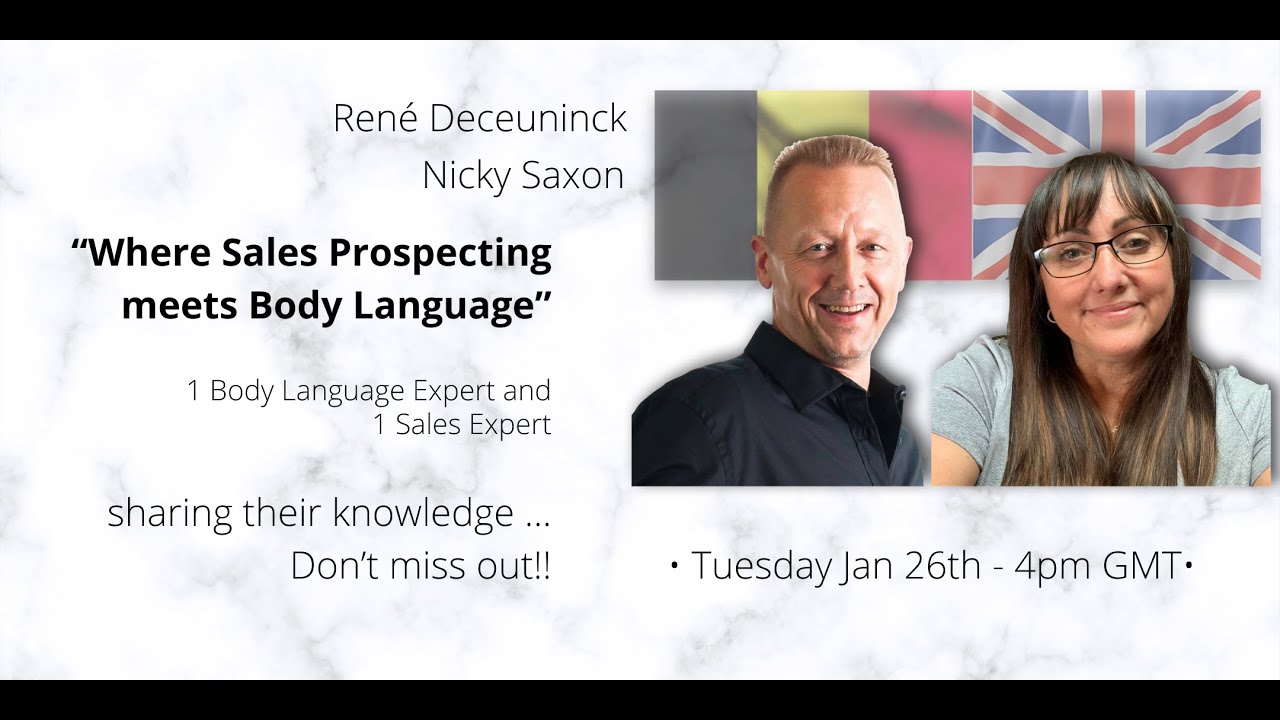
In this 45‑minute webinar, Rene Deceuninck and Nicky (Nikki) combine sales prospecting tactics with detailed body‑language insights to help sales professionals improve cold‑calling and door‑to‑door outreach. Rene shares his global experience teaching body language and collaborating with Tony Robbins, while Nicky draws on 20+ years of field sales to outline a step‑by‑step prospecting framework. Key themes include mental preparation (e.g., “armor” jacket), appropriate attire, setting clear objectives before a call, using an elevator pitch, handling gatekeepers, building rapport with everyone in a building, mirroring and matching posture, eye‑brain alignment (right eye‑rational, left eye‑emotional), reading feet for intent, subtle use of props (avoid iPad), objection handling (LERC method), persistence (6‑week cadence), follow‑up timing, authenticity, and the limits of reading body language (actors, pathological liars, substances). The session ends with a Q&A, practical script offers, and encouragement to practice and be genuine.
Chapters
Yeah, well, let's just start.
Hi, good afternoon everybody. My name is Rene Deceuninck and together with Nikki, we are going to entertain you for 45 minutes about sales, prospecting, and body language. I'm coming from Belgium, born and raised in Belgium. And, uh, moves around all over the planet. And, uh, I mean, all over the planet, all over the planet, Australia, Iran, Thailand, America, a bit everywhere with my company in body language. I teach body language all over the planet, uh, the secrets, the knowledge, and also the benefits, of course, about body language. What can you do with body language? How can that enhance your life? Um, and 20% of what I do is I collaborate with Tony Robbins all over the planet. Maybe some of you saw Tony the last 5 days appearing on Facebook. He's an amazing guy. I've been collaborating for years with him. And yeah, it's lately signed a contract with Thailand to represent him in Thailand. So it's an amazing journey. Now, I hope it's not about Tony, it's not about me, it's about the message that we have for you. And together with Nicky, we're gonna give you as much as we can in terms of information that you can use in the future. Because as I showed in the live on Facebook, I don't know if you saw the live on Facebook, I mentioned that you better be prepared when things go back to, I wouldn't call it normal, but when things go back to, hey, you can visit customers, you can talk to them, you can ring the bell and say, hey, I am, I do, and that's what it's all about, isn't it? So Nicky, the floor is yours.
Thank you. I'll just give you a little bit of background about myself. I've been in field sales for over 20 years. And sales, pure sales, as in 25. So the reason why I decided to specialise just in prospecting is because when I went networking one day about 3 years ago or 2 and a half years ago, somebody said to me, I couldn't do what you do. It's like, why not? You just go through the door, you just knock on the door and you just go and ask. And they went, oh no, no, no, no, no, no, can't do that, can't do that. And I thought, wow, that's amazing, because to me, I've never let go of my inner child, which basically makes me, pushes me through the door. I like exploring, and I like talking to people. And as one person said, I actually chat people up for a living, which pretty much does sum me up, actually. So, um, yeah, so, um, I came about and decided to make this business, business to prospect, or B2P. And, and so basically what I do is I go out and I prospect and either make appointments or act as a sales agent for you, because I'm passionate about growing people's businesses. I've worked in the corporate sector where I've grown businesses for very large companies, and now it's time to give it back to some of the smaller businesses and also for myself as well, to grow myself, because I think feeding your soul is more important than money in a lot of instances. So, um, to start, what I wanted to do really was to basically talk you through a cold call and just get you to understand what the science that is behind the likes of the body language, for instance, because there's so much in it that you just don't realize you're actually doing until it becomes like, it becomes normal to you, but you're just not aware of it. And it's not until Renee Deceuninck and I sat down one day and really just discussed it and looked at the mechanics of it. And it was like, wow, that's amazing. Oh God, yeah, I do that. And that sort of thing. And that's what we actually, we came about and then we decided to do something like this. So first off, Most importantly is you have to prepare yourself. Now Rene will testament to this, that you've got to make sure that you're in the right state to actually do the job. So for me, it's this jacket. This is something as simple as this jacket is my, basically my piece of armour that stops me from actually feeling any rejection if somebody says no, go away. Now I must admit, 99.5% of the people that you speak to every day will not say no. Go away. It's very rare. They normally are happy to speak to you. You might not get to speak to the decision maker, but everybody that goes through your— when you go through a door will actually say yes. So bear that in mind. It's still there to make me feel a little bit better and a little bit more in control. I feel more professional. And if I was to go in with just a t-shirt on, I'd probably be like this, because when— let's face it, you're all sitting there nice and relaxed because you're in your you're casually clothed, so you don't really think about where, how you feel. You feel just like natural, don't you? And just like relaxed. Whereas if you put your suit on, what do you feel like? You stand up, your chest is out. So how would you, what would you say about that, Rene Deceuninck?
Um, that's so true. Um, I remember many, many years ago— could you please, uh, put your mute, guys, because there's some background noise? Um, just some rules. It's far more easier to talk and to have less noise on the background. Now, it is a fact that there's not a second moment for a first impression, and how you show up is very important. How you shake hands— maybe not today, but in the near future will happen again— how you— what you wear. I mean, I used to teach at Oxford Business College at Oxford University and at Brookes University in Oxford, and every single day I went there, I showed up in a suit and a tie And that's a completely normal thing. People respect you and they have far more interaction with you because they look at you and they say, "Hey, wow, what an amazing person." That is so true that how you represent yourself, the first impression people have about you is so important. For the ladies, the makeup, the suit, for the gentlemen, the suit and the tie, depends on the business that you run, of course. If you are a plumber, I don't think you're gonna show up in a suit and a tie, but you know, You know, dress accordingly. And that's so important, Nicky. That's so true what you said. Yeah. Yeah, Nicky, I'll leave it up to you. You ready?
But also, before you go in, I want you to think about what do you want to get out from this meeting or this cold call? Don't go in thinking, oh, they might want to talk to me, they might not, because chances are they might not because of the way you're thinking. Go in with a clear picture of, I'm going in there and I'm going to go and get an appointment, or I'm going to get some information. The last thing you want to do is either get— the first is to get an appointment or to get to see them straight away. Second is an appointment, and the third one is to get some information and the okay to go back again. Never, ever, ever walk away from a cold call as if you've just burnt all your bridges. You have to wait another day because let's face it, it's about 7 times, 7 nos before you actually get a yes in a lot of instances. So that's what you've got to think about. So always think about the long game as well as the short game. So first things first, when you go through the door and you go through, because that door I know for a lot of people is a bit of a barrier. And the thing is, is that door is there for you to actually go in. The company is actually inviting you to go in. They want you to go and they want you to see what they're doing because at the end of the day, how are they going to actually get any more business? If they don't have somebody else to go with you, for people to go in. Admittedly, I'm going in to sell. However, I might tell somebody else about somebody else. So they always want you to go in. So don't ever think that just because there's a door there, you can't go in. So go in with a smile and be a good genuine smile, like, yay, I'm here, this is me, I'm Nicky. You know, this is what you want. You want a nice happy smile and you want to have a nice happy disposition. Because people react to happy people, right? So I know you might have had a bad day, tell yourself a funny joke or just think of somebody, like some people say when you're standing up and you're doing presentations, think about people being naked, yeah, smile, see, there you go, that's it, think about that before you walk in the door and then you'll be fine and that's what you need to do.
So you go in, go in with your Pad.
Don't ever go in with this or an iPad, okay? This creates a barrier. Believe it or not, they still anticipate that as being a barrier. This, a pad and a pen or a portfolio, isn't a barrier as much. It's almost accepted that that's okay because it's more a case of you're using it to take notes. But when you're doing it on here, the perception is that you're actually talking to somebody else. So you don't really want this, you want this out of the way. If anything, leave it in the car if you can possibly do that, that would be better for you in the long run. So get yourself a diary. So you go through the door and the first thing you say is, you go in, sometimes depending on the day, if it's a really cold day like today, I would go in and go, 'Oh, thank you so much for letting me in, it's so cold out there,' and they'll go, 'Yeah, I know, isn't it?' And then you start talking to them. This is it, you're building rapport now. And this is important because you need to build rapport with every single person that's in that building. It doesn't matter who it is, it could be the cleaner, because one day that cleaner could actually be the MD because the cleaner's on holiday, and so you just don't know, do you? You just don't know. So say hello and make friends with absolutely everybody in the building because the more friends you've got, the more raven fans you've got for them to make the decision. It's much easier. So that's another thing to do. So What would you say about that, Rene?
Well, first of all, what I would like to say is to acknowledge Andrew Carter, Fatima Alawa, Lee Stewart, Marion Thims, Marietta Maidman, Mark Bowden. Oh, Mark, how are you doing, mate? Matt Konarzewski, hope I spell that right. Michelle Heer, Ross Thompson, Roy Park, Sam Stryker, and Sonia Dibben. Adore. Something.
Adore You.
All right, awesome.
I think is what the company's called. Yeah.
All right. Now, and if you have questions, how many of you are in sales? How many do of you do prospecting? If you have a question, please put it in the chat and we'll come back to the chat, to the questions, and answer your questions anyway. So please, if you have a question for Nikki, for me, about sales, about prospecting, about body language, please put it in the chat and we'll answer your questions in the end, at the end of the, the webinar. Now, what I would like to add to you, Nikki, what you just shared is so important is that indeed people are mirroring. People will mirror you and they will copy-paste you. And if you know the technique about mirroring, it is so, so, so, so good to— your results will go, go up. And in the sense that, for example, if you smile and people don't smile back, smile even more, right? If they have their arms crossed, cross your arms. And then if they change, you change as well. They change again, change like— so copy-paste them all the time. Now do that very subtle because if they find out you're copy-pasting them, your conversation is over, right? So make sure you do this in a subtle way. Now, if you copy-paste them like 5, 4, 5, 6 times and you change before they change and they copy-paste your posture, which is a normal thing that will happen, you have a connection on a far more higher level. So mirroring, as Nikki mentioned, matching, leveling, It's so important. Level with your customer. Ask questions and level with them. Speak the same language. So, so, so important in a first interaction. When you see each other for the very first time, ask a question. Hey, how you doing? Listen to the tone of voice, the volume. Is it quiet? Is it loud? Is the guy very excited, or the lady? Or are they very, like, introvert or very silent? I mean, copy-paste them. There was Milton Erickson, was a psychiatrist, psychologist, And when he had customers in his office, he would always copy-paste them in all kinds of ways. When one customer came in, he said, hey, uh, doctor, I feel so bad, what should I do? And Dr. Milton Erickson would go like, I understand you, please take a seat, let's have a listen, what's going on with you? And in the brain of that person, that patient, it would go like, oh wow, somebody like me Now the rest of the conversation will go so far and the outcome will be so good, you can't imagine. It's just by leveling. So if you can level with your customer in terms of the prospecting, when you go into a company, make sure to copy-paste their posture, their tone of voice, the volume, and all of the rest. So yeah, Nikki, what do you think about that?
Yeah, definitely. I mean, that's if you've got somebody that is a bit like this. Okay, you can't go up to the desk and go like this, can you? But if you open your arms a little bit or just try and do something just to sort of like make them realise that they're actually doing this, so that by doing that they will actually mirror you anyway. So that's what you find. But to be fair, when you're going into reception, receptionists are trained not to be like that anyway. So as some people call them gatekeepers, I like first to call them receptionists because I think it's a nice name in the fact that what they're doing is there is to obviously prevent people like me from getting through the door. But at the end of the day, that's their job. And all I've got to do is try and convince them. So that's my job to do. So when you first come in, you introduce yourself. After you've had a little bit of banter maybe, or a little bit of rapport, it's about introducing yourself. So introducing yourself and saying, "Hi, my name's Nicky and I'm from B2P." So I'm going to give you my example of what I would do if I was cold calling my setting for my own company. What I do is I find appointments and new customers for your company. So that's what I did. First off, I'd start with a very small elevator pitch, a tiny one, just telling her a little bit about who they are, of what, what I do. So then the next thing to do is to then just pause for a minute and then say, would it be possible to speak to or make an appointment with the person that makes the decisions on where you get your appointments from? So that's what you would ask for. It's a key thing here, not the person that organises it, not the person that actually is the salesperson or possibly the sales manager, but actually you want the decision maker. Now the decision maker usually is, in most cases in smaller businesses, will be the MD. Even when I was like before when I worked in stationery, I would deal with receptionists and they would be the people that actually would be the people that order it. So although I wanted to speak to them because they're the people that are ordering it, I actually want to speak to their boss because he's the one that's gonna— or she's gonna be the person that makes that decision as to whether or not you're going to sell. Because otherwise you've got to do 2 sales because you've got to do a presentation to the receptionist, then she turns around and says to you, 'Oh, I've got to go and ask the boss.' They said you've got to then go and do the whole thing again. So help yourself out by actually asking for the right person in the first place. It's very important. So to go from there, if you get, so what's it say, would it be possible to speak to them, to make it, what I'd like to do is make an appointment for that person. If they say no, that person's not available, so we say get as much information as you can. So this will pertain to the kind of company that you are. So for me, it would be how many sales staff do they have? Where do they get their appointments currently? If they know that information. Gleaning information to find out, find out their contact details of the person I need to speak to, the best time to contact them, the best way to contact them as well. So that's important. So you want to find out if they prefer to have a letter, an email, a telephone call, or whether they'd love rather you could pop— oh no— came through the door. So again, because sometimes they do that, sometimes I get people say to me, He's not in at the moment, but he'll be back in about a couple of hours. Can you come back in a couple of hours? Of course I can. So then that's what I would do. So then, so there's a situation where you can't really go any further because you can't actually, they're not available. So that's fine, we'll just, we'll come back to that one, we'll have another try at chopping down that tree another day. So that's what you need to do.
Okay. Yeah, what I would add, Nikki, is very important to what you just mentioned, all the things you're mentioning, is that in fact what you're doing, you're connecting with a person and you want to get some information from that person. Now, it is very important to know that how do you ask that for that information. And I would not interfere in the words that you used, but I will interfere in how you position yourself towards a person. Because we all know we have a right brain and a left brain, if that makes sense. And the right brain is the emotional brain, where the left brain is the rational brain. Now don't be confused because of the camera and the zoom, it's the other way around, right? So, but the right brain is connected with the left eye.
That's right.
And the left brain is connected with the right eye. So that means that your left brain, your rational brain, is connected with your right eye. So your right eye is your rational eye. So that means when you speak about certain things and you know the things you're speaking about or you're asking for are rational, turn yourself a little bit to the left and look with your right eye into their right eye. That means you're going to connect the left brain with their left brain. That means that your outcome will be far more higher in the end, if that makes sense. It's like a Chinese talking to a Chinese. They're speaking the same language, they understand each other. So the left brain will be connected with your left brain. That means that, that you, you understand each other. The two brains are chatting in, in with, with with the correct, um, on the correct frequency, with the correct energy. Now let's say that I will look with my right eye in your left eye. That's like a Chinese talking to a Japanese. They don't understand each other. Because if I look with my right eye, which is my left brain, to your right brain, that means that there's a conflict. And that's what happens a lot of people say, why don't they don't understand me? Why do people not understand me? It's completely logical because you're connecting the wrong brain with the wrong brain. That's, that's why it's so important to know that right rational— think about Rolls-Royce, the car brand Rolls-Royce, right rational, RR, and the rest is history. So right eye, rational eye, left eye, emotional eye. If I would talk about emotional things, when you start a conversation about emotional, like, hey, how was your trip to whatever country, right, to Egypt or to France? 'How did it go?' That's an emotional thing. What you should do is turn your body a little bit to the right and look with your left eye in the left eye of that person. 'Hey, how was that trip to France?' Or to— and what will happen is that the right brain will connect with the right brain, and you will be speaking, or talk, or speaking, as I say, speaking the right language. You will be speaking to the correct brain. So the right brain or left brain will talk to the other correct brain. Does that make sense? Is it not complicated? Hope everybody understands this. If you want to know more about it, please ask for it in the chat. So make sure to connect the correct brain with the correct brain. Right eye, rational eye. Emotional eye is the left eye. And if you look with the left and the left, emotional. Right and the right, rational. Does that make sense?
In other words, when you're out on a date, you want to be looking at them through their left eye.
That's called seducing, but that's a different chapter, right?
So you get a yes and you're waiting for that person to come down the stairs or up the stairs or from another office. How do you do it? How do you sit? Do you— what do you do? Take a seat? Some people say take a seat, or do you stand up? Now for me personally, I prefer to stand up, and the reason I like to stand up is because for me it says, it says to the person, I'm ready to go. I'm not going to have to get up out of my chair and talk to you I'm ready to go. I'm not going to take too much of your time because that's important. Because those first fleeting moments of when they make an assumption about you is so important. So actually standing up, this is something I was taught a long time ago. Stand up, never do this whilst you're waiting, because what you're doing is you're creating a barrier. You're saying, I don't really want to talk to you. So you want to go, hi, and they'll be like this. Standing just like this, can you see now the way I've got it? Almost sat on my hip and just like standing there with whatever you're carrying with you at the time. It's always a good idea to have something in your hands anyway because then you don't feel like you're just like this all the time and like almost like Tigger or Winnie the Pooh. So that's the reason why having to stand up always and have something just to hand and just be open, be open so that way they can come into you. So when you meet them, say thank you for coming down to see me, coming to see me, whatever it is. Try and build rapport, try and find something that's in common ground. Now sometimes it's a case of you might go into a building and the name of the company is called— okay, there's one I've got a business card right in front of me, it's called Pair of Hands. So what does Pair of Hands mean? We don't know, do you really? It could mean that they're making gloves, It could be that they are making bionic hands for people that are disabled. You just don't know, do you? So what I tend to do sometimes is, 'I see your name's called Hair of Hands, but what does that actually mean? What do you do?' And by doing that, you see, you're getting them— you're— what you're doing, you're opening an open question. It's open-ended, so it's not a yes or no question. And also the thing is, is that they're going to start talking about themselves, and the moment they start talking about themselves they relax, they then start to calm down a little bit because let's face it, I'm cheeky madam, I've just come through the door and I'm just— I was— that guy was in the middle of doing his tax return, you know, you don't know, do you? So it just relaxes them and gets them then to go open up a little bit so that then you can start talking to them about what you want to talk about after, say, 5 or so minutes. It depends how quickly you can build that rapport, but as soon as you do feel like you've got that sort of like simpatico going, you're both looking at each other with your rational eye and that sort of thing, then that's when you know that you're in the situation now to actually go— maybe you might be having a laugh. I mean, I personally take the mickey out of myself constantly, and that I think I find is actually quite helpful because it relaxes people even more. So by the time you've got them relaxed and you said maybe you might have gone and sat down in the reception area and and they're sitting there and they're doing this, they're doing this, they're maybe like, no, they're not doing that, they're doing this, right, so Nikki, what are you going to tell me? Okay, so that's when I would then start going, wow, do you know what, and I'd start with my arms slowly coming down to then to uncross them, and then that way then they will probably notice and then they'll start mirroring me, so that way. Also take notice of where their feet are, This is one of Rene's favorite things, so I'm going to let Rene tell you about what you should look for in your feet.
Yeah, so what I— thank you for that. So what about the feet? The feet are so important. And why is that? Um, we all have a brain, otherwise we would not be here. And, uh, so what happens is that the body parts the further away from the brain are the less controllable, and the feet are the further away from the brain. So the feet will give you so much information. What I mean about that, when you stand up or when you're sitting and one foot is pointing away, that might be that the customer or the person you're talking to, the person you have a conversation with, would love to leave the conversation or wrap it up or even stop the conversation immediately. Now that's up to you to find out. Now how can you find out? Well, by notifying the feet. And when one foot is pointing away, it will be pointing away in the direction The person wants to leave. Now when that happens, you go like, hi John, or hi Amanda, um, listen, are we clear on, on what we've been talking about? You know, number 1, number 2, number 3, and then for next week, number 4, number 5, number 6. Would that be okay for you? Okay, so would we, uh, like to wrap up the conversation? Are you okay if we wrap it up? Um, let's take the agenda and make our next appointment for next week or next month or whatever. And you know, wrap it up. Because the person is not listening to you, or maybe only half listening to you. So when you see that one foot is pointing away, wrap up the conversation and do it in a very subtle way. Make a new appointment, make sure you got a new appointment, right? And then let the person go. And that person will be far more at ease when you do that, because if you give— if you keep on rattling and rattling, oh my God, and they will like look like this and they will look like that, and they will You have to pay attention to the, to the signs that you get from a body, from another person, and especially the feet. Because again, the body parts the further away from the brain are the less controllable, and they will give you so much information. So right, Nikki.
So if you've got somebody who's got his feet pointing straight at you, bingo, you're on to a winner. So that's true. So basically, when you first meet them and you've had a little bit of rapport, then you'd introduce yourself a bit more again. And say, my name is Nicky and I'm from B2P and what I do, and do the small elevator pitch again, I find customers for new company, for the new business, for companies. And then what you would then do is say, what some of my, some people tell me is that they find that going out cold calling is difficult. They find that getting their salespeople to do cold calling is difficult. They find that actually they're stalling a little bit in their new business. And is that the same for yourself? So you pick 3 things that would pertain to your business, and those 3 things you're wanting a no, yes, yes, yes. Salespeople hate cold calling, by the way. I am quite unusual. So, but most people actually hate cold calling. So, which is really crazy because I think it's the best thing in the world. So anyway, so you want 3 things. When they say yes, then you go, great. 'This is the thing, you've got to use a really good positive word. Great, that's great, that's what most people tell me as well. So have you got some time to talk about it now, or can I come back another day, maybe Tuesday or Wednesday next week, which would suit you best?' And that's where you get the appointment. So that's where you're doing— you're giving them, those people, a 'which' close, as in either/or, but at the same time what you're doing is you're actually getting them to actually commit to something, whether it's a living. If you get a no, then you've obviously, you've got to go through some objection handling. So then it's a case of you just got to ask the kind of questions that you need to ask for, you know, is it because of, have you not got the time right now, or, and they usually do give you, I haven't got time right now, or no, we've got salespeople, we're all right, thanks, 'and that sort of thing,' it's like, 'Well, okay, that's fine, thank you very much.' Listen, empathise, and then refine and secure and close. So that is called LERCs— sorry, listen, empathise, refine, and then close. So that's listening to what they're saying, say, 'Is that so? What you're saying is, is that at the moment you've got some Salesforce, but you're not happy with your results, your sales results at the moment, is that correct?' And then they'll go, yes, okay. So if I can show your Salesforce how to do better prospecting and get better results, would that be something you'd be interested in? Yes. So that's when you go, great, so can we talk about that now, or can I come back on Thursday or Friday next week? So again, we try 3 times. We start to the third no, back away. Thanks, thanks very much. Appreciate with time. Is it right if I come back in maybe another few weeks' time? And yes, then that's great, because not only— you're not going to get everybody on the day. It's always leave the door open, never leave it closed, slammed shut. That's very, very important.
So, um, what you just mentioned is so important about your— the question, the questions. If you ask questions, open questions, the, the W's and H's, so the why, where, when, who, which— if you start your question with those They will have to come up with a story. Millionaires and billionaires become millionaires and billionaires by asking questions, not by doing the talking. And the more questions you ask, the more information you get. So when you ask questions and you don't do the talking, you're in charge of the conversation. And when they come up with a story, right, you can use the time to create your new question, because the story they bring— based on the story they bring, you can create your new question. Based on the story that you hear, the time you get, you can look for congruency. If what they say is really congruent with their body language— if they tell you a lie, you'll find out immediately if you know about body language, right? And there's so many more things that you can define by letting them do the talking. Let somebody else do the talking and you listen, and it will give you information to work with. Bear in mind to ask open questions, not yes or no questions. Nikki, there was a very good, uh, A very good thing you mentioned there.
Yeah, so okay, there's one final tip before I wrap this up and we do questions, and that is that if you get an absolute no, bugger off. Excuse the terminology, but if you do get that, walk away. They're just having a bad day. And I have been told to fuck off and get out of this building, how dare you come in here, which did make me cry, by the way. But I was very, very early on in my sales career. Now when I think about those things, I just brush it off and think they're having a bad day. And I won't actually tell you exactly what I think because to me it makes me smile and it's a bit rude. So off I go and I open the door and I think about the next person that I'm going to see who's actually going to be nice to me and smile. So that's the way to think about things. And that's really important that you have some sort of coping mechanism for when you do get somebody that is that vile. You will get one in about 10,000 cold calls, literally just one, it'd be one, and it will impact you and it might even put you off, but don't let it put you off because everybody else is really lovely, everybody's lovely, and you're there to do a job, okay? And never ever apologize going through that door and saying, I'm here to talk to you, because that is very important. You're not apologizing, you're doing your job, you've got a message to say, say You are all business owners here, so consequently you are here to make a livelihood and you're here to, to actually get more business for yourselves, but also to support these people because at the end of the day you have a solution. So you're not there to sell them anything, you're there to give them a solution, whether it's Lee who does print, Marianne who does water and sleep, you see, and Sonia who does these amazing walks through the forest. If anybody's ever seen them, they're just amazing. You should go and do it. I went straight back to my childhood the day I went out with Sonia. And Andy— Andrew, sorry, who does HR, and Mariette, who does holidays, and Mark, who does systems. Amazing systems, by the way. Selena. Oh, hello, Selena. I didn't see you sneak in there. So yeah, so just think about, you know, the fact that you are there and you're there, you've got every right to be there, and never apologize. And think about the fact that you're there to build your business I got a story about that, right? Go on then.
So I went for— I mean, I've been collaborating with Tony for quite a while, but my very first presentation for Tony, that was in London, and I had the advantage or disadvantage, you might call it whatever you want, but I had the advantage to have the owner of Success Resources, who was the biggest organizer, event organizer on the planet, and organizes all the events for Tony. She was sitting in the back of the room. I said, oh no. So I mean, and then representing the big man for the very first time, having the organizer in the room, I was like, oh my God. And the first thing I did, I mean, I did the routines, you know, backstage and the breathing exercises, and you go on stage and there's a lot of people in the room. I don't know, I can't remember, like 500, 600 people in the room. We had an amazing time. And the first thing I said, hey, listen, if I say something that really doesn't make sense, do remind yourself I am from Belgium, so apologize. And then I went on with the whole thing, and at the end I say, hey, Veronica, can I have some feedback from you? And she says, Rene, you did great, you did awesome, you were amazing, people are in there buying tickets. However, one thing, never ever apologize for anything. Everybody is unique on this planet. If you're in sales and you do prospecting or you do sales, or— never apologize for anything. If you did something wrong, different story, you have to apologize. If you did something wrong, right, you don't show up or whatever— I had an experience myself and it happens once in a blue moon— I have to apologize for sure. But in a normal situation, never ever apologize. We're all unique and that's so important to remember. Back to you, Nagi.
Okay, so we've got any questions? Have a look in the chat. So I think the first thing I read was Marietta saying something about— oh, you need to take my glasses off, sorry, it's a bit too late now. Yeah, so, "It's great to hear you talk with a flag in your hand." "Dogs look at the right side of your face too." Is that true, Marietta? So they do, they actually do look at your right side. So yeah, it's actually probably right because it's all about tax, isn't it? And that's something very interesting. Yeah, yeah, I think that's a really interesting point.
I think that's a really interesting point.
Yeah. So anybody else got any questions? You want to unmute yourself and then maybe just call out?
Sam Straker is mentioning, I think that's a really interesting point, you're not there to sell to them, you're there to provide a solution. So true. That's so true. Once you understand the human needs, the need of the company, the need of that person you're talking to, if it's certainty or uncertainty, is it love and connection or significance or growth to contribute, the basic human needs, if you find out what their need is and you can meet their needs, you've got a customer. So true, Sam, thank you for that. Vicky, back to you.
I think at the end of the day, I think, um, as a salesperson— and you get— we do get a bad rap for being salespeople, but if you do it with heart and you really believe in what you're doing, then that comes across when you talk to people. And that's, that's the thing. If you're really genuine, and you will come across as genuine, and consequently people will warm to you much quicker than if you are— you hate what you're doing. So for instance, I went to work in— for first off I sold stationery, then I went to work for telecoms company. I lasted all of about 10 days. I really hated it and it was not a good fit for me and it fit and it showed. And that's why when I went in today and said I can't do this anymore because it's just not a good fit for me, I don't feel like I am giving you my best by doing what I do. So then I went and worked for Biffa and talked rubbish, which I was absolutely brilliant at. As you may have guessed. So yes, for them. And I know I ended up winning awards. And then they introduced me to networking. And then that's when I decided, you know what, I'm not going to work for a big company anymore. I'm going to work for smaller companies because they appreciate you more. And they really do. You all do.
And some people ask me, what kind of body language should I use when I go into a company? When I enter the door, what kind of body language do I use? I said, use yours. Be unique. Never ever change for anything or anybody, right? If you have a bad habit, please pay attention to it, that's for sure. But never change your body language because there's one rule that you have to remember in body language is to, to know that your body will never lie. Your body never lies. And if you come up with a lie that really doesn't make sense, but you're so convinced that it makes sense to you, so so you can guide the conversation, your body language will say differently. And do know that if you say something to somebody that is conscious, and when you do something conscious, that means the speaking, the listening, the touching, the tasting, which is conscious, which is in the moment. When you say something to somebody, right, that's conscious, you transfer 40 bits of data. When you transfer conscious words, you will transfer body language as well at the same time, the non-verbal, which is 93% of our communication. And when that happens, transferring non-verbal from one person to another person subconsciously is 40 million bits of data. 40 million instead of 40. So, and that information will be processed and processed in the brain of that person and come back to you. And that's why they say the outside world is in fact a reflection of yourself. So wouldn't it be important to know that lying doesn't make sense? Your body will never lie. So would you agree, Nikki?
Yeah, totally. And also, I have not got the brain power to remember all the lies that I'd have to keep to actually remember them, because if you— you don't remember lies, you remember truth. Don't you? It's as simple as that. So if you tell somebody a lie, you've got to remember that person that you've lied to, and you've got to remember that, otherwise they're going to go, didn't you say such and such and such? Remember when you've told a little white lie to your partner and then they catch you out with that? That's exactly how that's happened. So in other words, it's the best place to be. Honesty is the best policy, 100%, because at the end of the day, it makes your life easier, believe it or not.
So Yes, but there's, there's a few categories, like people using drugs and medicines and alcohol. You change the state of your body, and then the reading the body language is not such an easy task. There's a second, uh, category of people, people who are professional actors. They can act as much as they want, right? Very, very difficult to read body language in a proper way. And the third kind of people is not easy to read their body language is pathological liars. People who believe in their lies and their body adapts. For example, one kind of pathological liars are narcissists. Narcissists will always believe in what they say and they are right, and there's nothing that will change their mind, right? So the 3 categories of people who's not that easy to read body language. But in— for the rest, I mean, let's say 80% of society, if you lie, you'll find out. And if you don't know nothing about body language, your gut feeling will go like, yeah, there's something wrong here. I don't know what it is, but something doesn't— would you agree, Nikki?
Yeah, definitely. Now Lee just put on the thing here, how do you get past the gatekeeper? But this one could be tricky. It took me 2 years to win one company just to get past the gatekeeper of going in every 6 weeks, because that's what— I mean, there's a magic formula that the Lyrico, the company I used to work for, has actually come up with, which is 6, every 6 weeks. If you go in every month, it's, oh God, it's them again. If you go in every 2 months, it's too long, they've forgotten about you. So 6 weeks is the magic number. So go back every 6 weeks and go in and build rapport with that person slowly, slowly, slowly. The thing is, is the whole idea is it's a long game. In certain instances, it is a long game. It took me 2 years to win Portsmouth Football Club. That's how long it took me to win that one. And that's from the first day I knocked on the door, they said, yes, we want to talk to you. And I had an appointment the following week. But then it still took 2 years to close the deal. So don't ever think that it's a case of you're going to get things straight away. Sometimes you have to be patient in sales. It's just the way of life in that sort of instance. So when it comes to gatekeepers, build rapport, build more and more rapport, get to know them, get to know about their families, get to know about what they like to go on holiday. So that when you go in the next time, "Hey, you went to Greece, how did that go? Did you have a nice time? I see you've got a nice tan." Those are things you just either commit them to memory, because I do, because when I enjoy myself, I actually remember a lot more. But other than that, or write it down, make sure you remember it. Because when they— you go back in and say, did you have a nice time in Greece? They're going to go, oh, and that's that little bit more of breaking down that barrier that you need.
That's again leveling, isn't it? Yes, that's again leveling, right? Speaking the same language, right?
Exactly, you're getting to that point and then eventually what happens is, this is the great thing about when you get somebody that's actually really hard to win or to get past the gatekeeper, when the gatekeeper has got your trust, you've got her trust and she hands you over to the decision maker, okay, she becomes your raving fan and she will go, you know what, I was speaking to Julie down the road and she said she needed some stationery and that her stationery company was absolutely rubbish, can you go and pop down there? And I'll say, no problem, will do. So I tell her, you sent me? Yeah, great. Off I go.
There you go.
Yeah, it's so true. You've got it. For some people it is a case of— so I've had, as I said, 2 years to knock on the door physically. That was in Guildford, and that was like 2 years of going in every 6 weeks. Hello! And I'd literally go, it's me again! And they go, oh God, not you again. Yeah, like the bad penny.
And I'd have a laugh and they'd go, okay, no, not today.
Okay, go on then, off I go. But eventually you go, 'Oh, come on, I've been coming in here for a year now. Do you think that really you might want to give me a chance now?' And then slowly but surely you wear them down, then they go, 'Go on then.' So yeah, that's, that's the way to get past the gatekeeper.
That's so true. That's paying the price. Yeah, in fact, paying the price you're doing, right? It's, it's, uh, people ask me, 'How do you end up with Tony Robbins?' I say, 'I don't know. I really don't know. The only thing I was, I was persistent.' I never gave up. I sometimes drove 8 hours for a 5-minute meeting. People say you're nuts. I said, I know I'm nuts, don't worry about it. But I was paying the price and I was not even aware of it. I was so driven. I wanted to see that organizer, I want to see the manager, I wanted to see— and I kept going and kept going until the moment they say, oh wow, our Belgian friend is there. And I say, yeah, sure, I just drove 8 hours to get here, right? I didn't say it, but I was paying the price. And then all of a sudden I said, you know, enough is enough. And I took a decision and I went to the organizer and the responsible person in, in, in that company and said, listen, are we in business or we're not in business? Because I'm going to give up on you. And they were like, huh? And she said, stay. And they came back with the PA, personal assistant, and said, hey Rene, uh, we would like to have all your information. You're the new guy on the block. I said, excuse me? 'Oh, you still want it, don't you?' I said, 'Yeah, of course I just want it.' But that is a price to pay in business. You pay a price whether you like it or not. And if you say, 'Hey, ah, they're not going to become my customer because they're not interested,' that's not true. You have to build up rapport, you have to build up a relationship. As Nikki mentioning, you have to have that relationship with a person. If you have big goals with big companies, you have to create a relationship. And once you have that relationship you're in for years, that's for sure. That's how it happened with me, that's happened— that's how it happens with Nikki. So I don't know, is there anybody in sales, or is there anybody that is on a prospecting thing that said, hey, I'm prospecting a lot as well? If you have questions, please put them in the chat. Uh, Nikki, back to you. Sorry for—
okay, just one more tip: follow up. Very important. Follow up is key. Okay, I said a really great saying the other day on, um, of LinkedIn, which was collecting the compliment slips and business cards is a bit like picking daisies, they die within hours. So you've got to follow them up the next day, sometimes the same day, depending on what the person has told you is the best time to catch that person. So following up phone calls actually done early in the morning is actually really good because most business owners are actually in the business before everybody else is, so they will actually answer the phone. So there's a tip. Phone early in the morning because you might actually get the person you want to speak to as well. And don't forget, the cleaner might be the MD. Very important that you say hello to everybody. I used to say hi to everybody in every company that I looked after when I was working for Lyrico, and they all knew me as Nikki the stationery lady. That was me, I was the stationery lady, and they'd all go, hi 'Hi, Nick, just the person. We need such and such and such. Can you tell Julie that we need to order these, these, these?' And I pick up so much more orders simply by them seeing me and going, 'Just the person.' So yes, it's important. It is important to get to know everybody.
Lee says, 'How do you get past the keep caper?' Marianne says, 'Great talk, guys.' Thank you, Marianne. Thank you, Lee. And Lee has a question for you, I guess, Nicky. Do you use a CRM?
CRM, yes, I do. I was using HubSpot, but I'm actually in the process of looking at my own CRM, which I'm gonna have built for myself, simply because the requirements that I need for my company are different.
I would like to ask the participants, we're gonna wrap it up a little bit. We've been online for 48 minutes, normally it was 45 minutes, so I would like to respect your time. Is there one question you would have for Nicky? Is there anybody that has one question? Please unmute yourself and say, hey Nikki, I have a specific question about prospecting or cold calling. Anybody? Please unmute yourself and feel free. And don't be shy, please.
It's fine.
Anybody? We will share our information at the end of the meeting. The meeting is all registered. Is recorded, so it's going to be on YouTube. So if you want to rewatch it and have the information where you can find Nikki or me, it will be there. We will share it anyway. Um, is there anybody has a question about body language? Feel free.
Yeah.
Hi, hi Nikki.
Hi everyone.
Okay, um, I'm going to be going in, um, an area where it's people's personal lives. So rather than the professionals I want to target, is people on the professional, you know, their professional life. How do you think I should go about approaching people when it's a personal life? And say if they're professionals but I want to connect with them on the— so that it's something to do with a personal life, the service that I'm going to provide them, How would you say I go about doing that, Nikki?
Well, that would be an emotional level. You'll connect, you want to, you want to build trust, so you don't want to be direct like this. You actually want to be talking to them like this. In other words, you're looking at them through your left eye, so that way you're actually talking, you're connecting to them emotionally, because what you're going to be doing is providing a personal service. And be respectful as well. Now I know Selim is very respectful, so it's not an issue for you. But being respectful, thanking them for— especially if you're going in their home, thank you for letting me into your home today. I appreciate that, you know, this is your safety net, or this is your castle, and I'm a stranger that's come into this, and thank you very much. I always thank people. I'm probably known as the most polite sales rep there is, or was. So, you know, that's just me. So it's about— but again, you're just allowing them, just by saying that you appreciate them, And then obviously, and then, and then just start talking to their emotional side of their brain. That's how I would deal with it. Sorry, Lee, did you want to say something?
No, Lee has to go.
Oh, okay.
See you later, baby.
Let's wrap it up. Let's wrap it up. Lee, thank you for joining us, man. Um, and there's one more, uh, notification. Marion says, really interesting point about the left and right, actually. The left and the right eye. That's, that's so true. Connecting the right brain correctly in the correct brain. Actually, I apologize, Marietta, I think I got that wrong. I think dogs look at the left side of your face as they are looking to see your emotions. Could be, could be. I'm, I'm, I'm not gonna argue this one, but I will look into that, that's for sure. Um, guys, thank you so much for joining us. We're gonna leave our information at the end of this recording. The recording will be on YouTube, and I will send you a personal invite to have a look at the YouTube link. Um, thank you for joining us. Nikki, is there one last statement or thing that you would like to leave with the participants?
Just gonna say that if you want a copy of my script, then just let me— let me know. Just contact me, and then I'll send it out to you of what I've got so that you can then use that as well. Practice, practice, practice makes perfect. And remember that when you first go through somebody's door, they don't actually know what you're supposed to say, so it doesn't matter if you fluff it up a bit because it's just, that's the way life is. And have a laugh with it, have fun, think of yourself as being a child again because that's what I do. And it's getting really dark in here, so I'm going to say goodbye.
So yeah, thank you for joining. And in terms of the body language, make sure to be yourself, never fake it until you make it, just be you. And just do it. Thank you for joining us.
Thank you.
Everything will soon be online. I will share it with you. Thank you so much.
Bye!
More from Rene


What are ... The Silent Language of Connection and the Hidden Power of Non-Verbal Cues?








