How Influence Is Built on Trust with Richmond Dinh
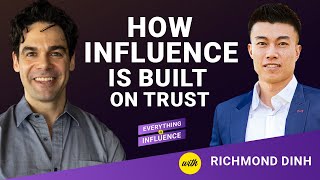
Richmond Dinh left optometry after 10 years to coach startup coaches full-time. He gives free challenges as samples of his paid program, uses NLP training to set his coaches apart, and built a team of seven doing $3M a year by starting with 10 pro bono clients for reviews.
Questions this video answers
April 21, 2022
"Results in advance" marketing (giving a result first, then asking for the sale).
NLP trainings (he certifies coaches and teaches NLP skills).
His first 10 clients were pro bono (in exchange for reviews and referrals).
Approximately $3 million per year.
Chapters
If you can be the facilitator for them to believe in themselves, then that's when, that's when sales becomes fun. But also it's a process where it serves them to the highest level.
Welcome back everybody, to the Everything Is Influence podcast, where on each episode we go back through the four pillars of influence, the four levels of influence, really. Level one, what controls influence over ourselves? Our own integrity, our values. How do we see the process of influence and how we manage our own lives? How do we take what's inside of us, the certainty, the conviction, our purpose, our values, and spread that to another person, which is level two influence. Then level three influence, how do we spread that to groups? And finally level four, where we replace ourself through people and process by instilling our influence into the people around us, where we can really have influence at scale or what we call life. Legendary influence. And really excited to talk to you today with a good friend of mine, Richmond, who has become a legend in his own right. I saw this guy just on social media one day and I was like, who is this guy? And I knew he was a Tony fan like me and actually got him to give me a testimonial and he helped me sell from across the pond. He helped me sell business mastery for Tony through his testimonial while I was doing a business mastery in Moscow of all places. So absolutely amazing to see what he's done in the coaching world. And this guy is just a light. You are prepared. You just prepare yourself for some fire today. So without any further ado, Mr. Richmond, how are you, sir?
I'm great. I appreciate you, Eli. And geez, this is very humbling to be on your podcast today.
It's going to be fun, man. We're going to dig into it. So the way we usually do it is we kind of reverse engineer what you're up to today, all the way back to how did you become this person? So let's start off for the listeners. What are you up to in the world? Like, what do you do? What does your business look like? How do you see the process of influence? Like, who are you and what do you do in the world?
Love this question. So we help startup coaches transition out of their current job into full time coaching. And so anyone who wants to, whether they're in a professional career, corporate career, or in personal development, say they just want to create a full time coaching income and do what they love, full time. That's what we do from an influence point of view and from a marketing point of view, we've adopted what we call results in advance marketing, meaning that the best way to build trust is to give someone a result first and then ask for the sale after. And that's what's helped us grow our business to where it is today, which has been a massive success, particularly in the last couple of years since we've been doing that.
Wow.
Yeah.
As we were talking before this, I've hopped into some of the free content that you've put out there and gotten some results and loved it. And so that's, that's amazing. Were you always doing it that way or is this a new thing? The last couple of years, we've always.
We'Ve always delivered value like most, most entrepreneurs or most people in the online space would give us some sort of content or free video or anything. But we've taken it one step further by giving away a challenge, like by doing challenges. And I know a lot of people are doing challenges these days, but it's actually, our challenge is actually a piece of our actual core program. So it's not so much, you know, a little bit drip feeding here and keeping open loops and, you know, keeping hanging to the end, but it's actually a real sample of what it's like to work with us. And so they get a taster.
Which part? So with a coaching business, there's of course, you know, attraction, conversion, delivery scale, there's these pillars. What, what part or is it mindset? What, what piece do you typically take people through?
Yeah, attraction mostly. Because that's what most people want. Like they just want to get more leads. And we do touch a bit on sales, but mostly attraction and that Everybody needs more leads. Everybody needs more leads. Yeah.
And what's. What I, I love about your process. I mean, there's so many other people out there that are, you know, coaching coaches on how to coach coaches and you know, all that stuff. But you actually have. Cause we both have the Tony Robbins background and you have an NLP background where you're really helping people. So it, it drives me crazy personally when I see a lot of these people go through coaching programs and they have scripts or even marketing scripts or whatever, and they're saying the things, but they don't know why they're saying what. So they're disassociated from their own words and they wonder why it doesn't land. So kind of walk us through what is unique about your process for people.
I totally agree. And that's the problem. And that's why there's a Bit of a stigma to this space because most people can be great at marketing or sales to some degree, but without being a great coach or understanding exactly what you're doing, then the client doesn't get served and you don't produce results. And then the client means they're saying, I spent these. This amount of money into this other person, and I didn't win that kind of situation there because that coach just wasn't really that good. And so our biggest. Our biggest point of difference and where we fill the gap is we actually include NLP trainings into our program. And so we certify coaches, but more importantly, we're getting the skillset to understand exactly how to communicate, how to influence, how to actually become an effective coach. Because if you want to be this, like, a successful coach in the long term, 5, 10, 20, 30 years, then you actually got to be good at what you do. You can't just be good at marketing because you get found out very quickly.
Yeah, there's a lot of great coaches that can't market and a lot of great marketers that shouldn't be coaching. It's great to make sure that once people are on board, they're getting all the tools that they need. Were you always a coach?
No. Five years ago, yeah. I was an optometrist for 10 years. As an optometrist? Yes. Yeah, yeah, I see that.
I see what you mean.
I see totally, totally, totally. Introverted, nerdy. Studied hard. I got ducks in high school. I won one of the highest optometry awards you could get in university. I was a very successful optometrist. And when I left that to do coaching, most of my peers were like, this is like the biggest waste to the optometry industry. Like, we're losing, like, a really good optometrist here. It just wasn't me, though. It wasn't my passion, and I just had to get out.
Yeah, and I guess. What made you switch?
You know, it's a funny story. You know how people change when they turn a decade, like turn 30, 40, 50, or something happens like that. So in optometry, you gotta sign an AHPRA form every year, which is a health professional board, to register, and you gotta do a survey. You gotta make sure that there's no felony. You don't have any convictions. You, you know, you're all good, like, as a human being, and you pass all the point requirements. And every year that survey, they ask you a question. How much longer do you want to be an optometrist for? And I always knew I was going to do this for a long time because I just wanted to please my parents, make good income, invest, and then find out what my real passion was. And every year I would tick the box. There was like a 1 to 3 years, 3 to 5 years, 5 to 10 years, 10 years plus. And I would always tick the 3 to 5 year box. And I tick that box for 10 years.
And the 10th year I ticked that box, the 3 to 5 years was when I felt like, I cannot do this for another year. And I just needed to build the courage to pursue what I was passionate about, which is personal development.
So you decided that you're making a switch, but you didn't have a job. You know, there's not. There's not coach. You know, we're hiring coaches. What was that transition like for you personally?
Tony Robbins. Tony Robbins changed everything. And through Tony Robbins, I met Scott Harris and then became one of his clients. And then that's how. That's how it all started. And the truth is, I only joined at first. I wasn't sure if I wanted to be a coach, but I knew that I wanted to learn the skill sets to coaching because I wanted to become a better father. Like, that was the main thing for me. And then it just snowballed into this career to where we are right now. Wow.
So you started. How did you. So for people listening that want to get into coaching, want to get their first clients, have, you know, proof, because it's one thing to want to help people. You got to market, you got to sell, you got to deliver all of that. Like, what was the. What was the initial process? Like you joined Scott's program or you went to a Tony event, you know, what. What was that like?
Yeah, totally. So I did a ton of Tony courses, went to Scott's program. But what really launched it for me was actually what I learned from. I believe I saw Jay Abraham speak at one of these events, and he said, like, for particularly startup coaches or startup business, it's really important to get your name out there by doing pro bono in exchange for a review and a referral. And that's how you launch a business. That's how I did it. My first 10 clients were all pro bono, but I got 10 great reviews out of that, and then also 10 great referrals out of that. That was the condition for working them for free. And then that just snowballed into the business to where we are today. And that is what got my name incredibly out there. So I know a Lot of people say, don't do pro bono. Don't do it for free, but you actually not. You're exchanging that for something more valuable, which is reviews and referrals, which build momentum for your business, because most people will take a long time to get that. And they try to charge straight up front. It could take a year to two years to get the first 10 reviews.
And so that's amazing. Starting off doing this free content and then from there. So what is your business like today? Like, understand what you do for people? Is it just you? You have a team.
What does it look like? Yeah, we've got a nice team of seven right now. Right now we do $3 million a year. We've got a nice team of seven and.
Just really proud of the team. Really proud of the team. They're all on board with the mission. They're all on board with the culture that we have, and they all want what's best for the business.
Amazing, Amazing. So you obviously Australian guy. Yep. You live in where you live?
Sydney.
Sydney, okay. And grew up there. Parents were there, you know, all of that. How old are you, by the way?
39. Too hard to tell with Asians. It's too hard to tell. Yeah.
You look. You look young, man. You look 25.
That's.
You don't look at age too.
Are you like, you know, it's. It's coming. It's coming. So that's cool. So you grew up there and your family wanted you to be an optometrist. Was your dad doctor or something like that?
No, no, my parents came in from the war. They had nothing like. I mean, when you speak about spiral, they were very. Going out of red into blue. And so they came from the war. They didn't have an education.
Explain that red to blue.
What is that?
They explain that for people.
Yeah. So when it comes to. Yeah, totally. I. I know we can geek out on spiral all day long. So my business plan is the NLP trainer. So I'll do my best to explain it. And I know if he watches this, you know, oh, my God, Rich is not explaining it right. So when it comes to, like, the evolution of human consciousness, we must go through these levels and levels of consciousness. And I believe we start off with purple. Correct me if I'm wrong, purple or something on the bottom, but, well, red is basically a level conscious where you value power, you value sort of authority, you value everything your way. Like that's kind of, you know, where you will lie, cheat and still to get things. And it's always very self centered. That's everyone needs to go through that. But there comes a point in time where you realize that behavior or that value only gets you so fine life. And you have a dip in your life and you have a moment where.
Nothing'S going your way and you reach this new level of consciousness called blue, where now you have rules and systems and processes and structure and discipline. And that's why most people who go out of prison moving from red move into blue, which is like rigid society or they find faith or they find God, they find some sort of structure in their life and that serves them to a point until you realize that only gets you so far and then you transition to the next stage which is orange and then you move up the spiral. So life is about going through that journey and accepting where you're at. And so usually from third world countries, they're a very red cultured country. And then when they move over here, they get indoctrinated into a blue sort of society which is more about Australia. America is more moving towards orange or orange quite society.
Yeah. When I, when I do trainings on this and for everybody, Claire Graves, I think at a Nobel Prize for this body of work, spiral dynamics because people are here, so success oriented, which is five orange. And you see somebody go to a success seminar, even in a program, some people get it, some people don't. And so I kind of reverse engineered, I said you're here for success. But all success, even if somebody gets it temporarily, if it's not grounded in a solid four, rules and discipline to support the success, you will lose the success. People make some money, they get some achievement, but they don't have disciplines and rules and standards don't manage their finances whatever. So they need a solid four. I'm like, look, you're leaking energy here. And then some people might have the success, have the structure, but they're a pushover, they don't have any of that. This is mine.
More from Richmond

How To Get Your First Coaching Client Without Posting Content (Day 5/5 of The First Kiss Challenge)

How To Get Your First Paying Client Without Posting Content (Day 4/5 of The First Kiss Challenge)



How To Get Your First Coaching Client Without Posting Content (Day 3/5 of The First Kiss Challenge)




