Tiny Challenge™ Choreography. What To Teach on each day of your Tiny Challenge™
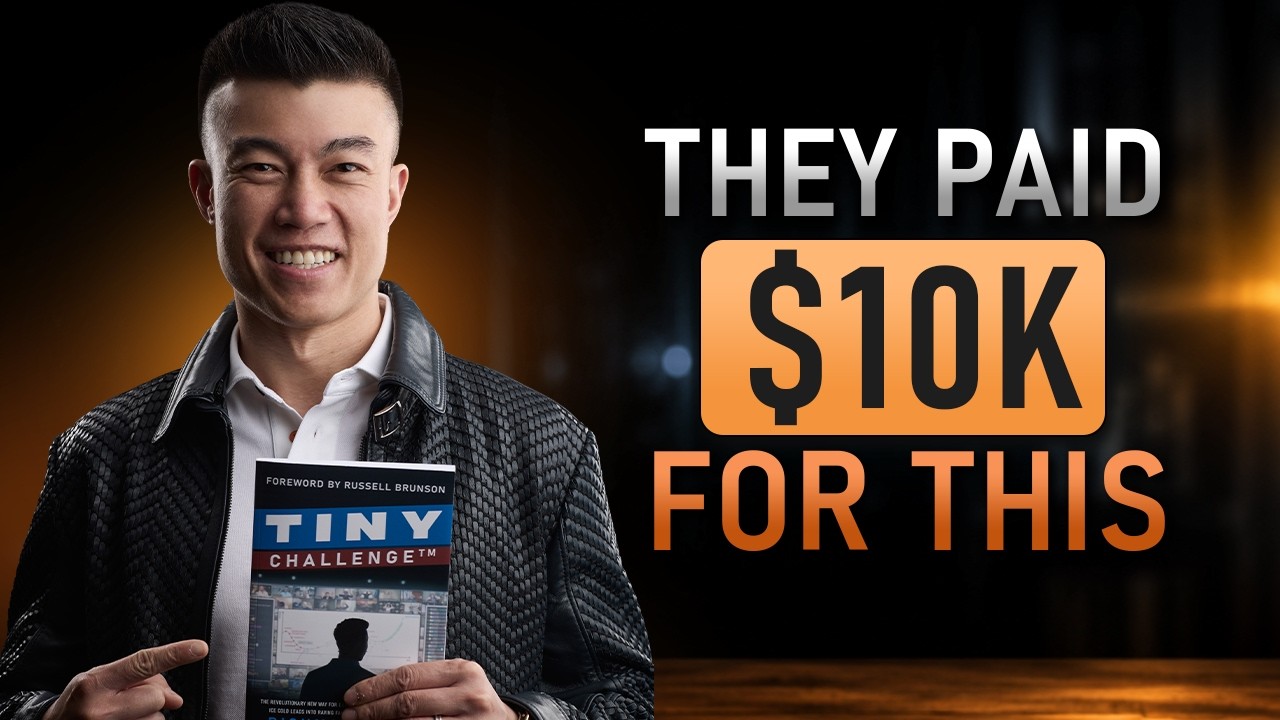
Richmond Dinh walks through his five-day Tiny Challenge model for one-on-one coaching, covering the daily choreography, vetting filters, pricing strategies, and conversion scripts. The framework uses the 5 Fs and 5 Rs to structure each day and includes homework, deposits, and handwriting commitments to qualify leads.
Chapters
Okay, so you may have heard me talk about the Tiny Challenge, and this is the first video that I'll be making about how to actually run the choreography from day 1 all the way to day 5. And the most important days to nail in order to increase your conversion rates is day 1, 'cause that's where you frame the whole conversation and they pre-decide whether you're gonna be the coach for them. And then day 5 is the close where they take action on their decision. And so this was a live training I did to Graham Cochrane's $10K Mastermind where I revealed the whole choreography and I answered questions unfiltered on how to fill it, how to weed out tire kickers, how to make 6 figures from one single tiny challenge, and all the other questions in between about the nuances of running a high-converting tiny challenge. And also in this training here, I give away a special gift to the audience, and I will give that to you as well. And this gift requires no opt-in, no funnel. You don't have to put in your email. It's a direct Google link.
And it's a really cool gift that's gonna allow you to get paid faster all through tiny challenges. So enjoy this video. When you're marketing, when you're selling your offers, you have to use a vehicle to be able to sell your offers. And so I love group challenges. I mean, that's probably our primary vehicle. And I know Graham does a lot of group challenges too. Myron does group challenges. Russell does group challenges because you win so much trust in a, in a 5-day model. And so people always give you their time before they give you the money. And the more time they give you upfront, the easier it is for you to present an offer and sell something. And so most businesses, they don't have a sales problem, they have a marketing problem. It's a lack of consumption before they've even seen your offer. And so challenges work extremely well. But yes, you can do webinars, you can do VSLs, you can do masterclasses, you can do workshops, you can do 3-day events. You have to do a vehicle to be able to present an offer. And when you're starting out, it's overwhelming because there's, number one, so many options to choose from. And then secondly, sometimes the options that you're choosing require some skill sets that are foundational to make that thing work. And so for example, if you're speaking to an audience, then you need to know how to fill up a room. You need to understand some basic tech. You need to understand how to speak to a camera. You need to understand on how to resolve issues such as if you get a heckler or what if people turn up and there's no cameras on. Like there's all those things that make it very, very overwhelming. And on top of that, You need a list to fill it out, and if you don't have a list or you don't know how to run ads, so there's a lot of complexity. Not to say that's impossible, and many of you guys may already know how to do that. But what is a tiny challenge? A tiny challenge is a vehicle to acquire a customer. It's a five-day challenge model, but it's done one on one, just one on one with you and one other person, and that's it. And it may sound. Live it strange at first, just you and one other person. But it removes all the stress, it removes all the overwhelm. You don't have to learn how to speak on camera, you don't have to worry about the tech, you don't have to worry about no one showing up because you get a 100% show rate. The time always works. But the key is it's one-on-one, not one and 3 other people, not one and 5 other people, just you and one other person. It removes all the friction from having to get started. And so all of you could get started. right now. You don't need a big list, it's easy. So this is great when you're getting started, but it's also great for 2 other categories. If you're already making a couple of thousand dollars a month, your business is probably very volatile where it may be like a month you make $8K and then the next month you're on zero, and then one, and then 10, and then 12, and then 2. It's like feast and famine. And you may have a period where you're like 3 months and you haven't had a paying client, it's very discouraging and your confidence is shot. And so Tiny Challenge is also great just to bring your confidence back. Because if you haven't signed a client for a while, but it's also really awesome for super high ticket as well. So for experienced coaches, if you got a $10,000 offer, $25,000 offer, $100,000 offer, you can sell this through a tiny challenge. And in fact, it's probably the best way to sell a very premium value offer at that price range. Russell Brunson did 2 tiny challenges. So he got me on his podcast to talk about it because he was so fascinated about it. At the end of it, he's like, this is so crazy, can I do one? I'm like, I guess you could, but you're Russell Brunson. I would probably charge for it. And he's like, yeah, okay, I'll charge. So he launched 2 tiny challenges. We were messaging back and forth 'cause he's like, how do I do one? How do I structure it all and stuff like that? And so I helped him out and he made $200 grand from 2 tiny challenges. So it works for super high ticket, super experienced people, but I didn't design it for that. I designed it for the person who's just wanting to get started. So it's one-on-one, but here's the thing, it can be paid or it can be free. Kind of like a challenge can be paid, like a group challenge can be paid, a group challenge can be free, a webinar can be paid, a webinar can be free. This can be paid or this can be free. It's easier to do a free version obviously, but there's pros and cons and I'll go through the pros and cons, but it can be free or paid. And here's the key. The gold standard is 5 calls over 5 days. Not 5 calls over 5 weeks, not 5 calls over 3 weeks, not 5 calls over 10 days, 5 calls over 5 days. And generally the calls are standard coaching calls, which is about 30, 45 minutes, around about there. I wouldn't go longer than an hour, but it's 5 calls over 5 days. Yes, you can do 3 calls, you can do 4 calls, you can do 5 or 6 or 7, but the gold standard is 5 over 5 days. Is this all landing so far? Pretty simple, pretty simple model. Cool. So when I launched this a couple of years ago, people were falling off their chair because they didn't realize that they could actually do a one-on-one challenge because no one has ever heard of it before. But it just allows you to get started very easy. Now, probably the biggest misconception that you'll have with running this model here is, what if I get a tire kicker? And that's a very legitimate concern because if someone subscribes to 5 calls, 5 days, one-on-one with you, and they waste your time, I mean, it's very discouraging and it's very frustrating, annoying. And that's why some people choose to charge for it, because you create a filtering process. However, 99.9% of our students don't charge, and they sell a $3,000, $5,000, $10,000 offer at the end of it. And the conversion rates are 1 in 3, and they're all beginners. And I was blown away. I didn't think that could convert that high because we don't really teach them how to like become master salespeople. And I figured out why they're converting so high, because the quality of leads that you attract through this model here are the highest quality people that will come into your world. And let me share with you why. So we live in a world right now, like if you look at your phone, right, my phone has, you know, 2 pages of apps. That's all I got. But I know, you know how some people have like 16 pages and you keep on scrolling? How do you handle 16 pages? They're very overwhelmed, but it's not their fault because we live in a world where it's harder to get someone's attention today than ever. Everything's trying to get your attention. Every app wants your attention. Outside that, you've got ads everywhere— YouTube, Netflix. It is so hard to get someone's attention. And even in, like, you know, I'm 43 now, but I don't know if you guys remember the time where on TV there was only like 4 TV stations, like 7, 9, 10, ABC or something like that. And now you go on Netflix and you could scroll for an hour and you got— you got— I don't have anything to watch. It's like there's nothing to watch because there's so much options. It's everything's trying to get your attention. And so distraction is the ultimate enemy today more than anything. And shiny object syndrome wasn't a thing 10 years ago, but it's a thing today because we live in a world where attention is the currency because they want your data. Because data is the oil, and so if attention's currency and data's oil, it's harder to get someone's attention today more than anything. And someone says, "Yes, I'll sit in a five-day challenge with one-on-one." They're in pain, and if they agree to sit in with your challenge one-on-one this week, right now, not next week, not next month, not next year, they have a problem they want solved now. And that's and that's the reason why. Our students were converting so high because the lead quality was so high. And you usually do it on Zoom, or you can do it on your phone, but usually do it on Zoom. Most people know how to use Zoom. And if you do it on Zoom one-on-one, I guarantee they're not showing up with the camera off. It is extremely high intense. Whereas in a group setting, yes, you can have some people camera off, and that's fine. But in a one-on-one setting, no one shows up with the camera off, and no one's showing up in a world where they're super busy. And I'll give you a real life example too. Like, I really believe if you're in the health space, this is going to benefit you massively. If you're a personal trainer, what's the business model of a personal trainer? Give a free 30-minute workout. If you liked it, buy 10. That model doesn't work anymore because if it did work, then most personal trainers would be rich. But if you— if a personal trainer came up to you and said, hey, I'm doing a free 5-day one-on-one challenge with me, or even a small fee, at the end of it, You're going to experience progress that you've never experienced before. They're going to learn everything about you, and they don't need to present a 10-session offer for $700. They could present a $3,000 high-ticket offer to work with you for the next 12 months. And if they did that twice a week, 2 tiny challenges, and convert one person, they'll make $150 grand a year just from that model there. But what I'm saying is, if I, if I got approached by someone at the gym to do a 5-day tiny challenge, I'm not doing it unless I really want to help have some transformation this week. Like, I'm not gonna go to the gym for 5 days just to get my ass kicked if I didn't want to, you know what I mean? And that's like that in a Tiny Challenge. And one of the benefits is you get— you do assign daily homework. So after every single call, you're gonna assign daily homework. So call 1, call 2, call 3, call 4, call 5. So after every call, you assign some homework and then you hold them accountable to that homework. And that's the second reason why it converts so high. So you get a highly qualified client coming into your world where everything's trying to pull away their attention, but they have a problem they want solved now. And then between every call, there's homework, and then they get progress that they've never had before. And then on the final call, that's when you present your offer. So that's the overall big picture framework. Now I'm going to go through what we do on each call, and then I'll pause, and then I'll pass it over to you guys for some questions. So on call number 1 is what I call the 5 Fs. So this is the part where you want to elicit their future, their frustrations, where have they failed in the past, and what are they currently trying that's not working. And then their fears. And then finally, you reveal your framework, which is your way, but you don't talk about too much because on call number 2, 3, and 4, that's when you deliver step 1, 2, and 3 of your framework. And then on call number 5, we go through the 5 Rs. Which is resolve any final limiting beliefs or questions they have. You ask for a, uh, you, you recap the 5 days with them, you get a review, you reveal your offer, and then you ask for a referral. So that's the overarching principle in a nutshell. So let's pause. Any questions or any concerns or anything about, I don't know if this can work for me, or how can it apply for me, or that kind of stuff like that?
Yeah, I'm trying to find my hand. I do have a question. Can you hear me?
Yep, yep, yep, I got you.
Okay, so on, on the 5 days where you said, um, don't let it go past 5 days, I just, I'm I'm in the midst of a tiny challenge. I did— I have 3 ladies. One finished, one just finished a few minutes ago. So, um, a lot of the women I work with, they're midlife women, so they are busy directors in the corporate field. So I gave them 2 weeks to get the tiny challenge.
Yeah, yeah, yeah.
So is there a big failure rate when you expand that time frame for them at all? Because it's just— they have to change and reschedule because meetings that get on their schedules.
Of course, of course, of course. So even though the gold standard is 5 calls over 5 days, because it's a tiny challenge, it gives you the flexibility that you can extend it longer and do it every second day depending on the client and your schedule as well. You might be super busy. And, and so it's not the end of the world. There is a correlation. The quicker you finish it, the higher you close. There is a correlation. But if that's the best you can do, then that's fine. What I would be doing is making sure I have touchpoints every day though. Whether it's a text or a message or something like that, because you just need to be front of mind and they still need to be in momentum for the entire process.
Okay, great. Thank you.
You're welcome. We've got Greg. Sound?
Greg, you're on mute. Greg, you're on mute.
My God, uh, Alavi.
Hi.
Well, thank you so much for being here. So good. How are you?
Good, good. Yourself?
Awesome.
Good.
I'm great. Um, I'm in Florida and it's sunny and it's beautiful, so I have no—
I was gonna ask, are most of you guys from Florida?
I don't think so. I think it's, I know me and Graham are, but I don't know. I don't think much. I don't, honestly, it just happened that way. Let me see, what was my question? So I am a voice coach and I guess my question more is like about leads, you know, filling the challenge or, you know, it's one-on-one. So I guess it's just finding the one person. Yeah, what's your suggestion on that?
Yeah, are you, um, doing organic marketing on either Facebook, Instagram, YouTube, something else?
Yes, all of those. Yes.
All of those, all of those. Great. Okay, so, um, how do you currently like normally get leads? Do you release some sort of call to action once a week, once a month, or do you have a lead magnet of some sort?
So I am working on my lead magnet, working on my book, short book. Um, honestly, I have done some in-person events somewhat recently, so I was working off of that. Um, I— and since then, I— it just hasn't been great. But I do, I do know that like, um, when I feel I have had, uh, some response to like a call to action on, on a, you know, short video, but I feel like my YouTube's I don't think, I don't know, but I don't think they really like the long form is really getting the leads that I would like.
Yeah. Okay. So this is more of a, this will be useful for everyone really. The most foundational thing, there's 2 foundational things when it comes to when you're starting your business to scale it to whether it's $100K a year or $100K a month or $1 million a month, right? And 2 things. Number one, who are you serving? And then what is your business model? What's the business model? And so if you are going to use tiny challenges, where does it fit in your business model? And you want to have a very simple business model. And so this is what we recommend for someone that wants to do tiny challenges, right? Then so I wouldn't recommend trying to do like tiny challenges and then a webinar and then a VSL. You don't want to do too many front-end things. You're not going to be good at any of them. So you'll be posting content online, but then where does that content lead to, right? And so in our case, we advise that it leads to a tiny challenge. That tiny challenge sells your core offer, whatever that core offer is. And then if you have a premium offer, you can go to the backend, right? So that is the foundational business model. So everything must lead to if you are using tiny challenges, a tiny challenge. So how do we convert content to a tiny challenge? Or it's, you can either have like a, what if you got a funnel, then you can have a link and it says like, hey, apply for my one-on-one tiny challenge. You can do a call to action at the end of a long-form video, but most of it will be through conversations. So conversations are the lead in organic marketing. And so if you did a post on Instagram or post on Facebook and your ideal client liked it, you always want to engage in a conversation with them basically within 24 hours, immediately. Whether it's a normal post, a value-add post, or a testimonial post or whatever, it doesn't have to be a call to action. But if you just did a normal value-add post and they liked it, hey, thank you for liking my post, XYZ, appreciate it. They say, yep, you're welcome. Hey, while I've got you here, you know, say something nice about like, I noticed you're doing this, this, this. Are you a coach too? Are you in singing too? Right. Awesome. Hey, do you mind if I ask you a few questions to see if I can help? And say, great, awesome. What's your biggest problem right now around singing? They'll tell you. Hey, if I can offer— and here's the key— if I can offer to work with you for free, or you can work one-on-one for 5 days to help you with that, would you like more details? And then they say yes, yeah, great. And then you send them these details of your tiny challenge.
Okay, beautiful. Awesome. Thank you so much.
You're welcome. We got Joseph.
Yeah, I think you have maybe answered my question already, uh, 'cause my question was essentially what kind of vetting do you do? So I'm trying to think of how to fit this in with, um, so, so just quick version of my situation. I have almost a 10,000-person email list and usually I say if it's not scalable, I'm not interested is like the thing that most of my friends know me saying.
Uh, but yeah, let me show you how to scale through this, by the way. You'll be blown away.
Perfect. So already your numbers are blowing me away, but I was wondering if like you slash you or, and Graham, I don't know if Graham wants to answer questions here too, but I'm wondering if it makes sense with somebody with like a bigger email list to leverage this challenge for like the real high ticket offer. I know you just said core offer and the diagram we literally see.
I wonder if it makes sense.
Okay. Because I was wondering, because It almost— that's the first thing that came to mind. So I was just wondering what your thoughts were on that. But yeah, thanks for doing this, by the way. This is amazing.
You're welcome. You're welcome. Yep. Okay, so let's just say you are starting out from zero and you're gonna get your first 10 paying clients through tiny challenges. That would mean you probably need to do, say, 25 to 30 tiny challenges. You're closing 1 in 3, right? And so let's just say you did Let's just say you've got your first 10 clients through Tiny Challenges and it would mean that you had to do around 25 to 30, if you're closing 1 in 3. Now, if you've got a good close rate, you know, we've got people closing 7 or 8 out of 10 and so then you maybe only need to do 20. Now, at some point, once you get to about the 10 one-on-one clients, you're gonna have to go to a more scaled approach And very much like, or if you've got a big list like Joseph right now. So 2 things you can do after you've got your first 10 clients is number one, you can go to a group challenge. And guess where your first cohort of leads will be for your first group challenge? It'll be from the 25 to 30 tiny challenges that you've done. So straight away, your first group challenge is the least overwhelming, it's the least stressful, you can get started straight away. But this is what this is what I do, and this is what I'm actually doing next week. So I do this three times a year. Okay, so you'll do a call to action now on your email list. You know a nine word email? Have you heard of what a nine word email is, Joe? Okay, a nine word email is simply that. It's an email that has nine words in it. It's simply, "Hey Joe, is growing your coaching business still a priority for you right now?" Something like that. Or, "Hey Joe, I'm." I'm bringing a small group of coaches together for a case study to help them get to $10,000 in the next 30 days. Would you like details? Boom. Like, it's very short. And they'll respond, man, yes, I want details. And then you'll, you'll get a ton of responses. You probably need some AI or assistant to help you with that. And then you have a vetting process. But this is what I would do. Okay. So it gets to the point where, because you're solving the same problems on the tiny challenge and So I will pick someone to do a tiny challenge on. Let's say me and one other person, right? And let's just say in this particular tiny challenge, I'm gonna give them a roadmap on how to get to $100K. And part of that roadmap is I'm gonna build out their ascension model. I'm gonna help them create their core offer. I'm gonna help them build out a high-converting tiny challenge, which is gonna be their business model. And then they just need to implement it. Now, a lot of our students are like, man, can I get the replay of that? And obviously you have to get permission from the person. They said, well, rather than having a replay, if I'm going to do a tiny challenge on someone, the only caveat is now that that person gives me permission to Sell shadow seats. For 50, 100, 200 people to sit in the same Zoom room and watch me coach this person one-on-one for the 5 days, and they have the same problems and they just extrapolate how it can apply to them. And guess what happens when I make the offer to this person on call 4 or 5, where the offer is to 100 people?
I don't know. Your numbers so far have blown me away. So I'm guessing higher than I think, because my number would have been like, I don't know, 10%.
But I don't know.
Yeah, 10% closer of this? The conversion rate?
Yeah, I mean, I would have guessed less than 10% probably, but I keep pushing it up because 33% for the original is crazy.
Well, it's a lot higher because this will be a paid shadow seat.
Yeah. Oh, okay.
Yeah.
Yeah.
Yeah. Yeah. Yeah.
Yeah.
You can expect to close 30, 40%. That's nuts. The last one we did with this model, we had about 50 people in the room and we did almost $300K.
Jeez. Yeah.
Wow.
Yeah. Yeah.
Yeah.
Wow.
Because, because number one, it was a paid charter seat. you know, they sat and, you know, had to pay $97 to sit in the room. But also, it's the ultimate demonstration of competency. I really believe, and this is an important sentence, the future of marketing is a demonstration of competency. And if you've heard the saying, you know, give your best stuff out for free, that's really what it means. Your best stuff is a demonstration of your competency. And so in a group challenge, Like, I mean, I, I still do group challenges, by the way. I do, I do more group challenges than I do tiny challenges, but I just do this more for community service because, you know, and just to prove the model. But I still do a group challenge probably like 5 or 6 times a year. And I do it inside our paid community as well. But it's just, it's just a different way. It's just a different vehicle. So because of the level we're at, I do webinars, I do masterclasses, I do events. I do this, I do group challenges, but because we're at $10 mil a year, but when you're starting out, you only pick one that's gonna, that you want to go all in on, you know what I mean?
So.
Sure.
So in this case, as you said, all the shadow seats are paid. Is the main person paid as well or is that the like free to the person who you're coaching individually, but everybody else is paid to be there?
Nah, they're paid too, but I give them an irresistible offer. I give them irresistible offer. So Okay. So I pick— so in my high end, I got my mastermind and inside my mastermind there's a higher tier which you can get to. So I usually pick someone from my mastermind to do this on. I'll charge them $5K and then that is kind of like a game plan to get them to the higher tier inside my mastermind and that $5K gets absorbed into the higher tier once they get there. So that's kind of like an irresistible offer. Very awesome.
Thank you so much.
Yeah, very helpful. But for you, I would shoot out an email. You're gonna get tons of leads. I would, you could do a shadow seat or, or you could do a paid tiny challenge, you know, charge for it and only take on 3 people as a case study and that'll filter out a lot of people.
Okay.
Okay.
So yeah, can I clarify? So you're saying send out an email to, to try to figure out who the like 3, 2 to 3 qualified like main people are and then sell shadow seats as Well, or see what the interest is.
So I'd send an email to 1,000 people first. I wouldn't do the whole 10,000 list. I'll just test the segment and then see what response you get. I don't know what kind of open rates would you expect for 1,000?
Right now, I was getting 30% open rates on general emails for a while. It's recently dipped to like 22%-ish, and I don't know if that's because of changes with email stuff or anything, but I've never seen below 20%, I don't think. For whatever.
It's right. Right. Okay, cool. So you send 1,000 emails out, 200 people open it. Ah, I'm sure 20 will put their hand up for, for something like this. Okay. Okay.
Yeah.
Awesome. What's your offer? How much is your offer?
I don't know because I, what I have been setting up is $97 for a ticket to the group offer that Graham teaches and $197 for the VIP just because I want to get as many VIPs in for my first one as possible. To, in theory, sell as many people on my $5K offer as possible.
Oh, you got a $5K offer?
Yeah.
Okay.
That was the answer then. Yeah.
Yeah.
Yeah.
My core offer is $5K to start.
$5K.
Yeah. Cool.
Cool.
And for those of you that are not super clear on your offer, like if you're not super clear on your offer, this is, this is why Tiny Challenge is gonna work so well because on that first call, the first call is all about clarity. You're not solving anything. It's basically like the beginning of a sales call. You know, in a sales call, you ask them, what do you want? What do you, what do you fail? What have you tried? You know, frustrations, all that kind of stuff. And so it's basically like a sales call, the first call. You don't solve anything, but they'll tell you everything. So you get all this data from the first call, and quite often I make a different offer on call number 5 because I've heard something different on call number 1. And there was one tiny challenge I did, and I was planning to do a, it was like a $10,000 offer, but the way she was talking and what she wanted, and then what we achieved over the next couple of days, and I built out this sick business model for her. And I had so much belief in the model that she could get to $1 million with the model as well. And so I ended up offering her a $100,000 offer matched to what she needed and wanted. And she said yes. So I amended the offer based on what I heard in the first 4 days. And it was, it was wild.
It was wild.
But this is, you know, yeah, this is, this is the beauty of it. Like I've seen people sell $500 offers from this, $10,000 offers, $100,000 offers. It's such a great model because it's so, it's so tailored.
Yeah, I love that. The idea, because the fear I have, and then I'll stop because I'm taking too much time, but the fear I had was my model, my challenge that I'm designing right now feels very beginner driven. But I feel like my content has always been more for the people who are like not beginner, but they wanna dive into songwriting a little more deeply. So like my, my core fear is being too simple for the average person in my challenge. And they're like, yeah, I already knew all that. But I love that with this model, you can tailor it to the person. So if they're intermediate or even an expert, well, you just teach them expert stuff. And either way it would work because the people shadowing aren't expecting it to directly help them. They're helping it to indirectly help them and to prove out, as you said, to prove out. that I am a coach who can help them, which doesn't even necessarily correlate with how much they specifically were helped by what I specifically taught so much as the way I taught, uh, which is such a fascinating, brilliant thing. It's, that's awesome.
This is a great concept you came up with for sure.
It's awesome.
Yeah. Thank you, man. You're welcome. Uh, I've got Brandon.
Let's see if Greg is working. We can go back to him really quick before you go to me.
Yep, Greg.
I appreciate that, Brandon.
You hear me now?
Yes, yes, you're good. You're good. I'll make it quick because you mentioned doing perhaps the tiny challenge for free. So do you have some sort of application process to filter out anybody and everybody? Question. Yeah, you do need to filter for sure, for sure. And so particularly if you're signing up through a DM, which is most of the time, like you do a piece of content and you're chatting via DM. If you're using funnels, you can do a similar process as well. But in the DMs, we ask them three questions. So if they want details, the channel is going to help you do XYZ, ABC, da da da da da. And they're like, awesome, sounds good. So so just to make sure that it's going to be a right fit for you. Number one, there's going to be homework assigned after every call. You committed to doing the homework after every call. Number one, cool. Yes.
Cool.
How coachable are you out of 10? 10 out of 10. And then the final thing is how committed are you to achieving your goals? It needs to be 10 out of 10. And so we've got 3 steps there. And then the final piece, the final piece is optional. So you can do one of a couple of things. Number one, you can give them a script to write where they need to write a handwritten letter, Saying I commit to da da da da. And so they take a picture of it and they send it to you. That's kind of their commitment, and then they're in. Now, if they pass all that and they and they're in, they're highly qualified again. No one turns up to these calls if they didn't have a problem they didn't want solved now. It's very high intentional call, but that's the way you can filter it out. The other way, other than handwritten letter, could be a fully refundable deposit where they get it back. It's kind of like a hotel credit card hundred dollar charge on your on your credit card. That's how you frame it. And then they get it back at the end of the 5 days. I like that option better because I like to say, hey, look, if you'd like to join the program, we'll just use that as the starting deposit. And then all you need to do is top up the difference. And so I think they're half in already.
Great.
I appreciate that. Thank you. Yeah, you're welcome. We've got Melissa.
Hi there. Um, a couple questions. My first one is super short. Do you call it a tiny challenge when you're marketing this?
I, I do. My audience understands what it is. Um, no, you don't have to. You can call it a 5-day accelerator, a 5-day, um, case study, you know, a retreat, or whatever it— like, whatever you want to call it. And particularly if you're more in like a feminine niche, then a challenge might be a bit too masculine or might be too far. So You can call it whatever you want to call it, and then you explain it's five days one-on-one with me, and then go from there.
Okay, perfect. And then do you tell them you're going to make an offer at the end?
Yeah, yeah.
This is a great. I mean, you tell them like the first day.
Yeah, yeah. This is dependent on now. I like to do it. Russell doesn't do it. Myron does it. I'm not sure if you do it, Graham, if you like pre-frame that there's going to be an offer. Yeah, you like to do it too. But I know it's kind of split 50/50 between who you speak to say, oh no, we don't tell them anything and they just shock them at the end with an offer. I always like to pre-frame that there's an offer and this is how I do it. So on call number 1, in the first 5 minutes before you ask the questions, this is how you kind of open call number 1. First of all, thank you for turning up to the call. These are what we're going to learn over the next 5 days. Here's what you can expect from me. Here's what I expect from you. Awesome. Yes, yes, yes, yes, yes. Now, at the end of the 5 days, if you're finding that this has been an incredible experience for you, would it be okay for me to ask for a review, a testimonial? They're like, of course. Great. And if you found it amazing and you feel like it would not damage your name and you feel proud doing this, would it be okay if you could think of 2 people that you know that might be able to enjoy the same experience? Great, so that's the referral. And finally, if you're loving the momentum you're getting out of this and you're getting so much progress and you don't want that progress to stop, would it be okay if we spend some time on our final call to talk about what the next steps looks like on a more paid basis of how we could work together? Something like that, right? And then they're like, of course. And so that all happens in the first 5 minutes. And then when you get to call number 5, hey, would now be a great time to talk about how we can keep the momentum going? And then you open that conversation. But call number 5, the reason why we do it like this sequence is all framing. So you don't do it straight away. So call number 5 will be, hey, do you have any final questions about the last 4 days? Any limiting beliefs around, hey, that this can't work for me because my niche is not suitable for tiny challenges, or I don't have the time, or, you know, I'm too busy, or whatever the case may be. Resolve any final concerns or doubts they have about what you're teaching. Great. Awesome. So let's recap the last couple of days we had together. On call number 1, we did this. 2, we did this. 3, we did this. What did you find most valuable? And they start telling you what they found most valuable. So I'll do a bit of a role play with you if you're okay with that, Melissa, right now.
Sure, of course.
So if I said, hey Melissa, let's pretend we're on call number 5. Hey Melissa, we've been here for 38 minutes. You've been in Graham's world. What have you found most valuable from the last 38 minutes of me going through this whole teach with you?
I would say just the power of getting in front of somebody one-on-one for such a long period of time to create that immersion experience.
Very cool. What else?
Well, I have a whole page of notes here.
Maybe another one or two things.
The homework after every call. To continue to get that buy-in and get them like their transformation over the course of the 5 days.
Awesome, awesome. And so who else do you think might like benefit from what you just learned here?
I think that the other people that I'm thinking of on this call that are beginners like I am, I think, I think this is perfect for us because it takes away the anxiety of having to fill a challenge or show up to a challenge when Only 1 or 2 people buy a ticket, um, and it allows us to really meet people where we are. So, um, Jackie, a few of us that have already been talking about it, I think they would be perfect for this.
Awesome, awesome, awesome. Hey Melissa, that last 3-minute conversation we just had, would it be okay with you? Can I have your permission to use that as a testimonial so I can help future people as well?
Of course.
Awesome. So then I'll just cut that 3-minute part out and then you got your review.
Okay.
Then it's not awkward, like, oh, then they have to come back for a testimonial and that becomes content that you post tomorrow.
Yeah, I love that.
Yeah. And the reason why— and so you resolve anything, at least you gave a great recap, they gave you an awesome review. Now they're anchored in this great positive state. And then after that, I'll say, so thank you for that. That means a lot. I know we're gonna help a lot of people. All right, Mel, would now be a great time to talk about how we can keep the momentum going?
Yeah, that's exactly what Graham did on his challenge with like the micro yeses, like getting them to agree to lots of things first and then primed and ready to say yes. I love that. Okay.
Yeah, and it feels smooth. It's not icky. It's not like, you know what I mean? And so I, I like to do it. Graham likes to do it. So yes, always— not always, but depends on the person, but I prefer to do it that way.
Perfect. Thank you very much.
You're welcome. We got Chess.
Yes.
Thank you very much for this today. How do you get, how do you ensure that people are bought into your premise before you get them committed to a 5-day call? The reason I'm asking is because somebody may, you know, with standard coaching, tell me your issue, right? And as you're starting to work them through the issue, you're working your premise with this is how I solve that problem. But there's a possibility if they're not bought into that, they're like, oh, that's—
I appreciate that works for a lot of people.
I'm not interested in that approach. I'm like, now you've got 4 days, you know, with this person.
Yes, yes, yes. What do you do to make sure they're actually bought into your premise first? Yeah, that's a great question. Um, this question here about where they failed, that F there, You want to ask some very specific questions. I'm kind of so you ask them, hey, where would you like to be in 12 months' time? We had a coffee together and you like to report how's life, how's business, how's your relationship, how's marriage? What would you like to report? They'll tell this awesome, awesome, awesome. What are some of the things that got in the way? Some of the frustrations, roadblocks.
Awesome.
Now I'm just kind of curious, what have you currently tried? What has worked for you? What hasn't worked for you? What are you not willing to try? So get that information out. For example, if I was on a tiny challenge and said, hey, why don't you try to grow your coaching business? Look, I've tried, you know, I've tried maybe doing a few posts on Facebook, just asking family and friends, referrals and stuff like that. Cool. That hasn't worked. I tried going on LinkedIn, that didn't work. I did, I, you know, bought this course and it completely flopped and it was a scam and I don't want to buy that course again. I definitely need more accountability. There was no accountability. I don't know if I'm willing to go and open a YouTube channel. Like, oh my gosh, that seems so overwhelming. So YouTube, I'm kind of anti-YouTube at the moment because it feels like so much time for me. And now, you know, if you're trying to teach YouTube and they're like, I don't want to go YouTube, Ah, so then now you can be armed with that information of going deeper into that rather than trying to push your way, because now you have some information. Hey, I'm kind of curious, how did you come to that conclusion? Uh, tell me more, tell me more, what happened with YouTube? Or tell me more, what, where, what happened in your schedule? Okay, cool. Now when you get to the end, if your way is a way that they're not willing to try Then I would always use it as feedback on what I can do to preframe them better. So one of the preframes I like to use in the beginning is, this is what I expect from you, this is what you can expect from me. So number one, number one, you, you can expect that I'm gonna be the coach that you need, not the coach that you want. And so that means I'm gonna give you homework that might stretch you to grow, but it's gonna allow you to become the person you've never been before. Number two, I'm gonna hold a safe space. Everything we talk about is gonna be private and confidential. And number three, I am going to be there for you even outside this course. So if you need help, I'm going to be available as well. Here's what I expect from you. Please be open to new ways, even if you've tried it before and it hasn't worked for you. Please be open to stretching yourself to grow. So get that agreement upfront so you avoid it at the end. Now, when it comes to stating your case when someone's highly skeptical of doing it your way. This is the part where we need to present your way as to why it's different from what they've tried. You know, like, what is, what is your— okay, I know you've tried that YouTube thing, I know you've tried tiny channels because we've been teaching tiny channels for a while, and I, I guarantee there's some people who've maybe done 10 tiny challenges and they've all got 10 nos. And now like, it doesn't work, you know. And if I get them on a call and they got that mindset, doesn't work, I need to state why they did it wrong or the mistakes they made during it. It's like, no, no, no, okay, this is what, this is what happened and this is why it didn't work for you. Oh, you totally messed it up. I had one client, he was trying tiny challenges and he's like, Rich, it's not really converting that well. It's like, what are you doing, you know? He said it's taking too long. What do you mean taking too long? Like, I mean, five calls over five weeks, man. It's taking so long. I'm like, dude, five calls over five weeks. Who told you that? It's like, isn't it? It's like no, five calls over five days, man. No wonder why you're not closing. And he's like, ah. So they're obviously doing something wrong, or you are teaching something different in that way, and you need to. help them realize that and have that breakthrough.
It's actually a very powerful thing in that first call, actually, to find something where they're in resistance and immediately go to that and say, let's, let's talk about that resistance.
Okay.
Yes.
Real quick question.
Do you have a sales page for the Tiny Challenge as a filter so they kind of know what your premise even is?
Yeah, yeah, yeah. Like if you are using a funnel, Like people ask, can I run ads to a tiny challenge? Well, you could, but then you turn off your ads after one registration. That's a bit weird, you know what I'm saying? So, um, so it really— yeah, you don't need to. And do we need a funnel through a tiny challenge? I wouldn't, because as the moment you get someone raise their hand for it, you want to have that personal touch point with them anyway. But if you do have a page for it, you, you don't sell your process anyway. You always sell the outcome.
True, right?
Yeah.
Okay.
Always sell the outcome. So, um, unless it's like a brand new opportunity or whatever the case may be, but it's, it's just the outcome. Right, right.
It's the methodology more that they're kind of in alignment with some aspect of the methodology.
Yeah, yeah, yeah, yeah.
As a, as a guide in, in this, you know, kind of spiritual development, you know, I want to make sure that the people are at least open to that idea.
Yeah.
Yeah.
That'll come from your front-end content and messaging anyway. And, you know, so it'll be, it'll be hard for you to attract someone, you know, because that's, that's, I'm guessing that's gonna be like your front-end brand. And when people see you online, they, they kind of get that sense. Yeah. Yeah.
All right. Thank you, Richard.
Very cool, man. We got Nick.
Hey, first of all, thank you for being here, man. Graham, thanks for putting this together.
This has been Awesome, dude.
Your energy is just dialed in right now. My question to you is, what is the max amount of people? You mentioned 3. What's the max you've done on a Tiny Challenge seat-wise?
The max I've done, like, you mean?
Yes.
I'm saying, like, have you ever done like 3 or 5 people on that Tiny Challenge all live at the same time, or is everything done one-to-one?
No, it's all done one-to-one. If you have more people that you want to do it to, then you do a shadow seat. So if I— so I don't do like— I've done tiny challenges where I'm doing one-to-one, but there's 5 other people in the room and just watching me. And I've done it with the same one where there's 10 people watching me and 100 people watching me and 200 people watching me do it. So it's still one-to-one, but if you want to do it multiple, then have a shadow seat. That's That's the best way to do it.
Appreciate that, man. Thank you. We teach Facebook ads and when I have my hands on their ads, it all works. So what my brain went to was, well, man, what if I took 3 people or 5 people and worked with them intimately one-on-one and not 1 to 50 but 1 to 5 where I can be involved in it? But I hear you saying just go one-to-one if that makes sense.
So one-to-one with shadow seats. Now here's what I did a couple of years ago too. So I had, I did a call to action to my high end and I said, I'm gonna do a tight, like a tiny, because these guys were already on 6 figures and they were now doing group challenges, right? And I said, hey, I dropped a $5,000 offer to do a tiny challenge on them to help them build out like the perfect group challenge. And the goal was to help them build out a 6-figure group challenge where they could make 6 figures every group challenge, right? And then 5 people put up their hand for it. They all wanted that offer and I'm like, ah, so then I said, here's what I'm gonna do. I'm gonna give it all to you. But rather than doing it, like I'm gonna give it all, all the offer to you, but then I made it even more irresistible that to make it easy on me and to make a higher quality, Every tiny challenge I do on all 5 of them, all of you can sit in the same Zoom room. And so when it gets to your one, you know, the call might only be 20 minutes long, something like that, because they've all had their questions answered and it provided so much value to all 5 of them. And then I pitched $25K off at the end of that. And then, you know, throughout the whole process made about $150K or something like that. It's huge, man. Thank you for sharing.
Yeah, it's so funny you say this. I was like, Man, if I could get like 5 or 10 people in a, in like a beach house, I could just like blow up their ads account in like 8 hours and they leave with leads coming in. And then you pop up on Monday going, we'll just work with them all week and make it happen at the end of it. So thank you. Uh, you got my brain spinning big time right now, man.
Yeah. Cool, man. Cool. Uh, we got Brandon.
Yeah.
So, um, I just did a challenge this last week and, uh, like a group challenge and had 5 people Uh, sign up for it. Right. So it's small. So in a, in an instant like that, and this is what I found with my group challenges, I'm still trying to figure out how to, how to get more people to come to the group challenges. But my thought has been, if I'm averaging 5 to 10 people signing up for a group challenge, how do I get those people that are saying, yeah, I want to, I want this experience with you and then shift them over to, you know what, we're not doing a group thing. I'm actually going to give this to you where it's just one-on-one. Like, would I just say that rather than just be like, I know I told you it was going to be on May 15th or whatever, but we're just gonna do it this— like, how would I— how would you suggest I shift?
Yeah, you would literally just send them a DM, send them a message. Hey, I got good news for you. I got bad news, group challenge is off. Good news, it's one-on-one. They're gonna fall off their chair. And that leads me to, um, a hybrid challenge. So I love group challenges for different reasons. I mean, um, It's just group energy, fun, you know what I mean? And so I love it for different reasons, and it's community and stuff like that. So particularly if you're doing group challenges of that size. So if you're doing a group challenge to say 10, 15 people, generally 7 or 8 will turn up, and then the other 7 or 8, just the time didn't work and they're on team replay, or you know what I mean? They just kind of fall off. And so this is how you get 100% show rate on a group challenge apart from a paid group challenge. Paid group challenge, you basically get most people show up anyway. Is let's just say you do a group challenge, you got 15 people registered and 10 show up. Well, the other 5 that couldn't show up, they couldn't show up because the time just didn't work out for them. Do a timing challenge on them. And so that way you get a 100% show rate because the ones that showed up get the group one The ones that didn't show, privately you DM, hey, notice you weren't there at the time. You want to do a one-on-one challenge? And that'll be like the best way to just never lose a lead again. Awesome.
So yeah, I think that makes a ton of sense to do that. What I found, because I do actually do a one-day challenge, it's like 5 hours. It's in-depth, but I had all of them show up and they were with me for all 5 hours. So like we went through and And I got great feedback. Like, I love the community. I love what we're, what we're getting here. And they would lose that in a tiny challenge, but I think they don't know that they would be losing that. So it'd be okay to like frame it up that way. Right. It's bad news. Here's the bad news. Here's the good news. One-on-one time. We're going to kill this thing. We're going to work through it together and, uh, and go. So that, that's, that's helpful.
Thank you. Um, but yeah, I just want to say, I appreciate the book.
I've done a tiny challenge, uh, converted, uh, some, it was just a $1,200 offer, but got them to come through. And the resolve thing that you do on day 5, I just like took the transcripts from, uh, from the first few days, threw it into AI, got all of the points on it and was able to resolve those doubts. Just like, well, you, you had this problem. Here's how we worked through it. This is, and it was, uh, it was great. She, she was just like blown away. So it was, thank you. It was great.
Thank you.
So good. So good. So good. Oh, then before I forget to, um, I'm going to give you guys my audiobook, the Tiny Challenge audiobook. I just recorded it like 2 weeks ago. No opt-in or anything. It's just a direct download from Google Drive link. If you guys can't download it here, I'll just pass it over to Graham and he can send it to you guys as well. So I'll grab that for you and then see if we've got time. We've got time for one more. Let's see how we go with Josh while I find this audiobook for you.
Yeah, thanks, Richmond, for putting this together. I'm kind of new to all this. And my question is, can I make a tiny challenge work in my niche? And how, what would I need to do to make it work? Specifically, my niche is for coaching high school students and helping them learn to design and engineer a product before they leave high school. And it's been kind of complicated because the parents are the ones who pay for it, but it's like for the kids. And so I get a little confused sometimes about who I'm talking to and who I'm marketing to. So would this tiny challenge model work? And like, where would the parents fit in this versus the kids?
Mm-hmm.
Would it just be the kid?
Yeah, yeah, yeah. Parents turn up on call number 1 and call number 5.
Okay.
Yeah, yep, yep, yep. Call number 1 so they just understand. Call number 5 because they're the ones that are gonna pay. Okay, cool. Yeah, that's so cool. Thanks. Yeah, yeah, that'll be the way to do it. Um, and then obviously the buy-in from the kid as well is super ultra important to, you know, making sure that they're making the decision they want this rather than, you know, someone pushing upon them. Cool. I think we can squeeze in maybe a few more. Let's go, uh, Jamal.
Oh yes, thank you, thank you so much. Yeah, so— oh, can you hear me all good?
Yeah, yeah, I got you.
Okay, awesome. Yeah, so, well, first I have to say, well, 2 things. So first of all, thank you for just jumping on to This in general, and especially for Graham too, for just welcoming you on here. I appreciate the time just jumping in. But as a quick thing too, I did miss part of the beginning of everything, just doing some business on my side. So as a quick reference, I still have to look at the replay of this kind of how do you tie together, tie everything together. But um, as a quick thing, so I actually, I saw one of your videos, um, pretty funny, like like probably like a month or two ago where you posted up just saying. That you were working with Myron in general and how it was and just that experience in general, which I thought was a great video, by the way. I was like, oh, this guy knows what he's talking about. He seems cool. But I'm just curious on like, how do you feel, especially after learning from what Myron would teach with like, I'm sure his main thing is more so like a group coaching model as well, how what you're teaching here with the Tiny Challenge kind of like collaborates with that. Like, do you, would you say that you You fit both of them in, in a way with like what you're doing now, or do you mostly like stick to one?
Yeah, well, because of where our business is at right now, we do tiny, we do shadow seat, we do group challenges, we do 30-day challenges. I'm about to start a brand new 100-day challenge. So, and that's a group challenge. That's not a tiny challenge. I mean, 100-day tiny challenge. Wow. That's, you know, I mean, I don't think my wife gets much of as much, you know what I mean? So, And then we do webinars. We do so because we're at a different stage of our business, but it's important to recognize the stage of your business of, okay, what's your vehicle to get you to that next level? And then you can upgrade vehicles or change vehicles to the next level, to the next level. And once you're at a certain stage, you will be using multiple vehicles because you've got a team, you can do it, and you're proficient in all those things. But it's important when you're starting out is to decide on a vehicle and it could be tiny, it could be group, but then you stick to that to get to a certain level and then you can change vehicles to get to another level. So if it's for you and you want to do tiny because what revenue are you on? Do you mind me asking?
I'm sorry, what was the question?
What revenue are you on? How much are you on?
Around $10,000 per month.
A month. Okay, cool. So So if, okay, I would, if you're on $10,000 a month, I mean, you know, doing group challenges is great. I would, I would use tiny challenges to upgrade. Do you have a backend offer? Like you got your core offer. Do you have a backend offer?
I do, but I'm switching around a lot right now, really. I just started with Graham's stuff pretty recently. And so I'm just getting into like the whole group coaching stuff, like now basically.
Right.
Right. But, um, so that's, I'm planning on that being like my main offer. And actually I'm kind of shutting down a lot of other offers. To kind of focus on that right now.
Okay, good. Yeah. Well, a tiny challenge is a great way to test out the validation of a new offer that you're thinking of doing, particularly if it's super high ticket, like the $25K+ realm. And then if you want to do that, then you can test it out. It's just a great safe way to test out a brand new offer without having to try to fill up a room of 50 people. And testing it out on 50, just test it out on 1, get the data, get the feedback. And if it sells, like, yeah, let's go, let's, let's do this at scale.
Okay, got you, got you. Thank you. And I like how you said that too, in terms of just using different vehicles for a different time to get to a certain level. And it depends on the person realistically, as you mentioned. So I'm sure what you're doing right now, you're at a whole different level than I'm at right now. So it wouldn't make sense to be trying to do the exact Yeah.
Yeah.
Yeah. Be very careful of copying what your mentors are doing because it's not what they did to get to where you need to go. Yeah.
Very true. Very true.
Yeah.
You need to copy what they did to get to where you need to go. That's, that's the key. And you don't see that online because they're doing different things to get them to their next level, not your next level. So that's, that's a big caveat here. All right, Graham, we are on the hour too.
Yes.
I know you gotta roll. So can everybody give some love for Richmond spending an hour with us today, dropping some wisdom? Bro, thank you so much for the time. Thanks for answering so many questions. Thanks for the free audiobook. You're amazing. Everybody go follow his stuff, support him, and pick up a physical copy of the book. Support the man. He gave you the audiobook for free if you haven't already. And Richmond, I appreciate you, bro. You're the man.
Well, thank you for watching there. If you love the training and you don't yet have my book, you can grab it. It's basically free. Just cover the shipping. Comes with the audiobook as well. On tinychallengebook.com. And if you enjoyed this video and you're wondering how to actually get leads consistently into your tiny challenge, I've got an 8-hour course for free on my channel called Leads Now on how to get leads into your tiny challenge and build your brand through organic social media.
Check out that video on my channel.
More from Richmond

How To Get Your First Coaching Client Without Posting Content (Day 5/5 of The First Kiss Challenge)

How To Get Your First Paying Client Without Posting Content (Day 4/5 of The First Kiss Challenge)



How To Get Your First Coaching Client Without Posting Content (Day 3/5 of The First Kiss Challenge)




