Dawn of Vive Reality (Rikard Steiber)
Rikard Steiber from Vive argues VR combined with 5G and AI will become the next computing platform. Viveport offers over 3,000 experiences with a subscription model at $6.99 for five apps monthly. Vive is investing $10M through VR for Impact, partnering with the UN on social impact projects.
Questions this video answers
Over 3,000 destinations.
Five apps for $6.99 per month.
$10 million.
Over 80 investments.
50,000 acres per day.
Chapters
I actually think we should give another applause to the digital initiative folks for putting this on. Let's give them a warm applause. So when I grew up, I wanted to be a superhero. I wanted to put on the cape, fly out and save the world. And Today I have two young daughters, Alexandra and Athena. They're 8 and 12. And I can see that they want to do the same thing. They want to make a difference, they want to save the world, they want to save the animals, and they want to save the rainforest. So in virtual reality, for the first time ever, we can all be superheroes and make a difference in the world. And we're approaching this new super reality that I'm going to talk to you about, where we're going to take the latest in technology, the latest advancement in technology when it comes to both AR and VR, 5G and high speed networks, as well as artificial intelligence. And we're going to combine that with the best of humanity, our hopes, our ideas, our passions, and together will bring forth all the things that we are imagining, all the things that we want to come real in the world, and we will create a new reality. And I truly believe that virtual reality is going to change the world for the better, both for us as consumers and for enterprises. Because in virtual reality, you can be anyone you want to be, you can go anywhere, and you can essentially create anything. So I run Viveport, and the way you should think about Viveport is the app store, Experience store for virtual reality experiences. And when we built Viport, we kind of thought of it as the place where you start your journey into virtual reality, where you can travel to these different virtual worlds. There are actually so many worlds out there today. Today There are over 3,000 destinations that you can go to. And we've been amazed by what creators and developers have created. So there are so many things to choose from. So I wanted to share with you, what is it that is the most popular thing that people are doing in virtual reality? If I look at the past million downloads we had on biport, so people can do anything. So they will travel the universe. And space is a big fascination by the customers today. So they'll join the Apollo 11 mission on the moon. They would go to ISS, watch the world, and get the halo effect from watching the planet. They would go to Mars before Elon Musk. And of course, more people than ever have been wielding lightsabers in Star wars as well as fixing droids. But you don't have to go to space. There are so many beautiful places on Our planet Earth that you can discover. So people have been going to magical places like Stonehenge, the depths of the rainforest, they've been on top of Mount Everest, as well as visiting beautiful cities like Jerusalem. And if you're like me, who are passionate about scuba diving, you're exploring the oceans, you'll come face to face with whales, with sharks, you'll learn how to scuba dive, or maybe even watching discovery in a 360 video and a new way to watch Shark Week. But if there's one thing that they've been doing more than anything this past year, it is to experience games and gaming. Entertainment in virtual reality is something completely different because you're moving from sitting in front of a computer in a 2D screen to actually moving into the game. You are the hero. And not only you can move around, you have haptic feedback you feel when you're getting shot or whatever is happening. So it's a completely different immersive experiences. So we have thousands of games currently and for the first time, actually we're starting to get the high quality games, the triple A titles like Fallout, Doom, Louisiana Noire. And of course, Hollywood is coming now as well. So it doesn't matter if it is Spider man or if it's Batman, if it's Justice League or Star Wars. And later this month, Steven Spielberg is coming out with Ready Player One, which is going to be an awesome virtual reality experience. However, I do think that if I ask Alexander and Athena, it is creativity, it is creating things in VR. If you're an artist, if you're a designer, you've been sitting in front of a screen in 2D and creating things in 3D, it doesn't make any sense. So for the first time, you can actually be in the 3D drawing. And also if you're going to, I'm Swedish, so if you want to look at the IKEA catalog, you can actually, you can do it now in 3D. So you can throw away this brick. But if there's one thing which is even more important, I think it's education. And it is when you use multiple senses, when you have vision, you have audio, you have your motor system that you truly can experience things. So if I go back to Alexander and Athena, if they can go back to Jurassic park, see dinosaurs, go to Machu Picchu or watch when the pyramids get built, it's going to be such more memorable experience than they ever had looking at it in a book. And it's not just going to be our kids, it's going to be here at Harvard, it's going to be our employee training systems at work as well. So at work I think that VR is basically going to solve some of the major business challenges that all of our companies have. It's going to be everything from marketing and selling products. If it's BMW to designing the car, to actually working collaborative in VR. Forget Skype and video conference. This is something much more immersive. And then as well as looking at things like collaboration and other things as well. So it's going to change pretty much everything. So we want all of these experiences to be found on VIPorort, regardless if it is games or apps or video or social experiences. And when we looked at what consumers really, really want is that they want to discover things in a new way. One of the things that's very important is how you interact with computers. So very much in the PC world it's a 2D interface, but with virtual reality it's 3D. So we're changing the way you interact with computers. So from moving from 2D interacting with the computer or the AI, you can now be in a 3D world. If you're watching things like movies, what will happen is that instead of just everyone, have Netflix. So instead of just picking a movie, see if you like it, then go back, pick another movie. You can actually be in the experience. And when you're in the 360 experience, you can pull up a little mini browser and pick the next experience without having any interruptions. We're also looking how can we change the business model? We have over 3,000 applications and of course consumers cannot buy them all. So we launched the world's first subscription service for apps. It's basically building on what we're seeing happening with Spotify, with Netflix. So you essentially have five apps. You pay $6.99 per month, and then on the monthly cadence you can either keep them or swap them out. And some of these titles are $20. So you can get $100 value for only 699. Works really, really well. The other thing which I think is super important is to think about technology. So today you kind of have three segments. You have mobile VR. You've probably seen that you put your phone in like Google Cardboard, something like that, and then you have high end PC VR. So in the middle you see the Vive, which we launched two years ago, and to the far right you see the Vive Pro, which was coming out later this year. So you have super high end. But what's interesting is that we're starting to get a new segment which we call standalone, which is the Vive Focus, and it doesn't require a mobile phone or a PC, it's a standalone, you just put it on. And which of course is going to be very, very convenient for schools, for education and anything, because there's no hassle with the phone or with the PC. So we think that segment is going to be very, very important. There's so much innovation going on and as a company, we're looking at how to make sense of it. And I think if you would ask Mark Zuckerberg, he would say that VR is the next computing platform and I think we would agree with him. But I would actually say what's even more important is that VR is the next interface towards computers. So if you think about the early days when you had a keyboard, that's a very rude and primitive way to communicate with computers. Then we had the mouse, then we had touch, and today we're probably talking to Google or Siri, But I think that the next one is going to be these augmented realities where you mix the real world and digital reality, or being completely immersed. So AR and VR is going to be the next way we interact with computers. In order to keep up with this, we started something called Vivex. And Vivex is essentially like an accelerated program. So we've done over 80 investment the past 18 months. And I do want to show you what's going on in this area for you get to see what's going on in tech. So a couple of things. In order to enhance the experience, you want to have things like haptic feedback so you can feel when you get touched. In VR, you want to have trackers so you can put it on a physical gun or a tennis racket and bring that object into the virtual world. You want to have wireless so you can move around. You want to have eye tracking so that instead of clicking on things, you can just look at things. Or here, from Boston, Honourable, you can basically think what you want to do and then that will happen. So there's so much innovation going on. So we decided to start at Vivex, because there's no way we could do it all. So technology is the first pillar of this Vive reality. The second pillar is connectivity. And we're all connected to the Internet. We couldn't live if we didn't have the Internet. Let's do a little quick trial here. Let's assume that there are two options for you. You have two choices. You can have Internet, high speed for the rest of your life connected and have everything for free, or you will be completely disconnected and never have access to the Internet again. Okay, which one would you like? How many want to be connected? Hand up. Okay, keep your hand up. Now, in order to get this future and not be disconnected, you have to cut off your pinky toe. Okay, but if you don't cut it off, you will be disconnected from the Internet for life. How many would still want to be connected hand up? No one. No one took down their hand. Excellent. Okay, so you see how important it is. And what's exciting with 5G is that you're going to have an order of magnitude higher bandwidth. So today you may be at 10Mbps. You're going to get into the gigabits per second, which of course today the killer is high resolution video. But in AR and VR, the demand for capacity is so much higher, you would have low latency computing. So you'll do the processing in the cloud, which means that our technology is going to be much, much lighter. So this is very, very important. And what's happening is that since it's lighter, you'll have 100 billion devices with trillions of sensors, which means that everything's going to be connected. Your mobile phone, your wearables, your cars, your phones, everything. Which means that this data is going to be available to you so that you actually will be able to know anything, anytime, in real time. This brings me to the third pillar of Vibreal, which is very, very important. So artificial intelligence is going to change the world dramatically. So recent advancements in both AI and machine learning is going to bring forth the next industrial revolution. And what that means is that the first industrial revolution, humanity managed to harness power from steam engines, from fossil fuels, wind, etc. And then we managed to distribute that on demand through the electricity network, so that when we were banging something with a hammer, we could replace that with a machine who would do it for us by using the power. What's happening now is that through the network we, we would have access to artificial intelligence, which means that any device, any machine, any person will have access to this intelligence that's going to change the world. So I want to give you an example of how quickly this is moving. So when I grew up, I played chess, I loved chess. And the hero at the time was Garry Kasparo. He was the world chess champion. In 1985, he was 22 years old, he became the world champion. He was in Hamburg and he was invited to do a simile Game Simile Game means that he was going to play 32 of the best computers at the time simultaneously. One guy versus 32 computers. How many games do you think he won? All of them. Of course, no one thought why computers can't play chess clearly, so he won all of them. Ten years later, in 1997, when this picture was taken, he was, of course, defeated by IBM's Big Blue. And everyone thought that no one's going to play chess ever again. But of course, that didn't happen. Today, your average mobile phone chess game would beat the Big Blue, and actually Google DeepMind beat the best player in Go. But a descendant of that AI called AlphaZero, learned how to play chess from scratch in four hours and beat Stockfish, which is the best chess AI on the planet, in four hours. So it goes really, really quickly. And that is something that all of us are going to have available on demand. So you can see how that's going to change everything. So it's very important that we use this technology responsibly and for good. So I think that we are entering vibrant reality where we're combining VR 5G and AI and we're going to access this augmented reality in a seamless way. We're not even going to talk about it. It's like today you don't talk about what you do on your iPad, you just access this. But this is coming, and it's very, very important that we think how this could solve some of the main problems we have as humanity. So in order to do power for good, you need to put the technology and the courses together. So we started something called VR for impact, partnering with United Nations, 17 sustainability goals. So the idea is bring courses together with developers and creators, put $10 million on the table to create new experiences. Because one of the things that VR can do really well is a medium where you can transfer empathy and emotions in a completely new way. So. So I wanted to give you a quick example. Did you know that every day 50,000 acres of rainforest goes away? How can you tell this story in a good way? So we partnered with the developer of an experience called the Tree. So imagine that you are a tree, a beautiful tree in the rainforest. The experience starts, you start at a little seedling. Gonna get out on the floor now. You start a little seedling and you sort of grow up. Your arms are the branches, your legs are the branches. You feel the wind coming in your face, you feel little critters going on your body. You feel the warmth of the sun, and you're becoming bigger, more beautiful. You're part of this magical experience. You're having the best time of your life, then suddenly you feel pain in your arms, in your legs, someone is cutting you down. You're becoming dephoretized, and you can sort of see how your world crumbles and you actually die. People come out of this experience crying. And of course, like Google Earth, they will provide a lot of data for you, so you really understand this problem and you're ready to take action and save the world. So hopefully, together, we can all save the world. Thank you very much. All right, We're going to take five minutes of Q and A. So if I could just get hands of if anyone has questions. Any questions? Is it all clear? Oh, hi. Over here. There you are. Hey. Hi. You mentioned that you'll be able to feel the pain. Do you have haptic feedback that's currently providing pain with your virtual reality experiences? So, yes is the answer. So what's really. There are three things I think is very fascinating. You've seen the vest that I showed earlier, right? So what it does, it kind of vibrates and gives you a sensation. The next step of that is something a company called Tesla. So what they do is they have electricity. You remember, you want to have apps, and you have this that will sort of fix your apps. So they use electricity to create sensors. But also, there are some devices now that we also invested in Vivex that can transfer heat or cold. So what's very interesting is that we have a great experience where you take a bow and then you can shoot arrows. So even if you have simple hand controllers, when you pick it up, it kind of buzzes a little bit. So you feel that you're holding the bow, and then you take the arrow, you draw the bow like this. What happens is that you have haptic feedback here. It's just buzzing. But your brain is translating that to resistance. So even though there is clearly no resistance, but actually your brain tells you, ah, it is resistance I'm feeling. So you feel the resistance, but there is none. So it's like reading a book, where, of course, you don't have all the pictures, but your brain fills in the blank. So even some simple haptic feedback, which is very primitive today and probably will go completely integrated in the future, is actually creating a very real experience for you. Thank you. Yes, sir. Thanks. You were talking about using AR and VR to kind of develop learning, especially for young people. So you're showing a lot of learning they could do. Do you see a Potential risk of reducing creativity as actually, young people don't need to use their minds to create the scenes which you're showing them. I would say completely the opposite, because if you take the dinosaur example, let's just pretend that you're standing next to the stegosaurus. It's a big one, it's eating grass next to you. You can sort of see it. You hear the roar of the Tyrosonian rex in the background. It lifts its head and you see the herd sort of start running. That took 10 seconds to do. But you learn now how big it is. It eats grass, it's afraid of T Rex. You learn so much more information than you could ever do on a book or a picture, even in cinema. And I think that if you can then interact with the dinosaurs and learn how they're behaving and how you should behave or not to behave, or you could create things. So I think that all the whole sort of interactive things that we have on our iPads today, we can take to a completely new level of interactive learning, for sure. So I would say it's the opposite. It's as far away from a lean back, watch the TV experience as you could potentially get. Thanks. So we've got time for one more question. Yeah, I think the fine gentleman in the front, maybe.
I have seen a lot of AR and VR. It's absolutely fantastic. And when you have the headsets on, your brain thinks that is reality, not just a program. So it's absolutely fantastic. You have challenges which will keep a lot of people busy. And one of those challenges is as more people go on the Internet to use AR VR downloads, that's a lot of data. And the question is, is the Internet prepared to handle that large volume of data? How do you see that within your experiences?
Yeah, so today some of these experiences could be several gigabytes of data. So of course, the way that we do it today is that you kind of download it locally, which sometimes takes forever, and then you experience it. However, I think we all got used to streaming videos and we want things on demand right away. So what we have actually done, pilots now in China with some of the leading cable operators, is essentially to have, instead of having it on a PC, you have it on a PC in the cloud and then you stream the experience. So think of it as you're playing a computer game. You turn in the car, right? That signal goes up to the computer in the cloud, it sends back the images of your turning, right? So all the processing is down in the cloud and this is why we need the next generation networks with not only high capacity, but also low latencies. You could go back and forth very quickly. So I think that we're in the play and download era. But as these high speed networks are coming, we will move to an on demand world also for VR and architecture. That's great. Yep. All right then. Thank you everyone.
More from Rikard

Commuting Through Clouds with Rikard Steiber, Investor & Board Advisor, Jetson Inc. - #FII7 Day 2
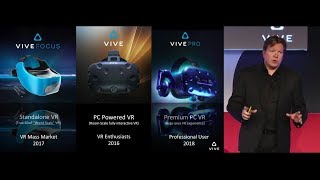
MWC Keynote: "The Dawn of VIVE REALITY" by Rikard Steiber President Viveport and SVP VR at HTC
Rikard Steiber (Viveport & SVP Virtual Reality, HTC Vive): Expanding the VR Ecosystem
Rikard Steiber, VIVEPORT, HTC about Silicon Valley Open Doors Conference SVOD2017

Rikard Steiber (SVP, HTC Vive) Virtual Reality – Perspectives on the Road Ahead