Keynote: Rikard Steiber, Viveport/HTC Vive - MIPTV 2017
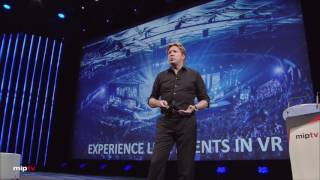
Rikard Steiber (President of Viveport; SVP VR at HTC Vive) delivers a MIPTV 2017 keynote advocating virtual reality as a new computing platform and mass medium. He demonstrates VR use-cases (travel, education, immersive storytelling, social creation), previews Viveport commercial initiatives (store, subscription, arcade distribution, studios, accelerator), and calls for content creators and IP owners to experiment with VR.
Questions this video answers
President of Viveport; Senior Vice President of Virtual Reality at HTC Vive.
32 countries.
Over 1,000 locations.
Over 500 titles.
$10 million.
Chapters
Good afternoon and welcome to today's Media Mastermind keynote. I often get asked what exactly TV is today, and it's true that it's getting harder to define. As I hope you've noticed, we have a major focus on VR this year at miptv, with a VR theater and a zone down in the exhibition area and a number of sessions on VR, recognizing that VR is an important new definition of the content experience. And that's why I'm so very happy to introduce our next speaker, Richard Stiber. There's probably no one better suited to identify the opportunities and challenges of this immersive new medium than Richard Stiber. He is president of Viveport, the Virtual Reality app Store, and Senior Vice President of Virtual Reality at htc. Vive. Richard Stiver, a native of Sweden who now lives in California, has worked in forward looking technologies for years. And I understand that he's actually a future astronaut with Virgin Galactic. Before joining htc, he was a CEO at mtgx, where he built the digital business for the Modern Times Group. He also ran global marketing for Google's mobile and social business. After his keynote, Ricard will be interviewed by Anna Carogatti, Editorial Director at World Screen magazine. So now please join me in a warm welcome for Richard Stiver.
Hello everyone. Great to be here. Great to be here. I think we should give the MipTV team an apartment for putting on such a great show. Let's give them an applaud. So when I grew up, I wanted to be a superhero. And today I have two young girls and I see that they want to have special powers. And for the first time ever, we can all have superpowers, because in virtual reality you can be anyone, you can go anywhere and you can create anything. 19 years ago, the Matrix was premiered. And I think for many of us, this was the defining movie that explained what virtual reality could be. And today we can see that you can actually be in the Matrix. You can be in the story and it opens up completely new opportunities. However, virtual reality has a problem. It's kind of hard to explain, like Neo and Morpheus. In the movie, Morpheus offers Neo the opportunity to take one of two pills because he says, you cannot explain the Matrix, you have to experience it. And the same thing with virtual reality. So to get everyone on the same page, I wanted to share with you a short movie from our partners at Valve that will show you something called mixed reality and show you some of the experiences that you can do in virtual reality. So this is typically what happens in the living room on Saturday nights. So me and my wife will invite some friends for dinner. We'll have a glass of wine, and then my wife will look at me and she'll say, ricard, let's not do virtual reality tonight. And then eventually my friend will say, is Star wars having this virtual reality experience? Can I wield a lightsaber? And then we sneak out and play. So what is amazing with virtual reality is that you can achieve something called true presence. And what true presence means is that when your visual system, your auditory system and your motor system, your body system is fully immersed, your brain thinks that the virtual reality experience is actually the real experience. So you can have sensations which are 10x, whatever you watch on a movie or something like that. So when you think about virtual reality, there are actually three levels of technology. You have mobile VR, where it enables your mobile phone to look around, typically a360 video. You could have the game console VR, which you probably sitting in front of a TV. You could have a headset, and then you can have some interaction, and then you have the full immersive VR with the vi, which we launched actually a year ago from today. But it's not just that kind of technology. It's also coming all kinds of accessories. There's a new ecosystem of devices, everything from haptic feedback to all kinds of controllers. You becoming wireless, you don't have to have a cord. And of course, there's much more social experience where you can talk and chat with people in virtual reality. My favorite experience is this one. It's a hybrid between mobile and VR. And what this team did was that they created a new experience with your mobile phone. So they put a tracker, this little thing that you see on the back of your mobile phone, and then it enables the phone to basically look into the virtual reality world. So the person in this case who's the hero of the movie is in an alien shooter, but his friends on mobile phones can peek into the world and then also help him fight the aliens. So we're starting to have these hybrid virtual reality solutions, and we're just in the beginning of what the technology can do. So if you think about virtual reality, I would argue it's. It's a new computing platform. It's going to be the next mass medium. So if you think back on the previous revolutions, think about the PC, think about the web, think about mobile. In the early days, it was always the, the geeks, the gamers, the early adopters that adopted this technology first. But it wasn't necessarily Gaming that made the PC big. It wasn't gaming that made the web big, and certainly it wasn't gaming that made mobile big. So if you think about your mobile usage, you're probably using social media right now, checking your emails, taking photos. So we're in this beginning. We're in year one of virtual reality, which means that it's of course entertainment and gaming related. But going forward, there will be new categories of content, new kinds of experiences. We don't really know what they are going to be yet, but we have a hunch, we think that exploring new worlds, education, creativity, social, immersive storytelling, and having brand experiences will be new things. So I want to share some examples to make it come alive a little bit for you. One of my favorite experiences is to travel and joint VR. They did this beautiful experience around Nepal and you can basically experience this like no other. It's a 360 experience. It's a new type of storytelling. But also you have Everest VR. And in Everest VR you're not just watching, but you're actually participating in the climb. So let's have a look at how it would look when you're actually yourself climbing Everest. So we're seeing these two worlds. We have the cinematic world and when we have the computer graphics world, the gaming world coming together, telling stories in virtual reality in new ways. Another great example is documentaries like David Attenborough's the Great Barrier Reef, where you get the opportunity to travel underwater with him and he explains what you see underwater. It's a unique experience and it's fully immersive. 360, you can look around and discover things. But also you have Weaver the Blue, which is a computer graphics animated experience, which is also interactive, which enable you to go underwater and interact with beings underwater. It's interesting to see his reaction there. The whale is not there, but he's like, whoa. So what's exciting with virtual reality is that you can not just capture things around you, but you can also capture yourself and become an avatar or have a sort of holographic movie. This is an example from Bjork, who just released a musical video using this technology. But you can literally travel the world or the known universe. And one beautiful example of this is Google Earth VR, which enables you to travel anywhere on the planet. So one of the things we found that's very interesting is that some of the most popular experiences is not where you just experience things, but it's where you create things. And if you think about what's happening in our society, we're all part of this co creation economy. And the distance between producers of content and consumers of content is being blurred and we're all becoming more producers and consumers at the same time. So one of the most popular apps are things where you can create art or paintings or designs. But today everyone can be a movie producer. Anyone can create shows. So I wanted to give you one example how you can actually create your own animated shows. Share them with your friends and their friends. Your friends can actually build on it and share it back to you. So my favorite experience, it's very embarrassing as well, but once you try it, you can't help G giggling is mind show. And let me just show you how easy it can be when you're standing on that wing. I can promise you that you wouldn't jump out. You would not jump out. So of course the entertainment industry is going to change radically. And actually today with this headset, everyone would have their own IMAX theater at their home. You don't have to watch on a small mobile phone anymore. You could actually be in a theater like this to experience your content. So we're starting to see these entertainment experience coming into cinemas, to amusement parks. And this is Ghost Train where you have collaborative social experiences in VR which are exciting. And of course, we're in year one. And the reason I'm here is to reach out to all of you people who are the real, real heroes who are creating the stories and representing the content. Because we're starting to see things like Star wars coming into virtual reality, doing experiments where you can be a Jedi and wield a lightsaber. We're seeing experiences where live events like esports events and of course musical events and sports events are coming into VR. We're starting to see the most popular sort of episodic content having 360 or interactive experiences. But we're still very, very early. And I think there's so much content out there, so much IP that consumers around the world really love. And there's an opportunity for content creator and distributors to capture what is VR. What is that window? How can we create stories that are much more immersive and intense than we have today? So 19 years ago, pretty much last week, Matrix premiered. In one year's time, Steven Spielberg is going to launch a new movie called Ready Player One, which is probably the number one book in pop culture which defines the future of virtual reality. A future where we go to work in virtual reality, where we go on vacation in virtual reality, where we hang out with our friends in virtual reality. So we believe that March next year there will be a defining movie that explains to the world what what virtual reality can be. So we're partnering with Warner Brothers, we're partnering with Steven Spielberg to create some experiences that could explain virtual reality to the masses. And we hope, and we invite you all to join with us on your IP to do the same. So there are a couple of ways we can work together. The first one is Viport, which you can think of as the Virtual Reality Experience Store. This is the place where you go to find your virtual reality experiences. And our job is to help creators and developers market their content around the world and monetize it. Today you basically download and sell it, but today we're doing a global launch in 32 countries. So we're launching the world's first app experience subscription service for virtual reality. So today, anyone online can go and do a free trial to subscribe to virtual reality experiences in a completely new way. And we hope that will be a success. And as you can see, you can travel the blue or to Mars or into space or whatever you like. So endless possibilities. The other thing which is really exciting is that if you remember the good old days with the Internet cafes, when people didn't have broadband Internet, cafes rose up. And we're seeing the same thing happening with VR arcades. So in cinemas, shopping malls and in all kinds of public spaces like shop, like cafes, these arcades are popping up where you can try virtual reality. So we're already over in 1000 locations, MK2 here in France or IMAX in the US. And it's a great experience to do this because I can bring my mom there and we can all try going on top of Mount Everest. But also it's a great way to distribute your content. It's a completely new window and we already have the world's largest arcade platform with over 500 titles available to these operators. The other thing we have is we have Vive Studios. So if you have great ip, but you don't have the skill set to develop experiences in VR, we can help. So it's a first, second party studio. We also want to use this medium, this technology, to change the world for the better. So we partnered with United nations and created VR for impact. It's a $10 million fund. And the idea is that we want to bring together courses around fighting poverty, education, climate change, together with creators and put some money on the table to be able to create these experiences that will change people's awareness and create empathy for the causes. So if you actually through virtual reality, go to the refugee camps in Syria. Then you really understand why you have to engage. And finally, if you have an idea how to start a new business, we have something called Vivex, which is our accelerator, innovation platform. We put hundred million dollars on our balance sheet. We're investing in startups, we invest in over 60 startups already. So please come to us if you have game changing ideas for virtual reality. So with that, hopefully like Nio, you'll take the pill and run down the rabbit hole with us. Thank you very much. So I'd like to invite Anna from World Screen and we're going to have a little conversation on how.
Wow, That was something, wasn't it? Could we just have a really quick show of hands? How many in the audience have already tried or perhaps even own VR headset? Wow. Aha. Okay. How many instead, like me, are new to this? Okay, all right.
We have believers in the audience. So those three of you actually in hole C on the minus one, you can actually go and try. So let's get it to 100% right.
Okay. So we can eliminate a lot of preliminaries. Okay. So we know the audience knows if they want to experience it, they can do it publicly in a public location like an arcade or a mall hopefully, or they can do it at home. All right, so but do you feel, despite the audience here, is there enough education out there to get someone like me to understand what it takes to experience VR, from what I have to buy to how much it costs and what content is available?
To me, I would say that we're still in the early phases, so the answer is probably not enough. So today I would say that it is the early adopters that are out there. It is the people who have a high end PC who are playing games today. And for them it's of course very easy to upgrade with a headset and keep having these kind of experiences. I do think that for us as a parent, for example, who have two young daughters, you know, education is, you know, so important and I can see how effective the media is. And of course we want to attract creators who have documentary educational content to use virtual reality so we can market it and then we can bring in the teachers and the same thing for creators or people who are, you know, have great IP or television or movies, but even brands, I mean, you know, I'm Swedish and I give the example of Ikea. We all have the IKEA catalog and we're clinging to it. But actually, wouldn't it be nice if you actually could move into your room and you could decorate it with all the furniture, change the color and then actually see how it actually would fit. So there are endless opportunities.
Right. All right. For producers who have always produced for regular linear television or even SVOD platform still, there's a certain type of narrative and a certain type of story structure. Is it completely different in VR? Is it a different language? Can somebody who's been producing successfully up to now make the transition? Or are you looking for completely new talent?
Yeah, I think. I mean, what's fascinating with 360 video, for example, it may not be real VR, but it's immersive storytelling. Then, you know, you put the camera there and then you have to kind of get out of the way. You couldn't do that close facial, zoom in on Tom Cruise when he's feeling really angry. So you just have to capture it. Whereas in cgi, when computer graphics, of course, then you can do much more. But it's non linear storytelling, so the user can actually choose path rather than having something predefined. So could the current storytellers do it? I don't know. I do think that there are a lot that won't make it. So I do think that there will be this new breed, new young talent who can understand both the essence of storytelling, but also how you can use this technology and this medium to tell that story really well in completely new ways.
Give us a little bit of background about how the deal for the Steven Spielberg movie came about, because that's pretty exciting, isn't it? And that will help more people like me join the bandwagon, so to speak. Right?
Yeah, I think, I mean, what we. I mean, the best way we found so far to explain virtual this, to use this mixed reality where you can sort of see what a person in VR is doing to some extent. And I do think that I had the opportunity to read the script and what the book and what the movie will do is it will take you to these different environments, it will take you to work or to vacation or how, you know, engaging in games and all kinds of fantastic battles. So I do think it will actually visualize like The Matrix did 19 years ago, what a virtual reality could be. It's dark. So like any technology, it has its sort of pros and cons. So I hope that that could be something that makes it a little bit more mass appeal, that people get curious and then want to find out a little bit more.
Right. What examples? Even though we're still in phase one, as you said, and it's principally for these people who are the gamers or the early adopters. What type of TV programs do you envision at this point that could lend themselves to VR?
Yeah, so I do think actually VICE was doing a talk earlier and they had Vice news, which is exciting. And I do think that if there was a terrorist attack in Paris, of course you watch it on news and it's two dimensional TV screen and that's fine. But if you could actually transport yourself to the streets of Paris and you see people lying on the floor, you see it's burning, you hear the sounds in stereo, you're actually there. Or you go to the streets of Syria where there's chaos and a lot of poor people and disaster, the empathy machine will come into play and you'll really feel something which you wouldn't do if you watch on a small TV screen. So I think there's an opportunity to change not just news and scripted and documentary, but also education. And I think the, the example I like to give is if you're into dinosaurs, let's pretend that you're going to read about the stegosaurus. However, if you were transported to Jurassic park and you walked side by side with a giant stegosaurus, you could see its big head leaning down, eating grass. And then you hear the roar of a T. Rex in the background. The stegosaurus raises its head, looks afraid and starts moving with the herd. Of course that takes 20 seconds to show, but for a kid, you will never forget that. You'll never forget how big it is that it eats grass. It's afraid of T. Rex. Can you imagine the amount of text that you have to read or maybe like images? There's no way else for you to actually transfer that experience. So in a sense, with virtual reality, we're democratizing experiences. You can go to Syria, you can go to Mount Herb, you can go to the planet Mars before Elon Musk. So things that only were available to the few is now becoming available to everyone. And that's the power of VR.
You mentioned the dinosaur roar yesterday. We were talking about the importance of audio. How does audio play into VR? It's a very important component, isn't it?
Yeah, yeah, I think so. I mean, in a 3D environment, of course you need to use like audio cues, for example. So like the Everest people, what they do is that they do audio so that you turn around and see that something going on. You have to help the user to see the right thing. But also when you're on top of Mount Everest. You hear your heavy breathing and what happens when you hear this is that it affects your body and it raises your pulse. So with audio, you can actually change your physical state. Maybe you're becoming excited or sad or something like that.
So if, if I go back in time a little bit to when 3D came about, I think 3D not reach its potential in part because in the beginning a lot of people did it inexpensively. The quality wasn't good and a lot of consumers were turned off by it because they thought that it wasn't good quality. What is the industry in VR doing now to avoid that from happening to VR?
Yeah, I think, I mean, I think what's most important is of course that we have great content, we have great storytelling, and that's why we're here and we want to, you know, invite you all to capture this opportunity. I do think that the 3D is an unfair comparison because this technology is, you know, orders of magnitude more immersive and a step change. However we are taking things, you know, it is costing you some money. It is technology. So we are in year one, but we're going to work very hard to make sure that it becomes very user friendly, very affordable. And I think it's getting people access to more content is going to be key. And that's why we launched the subscription service now, so that for a small monthly fee, you can consume lots more content than you probably would do otherwise. Right.
Imagine for a minute that we're a year from now. Where would you like to see the industry in a year's time?
Yeah, so I think, you know, when, when I'm here next year, you know, all of you will be selling virtual reality formats. Our biggest IP will be there probably in our schools and universities and libraries. There will be VR for us to test. You know, when you're going to buy your car, you're going to build it in VR and drive it. When you're going to look at your next vacation destination, you're going to do, look, check it out in VR first. And of course, when you're going to buy that IKEA sofa, you are definitely going to do it in VR first.
We have a few more seconds. You said something yesterday that was very interesting. There is an application for VR for museums too, right?
Yes.
Tell us about that.
Yeah, so I do think that if you're an architect, designer or creator, doing things in two dimensional is one thing, but now you can actually paint in 3D, you can sculpture in 3D. So we are reaching out to museums because I think that we can help creators create things in the virtual world that can be experienced by everyone. And we did an experience with Royal Academy of Arts where we printed the things created in VR in the real world. But I think the perhaps power is that in VR you can go to any museum in the world and you can watch your favorite paintings or your favorite artist. So you don't have to go to Louvre or to some places in London. Everyone can go there. So it's democratized access to art.
Fantastic. Our time is up, unfortunately.
Thank you very much. Thank you much for listening.
Thank you.
Thank you.
More from Rikard
Commuting Through Clouds with Rikard Steiber, Investor & Board Advisor, Jetson Inc. - #FII7 Day 2
MWC Keynote: "The Dawn of VIVE REALITY" by Rikard Steiber President Viveport and SVP VR at HTC
Rikard Steiber (Viveport & SVP Virtual Reality, HTC Vive): Expanding the VR Ecosystem
Rikard Steiber, VIVEPORT, HTC about Silicon Valley Open Doors Conference SVOD2017

Rikard Steiber (SVP, HTC Vive) Virtual Reality – Perspectives on the Road Ahead