Rikard Steiber (Viveport & SVP Virtual Reality, HTC Vive): Expanding the VR Ecosystem
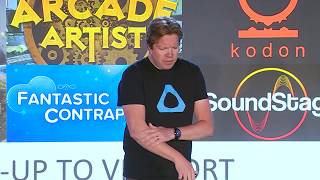
Rikard Steiber’s AWE talk describes Vive/HTC’s strategy to grow the VR ecosystem through four pillars (headsets, marketplace, content, and startup support) and highlights hardware trends (PC-tethered, mobile/cardboard, and an emerging standalone category), peripherals (wireless PC VR, haptics, universal trackers, eye-tracking), hybrid social/AR–VR experiences, and AI’s role both as an enhancer of VR and as a technology that can be trained in simulated VR environments. He outlines developer-facing programs and business models: Vivex (a $100M accelerator with ~60+ investments, typical funding $100–$500K), Viveport and a subscription pilot (~$7/month for access to 5 titles), VR arcade/content licensing pilots (pilot in ~15 countries), and partnerships for social impact (VR for Impact with the UN, grants to projects including SpaceVR which booked a SpaceX slot to send an HD VR camera to space). He also mentions the VR Venture Capital Alliance (40+ VCs, $18B capital) and promotional/media tie-ins (Ready Player One film tie-in planned for the film’s release "end of March next year" as stated).
Questions this video answers
$100 million
Over 60 investments
$100,000 to $500,000
About $7 per month to pick five titles (monthly cadence to keep/change them)
40+ VCs with $18 billion in available capital
Chapters
Thank you. Thank you. Actually, I have been backstage and I think we should give the awesome AWE team an applaud for doing such a great job. So when I grew up, I wanted to be a superhero. I wanted to have special powers. I wanted to change the world. And when I look at my two daughters, Alexandra and Athena, I can see that they are thinking the same way. And as you all know, with virtual reality, with augmented reality, we can all be superheroes and we can all change the world. But today I want to talk about the real superheroes. I want to talk about you, the entrepreneurs, the developers, the creators, the techies who are creating this new ecosystem that we call virtual reality. At Vive, a year ago when I was here, everyone thinking about the Vive was thinking about the headset. But our mission, to essentially bring people's imaginations and make it a reality, is happening and it's happening by four different pillars. We want to create an ecosystem of technology. We want to have a marketplace where you find great experiences and we want to produce leading edge content. But also we want to support all the startups and have an accelerating ecosystem of new technology. So let me talk a little bit about these four pillars. The first one, the headset. So the way I see it is that it's emerging kind of three pillars of VR technology. You have the PC powered VR where the Vive is among the high end or probably the high end. And then of course you have the low end with cardboards, where probably the cardboard, cardboard is the lowest of the low end. And as we announced together with Google a couple of weeks back, there's a standalone VR category emerging where you don't need a PC, you don't need a mobile phone, it's sort of made for VR and it's inside out, six degrees of freedom tracking very exciting so that this new category will emerge this year, but it's not just about the headset. It's an ecosystem of devices and enhancement that makes virtual reality happen. So let's have a look at some of the things. Couple of exciting things. First of all, this is the year where PC powered VR will go wireless. So we previously announced with TPCast, as you can see in this image, but also this week our partnership with intel and Wigig to bring new accessories that bring wireless possible. Also very important is all kinds of haptic feedback devices. This is one Kickstarter campaign that I just signed up for, but essentially to give us the feeling, using more sensory equipment. And then the tracker which makes any device possible to be tracked in the 3D space, it could be a gun, could be a golf club, tennis racket, or you could put it on your dancing shoes. So let's talk a little bit about building an ecosystem and the tracker. So the idea with the tracker is that you have this one universal tracker. You can put it on any device. So as a developer or creator, you basically develop for that tracker and then you can map the tennis racket, golf racket, or your shoes in 3D space. So you only develop for one piece of device. But also as a consumer, you don't have to worry about buying a lot of different gadgets. You basically buy the tracker and you can put it on the thing that you want to be attract. So basically you get scale and you don't fragment the ecosystem. So I want to show you a quick video how this can be applied. If you put trackers on your feet and on your body to have full tracking in VR. So let's have a quick look. If we can lower the lights a little bit, have some sound, You see your body. And of course this is very, very dangerous because you might kick things, But you can imagine that you're actually getting into it. You have full presence. You have no doubt that you're on the street defending yourself from furniture. So it's super exciting because you can see yourself, but you can also, you could also see other people in VR and their movements in real life. So it increases the notion of presence. What's exciting is also that the cinematic VR world and the interactive or the CGI VR world is coming together. So not only can you capture anything in a holographic sense, but you can mix it up with the computer graphics. So I think that the avatar and our representations in VR will be pretty awesome. And this is from a shoot with Bjork, famous Icelandic rock star, for some of her performances. I just want to show you quickly how she's turning herself into a sort of mythical Icelandic creature combining both CGI as well as cinematic. The exciting thing is also that there's coming new add ons that will be game changers. One of the Vivex companies just announced eye tracking. And I do think that eye tracking will truly be a game changer for VR for a couple of reasons. Of course, in social, if I can see you and we have eye contact, that radically changes the notion of presence. But also the way we would interact with the world through, for example, navigation, we would do that with our eyes, we would look at things that we want to interact with. So it's going to change the way we interact with the computer in the VR world. But also as we know, we're approaching more and more high resolution, more and more advanced ways of solving the parallax situation. So there's a lot of bandwidth. So of course, if we have eye tracking, we can then of course make sure that we have higher performance where we're looking and reduce the performance and save capacity where we're not looking. So those are just some of the things happening with eye tracking, which I think will be a game changer for the experience. One of my favorite things is how we get this hybrid solution, solution that can make social experiences at cs. We demoed a couple of different interesting. The most favorite one is how one company used a tracker to put it on their mobile phone. And then the mobile phone basically became a window into the virtual world. So you can sort of look what the person is doing in VR. But not only that, the person in VR can also see that there is someone on the mobile phone. So you have presence and you can actually interact. So in this case it was an alien shooter. So as the hero, you're there, but you actually have up to four sidekicks who could help you defeat the aliens. So I think in our living rooms and in our arcades, we're going to have hybrid solutions where some people will be fully immersed in VR and there will be some hero sidekicks. One of the most interesting developments this year is the rise of artificial intelligence. And I think we all heard about how the computer is beating chess players and go players, how computers is getting some memory, learning how to drive cars on our behalf. And eventually we do think that there will be some limited artificial intelligence, similar to like a C3PO from Star wars, who could interact with us. And a couple of things that was very, very interesting is that not only will artificial intelligence enhance what is happening in virtual reality, so the virtual assistants that we have today, perhaps on our phones, will of course move into VR. The technology that we see that recognizes our speech will move into VR. The technology that recognizes images and, and can determine what's going on in the image will move into VR. So AI, there's so many applications where AI can enhance the VR experience or AR experience, but also I do believe that VR will train the AI. One interesting example, it's a little bit crazy. Typically here in California we're obsessed with self driving cars. And of course Google and other companies are having fleets of self driving cars to learn, but actually they don't have to drive on streets, they could actually drive in virtual Reality and then actually learn so you can do it much more scalable. And there's some research at Princeton who did something very interesting. They used a game called Grand Theft Auto. How many know what Grand Theft Auto is? Okay, then you know. So they use that to basically learn about objects like moms with a baby carriage to avoid them and not hit them. So there will be plenty of applications where you can do simulation in VR and teach the AI as well. And then eventually AI will become self aware and then it's game over. So the way we try to encourage some of these innovations is through something we call Vivex. So Vivex is an accelerated program. We put $100 million off the balance sheet. We're doing biannual startup accelerators. We made over 60 investment the past year. So if you have something which is enabling technology, software content, we're interested, we're primarily interested in things that have a multiplicative effect. So that if you have analytics, multiplayer, AI, something that can help all other developers in the ecosystem, we're especially interested. It's early stage and it's typically 100 to $500,000. A lot of support from our team, tech, software and marketing, et cetera. So please check out that if you're bigger, if you're on your road to global domination, Please connect with VRVCA, which is the VR Venture Capital Alliance. It's plus 40 of the top VCs in the world. They have $18 billion in available capital. If you go to their website, you can actually pitch all plus 40 of them at the same time. So it's probably the most efficient way for you to contact investors. So the most favorite slide of this event is talking about the next computing platform. I think my main message here is it's not just a different computing platform, but it's the evolution of how we interact with computers. So in the early days we had our keyboard, later on we had our mouse. Eventually we got our touchpads and we interact with touch. And now as humans, we're kind of using our body to interact with the computer. We're in the computer, we're touching it, we're interacting, we're talking to it, we're looking at things and the computer understands. In the beginning of all these platforms, it was you, the early adopters, who embraced the technology. It was typically entertainment and gaming applications in the early days. But it wasn't necessarily gaming that made these platforms big. It wasn't gaming that made PC big, or the web or the phone. You're probably taking Photos now or tweeting, connecting with your friends on social networks. So there are other things that made the platforms big. So we're in year one of VR, so of course it is primarily entertainment, but it will be other things that will make VR and AR big. We don't know what it is yet, but. But we do think that there is great potential for exploration and education. This is probably the most memorable and transformative media for education. We do think that for creativity, it's going to change the way we design things and create things in the 3D space. The days where you actually look on a 2D screen to do a 3D drawing is over. It's not going to make sense anymore. And of course this is going to be the most social media of all. The days where we're connecting on a 2D Skype call and share the screen. It's going to blow up. And of course we're going to be social and collaborative in the 3D space. And the entire movie industry is not just going to do great entertainment, but we're going to be the hero, we're going to be in the movie. It's going to be about us. It's going to be a different experience. And of course, brands are embracing this. So there will be new kinds of shopping experiences, whether you buy a car or, or you're going to Ikea to decorate your bedroom. So where do you find all these experiences? So we have a strong partnership with Steam, who is probably the world's leading player when it comes to gaming. So what we try to do is that we try to see how can we help developers and creators get more distribution, more awareness and more money. So what we're doing is we're collecting these experiences in a destination called Viport. It's kind of where you go to find your experiences and it doesn't matter if you're on Vive or on Oculus or mobile. We're having a platform and device agnostic approach and we're focusing primarily on beyond gaming experiences because we think that gaming is kind of happening. So we want to see how can we help creators, how can we help teachers and how can we help brands find great VR experiences, but also help developers that are creating things for them. So let me tell you a little bit about what we're doing. So one of the things is being a developer in the early days is really hard. It's hard to build a business. So we're looking for new ways to monetize for developers, but also for them to get recognition. So at gdc they did a survey on which platform are developers developing for today. And on left hand you can see that HTC Vive is in the lead. But when asked about what is the next application you're developing for, on the left hand side, you can see that Vive is really the platform. So we're really thankful and our partnership with developers is our main objective. So we need to think a little bit cleverly. How can we help developers sell more and build their business? And how can we help consumers like yourself in experience more content because you only have so much money. So we looked at how the music industry has evolved, we looked at how the video industry has evolved and probably all of you went from CD ROMs to MP3 downloads to streaming on Spotify or something and you're probably getting ready for House of Cards on Netflix streaming. So we started a subscription service where you, for a low monthly fee, seven bucks can pick five titles and then on a monthly cadence you can either keep them or you can change them. So we're experimenting and learning from consumers and developers. So the value here is titles that will cost over 70 bucks, you can basically have access to for 7 bucks. So factor of 10. We also want to help developers. We have a studio called Vive Studios, so we invest in content projects. So if you want to create something that is pushing the boundaries of what VR is, it's not just games. Could be education, could be creativity, could be interactive experiences. We are very interested, so come to us and pitch. One of my favorite experience is something called make VR. So you basically go in VR, you can create any object in VR and then you can print it on your 3D printer or you can send it to one of the 3D printing services. So basically combining the virtual world with the real world, really interesting. One of the things that happened a long time ago was that we didn't have access to the Internet or broadband, so we had the rise of the Internet cafes. And we're in a similar situation where not everyone have access to high end VR. So the rise of arcades, VR arcades are happening. And the problem for these arcade operators, because we all want to start one, is that the content is for personal use only so that you can't really put it in your vrcade. Similar to we couldn't take 10 DVDs and start a cinema. So at Vyport, what we've done is that we partner with developers. We have over 600 developers who joined the program where we can offer arcade operators online self service access to content so they can start a VR arcade. And we're doing a pilot now in I think it is like 15 countries. So we learn how it's coming into libraries, cinemas, shopping malls, arcade halls, your pool hall, everywhere. So this is going to increase access to VR to everyone, to your mom, your kids, in a completely new way. We're also using this system to give access to VR in stores around the world. So this is going to be great for developers because it's a completely new window to monetize their content. It's great for small businesses because they can now start. And it's great for VR because more and more people understand the power of VR, of VR. But VR is not just going to come to arcades. VR is going to come to everything. It's going to be in your shop, where you buy your car, it's going to be at your school, it's going to be in your workplace. So I do think this year we'll start to see the rise where actually VR becomes available everywhere. So as a Swedish person, I of course go to IKEA all the time to get my Swedish meatballs and also some furniture. So of course the IKEA catalog, I love it. But if you could go into VR, decorate your room, see if the sofa fits, it is a much, much better experience. I think also this year we'll see much more marketing stunts. So the car industry is of course embracing VR fully and I want to share sort of a fun look on how a company like Nissan is starting to sell their car. So let's look at the Nissan experience. If you could drive in a Star wars world. Here we go. Watch your backs. There's one. So let's get ready to buy a Nissan. But I do think last year when I was here, I talked about how the Matrix kind of made VR come alive for us all. But Hollywood is going to change it all. The superheroes, Batman, Spider man, everyone is going to be in VR. But next year there will be a defining moment happening. Next year, Steven Spielberg is going to launch Ready Player One. So Ready Player One is an awesome pop culture book about how the world is going to change in VR. It's going to come out in end of March next year, and we're partnering with them to bring a taste of VR in the next couple of months leading up to the movie. So stay tuned for more exciting stuff. But the world of VR is not just about who commercial stuff. It is about doing good. And I think it was in a Spiderman movie. Someone said, with great powers come great responsibility. So we started something called VR for Impact. And VR for Impact is taking courses and bringing them together with developers to create great VR experiences that will tell the story around some of the key things that are facing our planet. So we partnered up with UN and UN VR to raise awareness around the 17 UN sustainability goals. Poverty, climate change, et cetera. So a couple of weeks back, we announced the first three grant holders at Earth Day. So it's the tree, SpaceVR and Honeybee. And I want to just share one of those experiences with you. So if we can roll this little video here. So SpaceVR have a great idea. I'm personally very interested in space and I'm going to go into the program with Virgin Galactic. But the thing that really is interesting is how the astronauts, when they come back from space, have changed their perception on the planet. So they see the Earth, they see the very thin atmosphere layer, and they realize that one meteorite could kill anyone in an instant. They realized that we're one people. It doesn't matter what color, what religion, there are no borders. So you basically have this new perspective that we are one. We're not competing with each other. It doesn't matter what politicians like Trump or what the people in Sweden are doing or the border, it doesn't matter. We want people and we need to have a new perspective. We need to take care of this planet. It is called the overview effect. So what SpaceVR wants to do is that they booked a slot with SpaceX and Elon Musk to send a high definition virtual reality camera into space so that all of us could become astronauts and get this perspective and hopefully take responsibility and save our world. So hopefully together we'll change the world. Thank you very much. I have one surprise. I have one surprise. One of you is going to leave with a vibe. It's an old, shabby vibe that I had in my, in my drawer, but I was thinking I'll give it to someone. So if you look to the right on your seat around here, if you see a blue business card there, it's on your, like, hand thing. If you have it, you're going to get a vibe. You have it. Come on, come on to the front. Let's give it an applaud. I recognize you. You don't need a vibe. All right then, thank you very much and enjoy the show.
More from Rikard
Commuting Through Clouds with Rikard Steiber, Investor & Board Advisor, Jetson Inc. - #FII7 Day 2
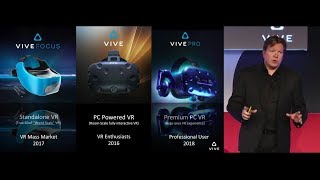
MWC Keynote: "The Dawn of VIVE REALITY" by Rikard Steiber President Viveport and SVP VR at HTC
Rikard Steiber, VIVEPORT, HTC about Silicon Valley Open Doors Conference SVOD2017

Rikard Steiber (SVP, HTC Vive) Virtual Reality – Perspectives on the Road Ahead