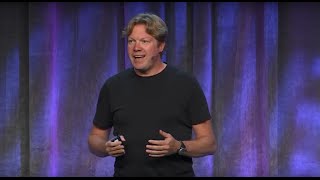
This content was created by Rikard AI. This content was uploaded by Rikard AI. This is a YouTube video titled "Rikard Steiber Keynote at Future Science and Technology Leaders (Short)" created on September 28, 2025. It features a keynote speech by Rikard Steiber discussing the transformative potential of virtual reality and artificial intelligence, particularly in education and learning, and the anticipated AI revolution akin to the Industrial Revolution.
Chapters
All right, all right. Thank you so much. It's great to see so many technology enthusiasts here today. So when I was your age, I wanted to be a superhero. I want to put on the cape, fly out and save the world. And when I look at my two daughters today, I can see that they want to do the same thing. They want to save the world, they want to save the animals, they want to save the rainforest. And with virtual reality, for the first time ever, we can all be superheroes and save the world. We are at the dawn of a new reality. And in this reality, I believe that we will take the best of humanity, our beliefs, our hopes, our, our passions, and mix it up with the latest technology, virtual reality, augmented reality, artificial intelligence, and the latest of five generation networks. And we will do this to create a world that we want to become true. I believe virtual reality is going to change the world for all of us, every consumer, for you as students, for everyone in the business area. And the magic, the magic with virtual reality is that things that are impossible are now going to be possible. So think about what would you do if you could be anyone, if you could go anywhere and if you could do anything, because that is what virtual reality can do. I believe that the one area where virtual reality will have its biggest impact is, is in education and learning. And the reason for that is that we will use all of our senses when it comes to having these experiences. And I want to give you a quick example. Let's pretend that you put on the VR headset and you go back to Jurassic Park. You're in the jungle. You see the giant brontosaurus eating grass next to you. You hear the roar of the T. Rex. The brontosaurus lifts its head, looks very afraid, and starts to move. Actually, the entire forest starts to move past you because the T. Rex is coming very fast. And you are also, by this time, running. This little experience took 10 seconds. But let's think about what you Learned during these 10 seconds. You learned what some of these dinosaurs are eating, how big they are, how fast they are, who's afraid of who. In these 10 seconds, you created memories that will last a lifetime. How long do you think it will take you to read this in a book and learn the same thing? So it's a very, very effective medium with a higher recall than anything out there than ever before. So I want to come to the third chapter. You have technology networks, and the third pillar is artificial intelligence. So recent advancements in artificial and machine learning have made tremendous progress the past couple of Years. Today, artificial intelligence is primarily used for very specific tasks where the computer is really good. And we still have some years to go before we have these self aware AIs that's trying to kill us that we see in Hollywood movies. We're not really there yet. However, the direction is very clear and very fast. I want to tell you a little story about this. Thirty years ago in 1985, my chess hero was Garry Kasparov. He was 22 years old and he had just become the world champion. This year he was in Hamburg and he was asked to play a simile game where he was supposed to play 32 computers, the best computers at the time, at the same time. So him 32 computers at the same time. How many games do you think he won? He won all of them. And no one was really surprised because computers can't really think and you know, play games of chess. Anyway, 10 years later, when this picture was taken in 1997, IBM's computer, the Big Blue, beat him. And the world was devastated that a computer had beaten the world's best or greatest championship. Today, on your mobile phone, if you have a chess game, that chess game would beat IBM's Big Blue. So a lot of things have happened. And actually last year There was an AI called AlphaZero who taught itself from scratch how to play chess on a superhuman level to beat all humans. In four hours it also beat the current chess world champion program, Stockfish. So in four hours it learned how to play chess and beat everyone. So things are moving quickly. This week in the news, how many Dota 2 players? Ah, some. Not so many. So Dota 2 is one of the world's most popular computer games. You have five players versus five players. You need strategy, tactics, collaboration to win. So the AI from OpenAI actually started to be now the world's best players. So things are moving really quickly. And I believe that you are coming into a world where we will have an AI revolution. We will have an AI revolution much like we had the Industrial Revolution. And listen very carefully now, the Industrial Revolution happened because we harnessed power and distributed that to any device and any person through the electricity network, so anything could get power. If you were hammering something, you could add electricity and have a machine do it. What's going to happen now? What's going to happen now is that we're going to harness intelligence and distribute that to all machines, all people, all robots, all devices through the Internet. So everything is going to be much, much smarter. And that's going to change the world. There will be a lot of new companies coming up, but it will be a lot of companies going away, a lot of new jobs, but a lot of jobs going away, and that's going to be your future.