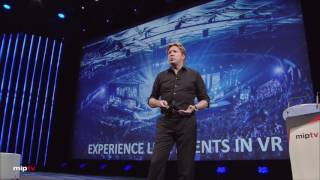
Rikard Steiber (SVP, HTC Vive) Virtual Reality – Perspectives on the Road Ahead

Rikard Steiber of HTC Vive argues VR is an emerging computing platform with immediate strength in gaming but broad potential across education, retail, and industry. He cites examples like Tilt Brush, IKEA's app, and Boeing, and identifies room-scale tracking and low latency as core technical requirements.
Questions this video answers
Below 20 milliseconds.
Our next keynote speaker is Ricard Stiber, SVP of Virtual Reality at htc. Ricard will take the stage to talk on how and why VR will change the world for consumers and businesses alike, providing perspectives on the road ahead for this emerging medium. Please join me in welcoming Ricard of HTC to the stage.
Thank you. Hello, everyone. Great to see so many VR and AR enthusiasts here at the show today. My name is Rickett Stiber. I'm with HTC and I thought I'd give you some perspectives on virtual reality, where we are and where we're heading. So I think all of us had some moments in, in our life where we got inspired. It was something that triggered you all to come here to the show, and I think for me it was the Matrix, it was Neo jumping into virtual reality and having all these experiences. So I would say that we are on a journey. We're just in the beginning of the journey. I think all of you are very fortunate because you're going to remember this day as the very early days of this journey. So I believe that virtual reality will change the world for consumers and businesses alike. I believe that it will make it a better place. It will create opportunities for us to connect with friends, family, places and experiences in completely new ways. And the way we see things is that virtual reality is like this magical portal that could take you into pretty much anything imaginable. So as we have launched our product, and I'm going to talk a little bit about the tech later on when we see what people are doing in virtual reality, now that it's sort of available for the masses, is that there are a bunch of different experiences. So what I thought I'd do is I'll show a little video from our partner Valve, who did a mixed reality video. So basically filming you when you're in virtual reality in front of a green screen, so you can capture both you and as well as what you're doing in virtual reality. So let's have a quick look on what the early users are doing in virtual reality right now. From walking to the couch, walking into the walls.
Oh, this is so cool. I can't remember where to stop.
Look at this thing. Yes.
Probably gotta keep it the beat. Oh. Oh, that was good.
So, as you can see, there's a bunch of creativity out there. But what's really interesting is that today it's primarily gaming and games. And the reason for that is, of course, they are the early adopters of new technology. They have the PCs or the game consoles or the High end smartphones being able to consume this kind of content. But it is changing and it's interesting. We speak a lot with a lot of the really big gaming studios, the movie studios. And as you know, creating content for virtual reality takes a lot of time. So entertainment as we know it will change. And it's interesting how it's going from sort of sitting lean back in front of your television, to being immersed in your favorite Netflix show, to being in a computer game, to being completely immersed. And it's going to be both graphical and cinematic storytelling that we have never seen before. So it is very early days. But for this Christmas and this holiday, you will see some of the big titles also having a lot of immersive virtual reality experiences. So entertainment is definitely going to change. However, I think that one of the things that's really going to change is the way we think about social media. So most of us are probably spending far too much time looking down on our phones, checking out what our friends are doing on Facebook or Twitter or Google or Instagram or whatever your favorite social media is. So I think virtual reality has the potential to bring us together to share experiences. It could be just hanging out in the chat room, chilling, watching a movie, playing a game, but it's also doing all these discoveries together. So I think what we're seeing now is that more and more of these early virtual reality experience having social components, so experiencing things with your friends and that's going to go across all the different sort of verticals coming. Personally, I'm most excited about education. So I was maybe not the best kid in school. I have two young girls and you know, when you think about topics like history or geography, maybe you didn't think those were the most exciting topics in your day. However, if you actually could travel with your friends to Machu Picchu and experience it, or go back in time to ancient Egypt and see how they built the pyramids. Education will change the way you think about physics, shapes mathematics. There will be a completely new revolution when it comes to education. I think a key point here is that I think most of us heard that if you read something, you remember certain things. If you see a picture, picture says a thousand words. If you see a movie, it becomes much more immersive. But you're actually doing it and you think you're there, your recall of that piece of information is going to be so much higher. The other thing we're starting to see is how businesses now realize the potential for virtual reality. So we have a bunch of car companies Coming to us basically thinking very differently about their retail experiences. So what they're doing is that you're able to test drive any car. So this is. We have BMW, we have Audi, we have Tesla. They're all thinking about how you can change the retail experience. So not only are you going to be able to drive your car in VR, you're going to build your own car. So if you think about that showroom, maybe you have one or two cars there. However, you will have this thing where you will be able to build your own car, get in and drive it around. And it's happening for most retail. So we see that virtual reality experiences will be something that will change retail across almost any vertical. The other thing which is very, very interesting is how science is changing with virtual reality. So today, very advanced operations and medical procedures change. You can practice them in virtual reality. There is really no way else you could do that. You could have your teacher coming in, showing you how to do it, or you could basically be in a ghost mode doing this thing. We are having big engineering companies like Boeing thinking about how do you create these engines and basically putting them to pieces and putting them back together again. You have service personnel who need to know how to repair something. They could have a tutor coming in and pointing it. It's this little button here you should press. So all these industries are changing. And pretty much what's happening is that if you show someone virtual reality and the potential, they can take their experience plus virtual reality, and they will figure out what the new business opportunities are. So I'm a Swedish guy, and as all loyal Swedes here in the US we go to ikea. And Ikea, of course, also launched the virtual reality app. But it's very interesting how companies like Ikea, they have already scanned the CAD measurements of every furniture they have. They have all the textures. So you basically can fill your empty living room with the furniture, see how it looks. Also, some of you maybe been thinking about buying a house, talking to architects. Instead of looking at boring drawings, you can now go into the house. You can change that door from being square to being sort of a portal or whatever you want. So a lot of these industries are changing forever. And I think that the companies who are the first to adopt the technology are going to be the winners for the future. So when you think about virtual reality, take a second or so. What would you be in virtual reality? I think we all saw the movie the Avatar, but what would you do if you could do anything? What would you do if you could Go anywhere or be anything in any universe, in any point in time. So it's pretty mind boggling what you can do, because you can really do everything. So at htc, we talk about full presence. And full presence basically means that when you're in virtual reality, your brain tries to make sense of your reality. Typically when I talk to my wife, she has certain perceptions on what the reality is, and I have a different one. But our brain always tries to make sense of reality. So if you have a really good experience, your brain thinks that you're really there. It's not pretend you're really there. And the technology that we have today which makes this possible is a couple of things. You can see that you have the headset, you have some hand controllers, and there's little bumps on these devices which basically are sensors. So in each corner of the room there is an infrared laser that basically maps the entire room so that you can move around in virtual reality. And the latency between you move somewhere to it actually happens in virtual reality is below 20 milliseconds, which means that it is no delay at all. You probably heard that people might get sick in virtual reality. And the reason is because there is longer delay and latency and that you're also not able to move around or interact with objects. So currently this is the state of the art technology. This is of course beginning of the journey, so it will be much, much better going forward. But this is where we are today. So looking ahead, the way I would think about it is that we're basically entering a new era, a new computing platform is emerging. So we probably were all part of the, the PC and the web, the mobile revolution. And now I think it's safe to say that we are entering the virtual reality revolution. And there are three factors to basically support that it's happening this time. Because we had this conversation a couple of times before in the past. The first one is that consumers are here. People have access to mobile phones, people have access to game consoles, PCs, and for a little sum of money, you can have access to technology. The consumer market is here. The second is that the distribution of content is free through the Internet, Google, Facebook, YouTube, you can basically distribute content for free. The third thing, that production doesn't matter if it's 360 videos or if you're doing a game based on Unity or Unreal or some of the other gaming platform. The cost and easiness of creating virtual reality content is very, very low. So you have production, distribution and consumption all falling into place. And with a very rapid speed increasing in terms of performance and quality so that is why it's happening now and I think that it will happen very very quickly much faster than anyone can imagine. So think about virtual reality as a couple of different layers. You have your phone maybe you have some simple 360 videos you would have your game console where you have maybe sitting moving around playing a game and then you'll have fully immersive experiences where you will move around in the virtual reality space and have full presence. So this girl I want to show a little quick clip from YouTube one of my kids favorite applications a paint application very simple paint called tilt brush so let's have a look what you can do in Tilt brush it.
Sam.
So thank you for that Google. So hopefully I have got given you some taste for things to come hopefully you like Neo will take the red pill and follow me down the VR rabbit hole. So with that thank you very much for your time and ATT.
More from Rikard
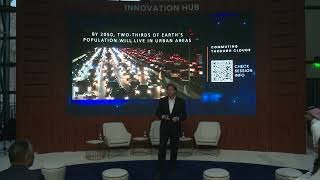
Commuting Through Clouds with Rikard Steiber, Investor & Board Advisor, Jetson Inc. - #FII7 Day 2
MWC Keynote: "The Dawn of VIVE REALITY" by Rikard Steiber President Viveport and SVP VR at HTC
Rikard Steiber (Viveport & SVP Virtual Reality, HTC Vive): Expanding the VR Ecosystem

Rikard Steiber, VIVEPORT, HTC about Silicon Valley Open Doors Conference SVOD2017