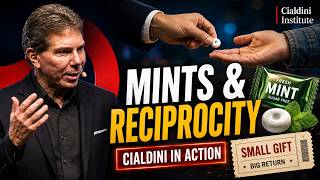
Robert Cialdini shows how a five-cent mint can boost restaurant tips by 23% if delivered as a personalized surprise. Two mints raised tips 14%, one raised them 3%. The effect isn't about the gift's size but about giving first and making it feel unexpected.
Chapters
One of the best demonstrations of the principle of reciprocation comes from a series of studies conducted in restaurants. So the last time you visited a restaurant, there's a good chance that the waiter or waitress will have given you a gift, probably at about the same time that they bring your bill. A liqueur perhaps, or a fortune cookie, or perhaps a simple mint. So here's the question: does the giving of a mint have any influence over how much tip you're going to leave them? In the study, giving diners a single mint at the end of their meal typically increased tips by around 3%. Interestingly, if the gift is doubled and two mints are provided, tips don't double. They quadruple! A 14% increase in tips. Perhaps most interestingly of all is the fact that if the waiter provides one mint, starts to walk away from the table, but pauses, turns back, and says, 'For you nice people, here's an extra mint.' Tips go through the roof. A 23% increase influenced not by what was given, but how it was given. So the key to using the principle of reciprocation is to be the first to give and to ensure that what you give is personalized and unexpected.