Santa Clause: The Man, The Myth, The Legend
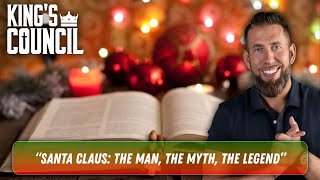
A recorded YouTube Bible-study-style talk by Christian Edwards examining the historical life of St. Nicholas (a 3rd–4th century bishop of Myra), how his secret generosity and miracles inspired traditions, and how those traditions evolved—through European practice, Protestant Reformation shifts, literary and commercial influences—into the modern figure of Santa Claus. The speaker interweaves historical notes, theological reflections about Christ-centered celebration, and interactive audience discussion.
Questions this video answers
270 AD
Patara, Asia Minor (modern-day Turkey)
December 6, 343 AD
Battle of the Milvian Bridge, October 28, 312 AD
313 AD
Chapters
I need you to shout it out.
Sing it out.
You are.
I never see you fail.
You are.
Have a testimony.
I have a story to see.
This is my story. This is my song.
Have a testimony.
Rain came when blue My house was built on you.
I say with you.
I feel somebody's faith rising.
This is the reason you made it.
Day.
Good morning. Good morning. Happy Wednesday to everybody. Happy Christmas season. John Jeff Brooks. John Jeff Brooks, my man.
What's up?
What a pleasant surprise, man. How you doing?
Good morning. Good morning.
Wow. Awesome. I love it. I love it. Good to see you, brother. Good to see you. If anybody doesn't know.
John Brooks, he is one of the OGs of King's Council. The OGs. Good to see you, man. Good to see you, Mark. I see your. Your message. Roger just answered. If. If you're on South Africa time, I assume they got YouTube in South Africa. I don't know. Roger, if you want to put that YouTube link in there so you can find it. Yep, that'd be good. And if not, I could always.
That should be fine. But get a hold of us if that doesn't work and I could get you a copy of this.
Good morning, everybody. As I'm looking at faces. Alan, what's up, man? Lauren, thank you for turning the camera on. So he's appreciative.
I don't know. I saw Zach was on as well. I don't know if he's with you or not. If you're going to be sharing. No. Okay. Reuben. Donald. All right. This is good. I see. Leah Harrison.
I. I know. I know your name. I don't know if this is the first time that you're on here, Lee, if it is, welcome. Hey, I've been here before, actually. Look at you guys. Emails and topic today just caught my eye, which I love. Okay. Good to see you. Good to see you. Likewise.
Yeah. So the. The topic today, we're not going to be diving too much in scripture, but I thought it would be an appropriate time to talk about Santa Claus. Right. It's the Christmas season and we could talk about jolly old St. Nick. And for me personally, when I actually learned.
You know, who the real Saint Nick was and how.
Well, really the evolution of how the man who was named St Nicholas evolved into who we know as Santa Claus, I thought it was absolutely fascinating. And I. I always think it's fascinating when you learn something that may be contrary to something you learned in school. And it's like, wait a second. Oh, that there's actually, like Christians behind this Story it's not what I learned in school or there's. Well, I don't know if you go to public school there's probably a lot of learning things that where a lot is left out. But the story of St. Nick, it is to me just absolutely fascinating but not just fascinating but really inspiring.
The story inspires me. I shared with you guys last year I, I sat down Ezzy and all six of my grandkids on Christmas Eve and went through a story, a Christmas story with them. It was, I don't know how much it was received by the at that time the two who weren't even one yet or even the, the two year olds at the time. Ezzy was very intently listening but every year we're, we're going to go through that because what we celebrate as Christmas today, yes it is the, the celebration of the birth of our savior Jesus Christ but obviously what the the world knows is Christmas. It's probably the, the most celebrated Christian holiday on, on planet Earth. However a lot of non Christians do celebrate it. I grew up with Christmas as my favorite holiday. Loved love as a little heathen getting all the presents getting spoiled, loved putting the milk and cookies out for Santa Claus and But I came to a crossroads when I found out from my friends at school that Santa Claus wasn't real. And I was like wow, my mother believes in Santa Claus and it turns out he's not even real. This is going to be devastating for her. And then I realized it was my mother and father that were pretending to be Santa Claus and take the bite of the cookie and leave the presents and then that, that.
A lot of coal for me. Thanks Jonathan. I saw that.
I, I remember like there was like two years in a row can't remember exactly my age where I just felt like I had to play along with still believe in Santa Claus was coming down the chimney and leaving those presents because I didn't want to disappoint mom. And then I, you know, didn't grow up in a Christian household but definitely a loving household with, with morals and values and I was conflicted as to like why my parents would just keep lying to me like this. So I know the truth and I was waiting for them to tell me and we never had that conversation. It was just they kind of realized at a certain point I guess by the time you're a teenager my mom kind of realized Santa Claus isn't real and but it didn't stop her from celebrating and doing the whole Santa thing the presents. And I like many Kids were spoiled on Christmas. And I remember it was even the, the, the source of contention in my parents marriage before they, they got divorced because of how much my mother would spend on Christmas. And so obviously Christmas was a day that was celebrated, but Christ was far from the, the center of it at that time. So today's Bible study, it's called Santa Claus, the man, the myth, the legend. And I'm excited to get into this with you. I definitely want this to be interactive. A lot of you have your cameras on. I want you to offer insight. Let me know your thoughts on what you hear today. Maybe.
The, the first time you're hearing some of this about St. Nicholas, but I plan for this to be a, a fun time of just being with one another this holiday season celebrating the birth of Jesus. And every day we should be celebrating the birth, the life, the death, the resurrection of Jesus Christ. So St. Nick, St. Nicholas, he was a bishop of Myra and he was born in the late third century, it was 270 AD in Patara, it's in Asia Minor, modern day turkey. And St. Nicholas, he was born into a time in history where there was great persecution for Christians. And this is, this is part of why, you know, we, we talked about this for Thanksgiving, ultimately how the pilgrims wound up on Plymouth Rock and just not just their devotion to Christ and wanting to flee persecution in England, but just whenever we talk about the history of the church, I get convicted because there, there are stories of Christians who absolutely willfully died for their faith, willfully die for their faith. They would not budge. They had a zeal for, for Jesus and nothing could or would shake them. And when you look at the persecution of Christians in this country today, it's really that there, there isn't any like real persecution in this country in this day and age. Do we get shadow banned on like YouTube and social media when we mention Jesus? Yes. Right. That's far from, from persecution, especially the type of persecution that a lot of believers of the early church went through. So the, the, the time that 2 AD.
Was, was around the time and season of some of the greatest persecution of Christians in world history. And it was if you've ever heard of like the, the 10 persecutions, starting with, with Nero and then just ultimately all the, these emperors that would just persecute Christians more and more and more. And Diocletian who was the emperor, became emperor shortly after St. Nicholas was born. He was one of the worst. He was one that burned down churches where if you had any, any Bible or scripture, he would Take that away. He would kill Christians. There was just an intense persecution and.
There was a movement amongst Christians at the time and it was called pietism, right? Where if you were a devouted Christian, you were, you would devote your life, right? And keep in mind, if you outwardly profess Christ, you know, this is 300 years, about 300 years post the Book of Acts where John and Peter are arrested for preaching Christ. And it was the same, same 300 years later where you're not going to say the name of Christ, you're not going to start your church, you're not going to do any of that. Because remember the emperor, even like Diocletian used to sprinkle gold dust in his hair and he was considered a God. He wanted to be worshiped as a God that was part of the Roman Empire. You worship the emperor as if he were a God. So Saint Nicholas is born into this culture of intense persecution. And you know, from the time of the apostles to St Nicholas being born, we had Polycarp in 155 AD who was persecuted and, and, and, and ultimately thrown to the lions. But his heart was like he said, 86 years have I served him and he has done me no wrong. How can I blaspheme my King and my Savior? Can you imagine that being persecuted for 86 years on this earth as a believer and say Christ has done me no wrong, he's done me no wrong. Right? Just that outlook, the perspective that some of these early church figures had was God. And they had so much less than what we have today. They, they had such intense persecution and to have the heart where Christ has never done me wrong, he's never left me, he's never forsaken me. How could I blaspheme him now by saying that I'm not a believer. So the, the culture was intense and St Nicholas was born to wealthy parents. And when his parents passed away, they left him a pretty nice inheritance. And Nicholas in this pietist movement, he wanted to give it all away, right? Kind of inspired by the rich young ruler, he wanted to give it all away, sell everything he had, bless others and let, let Christ be glorified. So he did that. That's exactly what he did. But he didn't want to receive any of the glory for doing that. He wanted to do it in secret. And he's somewhat infamously known in this particular instance where there was a merchant in town that went bankrupt. And in those days when you were in debt, one of the ways you could pay off your debt is if your kids basically became enslaved to the one you owed money to. So this merchant had three daughters. And what the merchant decided to do, came up with the plan. He said, okay, if I could marry off my daughters before the merchant comes and takes them to be slaves. And at that time, certainly they could be involved in what we would just simply call sex trafficking. Today, especially if you're a young woman and you can imagine a father, you're doing everything you can to not have your. Your daughters become servants of those who you're indebted to. So he wanted to marry off his daughters. Problem was, he didn't even have enough money for a towery dowry. Was the somewhat of a down payment that the bride would pay the groom's family when. I wish I had known what a dowry was when Lucy and I got together, because I definitely would have insisted you, I'm worth it, baby. You got to put a down payment down on this thing, okay? But I had no idea what a dowry was. All I knew about Jesus was all that she had shared with me to that point. We hadn't gotten into dowries at that point. So what St. Nicholas did was.
One night he went. Now, the oldest daughter, she. The father was trying to come up with this dowry so she could be married off. And St. Nicholas heard about this and he wanted to bless his family. He wanted the father to be able to keep his daughters. So in the middle of the night, he snuck up to the window of the house and through gold onto into the window. And as the story goes, typically at night, people would take off their socks, leave them by the fireplace to dry. And he threw the gold, landed on the. The socks that was by the fireplace. And the father woke up to this money. Hence a lot of the things that I'll talk about. You'll say, oh, okay, yeah, stockings. The tradition of stockings, it comes from this, from St. Nicholas throwing the gold into the window, landing on the sock drying by the fireplace. So the merchant finds it, and.
He has the money for the dowry for his first daughter. So he goes to marry off a second daughter. St. Nicholas creeps up to the window again overnight, throws the gold in, and the father has the money for his second daughter to get married. Now, for the third daughter, the father is expecting it. So he decides, I'm going to stay awake every night until I catch whoever this is throwing money in my window. And he did. He caught St. Nicholas throwing the gold into the window for the third daughter. And.
St. Nicholas made him promise that he wouldn't tell anybody who gave him the money because he didn't want to be glorified in any sort of way. Imagine that. Like you're literally throwing money into a window, wanting no credit at all. And I just think of how many churches have like the, the hundred dollar line, fifty line. It's like, it's just this big expose of, of your giving, right? Everybody, not everybody, but a lot of people want to be seen as they're, you know, dropping that envelope into the offering bucket. And St. Nicholas is truly doing the work of Jesus by blessing this man and his family and allowing his daughters not to essentially become sex slaves. So those, those three offerings of gold.
I think I've been into one pawn shop in my life. I don't know if any of you frequent pawn shops, but pawn shops, even today, a lot of them, they have three gold balls, like, hanging outside the pawn shops. And those three gold balls represent the three offerings of gold that St. Nicholas gave to this father. And the pawn shops, their perspective is, you know, he's the patron saint. And the pawn shops say, well, this is our way of helping families when they're in need, offering services of a pawn shop. So they like to think they have good intentions with that, and maybe some of them do. But if anybody has been to a pawn shop and they've noticed three gold balls hanging outside, let me know. But apparently that's still the case today. So what St. Nicholas wanted to do was take a pilgrimage to the Holy Land. And he visited a place like the Church of the Nativity in Bethlehem, and he planned on joining a monastery. And that this piety movement, that, that's what devout Christians would do. They would sell everything they had and then go serve. But ultimately they, they'd be locking themselves away in their devotion to God. And the Lord convicted him and conveyed this message to him. Do not hide your light under a bushel. It's wonderful when you have a privately devoted life to the Lord. But if we're called to be God's servants, I think the, the Bible's pretty clear that we're not to just lock ourselves in a room and just keep Jesus for ourselves, right? We're to be used. We're his vessels. We're. We're the salt, we're the light. So.
So St. Nicholas decided, okay, I'm gonna not join this monastery. I'm gonna serve the Lord. And he was directed back to the. The coastal city of Mara, which is in today's modern day turn Turkey. Now, in the city of Myra, the bishop of the church there had just died. And the church leaders, they were praying and fasting, trying to hear from the Lord who their next leader would be. And one of the. The elders, elderly men in the church, had a dream that said. And said, the first man to enter the church tomorrow morning is going to be named Nicholas, and he's going to be our next bishop. Well, Nicholas had made it a practice to get to church early. When he went to church, he would actually fast through the night, which most of us do by way of sleeping. But he wouldn't break his fast until after church. And that's where you get breakfast from, right? Break your fast. And so he was the first person to show up at the church. And one of the elders got there, asked his name, because they were just waiting for this man named Nicholas to be the first one there. And he said, nicholas. And the man jumped and. And said, here, you've been called to be our next bishop. And Nicholas was like, thanks, but no thanks. This was the time where bishops were being thrown into prison, churches were being burned. And he was like, I appreciate the offer, but I don't know about this. But ultimately he decided to. He deferred to God's will, and he became the bishop. And it was quickly arrested. Now.
After Diocletian, there was the. The next bishop. Not bishop, I'm sorry, the. The next emperor. He was a little bit more tolerant to Christians, but there's still persecution going on. But Nicholas was thrown into prison, right? So we think about Santa Claus, Jolly Old St. Nick, and. But then you. You could just imagine just this willful servant, St. Nicholas, who's sitting in a Roman cell, arrested for. For preaching the gospel, for being the leader of a church. But Diocletian died in 305of.of an intestinal disease. And he abdicated the throne.
Well, he abdicated the throne, and then he died. But delirious was the. The next emperor in line. He was struck with a similar ailment, and he died in 311. And that kind of opened up the door for an emperor that many of you may be familiar with. Constantine. Constantine. And the story of Constantine was after Galerius died, kind of his four top men were gonna fight it out, see who became the next emperor. And two of them kind of just kind of defeated themselves, whittled themselves down. And that was between Constantine and his men and one other leader named maxentius. And on October 28, 312 A.D. the night before the battle of the Milvian Bridge, Constantine, that this was the. The moment Constantine had with Jesus as The story goes he saw the chyro in the, in the sky, right? Which would be the first two Greek letters, X, which would be chai, which would be the CH in Christ and then row, which would look like the letter P. So we saw an XP in the sky. And this was this moment that he had with the Lord and he got saved. And he, he actually put an XP on the shields of all of his men. And Constantine, he won. He won the battle. And now this is really a turning point in world history because now you have, he was freshly converted, freshly saved, but now you have a Christian who's leader of the Roman Empire. He issued the edict of Milan in 313 A.D. and for the first time in history, Christians were not being persecuted systemically by the state, right? So Nicholas was freed from prison. And that, that, that xp, that, that chiro, the X, like X marks the spot. Even, you know, people think that they're taking Christ out of Christmas when they say Merry Xmas. That's what the X actually represents. X represents the first two letters in Christ's name. So you're not taking Christmas at, or Christ out of the equation when you say Merry Xmas. You're not taking price out of the equation when you say Happy Holidays. Holiday just simply means holy day, right? It's a holy day because we're celebrating Christ's birth. So even as the world, they try to.
Take Christ out of Christmas, that they fail in their, their feudal attempts. I just saw a clip. I don't know the guy's name. I guess he's a comedian. He looks somewhat familiar and some of you may have seen it, but he said, no, I, I go out of my way not to offend anybody by saying Merry Christmas. You know, everybody wants to say Happy Holidays. So I don't say Merry Christmas anymore. I say may you and your household be blessed by the celebration of our, the birth of our one and true only Lord and Savior, Jesus Christ. Right? And it's just hilarious to me, if anybody, even of the world, they get offended at, at Christmas. And I, I get it. You know, the world wants to, and the enemy wants to take what, what, what God means for good and turn evil. But we know that God turns what the enemy means for, for evil and turns it back to good. So Nicholas, once he gets out of prison, he's this fearless preacher. He makes his way to Ephesus. And we, we talked about this a little bit when we went through the Book of Revelation and earlier, I guess it was last year when we went through the book of Acts.
Ephesus was kind of like the Las Vegas of the ancient days. There was a famous temple with 127 huge pillars. It was one of the seven wonders of the world. It was filled with prostit. Right, and that would be the way you worshiped this, this Greek goddess Diana, right, this fertility goddess. And so St. Nicholas goes there, he preaches against this cult. And.
Essentially the, the people of Myra tore down this temple of Diana and he preached against divination, he preached against human sacrifice. If Saint Nicholas was alive today, he would be one who'd be confronting false teachers. He'd be one who'd be confronting corrupt politicians. He'd certainly be pro life. And outwardly speak on being pro life. He was a man of generosity. At the time, there was a practice in the Roman Empire called exposure of unwanted infants. And it's, it was the Roman equivalent of abandoning your babies. If a woman had a baby, if the, the father wanted to keep the baby would.
The baby would be placed at his feet and he would pick up the child and accept it. If he ignored the baby, the baby would be taken outside in a basket and just left out in the cold. And by this time in history, people knew that, knew who the Christians were, even though they're trying to stay somewhat under the radar. And usually somebody would take these babies to the house of a Christian, which is phenomenal. Imagine that. Like, if people just knew you were a Christian, would you even be willing to just have babies show up at your doorstep? Because otherwise they're going to die. But this was the, the culture at the time. So he spoke out about that.
He, he spoke up. He was very opposed to the Olympics. The, the, the word gymnasium, the word gym means naked. I don't know if anybody knows, but the Olympic Games back in the day, these, they used to be naked when they, when they had these Olympic Games. And there was a lot of immorality involved with it, for sure. He spoke out against that. So he was, he was holy. And he, he, he preached with a boldness. He was a defender of the deity.
Many of you are probably familiar with the Council of Nicaea. So here, here's what happens when Christians for 300 years, they're, they're being persecuted and they don't have time to squabble about.
You know, doctrine or tertiary issues, sometimes bigger issues. Now when you could openly practice Christianity, now you start to argue about what the Bible actually says. And there was a, this heresy by.
A bishop named Arius. And what he basically said was Christ was a created being. Well, that was blasphemy to, should be blasphemy to any of us who read our Bibles. And it was to St. Nicholas. He wasn't a creative being because what that does is take away from the deity of Jesus Christ as full man and full God, right? It's the hypostatic, the doctrine of the hypostatic union, which just means he was fully man and fully God. So Constantine, as this Christian for the first time to, in the history of the Church, he gets all these bishops together to, to settle this. And what, what I love about St. Nicholas and I don't know, maybe this is still that a little trace of that little heathen in me that, that, that used to be, as the story goes. And there's actually some artwork of this, ancient artwork of this. What St Nicholas did was he actually slapped Arius across the face for preaching heresy. And I was like, man, jolly old Saint Nick, he had a bit of a temper, right? So I don't know, I was praying about every time I hear heresy, just slapping that person in the face or just finding a different way to confront people. But that's what, that's what Santa Claus did. That's what jolly old St. Nick did. He slapped him across the face. And ultimately that.
That Aryan doctrine, as they called it, was, it was settled and Arius was excommunicated from the Church. There are stories of miracles that follow Saint Nicholas.
Trade ships will come from North Africa and along the coast there and in Turkey. There's two particular stories. One where the, the seas were just raging and St Nicholas came down by the water and he just spoke over the sea, spoke for the, the storm to cease. And it did. There's another time where there was great famine, I mean, all throughout history, but in particular here where, where St. Nicholas was. And as the trade ship had stopped at a port in Turkey, Nicholas went down and asked for, for some of this wheat for, for the people of the land there. And that, you know, he, he preachy ministered to these sailors and the sailors, they, they, they obliged. They gave Nicholas wheat for, for the people there. But as the story goes, the what they gave to St. Nicholas so he could feed people there in, in his land wasn't depleted from the ship. When the ship ultimately got to where it was going, it was like the wheat had been multiplied. And just in the performing or. I don't want to make it seem like it was just him performing an act, but just these acts of God through St Nicholas, many came To Christ. And then there's an example where a governor was confronted by Nicholas. This was a corrupt governor, and he had done some shady things. And to cover up his corruption, he sentenced a couple guys to die because they knew the truth. And what happened was it was supposed to be a public execution. St Nicholas, he. He made his way through the crowd, he took the sword out of the executioner's hand, threw it to the ground, and he told the governor he had to repent. And he told the governor what he had to repent of. To which the governor said, there's no way this man could have known that. That that's what I did. And the governor repented right there in the moment, gave his life to Christ, that one. That only God could have revealed this to him. So it's interesting that some of these gifts of the spirit, you know, they didn't just come come back around in the Azusa street revival in 1900, 1902, I think it was, right. Some of these Pentecostal gifts, like they were flowing throughout the church at the time. So.
How did that man who was so devoted, so dedicated, become Santa Claus that we know today? Well, the Dutch deeply honored St. Nicholas. And he's not just a patron saint of pawn shops, but also of the sailors because of the miracles he performed at the sea there, but of the Greek Orthodox Church. Many St. Nicholas churches are around today because of St. Nicholas. And the Greek Orthodox Church consider him to be what the Catholic Church would consider Peter to be. But even if you think of the name Santa Claus, right. In Dutch it would be St. Nicholas would be pronounced Sinterklaas. Right? So, so St. Nicholas, it was center class. And ultimately that evolved to. To Santa Claus. But after Nicholas died, December 6, 343 A.D. became known as St. Nicholas Day. And where he was buried in Turkey. Once Islam came about and the Ottoman Empire and the Ottoman Empire started making their way from, from the east. When. Because what they would do the, the Muslims at the time is they would go and, you know, they would try to desecrate the tombs of early church fathers. So like the, the tomb of Peter, the tomb of Paul, they wanted to desecrate them. So when the Muslims made their way to Turkey, those who honored and revered St Nicholas, they wanted to move his tomb from Turkey and they moved it to it where the Muslims hadn't gotten yet. And some of the traditions of celebrating St Nicholas Day, where they celebrated his life and what he did as kind of a secret gift giver that made its way into the western part of The Roman Empire at the time, and even between Eastern Europe and Western Europe. Eastern Europe would celebrate, even in, like, Greece, this January 6th, that. I'm sorry, December 6th. Well, I'm sorry, January 6th is the day that's more.
It's more celebrated as what they would celebrate as Christmas. In Western Europe, it was celebrated as December 25. So when the two kind of merged, that's how you got to. They decided just to celebrate the 12 days of Christmas. That's where we get the 12 days of Christmas from.
But ultimately.
The traditions of St. Nicholas and his giving just spread throughout the land. And there was a lot of, as you can imagine, idolatry going on. Even, you know, St. Nicholas was an awesome man, and I think it's good to know his story and it's good to teach our kids the. The man behind Santa Claus. But when Martin Luther came along in the Protestant Reformation, he rejected Saints Day, right? All every day of the year, 365 days of the year, there was a saint to be honored. And like anything, if we. We could turn it to idolatry, right? So Martin Luther, one of his.
One of his objections to what was going on in the church was the celebration of these saints. And he moved. He removed St Nicholas Day from December 6 and decided that gift giving should be done on December 25. What they knew to be the birth of Jesus Christ. Now, he taught that, that the gifts that were given, we shouldn't be giving gifts to honor any man, but that all gifts that we give, all gifts that we receive, they ultimately come from the Christ child. And that was. Would be Chris. Chris Kindle. Right. Which ultimately turned to what we know as Kris Kringle. Right. In some of these Christmas movies, Santa Claus's name, Chris Pringle. But that's because Kris Kendall would be what it means to. To celebrate the Christ.
So long story short.
Martin Luther, as he spread Christianity into Germany and into Western Europe, as the story goes, he was coming home one night and there was. There was lights from.
Lights within the houses that were kind of sparkling behind the trees that were covered with snow. And the evergreen tree by this point was, was a. A symbol for. For Christmas, which I believe evergreen trees are. Are a good symbol just to celebrate Christ. There. There's nothing in scripture that says that you can't have a tree in your house, put lights on it and celebrate Jesus. Right. The. The issue is, is idols. The problem would be worshiping trees or worshiping anything or anyone that isn't Jesus. But the. As tradition holds, just the.
Tradition of putting lights on a tree. Martin Luther wanted to show his kids how beautiful, that the lights would look kind of sparkling through these trees. So he put the candles on the trees. And I mean, ultimately what we teach our kids now, I mean, the older kids are older, what we teach Ezzy, and what we teach the grandkids is the evergreen tree. It's. And I, I am all in favor of Christmas trees, Christmas lights. I love it. It's nostalgic for me, even though as a kid I didn't know Jesus. But it was just a festive time even. You know, Lucy works at a hospital down here. I worked at a hospital in New Jersey for years. When it gets to be around the holidays, everybody just has this different spirit about them, right? Everybody's friendlier, everybody is more peaceful. And even if they have no relationship with Jesus at all, there is festive atmosphere that comes along with Christmas. And I'm all for a festive atmosphere. And if we could direct people's attention and their, their, their hearts devotion and their minds towards Christ, then that, that's what we should do. But. So the Christmas tree, it's an evergreen tree representing everlasting life of Jesus Christ. The star on top represents the star of Bethlehem. The, the lights represent Jesus, the light of the world. Yeah, palm trees, that, that's, that's blasphemy, man. Palm trees for Christmas trees. I, I don't like being in Florida or like, I'm sure next week in Arizona, I'm not gonna like it. Being in the desert, seeing like Christmas lights in the deserts, that's just strange. I'm okay not having snow in Texas. I'm okay with that. But a little bit of snow, it would be nice.
One of my favorite Christmas songs is by the Drifters, Dreaming of a White Christmas, right? The little kind of doo wop Drifters version of it. I heard that.
Infinity times as a kid. My father listening to the oldies station all the time. And that was the song that was on rotation, like every third song. So I have an affinity for that song. But. And then back to the Christmas tree, the ornaments, you know, the ornaments represent the, the fruit of the spirit. So wherever all that originated from doesn't really matter. That's what I'm going to tell my kids, my grandkids, that that's why we have it up where everything points towards Christ. Now, as far as how.
How.
St. Nicholas evolved into this jolly old St. Nick.
Now it's interesting, we were talking about Thanksgiving a couple weeks ago, of course, and even when the pilgrims got to America, the, the captain of the Mayflower, he actually recorded in his logs that, that these guys, they don't celebrate Christmas, right? Like, like they had rejected like celebrating Christmas and just some of the, the pagan activities that were involved with it from where they came from in England.
But Christmas was introduced through, through immigrants, the Dutch, German and French settlers that ultimately came to America. And just the influence of St Nicholas, the Christmas trees, the gift giving, the festive traditions. And then New York's first church was actually called St. Nicholas Church. And.
What they, they wound up doing is they would actually every year just have kind of act out revelation a little bit. They, in honor of St. Nicholas, they would have, have a play where St. Nicholas because you know, all the saints come back with Jesus Christ is on the white horse. All the saints. So all of us are saints, right? Once you're saved, you're a saint. But they celebrate St. Nicholas by having St. Nicholas come back a little early on a white horse. And that would be the play they represented to honor St. Nicholas. But there was mythical elements that were added to it where the white horse became a reindeer, heaven became the North Pole, angels became elves, and then the book of life, life became naughty and nice list. Okay, so you can see how the, the influence was of, of St. Nicholas and some of these traditions were corrupted. At the end of the day, commercialization is going to corrupt everything at any opportunity it has. Right. Even with the celebration of Thanksgiving. Thanksgiving for many years was always on the last Thursday of November. And then I forget which president it may have been as far back as Lincoln changed it to, to the fourth Thursday just in case, just to give that, that extra time. If, you know, if Thursday fell on the last day of November, that, that would be one less week for, for merchants to make money when people are spending money on Christmas. So even, you know, the day we celebrate Thanksgiving was changed from the last Thursday of the month to the 4th of the month. I see Roger fact checking me on something. Do you have.
Yeah, it was fdr. I thought, I thought that's fdr.
Yeah, yeah, yeah. I was a Lincoln that, that instituted Thanksgiving to begin with. I think for every last Thursday, I think Lincoln has something to do with it. But this is about.
Right.
I just, I just remember FDR was the one that did the last, that moved it.
I don't know who did. You're right. That is fdr. I'll make sure I have the information correct next November when we talk about Thanksgiving again.
So. But here in America in 1809, Washington Irving wrote Knickerbocker's History of New York and portrayed Santa as a pipe smoking Dutchman flying over the city. Then in 1823 there was a famous poem written twas the night before Christmas and the poem gave us reindeer, sleigh, chimneys, elves, stockings and Christmas eve instead of December 6th as this gift giving day.
And it depicted Santa as a jolly old elf. Then the late 1800s there is an illustrator who drew Santa as this fat jolly old man with a red suit.
With a North Pole workshop and a naughty and night list. And then for all you entrepreneurs who appreciate the Marketing in the 1930s, Coca Cola commissioned had in Sunbloom to create Santa for their ads, kind of solidifying this look. And really what we know and what we see as Santa Claus today is because of Coca Cola in this marketing campaign. And I mean Coca Cola still has the same marketing campaign every Christmas. But can you imagine if you know, it was Pepsi Cola that came up with this marketing idea. I mean, Santa Claus maybe blue right now instead of red, but we have a red Santa Claus, A red and white Santa Claus and Coca Cola. It was one of their genius marketing ideas. But really, think about that. A soda company, a beverage company, really it was a big shift. Obviously there was transition and evolution along the years from Saint Nicholas the Man and what he did and his custom is his generosity to, to Santa Claus flying down from the North Pole and coming down your chimney and eating cookies. But Coca Cola had a huge deal in what we know today. So.
I didn't realize I'd be 48 minutes in at this point. However, when we think of Christmas, we should be celebrating gift giving for sure. But who's the greatest gift? The greatest gift is Jesus Christ. What I constituted for Ezzy, my youngest, who's five this year.
Got into it a little bit last year with him, but he was four then, didn't understand, you know, every time an Amazon package comes, he runs to the door, he says, is it for me? And that's when I, I start to realize, I think I spoil this boy a little too much because I like to, if I see something on sale, Lego that's on sale, I like to get it for him. We sit down, we have in front of some time. So now he just likes to check, he wants to inspect like who the Amazon package is addressed to. Because I think a couple times as a gift, somebody sent him something through Amazon, it showed up as Ezra Edwards. So he wants to see who it's addressed to. And then he, he's dying to See what gets into it, what's in it. So last year we decided we're gonna. He's gonna make a Christmas list like I did. I. Every year I made a Christmas list of, like, I numbered them the number one gift I want all the way down as long as my heart desired. All the things that my. My greedy heath and little heart wanted. And I got a lot of those things. So for. For Ezzy, what we did was he's gonna have a Christmas list. But his Christmas list is going to be. When you think of people that you care about and you want to bless and what might bring them joy, I want you to write their name down, what that gift is, and we'll give it to them. So he went through pretty much all the kids he was at his pre K with. And it was just different Paw patrols at the time, right? The girl's got sky and whatever Liberty, and the guy's got, you know, Marshall, and gosh, he's out of that phase. So I'm forgetting their names. But this year it's somewhat similar and. But now it's Lego sets that he wants to give less his friends with.
And I love that because, you know, I. The more you live, the more you see that. If you see somebody who's just like a jerk human being as an adult, you probably trace it back to their childhood. If you see somebody who has these just like obnoxious, ridiculous views and ideologies, it's probably because of the household they grew up in. So what better way to celebrate Christmas than, I mean, we should point everybody to Christ at any point that we can take everything as an opportunity to turn hearts and minds towards Christ. But in this day where obviously, I mean, Christmas could be a burden, right? It really can. Where it's like this Secret Santa.
At your jobs and things like that, and everybody just feels obligated and it's like, man, if. If the limit is $20, like, why do I have to now take my time and try to find something that's good for $20. Wrap it in the Secret Santa. When it's like, let's everybody just keep our $20 and we maybe go get coffee together, just have a chat. Let's, let's, you know, let's fellowship with one another. But the season has been so commercialized and I mentioned earlier, like Black Friday and things like that, just the spending that's done. However, I have come across. And, you know, I don't know if this is inappropriate for Wednesday morning Bible study, but I have come across a Website called Deals by Brian. Then it turns out there's a website called Deals Deals by Zach, and they have, like, not just some of the best deals on Amazon, but if you put in their promo code, it's stuff like 50, 60, 70% off. So for like the last month, been. Every time I'll check the list, there's like 15 new items on the list. And I've been able to get lots of toys and goodies for the grandkids for Christmas over, like, the last month. And it's ridiculously cheap. So pro tip right there. Deals by Zach, Deals by Brian.
So anyhow, as far as.
You got it. Yep. Thanks for the list, Zach.
At the end of the day, was Christ actually born on December 20? I have to give his mama hug.
Okay. Was Christ actually born on December 25th? I don't know. Could have been. Maybe it was, maybe it wasn't. I don't think it really matters.
People who get real dogmatic about that. I think that's. That's not really relevant if he was actually born on December 25th. I mean, between, you know, the, the Roman calendar, the Greek calendar, all that, like, there wasn't even 365 days in the, in the year calendar not too long ago in human history. Right. So what was that today? Who knows? I mean, if, if, you know, Lucy and I go out to celebrate her birthday or something, we're happy if we just get in the same month. Right. It doesn't have to be on the day. If, if it's like, all right, sometime in June, we're going to celebrate your birthday. We're going to get a night away. And I, I think, shoot, we've probably done it sometimes in July, sometimes in May. Right? It's just, it's not about celebrating or being dogmatic about the day. It's about what the day represents.
So in conclusion, and I started this by saying, hey, this is going to be a very fun interactive, lots of feedback, lots of stories, and I haven't given you guys that opportunity yet. So I, I want to hear from you guys if any of this is new to you.
If you know the story of St. Nicholas and just kind of how some of these even think about this with the Valentine's Day cards today. Like, or like xoxo xo. So if you used to sign a document, you sign at the X, and the X represented Christ, and then to. Sometimes they would seal it with a kiss. So what we know is today as XOXO for St. Valentine's Day. What literally is in Honor of Christ. You know, it's just so much stuff that we get. Has Christian roots and we just don't know it. And the world kind of takes it, hijacks it and takes it along another path. Gonna get caught up in the. The notes here. St. Nick Patron, three tape makers.
Oh, I. My family is.
Are. We go back to the Czech Republic. Czechoslovakia is where my heritage and my roots are. So we used to set. We used to celebrate St Nicholas, Nicholas on December 6th. That was something my mom would always do. We kind of mix the two Christmas and that. So we would always get a presentation from St Nicholas or Nicholas or whatever on December 6th. So it was a way of kind of going back to the heritage of the Czechoslovakian roots.
But never really knew where it came from, why it was different than the original Christmas or from our Christian Christmas. You know, I didn't grow up in a really Christian household either, so it was, you know, Christmas wasn't for celebrating Christ. It was really for Santa Claus and the gifts. So I appreciate you throwing that out there and bringing that part of the story into some perspective for me.
Yeah. Yeah, absolutely. Yeah. I'm just fascinated by the story. And like I said, story like this inspires me.
You know, obviously, the. It's fun to see the evolution from St. Nick to Santa Claus, but when you see the life of St. Nick or. Or read about the life of St. Nicholas, it. Whenever I, I. I hear. Read about the life of somebody who's devoted, I always immediately kind of look inwardly and be like, man, how would I be living at that time?
You know, how many of us today, sometimes we don't want to, you know, we don't want to offend somebody at a family gathering. And this joker, he. He pushed his way through a crowd to confront a politician who was corrupt and call him out on his junk, right? So he just had such a boldness, and there was such a zeal that he had. And that. That zeal, you know, that's something I pray never wavers or wanes within me. I want that zeal, the zeal that you had probably when you first came to Christ.
You know, when you're on fire for the Lord. And then I remember hearing, when I was a new Believer.
Like, people would say, like, oh, yeah, fire for the Lord, New believer. And I was like, yeah, is this fire supposed to go out? Like, as long as I'm a believer, I should have this fire, right? You shouldn't get used to just this walk as a. As a Christian. And if you don't have that fire. And there's times where it does wax and wane, right? And usually it's our own doing. If we get up every day, we forsake our time with the Lord. If we, you know, if we get caught up in just the jolly festivities of Christmas and just putting on the. Putting up the tree and drinking some hot cocoa and listening to some Christmas carols like, it's great fellowship time with the family. But if Christ isn't at the center of it, you're gonna find that. That fire in your belly starting to. To wane a bit because Christ isn't at the center of it.
What else? What else.
Sean?
I'd never heard that story about why he was the patron saint of sailors. That's. That's a very interesting story. And, like, looking into it a little bit further, the. The. The fact that the sailors were so moved by his evangelism that they were willing to risk punishment from the emperor by having their cargo shorted and. And saving the city of Myra from the famine was. Is just phenomenal. It's. It's motivational to me to be just that much more.
Persuasive in my preaching.
And.
Generous as well, and not worrying about the repercussions of what might or might not happen by my generosity, but leaving things in God's hands.
Amen. And I've talked before on these Wednesday mornings about the. The miracles we see in the Book of Acts, you know, in the early church. And even with this, as far as St. Nicholas and, you know, commanding the. The storm to. To stop, you know. What's up, bud? Good morning. Good morning. Oh, we're just talking about Christmas. You excited for Christmas? Yeah. Yeah. Because you're going to give gifts to your friends. Yeah. Yeah. Okay. Come join me. E. Do you remember him? You met him a long time ago. John Jeff Brooks. You haven't seen him in years. You remember him? You don't have your glasses on, so you could probably.
Hey, A.
I can see him. Okay. Okay.
Well, anybody have anything else this morning?
Yeah, I'll add something.
Well, it's good to be back in this room again. That's the first thing. Some familiar faces in here. Good morning, everybody. I'm John Brooks. He says, oh, gee. One of the, you know, first few people who said yes to this program back in 2020. 2021. So it's been a long journey. I'm glad to come back in. I think I should say what brought me in is I saw a post, a post from Riley that says, delay obedience is still disobedience. And I'm like, man, I've been procrastinating on this for the longest to come in here and I needed to do it. And it's a good thing to jump in here. Of course, Christian has been the man. He's always give us those in depth stories and timeline and he's always come through and put things into perspective. So hearing the story of Setnik so in depth, what it does for me, you know, it's. What he brought out is like it's deriving from goodness, love, careness, compassions. It's all those things that I'm seeing that which are Christ like characteristic that is being shown. That's what highlighted in my, in, in my mind as he goes into that happen. Of course I got a call, came in and, and I'm like, yeah, you know, as much as the world tried to erase what Christ and Christmas is all about, you know, the essence of it all, even though it's commercialized, the essence of it all is still about compassion. It's still about love, it's still about caring.
Christian even mentioned that, you know, you could feel the aura of people even desiring to be more nice to others on Christmas, even though they haven't done that all year round, right? If they will pretend to, to do that on that day, which makes the mark, whether they know it or not, they this is a Christ infected goodness that they don't even, you know, acknowledge. Well, so hearing this in my mind, I wrote down something very quickly as I'm hearing this. I'm like, do you know the world has, you know, completely trying to remove price out of Christmas, right? But one thing is that there are some landmarks about Jesus that are so notable that they can't erase no matter what they do, right? The fact that the world's calendar was also split in two.
Marks the very thing that is undeniably the probably the most impactful thing that happened in time a step, right? Whether they want to acknowledge it or not, this had occurred, that there is a before and after Christ. And that's one of the things I'm like, guess what? The world has already acknowledged some things about Christ, right? So what is what Jesus came to do? And as you guys may or may not know, the before and after is before grace. And after grace, which is the period that we're in, which is the time stamp that the Lord has placed us into. And so whether they acknowledge it or not, this is something that the world has come to put on their calendar, right? And so I, you know, acknowledging grace and, and the era that we're in, the birth of Jesus. I like to think of it this way, that the, the Bible says that every knee shall bow and every tongue shall confess that Jesus Christ is Lord. May I submit to you guys that through the birth of Jesus Christ and the spirit of the calendar and all the goodness that people are attempting to do, they have already acknowledged Jesus Christ in their lives. They have already acknowledged the goodness of God. And so Christmas for us.
Believers is just a, a reminder of all this goodness and all this thing that Jesus represented him to do. And so we proclaim it even more. But it is something that we should always be doing because Christ our Savior is, is all in all and everything. So thanks for the reminder, Christian. And of course, I jump in here. I, I'm blessed to even be able to share this with you guys. I, I thank you for allowing me once again, Christian.
Amen, brother. Thank you for sharing that. And talk about zeal for the Lord. Every time John Jeff Brooks opens his mouth, you just hear passion for the Lord. Love that about you, man. I love the heart you have for, for Jesus and for others. And don't hide your light under a bushel. Get on here more Wednesdays, man, and bless us with your presence. All right.
Love you.
All right, any closing remarks, closing thoughts? Zach, Lauren, I usually turn to, to you two, as you're not my elders, but in wisdom, most of the time you are. And John, you are my elder for certain.
I'll share one thing, Christian, one thing that you said I really appreciated because it's, it's kind of something I, I feel strongly about and I like the way that you articulated it, talking about the different seasons of history, when the church is or is not oppressed and how when, when we don't.
When we're not going through those difficult times, then we find ways to kind of divide what we, we dive into theology and doctrine, and then we kind of find ways to divide and, and how.
When there are times where culture is really oppressive towards Christians or when we are going through trials and tribulations or however you want to put.
Does kind of unite Christians. And so there was something kind of like just scratching at the back of my mind, like, I wonder if, you know, some of the prosperity that we have experienced here in the Western world is almost like the, oh, we'll just keep them, keep them pacified, keep them comfortable, keep that, you know, and they're just something about that feels gross to me.
And I appreciate that. I remember going to my interview when I was first. Lauren was there when I was first getting my credentials. And, and I just. I think I just told them, like, look, there's a couple things that I'm not really so sure about in your. Your list of, of, like, fundamental truths even. I mean, like, I get it. There's nothing like, terribly off about it, but there's just a couple of things there that, that aren't really, like, fundamental. And I just don't think it's that big of a deal if you don't think it's that big of a deal, and I'm not going to lie to you at my minister interview, but we invite. We invent new ways of dividing ourselves and setting ourselves apart, which is really just glorifying ourselves instead of glorifying Christ anyway. And so in a season that really is supposed to be all about him, just kind of focusing on, on the things that we believe that are similar and that are foundational and fundamental, like John was talking about, it's really all about grace. It's about relationship with Christ. It's about drawing close to him and showing his light to other people and, and focus on those things in the season rather than all the things that divide. It seems like there's a big kind of resurgence of the Catholic Church, of the Orthodox Church. And when I was pastoring this year, these young adults, there was a lot of people, a lot of these young adults were interested in these other theologies or the, these other sets of doctrine that they would then go and research. And it became like a hobby to them. And I'm like, look, I, I don't really care. I mean, like, I get it. We could talk about it. At the end of the day, there is some idolatry and, you know, like some of what you're talking about. But yeah, so, so all that to be said, I really appreciate the way that you had. You talked about how the church has been kind of oppressed during certain times. Then we get into it and then it all kind of separates and it gets disjointed. But I love being able to be on here on Wednesdays and, and there are people from different denominations and, and different parts of the country and being able to come together and enjoy one another's company and, and get into the word together, it kind of shows that there is still hope for all of that.
Yeah. Amen. Amen. Yeah. Speaking of. One second. Speaking of, like, the oppression, how the church could unify. Oppressed. Right. You know, you see Kirk Cameron catching a lot of Flack about, you know, talking about annihilationism, which I, I disagree with wholeheartedly. But if, you know, people started knocking on our doors saying, you know, renounce Christ or you're gonna get killed. I would go to Kirk Cameron's house that I, I would band together with him. I'm sure he would with anybody else, right? And even in the book of Nehemiah that they start rebuilding the wall. In chapter three, chapter four, you see the enemies of God try to, you know, throw banana peels in their way. More than that, they, you know, try to stop the building of the wall and then try to altogether, like, kill them. But you see the enemies of God in chapter four, chapter six, chapter seven. But chapter five, they're. They're missing altogether, right? So there was no attack from the enemy in chapter five. In chapter five starts with. And there was a great outcry for the people and their wives against the Jewish family. It's like, wait a second, they're getting along. They're working together when the enemies are attacking. And as soon as you don't see the Sam Ballad and Tobiah, the, the enemies of God, they're not throwing a wrench in the planes of God. Now all of a sudden they start mumbling and complaining amongst themselves. So whenever we see any, any circumstances in our lives where we're feeling oppressed, best believe God will allow that to happen. So you could get, get back to the basics where it's like, yeah, stop squandering about, squabbling about some of those issues that don't matter at all. Unify. Be the light, be the salt, preach with boldness, go out. And when we have this boldness, the zeal, like, we're going to start seeing more miracles, right? The story of St. Nicholas where, you know, the, the wheat and the grain, it comes off the ship, but the people on ships is like, yeah, it's like it multiplied. That's a first Kings 17 type story. Like the, the widow's oil, right? It's like God just continues to multiply. But we gotta do. We gotta walk in faith, walk by faith. And.
Yeah, I. It's a, it's an honor and privilege to spend these Wednesday mornings with you guys. And I'm excited for Christmas. I'm excited to use every opportunity I can to glorify Christ. And just ironically, I'll share this real quick. I was meeting with a couple last night from the seminar, and I was there way longer than I was supposed to be because at the very end they mentioned how they go to two different churches and they asked what I thought about that. And then one of the big issues was the husband, the way he prays. He doesn't pray in Jesus name. He prays in the name of God and Jesus. And whose explanation was. Because it's two different people, that God created Jesus. And it's literally the same thing. The reason why St Nicholas slapped Arius at the Council of Nicaea for that same thought, that same doctrine. So I did not slap him because, you know, I wanted to close the deal, quite frankly, but I did, I did speak some truth into him as best as I could in a loving, gracious manner. So at the end of the day, it's like, if you want to pray in the name of God and Jesus, you pray however you want. Just like Pentecostals who only baptize in the name of Jesus. They don't baptize in the name of, of the Father, Son, and Holy Spirit. It's like, that's cool. But don't now condemn somebody who does baptize in the name of the Father, Son, Holy Spirit. As long as you know that God and Jesus, they're one, right? As long as you know that you want to end your prayer in the name of God and Jesus, that's fine. As long as you, you know that they're one. So I had to, I couldn't, I, I, I didn't care how long I had to be there. I couldn't let that go, where he's just believing that Jesus was a creative being and ultimately denying the deity of Christ. So with that said.
Look at I drew out at school. That's wonderful, Bud. I love that.
This one was the cat.
This one was for Tiger. Looks awesome. It's amazing.
All right, you want to say bye to everybody? Merry Christmas. Bye. Merry Christmas. Merry Christmas, Ezra. Love you guys. I will see you next Christmas. Have a blessed week.
Bye.
Bye.