Build in the Wild Ep 1 Part 1
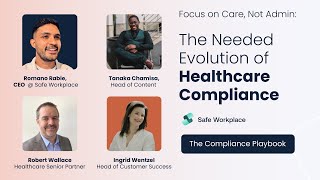
Luke, Romano, Steph Davis of Respawn Manual, and Marcus, a nurse, discuss building a healthcare compliance solution. UK life expectancy is declining. They argue compliance needs outcome focus, not box-ticking, and better tools to replace spreadsheets and manual name-matching.
Thanks for tuning in. What we're aiming to do today is start a series where we hope to build in the wild a compliance solution which hits the major pain points of compliance directors, especially in the healthcare setting. So my name's Luke, I chair Safe Workplace. We have Romano here, the CEO of Safe Workplace, Steph and Marcus as well, who have both practitioner and now professional compliance background. So without further ado, if we could ask you guys to introduce yourself before we dig in. Steph, going to you first.
I am Steph Davis. I am director of Quality and Respawn Manual. We are an online digital healthcare company. I've got a background as a clinical background as a nurse and a legal background as a solicitor. And when I moved to the UK around 11 years ago now, I mushed them up and fell into the very exciting world of quality governance, risk and all those kind of exciting things.
Awesome, thanks. And Marcus.
I'm a nurse also by profession, did 22 years in the British military and in the process of doing so various, through various leadership and management roles and deployments overseas, ended up in charge of various compliance, governance, reporting, quality functions. And then on leaving service, I found myself accidentally falling into compliance again and governance and assurance and risk and quality and all those great things that make sure we're safe and happy and secure. So yeah, I think that's me. There's a lot more. I won't bore you with that.
Horseman Romano.
I'm Romano, CEO at SafePlace. We're trying to build somewhat of a compliance operating system here. This is kind of the goal of this, this podcast. My background is technology and hopefully we can have an interesting conversation and solve some big challenges through this.
Cool, that's great. And I think it's fair to say, just to give you guys viewing this context, Safe Workplace started off as a whistleblowing and case management platform. And after building and progressing that platform for a while, it turned into more a full suite compliance solution. And through that work and working with Steph and some others, we realized how big a, how big the challenge is in healthcare and how specific it is in healthcare, especially in small to medium size and scaling healthcare organizations. And thus we're aiming, with your help in the audience and these guys help here, work out what should exist to make both your lives easier as the audience, but also patients safer. Steph, I'm going to bring you in here. You were rather modest in your intro, but Stephanie, for the benefit of those listening, has run compliance programs in some of the largest healthcare organizations in the world and is now at a very successful scale up. So she's. You've seen, you've seen compliance done, if you like, in beasts and smaller animals combined.
I've now ticked all the boxes.
Yeah, yeah.
And.
And you have a practitioner background. Right? So one of the, one of the things we've all seen is the quality of care, according to the reports, anyway, is. Is coming down. What do you think, from your perspective, Seth, is the quality of care coming down and if so, why and what in compliance is our role in both that and improving it?
I think, unfortunately, we can't look away from the data and the findings and it can be disheartening. We know that UK life expectancy is lower than many of the other countries around us and that we've got some of the worst cancer survival rates among those comparable countries, amenable mortality rates, meaning deaths that could have been prevented if the right care had been in time. At the right, you know, at the right time, we're looking at 88 per 100,000. And that is a stat that is scary and I'm sure is one that keeps many clinicians up at night, considering we're kind of 20 points above France, Netherlands, Australia, all kinds of countries where we'd want to be on a parent. So we're looking at lives being lost due to a system failure. And I think that's why we want compliance to be about outcomes and not checklists. And certainly that's how we like to operate and how I've progressed in compliance over the years, we don't want it to be any more about the audit and the tick boxes. We want it to be about the outcomes of our patients.
I mean, that sounds great. In principle, of course, compliance is about providing constant quality. It's about having quality management in their processes that get adhered to and overarchingly about safety. But we're not always viewed that way, I think, perhaps by the rest of the organization. Steph, how do you see compliance and then how does your organization see compliance and how have you tried to pass, perhaps align differing perceptions of the discipline?
So we have transitioned. When I first started with manual, I was the head of risk and compliance and I'm now the director of quality and risk. And I think that's a massive shift because it's not just about. It's not about compliance, it's not about audit, it's about quality. And when you speak to the clinicians, the people who are delivering the career, they see delivering patient care as something that they come to work every day to do. And I think we've talked about in the past, and Marcus, I'm sure you'd agree with me that no one's going into healthcare for the money, even the consultant. That's not why you're going into it. If you want to make lots of money. It is crypto, it is your finance pros and things like that.
Definitely not in the UK anyway.
Yeah. So it's. It is certainly there has to be something about you that wants and needs to care and deliver that quality care, your safe and effective care to your patients. And I think that's how we frame it, certainly. And we work now where we don't see ourselves as the high and mighty custodians of quality. We work in partnership with all of our clinicians and it's making sure that we can evidence and make it as easy as possible to evidence the quality of care that we're providing to our patients. And importantly, have an open, transparent culture where we're not. Where we're not doing that, that we are happy to identify it, that we can put our hands up, that we can say, hang on a second, something's right, we're doing something about it. So that constant improvement, and that's when it becomes part of the culture.
Marcus, you see this, I would imagine, or have seen this through a different lens. You've been in charge of compliance in challenging situations. I'd imagine the army provides a slightly different context to a BUPA hospital, for example. But also now as a consultant, you come into organizations where I would imagine you're called in to solve problems at least half of the time, and I would imagine, and correct me if I'm wrong, that a lot of those problems aren't just necessarily systems, but sometimes simply about evidence collection or aggregating evidence, ready for audits or reports or whatever it may be.
Yeah. So there's. I've worked in a spectrum of things where I've entered a system that's got a strong compliance background. The military would be one. An example would be, I took over lead of healthcare governance in the Ebola crisis in Sierra Leone from a very capable person who had established a brilliant safety, risk reporting and cycle of improvement there. So I've taken that on and just had not to do very much and just follow that. I've also gone to a relatively few years in startup where I had to reverse engineer the compliance frameworks backwards, which was really hard, but necessary and the organization knew they had to do it. That's what I did. And now I'm working with smaller startups who are at the beginning of their journey. And we're establishing compliance frameworks from the grassroots, from the beginning of their journey to ensure that they build up like a lovely pyramid of compliance.
So.
It can be challenging. In all of those scenarios, it is all often about metrics and Stephanie touched on it. You have to be able to measure it. So the way to measure that has to be embedded in some way that is easy and natural and not someone that bought and not the person potentially self reporting. You need to have an ethos of safety understanding and corrective action, really. I mean, the aviation industry is always, you know, brought out in these sorts of chats, but they've done an amazing job of making it okay to admit a problem, to report a broken piece of machinery and have a decent response to that, which is not something we do very well, especially in the nhs. Stephanie said it, she, you know, she's worked with clinicians. Get those who are involved, no one goes into work wanting to do a bad job. Get those involved, say, I didn't do it, I didn't do a good job today. Because, you know, and that could be an equipment failure or lack of equipment or whatever, lack of staff. Usually it's lack of staff, lack of oversight, lack of equipment, lack of accountability. And if these things can get measured, annotated, reviewed and then change, then we're getting there.
Well, I, Yeah, no, that's fine, thank you. But you touched on an important point there, right? Because in your, in the last part of your answer, you mentioned the word accountability. And in a previous conversation we've had, Marcus, you said that lots of people will go all compliance. My boss is still.
Yeah, I mean, in my personal experience and the way, you know, I've been a clinical nurse and I've been a clinical nurse manager and, and, and most people, patient facing, don't go into a room thinking, right, I'm, I'm. There's a number of compliance things and metrics that I need to meet today. I'm willing to be argued with most especially fairly. Junior people in the NHS do not think about compliance. Their boss or their boss's boss, probably the matron or the department head, are the ones who are being hammered by the CEO or COO of a hospital.
Stephanie, bringing you back in. So that accountability point, how Emmanuel and how the HCA and BUPA and the plethora of places you've been at, have you guys tackled that accountability problem or challenge?
I think that it starts with SLT or your board or your exec team, whatever your senior team is recognising the importance of quality and risk to the business. And then I see my role and the role of the quality and risk team is making it, as Marcus said, making it easy, but also showing them the benefits. And you hope that there's always the sad stories that something went wrong and it could have been prevented. You never forget those and those are the stories that you hope that you can learn from. And so once you've got your SLT buy in, you've got your exact buy in and then you make it easy and you show people that it's okay and that it's, you want them to put their hand up and then you give them a good experience. And that's our role, making it a positive experience. It's not a, it's not a slap on the hand. It's not, you didn't do this right. And it's not about people anymore. It's not about, well, this person did the wrong thing. It's about the systems, it's about the processes. It's, you know, PSERF and CEIBs and all the amazing tools that we have that we've borrowed from the airline industry, as Marcus said, and Toyota and all those bits and pieces and bringing them all together and trying to make it a great reporting culture I think is really significant. When I started at manual, it was on average 13 incidents a month. We now we trend about 120amonth. And in the beginning SLT were like, oh my goodness, oh my goodness, why are there so many incidents? What's happened since you came? And I was like, no, it's good, it's good, you know, and we've seen it trend up and we're, you know, we're sitting nicely now and if we have a big drop, that's when I'm getting worried. You know, we're probably still under reporting but hopefully people know that when we report we're going to identify it, we're going to do something to a quality improvement plan. We'll do something. No one's getting in trouble. We get people involved and we have a big section that I think is very exciting. But you know, who knows, during onboarding, when we onboard, our staff, you know, day one, this is how you report an incident. This is why quality and risk is important. This is what the CQC are here to do. And our regulators, at the end of the day, they just want us to show them that we are providing safe and effective care to our patients. And we often put it back to, if this was your mum, would you want there to be, like I often say, if your mum was in hospital, if your mum was our patient, would you want there to be proof that the care we're providing is safe and effective? And no one ever says no to that question. So I think that's how we do it at manual. The evidence tells us that with, you know, that culture, we've seen that culture go up. Obviously the tools are important, so lots of great feedback on our tools. Thank you, Ramado. So, you know, but always iterating, always trying to make it easier, how can we embed it into a different system, etc, etc.
So you've mentioned systems and tools and I think that's a really interesting segue. We're having this conversation because the tools aren't necessarily serving us or serving you guys and certainly lots of the people you talk to in the way that you'd want them to, so far as I understand, anyway, and having talked to more than just YouTube in this space, there's an awful lot of people that respect the tools out there. They're very, very competent and often hugely featured. But often, as I understand it anyway, from a usability point of view, and the output or outcome from using those tools can leave one frustrated or leave things difficult to evidence. If you could just solve two or three things, what would they be and why would they bring. Why would they bring catharsis? The situation?
I mean, now we're moving more away from, let's say the coalface clinician. I mean, we've already discussed what would make their lives easier is easy data collect on metrics that matter. I mean, quite a lot of people are still working off Excel spreadsheets and either either not collecting them at all or over connecting them with macros, which means that adjusting one disrupts an entire organization and if one fails, it's a nightmare. And that is the basic tool. You need something that will gather the metrics and then apply them to the right compliance structure that you've got in place. And this is where we start getting into complexity of healthcare compliance, where you have, for example, the CQC levels of compliance, the 13 sort of outcomes for them that you need to meet. But then if you are a data organization as well, then you've got cyber essentials and data protection and then you've got sort of training levels that you need to monitor. So you want your training metrics to be part of that and training's on all of them. So that's a good one. That will be accessible by different aspects. I want to look at a system and go, right, how are we doing against this particular DCB0129, the clinical safety aspect of DTAC for the NHS? I want to be able to look at how I am doing against that on a. Almost a contemporaneous way, so that it isn't a. Oh, Lord. We're being audited in a week. A bit like bits of the CQC. If you've got ISO 27001, there's a big overlap. DSPT, the data security Protection Toolkit, there's a big overlap there. And Cyber Essentials, also your care quality metrics, such as returns to hospital, mortality, as discussed earlier, secondary infections, all of these things, you know, they are all part of these systems as well. So I don't know. People have tried to integrate some, but they're not particularly good. They're not far off. A number of spreadsheets just placed within, basically with a database front end thing. So I haven't seen anything works particularly well in the healthcare sector, I suspect, although I don't know, the finance sector has got this pretty much swept up. You can tell me if I'm wrong, Luke.
I shan't name them, but I shall say I sat down with the Chief Risk Officer of one of the largest companies in the world less than a few months ago, who took me through a very large number of spreadsheets which all had a very large number of tabs. So I'm not sure there is. As far as.
I think one of the differences with finance as well is that it is standard met or standard not met. And that's very different to healthcare. And I mean, that's another podcast. Should the CQC be handing out these. Arguably subjective, when it comes down to something outstanding as to, you know, as opposed to good. So I think it's, you know, it. It gets tricky. I still remember sitting in a meeting when I worked in an NHS trust and it was with the CCG and the reports that they were asking for and I was like sitting there next to the Chief Nursing Officer who was sitting there with her matrons and how they were going to do these reports that were required that I don't think anyone. I didn't see the value of them and still don't. And that is what I think is so frustrating, especially for people who are frontline and it does. You don't want reporting and the gathering of data to take away from our ability to provide safe and effective care to our patients. And I Think in the nhs, that's certainly what's happening. I am very privileged and I work for manual and we are a scale up and the data that we have access to, plus the tools that were, you know. And that's when I went to market. I was Marcus, we were on a spreadsheet and all of a sudden we got very big, very quickly and I was like, I'm going to go crazy doing this. And I went to market and I went to all of the usual suspects and I was like, no, I've used this before. I know that I'm going to get frustrated with this because when you put in Stephanie Davis and you put in Stephanie Davis as the person involved in this incident and it's D A V I S and it saves, and then the next time Stephanie Davis comes up and someone puts D A V I E s and it's a different incident. And so then when it comes to my appraisal and it's searching incidents involved, there's 17 different types of Stephanie Davis. Like just little things like that. Can we fix this? No. So we would have to have someone manually go through and sift through all those different people. You can imagine if you're in a trust, an NHS trust or a private hospital with 5,000 staff members with slightly different spellings. It was a logistical nightmare. So I wanted, you know, being aware of those little things that are tiny, but they take up massive amounts of time, you know, a day, a month, cleaning up that system. That's a lot. 12 days a year. Wow. You know, and you add in all those little things, that adds up to a full aft. So when I started, when I was looking at the market and I couldn't find anyone or any, you know, and that's why I started working with Safe Workplace, because they were like, okay, we can, we can do that. Some of the things, they're like, oh, goodness, can we do that? And I'm like, yes, we can. So we're a bit Bob the Builder with it, but it is making it easier. So for that exact example, it pulls from our HR system. And so it is Stephanie Davis is coming up that's being linked into that incident. And it's a dream. It's those tiny things. So it's not those big decisions that make the difference, it's those tens of decisions that you make every day that end up giving you a system that is more user friendly. It's also that audit, risk, policies, everything's in the same system. Not like, I've got to send a policy Review round via Microsoft Word to six different people. They're all. I get it back. It's got all these track changes. I don't understand what's happened. I want to cry. Do you know what I mean? It's not. We're not doing that anymore. It's making it easy.
I'm most grateful for you giving Romano the nickname Bob the Builder. Oh, sorry, Marcus.
I think anyone watching this who's ever been involved with patient data of any.
Form, you know who I'm talking away, don't you, Marcus? You know what I'm talking about here.
You will agree that the free text box in general has probably caused more clinical incidents and more damage to humans than any other single digital thing ever created. I mean, I've seen, as you say, mistakes in people's names. In Afghanistan, there were two personnel in the same unit with the same name, and we very nearly reported their injury to the wrong parents, for example.
You've both mentioned, from a cultural perspective, feedback loops during this discussion in different guises, in different ways. You both said there needs to be, for the clinician, for the person on the shop floor, if you like, and that positive feedback loop so that the box ticking, form filling, etc. They feel and see the benefit of the improvement. And I wonder, Stephanie, if you, if you wanted to speak to that slightly, what, what, in terms of feedback loops have you seen in other systems? What do you do at manual? What would you love?
So I think you're looking at it on a multifactorial level. We share, and this is a hospital kind of saying, but board to ward and ward to board. So you want to be feeding up and down both ways throughout your organization, whether that's a hospital, whatever it is. So you want everything to be reported up. You want to make sure that your board knows what's going on. And for me, it's. I see my job as slt, knowing what's going on, and if there's a problem that we're doing something about it, there's a plan in place and they're happy with that plan. And then you need to be feeding down as well. So your clinicians are obviously going to be more informed and have a greater interest in the incidents that have happened in their patch in the last month. And then there's an individual feedback. So if I put an incident report in, if I don't hear anything about it and I don't know that something's been done about it, then why bother incident reporting? Again, you know the most, the best way is the investigation's been done, there's been some learning and Romano put that incident report in about, you know, there was no champagne left in the fridge, which is my favorite incident example to use. And we've done an investigation and we've got things in place now to make sure that that is never going to happen again. It's been added to the weekly shopping list. The CEO has been informed and once we close that incident, Romano gets an email or a Slack notification say, hey, Romano, thanks for putting that incident in. It's really important that we incident report. And just to let you know that the following things are being done.
Stephanie, can I ask you a question? One of the things I've noticed in my career is, especially within the MOD and the nhs, is the inability to apply a weighting wei ght to things like instant reports. So what I tend to see historically is they all go in in chronological order and obviously the champagne incident, a brilliant example, must be a low weighting. It should be. But I have seen things like that wrapped up with a death due to, you know, and because the person or machine or whatever is going through it. This is one of the good things about machines. But person won't get to the death one until they've done the two champagne ones and they. Whatever else. So do you have a good process for waiting complaints? I know, I know there's ways of annotating them on complaint systems, but they tend still not to be viewed in that order. I don't know why.
So we have. When an incident is put in and like when someone does an incident report, it's that person, it's allocated a harm and we go through the usual kind of matrix of harm. For anything that's moderate or above, there's an instant notification to the Quality Risk team or for example, safeguarding incidents immediately go to the safeguarding lead, et cetera, et cetera. We can do that via Safe workplace, which is very handy. So we had a safeguarding incident on a Friday a couple of weeks ago and interestingly, our safeguarding lead was off that day. Our deputy was in charge and the Quality Risk team got the notification. We were like straight onto it and was solved within and was actually one that we couldn't locate the patient. We had to do contact 999 to go through the pathway and get a welfare check. So for those having those automated abilities are really, really handy. We train our staff. So as I said right back at the beginning, all staff, day one, learn how to report an incident. They learn that incident Reporting is important how to report an incident and within that we talk back home and therefore if something goes in and there's low harm, you know we may not look at it that day. If something goes in as a moderate harm or above, we're looking at it straight away. I'm getting a notification via email. I'm also getting a notification via Slack and if you've used Slack you'll know that it really just like haunts you. But then we also you need to make sure that your governance processes are slick. So we have our KPI within our team is triaging within 24 hours. So it's a crumb ballers wise from, from your perspective.
Even though the CQC or a regulator may say may, may grade you A to D or whatever and they're all passes. What's your opinion on whether internally you should have a firm line in the sand as Met or unmet regardless of what any overseer might raise you?
I mean we, we align with the rest of the business and so we are very hard line on, on KPIs and metrics. So yeah, I mean but Manual is a different, Manual is a very different beast. So you know Manual was the 16th fastest growing startup in the UK last year. It's a different, it's a different world right?
I, I it, it's a complex question because there are you, you need to wait again triage each of the things you're complying against. So for example life and death safety should be a met. Not really but that will be comprised of thousands of sub achievements and the question would be is it possible to meet all of them 100% probably not. So you know I quite like scales. For example let's say there are 10 subheadings where it says 9 of 10 met and then you can just go all right, what's the one that kind of scale works well for me because and then you can choose whether 9 out of 10 is good, bad or ugly depending on what that is but at least you know within your own organization because some it won't matter that much. You know infection prevention control in a field hospital in the middle of somewhere awful is normally a very high priority in a hospital but you're never going to be able to get above a 4 out of 10 in a field hospital so that then gets a lower weighting based on the scenario we all.
Agreed at the beginning of this. The CQC is simply there to make sure that people are giving safe and effective care which is to your point, everything we wish for ourselves and for our relatives. If my mother was in a hospital, we'd want outstanding. But, Marcus, you've also mentioned that sometimes evidencing outstanding care can be a bit of a pain. Why don't we talk to that as a last point before we move to our magic wand moment of if we could do. If we could create the perfect system, what would it be? Marcus, have you got any thoughts on evidencing?
Oh, yeah. I mean, it's. I think evidencing is incredibly difficult because a lot of the 95% of a healthcare professional's day is going to be doing good things. In fact, it probably is all going to be. And a few things might have got missed or something might have gone slowly or it might have been the IT system that crashed or whatever. But capturing the good is quite hard because it. It's like the flow of a river, you know, and it's the odd stone in the river that breaks the flow that gets noticed. Not. Not the flow of the river. In Afghanistan, we were there a few years and one of the things we noticed is, well, including myself, is you never knew what happened to the patient once they flew back to the uk and so you had this sort of sausage factory of injured, an ill personnel that you were sending home, but you didn't know. And actually, within about three or four years, this became a known problem and we actually started getting reports back, which I cannot express how much that helped morale, like a thousand percent, because you just knew you got closure on these things. So, yeah, I think it's something we need to be better at. We need to be, you know, actively telling people that they're doing a really good job and, you know, if you know how to present feedback, you always go. You always start with the nice bit and then say, oh. But then we, you know, we've missed out on this, this and this. So we'll do that better moving forward. So, yeah, it is a challenge.
Steph, I think you mentioned to me, was it a notice board or a whiteboard on a wall?
Yeah. So. And Marcus, you'd know this old chestnut, the number of days since a fall on award. Absolute classic. So for everyone to see. And Betty has her fall and that's it. And so then it's a very slow climb from zero all the way back up again. And you see those wards and those. You know, I used to go on to wards and the ward system, the first, you know, like. And we're. We're 372 days since our last fall kind of like, just pride of. Pride of place. And I think that certainly we measure a lot at manual and I think being digital is very handy because we're constantly looking at metrics and it was something that when we're working with safe workplace, we have up there so that everyone can see. This is the number of extreme risks we've got in the business at the moment. 7. This is the number of incidents that we've got. You know, this is the moderate harms, et cetera, et cetera. So if your team leads look in it, they've got bespoke to them. So I think it's about people being able to see the data. And even though it may not be a positive, when you are able to say, well, we had one moderate harm, but we also had 433,000 patients this month, then it's like, okay, well, actually, when we think about that as a percentage, I think it's about being visible and it'll be different as we move forward into digital health.
I really like Stephanie. I was thinking about it as we were talking. I worked in a cardiothoracic surgery ward for two and a half years. I could not tell you how many patients went through our doors. What a lovely metric for me to have known. Oh, this month we did, you know, 600 cabbages or, you know. Yeah, 400 valves. You have been part of a process that has allowed you. Allowed us to successfully discharge 99% of our patients. You know, that's quite a basic metric, quite easy to capture, but never reported. Active reporting to the floor is really important and it will only increase people's engagement with compliance.
Thank you to both of you. What we're going to do for the benefit of the viewer or listener at home. Now, if you were a consultancy, we'd start this project by putting together a whiteboard and sticking together, sticking pain points on the whiteboard, working out what the most painful areas of the problems you guys face are. Kind of create a hierarchy, if you like, what are the most painful to least painful. And that gives consultancies or software builders or Bob the Builder, as Romano has been named, a roadmap on what the most important things to build first are. So we're going to pause recording now in just a second. We are then going to create that Miro board and we're going to send it round to at least a thousand of you guys for your input and we'll record the second half of this episode in about a week's time.
More from Romano
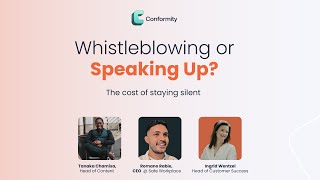
Whistleblowing or speaking up? The cost of staying silent | Conformity episode 3

Compliance isn’t optional in healthcare. But the way we manage it has to evolve.
Beyond Compliance: Building a Culture Where Speaking Up Saves Lives | Conformity Episode 1