Healthcare Compliance in 2025: How AI Changes Everything
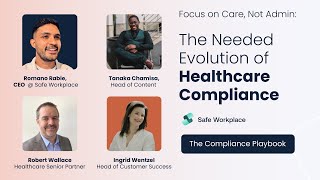
Webinar discussing the evolution of healthcare compliance and how AI and digital technology are changing compliance practice. Speakers (Romano Rabie, Rob Wallace, Ingrid, TK Tanaka) cover why compliance matters (efficiency, quality, culture, risk reduction), historical milestones (paper-based 1990s; 2008 Health and Social Care Act and CQC), the move toward continuous/digital compliance, and the importance of culture and staff engagement. Practical examples include improved incident reporting and task-level digital recording to support inspections and reduce burden.
The topic today really is the evolution of compliance and the influence of AI.
Essentially is to enable healthcare providers to achieve consistent and successful compliance, but also for healthcare workers and teams and essentially patients to benefit from that compliance from.
A legislative standpoint or the regulator standpoint. Instead of just enforcing the these are the rules you need to abide by. It's the understanding that in order for us to compliance is ultimately a good thing.
Maybe like the fund, I think essentially the fundamental thing is really ensuring that you have a solution that's going to bring everything into one place. And because that also increases the already heavy burden that's that's on healthcare professionals foreign.
Good to see everyone. Good to see you all. We've got a great lineup today. The topic today really is the evolution of compliance and the influence of AI. I'm going to be pulling from all of Rob's expertise today who's got who's not only an incredible entrepreneur, but brings a wealth of knowledge into healthcare across the UK and Ireland. Healthcare partner at SafeWorkplace so quick intros around the table. We have TK Tanaka on the call, head of content at SafeWorkplace. He's going to be helping me run this conversation. Ingrid, our head of customer success who not only has great insight into healthcare herself from her past work entirety, but also personal connections into private healthcare in South Africa. This is the Safe Workplace Compliance Playbook series. And so for those who don't know me, I'm Romano. I'm CEO at Safe Workplace. This series is built to bring in experts from the us, the UK and the EU in compliance across specific fields to help really bring some valuable expertise that you can use as strategy or to, you know, perhaps think, oh, we're actually doing things the right way ourselves and we can dig our heels in. And this really is for risk and compliance officers, professionals, auditors, chief medicals and more within healthcare and medical. So without further ado, Rob, thanks for having. Thanks for joining us. Great to have you on the webinar today. For someone that doesn't know you for our audience, please introduce yourself.
Thanks, Romano. Pleasure. Tanaka, Ingrid, good to see you today. So I'm Rob Wallace. I'm the healthcare senior partner for Safe Workplace. Just to give you a bit of background, I am a qualified dentist and I both practiced and owned clinics in Ireland and the UK for about the last 30 years. For many years now I've had like a deep interest in compliance, I suppose through my own organization and other organizations I've dealt with and my role with Safe Workplace essentially is to enable healthcare providers to achieve consistent and successful compliance, but also for healthcare workers and teams and essentially patients to benefit from that compliance. So we would like to get the maximum value from the regulatory and legislative requirements and allow health organizations to benefit from that. So that is my objective within the group, is to make compliance a success.
Fantastic. Thanks for that, Rob. All right. I think a great place for us to start really is I think most of us have an idea of what compliance is, but in your own words, why is compliant and being compliant important? What are we actually trying to.
Again, from my own experience, I think. Romano. Sorry. I think that we all know that compliance is a regulatory and legislative requirement, but many things are legislative requirements of the rtg. For many years I've taken perspective and within my team here and in any other organization that I've worked with, we've always projected compliance as being a highly beneficial thing, not a burden. So from a technical point of view, being compliant, it will improve efficiency of an organization, it will improve quality, it will improve standards, but above all, it improves culture. If your organization is compliant and if you're permanently striving to be compliant, well, then that's beneficial for everybody. Now, in a practical point of view, undoubtedly being compliant has cost benefits, it has efficiency benefits, and it certainly has risk benefits. So if you can mitigate risk through compliance, well then your risk of litigation, your risk of incident, your risk of reputational damage, well, that's diminished significantly. So these systems are often seen to have been put in place to be a burden or consider to be a significant benefit. I think now more than ever we are accountable as clinic owners, as healthcare operators, we are accountable and this is why we need to have consistent compliance across the board.
That makes great. I sort of want to, I want to break what you said up into to two points really, around the cultural aspect and then perhaps more around the process or operational aspects of. How do you, have you seen compliance evolve over the last, let's just say 10 years, 10 to 20 years or so. And take us back to when you first started out, looking that through, you know, more of an operational and process driven lens and then perhaps, you know, touching on that, the cultural aspect of compliance culture, how, you know, what have you seen? What has worked well for you?
Well, I think when someone asks me to take me back, it makes me feel very old, but I'm going to take you back. So I'm going to take you back to the 1990s when I started practice in the UK. First I worked in the NHS and I also worked in a university in the UK and yes, there was regulatory requirement in place, but that would now be described as a link touch. So we used paper and pen and a lot of it was based on traditional standards. So if we want to understand the evolution of compliance in healthcare in the uk, in Ireland, where I am based, and in multiple jurisdictions, around 2008, the introduction of the Health and Social Care act, that was a game changer because it established the cqc and following on from that, many other jurisdictions established much more comprehensive inspectorates, regulatory bodies. But I think a problem occurred in 2008. What happened was after 2008, and multiple subsequent pieces of legislation five to ten years after that, introduced an onus on healthcare providers to implement compliance with an absolute, agreed objective to improve patient outcome. And that is everybody's focus is patient outcome. But the problem that occurred was there was no guidance given at that time, there was no framework, no pathway. So if you take any compliance officer, risk officer, back 10 to 15 years, that would have been an extremely difficult time. But I think now what's happened and why we have an opportunity and why we're having this conversation in the last five or ten, in approximately the last five years, I think a lot of regulatory bodies, including the CQC in an Ireland hick, would have done this. They've decided to collaborate with healthcare. So they've now provided pathways, the provider frameworks, the JCI provides handbooks. For example, the NHS has recently issued documents, the Premises Assurance Model. So we now have the information and we have the guidance to achieve compliance. So it's an opportunity to take this collaboration and to build new compliance systems. So while it was considered a monumental burden on healthcare workers over the last 15 years, and this is consistent staff turnover, disengagement, burnout, and many, many healthcare workers, if you ask them, will not say that it was patient care that caused these problems, that it was patient care combined with very, very onerous burden and obligation. So, like I see this and this is why, again, I'm involved in this. I've seen in my own organization we have significant guidance and we can guide our teams and if we can automate this guidance and maximize the benefit from it. So I would be positive regarding compliance. I think finally that inspectorates and regulators want healthcare organizations to be successful when it comes to compliance. You know, so it's no longer adversarial in my, in my opinion, or no longer needs to be adversarial. So that's how it has evolved. It's gone from working Alone to working under duress and under burden. And I think in the future be working under much better what a much better structure. You know, this will achieve much better standards. It will ultimately achieve the same thing. Patients will benefit, healthcare workers will benefit. Yeah, this is what any organization should want.
Yeah, I think that it's an interesting. Well, I suppose it, it's both interesting and very sensible in terms of from a legisl legislative standpoint or the regulator standpoint instead of just enforcing the. These are the rules you need to abide by. It's the understanding that in order for us to compliance is ultimately a good thing and that in order for us to meet the standards that we, we want to we all need to I suppose agree and opt into the methods and the means that we're going to go by in achieving that. And that in itself I suppose in a landscape creates a bit of culture around like this is, you know, the behaviors and the shared things that we're going to do. But if we take that, that cultural piece and then just touch on, you've mentioned to me in the past how, how you know, you're very proud of the culture you've created in your own clinics. And so I'd love just to touch on that compliance culture piece that you've personally experienced and sort of how it's worked for you and how you think, you know, had it been very opposite success you had achieved culturally like where you see the challenges would have been in, in terms of achieving compliance consistently and at a high standard.
I think Romano culture is the key. So culture is a top down thing in healthcare organizations. All right. If you see things being done correctly at all levels and I don't see healthcare as having levels okay. In our organization and any clinics that I've operated we operate on a basis that everybody can have input into our organization. So any member of our team can highlight problems and also we ask them on a regular basis what will be beneficial, what is going to make us better. And I appreciate that this is more difficult in an organization with four or five hundred people. But currently like we have digital processes to allow every member of your team to communicate with management level, with compliance officers, with risk. And I think many surveys, the NHS survey will show this. A significant number of healthcare workers are still reluctant to engage with their organization. I think that is the culture that needs to be in place. Tell us what the problem is, tell us what you want solved and implementing any sort change is coming. So it is unavoidable that automation will enter the workplace. AI will enter the workplace. And if you take the steps to organize or to put in place collaboration before you try to make significant change, then that's where you will see the benefits. And in my organization, I am lucky for 20 years and I have many people that work with me who have worked with me for 20 years. It is communication, it's collaboration, it's engagement. And the reciprocal of this is poor engagement, poor collaboration. They're detrimental. They're detrimental to any healthcare organization. You know, and I think we now used to need to use on large organizations. We do need to embrace the tech that would allow us to achieve these improve methods of engagement and confidence in culture.
Yeah, that's, that's fair. I think actually while we're just on this culture piece, it'd be great just to get Ingrid's opinion on that because we've had recently some interesting I suppose case studies and really alignment what we with what we believe, you know, at Safe Workplace around culture and how good compliance culture really influences, well immediately impacts, you know, high reporting rates and how soon people hear and learn about things Sayings. What is your like just connecting to what, what Robert was saying. How have you seen that play out most recently in, in the clients that we work with and there's. Are there any other suppose tidbits and value that you can add to, to what Robert saying?
No for sure. I think sometimes even from my perspective, I think before entering, really entering Safe Workplace and diving deep into.
How the.
Healthcare sector really runs when it comes to this sort of thing, you kind of maybe make the gross assumption compliance and culture two very different things. But I mean we recently had such incredible feedback from one of our clients that they sort of flipped my script saying that this, this good culture and compliance are completely, they're completely connected. And they saw massive increase of like 300% in their incident reporting, which I think would scare most people. But in essence that shows such important factor the people in your organization feel confident and comfortable report when anything goes wrong, no matter how big or how small, giving you instant visibility and allowing you to identify any issues and making sure that if there is any connection, which a lot of the time there is to ensure that you are compliant and making sure that all the necessary steps are in place.
Yeah, that's great. I think that's probably, that's a great way for us to take this conversation into how technology plays a role here. And Rob, you were talking about, you know, we're in digital era. We have you know, kind of more opportunities than ever to collaborate and communicate internally with each other in order to achieve our outcomes. And ING's kind of just touched on that now in terms of, like that world of technology. But we think about that evolution of moving from pen and paper to spreadsheets systems. How have you seen what technology, how have you implemented that yourself? 1 and how do you see that evolution really continuing, let's just say, or maturing from, let's say, the last five years to where you see it going to now and. And then how really that should help any healthcare organization achieve compliance more consistently and really without more effort or more stress.
I agree with Ingrid that it is culture. Okay, I know we come back to this, okay? But when it comes to compliance, what's happened in the last five years, the requirements have expanded quite dramatically. But also there's a slight change now, particularly in the CQC and local authorities. You no longer report when they come to inspect you. So people can now ask for data at any point in time. And regarding care homes and hospitals, there is an obligation to do incident reporting. I think for local authorities and care homes, it's within 24 hours. And when our own organization is here, it's within three days to report specific incidents, let me say. So the problem here is in the past, you would accumulate all of the data for casualties completed, but you would then only analyze the data and see what the outcomes were when either someone was coming for an inspection or you did an annual audit or biannual audit or something like this. So we introduced in the past or in the recent past was we record every task. So this has given a lot of value to the work that our team do. So these might be small tasks, they might be things like. Which are essential, like cleaning water lines, autoclave tests. These are a lot of technical things that always would have been recorded, but now we're recording much more basic things. But what we find is we can look and see where there are gaps, where something isn't being completed. We can see it very quickly. And I think because of the change that the CQC are making and moving towards what we would term as continuous compliance, I think what you need is a system whereby all tasks are completed, all requirements are known, and there's a lot of benefit to this. There's no additional cost to this. I mean, you eliminate duplication, you improve efficiency. No question about it. But what it does is it gives your team, and I keep coming back to the team, it validates the work that they are completing. How many healthcare workers say, my employer doesn't even know what I do. They may still care what you do, but your employee isn't going to know that. If they can see the work that they are being, that is being done at every level in healthcare, it's essential. Cross infection control, patient care, audit, all of these things are essential. And I believe that tech now, and I think there's an absolute obligation because the products are available, there's an obligation to record what has been done, you know, and I think that is the way that it will go and it does not. It has never interfered with our processes here. So I put the processes in place and then staff are delegated to enter data relating to each process. They don't analyze it themselves. I just simply take the data, see where we have gaps, see what our standards are like, see what our compliance is like. So I don't have concerns about inspection. If somebody wants to come tomorrow and inspect any of our requirements, well, then that's fine by me. For me, it removes the stress at my end. It removes. I don't have to go and ask someone, did you do that? It just appears for me, you know, so that's where it will go. It will just become integrated. It will become seamless. It will not increase the burden. This is a major concern with new tech. It's a major concern with change. This will diminish the burden. If we can use the tools available to us and engage with staff to use them, no question. No matter how much they expand the legislative burden, I believe the tech can keep up with it now and that we can simply get on with the job, which is patient outcome, you know, so that's where I see it going in a very strong way. I see it going now.
Yeah. I think that what's great in what you've just said really also highlights the accountability already, the clear ownership that you can see what's being done, you can see who's doing it, you can see that it's being done consistently. So at any given moment, if you're being inspected against, I suppose, any data point within the organization, you have no fear or worry really, that, you know, you're gonna, you're gonna fall short because like you just said, you have that data at hand at all times and, and then the, I suppose the peace of mind that that gives not only yourself but the team too, to know that, you know, Rob's doing well. Rob's doing what he says, Rwanda's doing what he said he was going to do. We can clearly see it. Ingrid can track everything. She can pull reporter at will and on really, really small levels, day to day things. And then of course like bigger obligations, which is, which is really, really interesting. And so that sort of just digging further into this automation piece of. You mentioned the changes coming into the cqc. Right. And of course there are no, there isn't a concrete decision on that inspection review yet. But how can we give people like a really practical example of how that automation can play a part in connecting perhaps the obligations again, quality statements and the key questions on a day to day manner and how small firms perhaps can even take advantage of this now? Because I think what we see internally or at safe workplaces, people only opt for tech or software when they reach 100 employees, 150, 200 and above. I think now is the time to mature. But really what I gather from what you're saying is you bring this on really, really early and it's going to make your life a lot easier. So could you just expand on that for us?
Yeah. I'm just going to add one last point on our previous point of discussion there. I know I take a very positive perspective to compliance and I think it's highly beneficial. I probably should also have mentioned that these systems that we're proposing that I use myself.
More from Romano

Whistleblowing or speaking up? The cost of staying silent | Conformity episode 3


Compliance isn’t optional in healthcare. But the way we manage it has to evolve.
Beyond Compliance: Building a Culture Where Speaking Up Saves Lives | Conformity Episode 1