Whistleblowing or speaking up? The cost of staying silent | Conformity episode 3
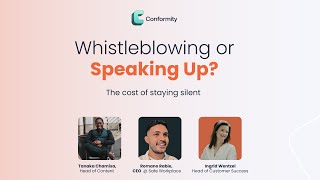
Ingrid, Manu, and TK debate when to speak up versus blow the whistle. In healthcare, speaking up improves safety outcomes from 32% to 82%, but whistleblowing carries stigma. Real culture change takes six to twelve months of sustained effort, not a policy announcement.
Questions this video answers
82% witnessed concerns; only 32% actually reported those incidents.
My main takeaway from this conversation is that we're all bullies. So good.
Yeah.
Go team.
Yeah. I feel like it was off.
And she's like, this is what happens when women are off. You just keep changing things. More structure.
Look at that Netherlands. Look.
It was turbulence. I was like, oh, crap, it's happening. What do I do now?
Theory. It's happening. It's happening. Referring to it as, like, someone. As a whistleblower. I mean, what's the first thing that comes into your mind is that they snitched? I mean, right.
Whether the speaker for the whistleblowing thing is right or wrong. I think you can call whatever word you want, but it's still an intimidating thing. Right. Like, generally not going to engage. And it's always just say, you know, we're hearing about incidents too late. You know, it might be in a hospital setting, it might be patient neglected, might be rigged. There's so many scandals that are woken up. I'm glad you're here. It was quite weird doing. Trying to do one. Do this without you.
Oh, really?
I think we're so. We're so used to. I think, used to having, like. Used to having you on it. Like when.
And interrupting.
No, just like.
I think it's the dynamic. Like you're trying to have a conversation. Like, me and Tigo don't have contact. We actually recorded it twice. So we did it the first time half an hour, and we. And then we were like. I just. We stopped and you were like. She kind of strained. He went back to it the next day.
That. That we had. I think. I think we shifted it like, twice. We moved it like twice or three times. I told my wife. And then. So my wife knew that ink was off, and she's like, this is what happens when women are off. You just keep changing things. More structure.
What's up there?
Yeah. No, it's crazy. Every time we schedule a webinar and then move it, the first thing she asks is, is Ings working? Like, yeah, she is. Okay, so why is it shifted then? Like, what's happening? I think we. And she's like, okay, so why has it shifted then? If things is back. But anyways, cool.
Don't give me just as a sidebar, like, the whole Bali trip, I literally just packed my bags and rocks up at the airports. Don't. Don't make me plan a trip. Khlo did everything. I'm just like. And he's like, what do you think of this place? I'm like, great. Just. Just book it Just book it.
That's me.
Yeah. Yeah.
I just want to show.
I. Just do it. Let's go. Just do it.
Yeah. Well, that's an interesting. That's interesting. Yeah. I think every couple has their. Has the. Who is a super organizer and who is the, like, person that just rocks up.
And I can be quite controlling. Like, I want to have controlling.
I was quite surprised by that, actually. Saying. I'm quite surprised by that. Yeah, I'm very surprised by that. You strike me as the organizer in certain aspects.
Yes.
But with trips, does he hold all the passports?
Well, he did because I obviously flew alone. Do you guys want to know the backstory? Sorry, this is like, random chitchat now. Before this. So he'd obviously book the flights and stuff like that. Man puts me in an emergency exit by my. So I'm like, if touch wood, something happens, who's supposed to open this door, My angel, Not me. Like, next to the emergency exit and there's no window. And I like looking out the window, but it's fine. Extra leg room. Plenty of room for activities. Then on the way back, that's obviously when. Because he flew from Dubai. On the way back, I do have a video of him saying, passport, give me your passport. I was like, you look like I'm. I look like I'm being held hostage. I was like, can I please have it before we get to security? It's like, I'm not completely incapable.
Is that bigger crazy?
I've flown so many times, right. And then, you know how they give you that thing, that. That tutorial, what you do in case anything happens when you pull that. The oxygen mask thing? Yeah, whatever that. I have no idea what to do. I've watched them do it so many times. I still don't know what to do if anything goes wrong, God forbid. But genuinely, I look at them. I pay so much attention. I've actually watched videos, even, but I genuinely have no idea what to do in this one time, I was flying to the Netherlands and it was turbulence. I was like, oh, crap, it's happening. What do I do now, really?
It's happening. It's happening right enough.
Luckily, it didn't happen. It wasn't what I thought. It was just turbulent. But, yeah, I genuinely. I don't know how many times I've been on a plane, but I have no idea what to do if. If things just go.
Maybe that's a good.
That's why. You're exactly why the airline companies tell people, take care of your own stuff first before helping Other people.
Yes. Of airline safety videos have told me my John running joke about, like kids. He's like, if airline safety videos have taught me anything, you put your own mask on first before the child.
100%. 100% liability. Yeah. I don't know if I wouldn't want to be tested if I marry. But the other thing is I fall asleep instantly on the plane. So, like. And I sit down and in two minutes I'm asleep.
You like that. You're like, kulo as well. I'm like, now what am I supposed to do?
Watch the movie. Doesn't mean it's angry. I get.
I guess I get it.
Like, how are you assumed? I'm like.
I've got the neck alone and the armor, the sleep silk eye mask with like, like, you know, nothing.
Yeah.
No, but I've actually won, like, genuinely in the case that something happened. Obviously I've never been in the situation. I hope I don't ever get in one. But if anything happened, what is the procedure? Like, does someone just speak up? Like. Like, is it the pilot's duty to be like, hey, yo, just calm down?
No, the hostesses and they host it and yeah, male version of that. Hoster.
I've never seen males. Seen males. Personally, I've never seen males. Really.
I. Quite a few males on board.
Never.
Is it a student? A steward is on a boat?
No.
I think no, but stewardess is female. Ange. It's not very gender neutral.
I know, Stuart.
Anyway, well, they just.
They're the ones I sorted out. Yeah.
But it's crazy how I was speaking about planes, right. Because I think we actually had a chat about this past. One of our previous discussions was speaking up save lives. And in this case, literally the air host. They speaking up could save lives or cause panic in my case, because I don't know what you do.
So. Yeah. Yeah, well, that, yeah, depends on badly. Because if they're locked into their own, you're on your own.
Also, speaking of planes, interesting. What happened to those Boeing whistleblowers? Hey, transition, Transition.
What happened to her?
Did there. Was that. Because Boeing had all of those issues and a lot of like, security checks and things kind of not procedures not being followed. And there was a couple of those whistleblowers that disappeared and are no longer with us.
Really?
Yes. Happened a couple years ago. I think there was like there a few people that spoke out.
Both John Farn and Dr. Dean have died this year, leading to qu. In their work.
I refuse to get on that. If I'm on A Boeing. I hate flying Boeing now.
Hate it.
Put me on an Airbus.
This is why I like p. Ignorance. And I don't like knowing stuff. I just do stuff. Now I know stuff. Now I get scared to do stuff.
That's. That is fragrance. That's scary. Yeah. Stuff like that just feels. You have to read more into that. But that is. Yeah, that's what we're saying before. Like, it's a very. We have to tread so carefully around this kind of topic because like. Like muscle blowing or not muscle blurring, not slowing your muscle, is not conformity. Our negative form of it is just fear and intimidation and feeling and like, you know, there's a reason why people don't do it. Right. Begins.
Yeah.
Gary, would you call it, in Zulu, you call it being an mp, like a snitch?
Yeah, yeah, exactly.
That was, I think, the word, the term whistleblowing. I mean, it says exactly what needs to be done, but I think it has such a negative connotation. Connotation? Like referring to it as, like someone as a whistleblower. I mean, what's the first thing that comes into your mind is that they snitched. I mean, rightfully so. If it's a. If it's. If they're a whistleblower in a context like, for example, with Boeing, they are the ones like speaking out. I feel like there's such a negative connotation to that word, being a whistleblower.
I mean, there is, right? But at the same time, don't get me wrong, yes, there is a negative connotation, but at the same time, it's also, which is my opinion, speaking up, like I said in the beginning, can genuinely save lives. Obviously now you're putting that pressure on someone to point out when something goes wrong. Like you said, mano, it's a very scary thing to do. It isn't as plain and simple as just speaking up and things change or whatever. And it's crazy because in a bunch of industries, a lot of industries actually speaking up, I'm trying to reframe from the word whistleblowing. Speaking up can genuinely have one of two consequences. Might be bad, it might be good. In healthcare, for example, there's a case where 82% of healthcare professionals witnessed concerns that could have been avoided and that could actually harm patients. But only 32% actually reported those incidents.
Right.
Why they weren't all reported, I don't know. I assumed fear. Fear of the consequence, fear of the outcome, I don't know. But speaking up can be, in my opinion, Excuse me, an act of conformity to shared values in the sense that you are trying to do in the case of healthcare, you are trying to look out for other people, for other patients, for the organization itself. Right. But I guess it's a two sided argument. It's a two sided argument as to whether or not someone should or will speak up.
If we go back to, if you go like for example to like look how say workplace started, right. It started in like predominantly into like how safeguarding, like how can tech employee safeguarding. And yeah, you know that all that initial research that came out of the early days and the, the, the percentage of workplace concern nor misconduct that goes unreported and the reason for that and you know, fear, intimidation, people don't trust that anything's going to happen anyway. People don't want to be seen in is very, very closely linked to this was whistleblowing and then I suppose as a sort of in an attempt to make the whistleblowing seem less intimidating and more normal as most people came up with the speak up term of like it would just have a, of culture. We all talk about things and things go wrong then everything we buy. But I, yeah, I'm not convinced that that is solved anything really. I think the greater issue is I don't know if it's whether like how I don't think it's whether the speak up or the whistleblowing thing is right or wrong thing. You can call whatever word you want but it's still an intimidating thing. Right. Like generally not going to engage. And it's always very, very hard to make people engage and proactively going hey, you know, I saw something, I don't think, you know, I saw this doctor do something that wasn't actually perceiving me direct or cut a corner or something. And you know, I think that was lightweight. And being next the chances of someone actually saying that if nothing bad happened, it's such a nuanced human behavioral thing and environmental thing that you almost got to rewire society.
Yeah. But I think with your example, for example a doctor cutting corners in that case and if you compare like whistleblowing and speaking up and just I think from my perception and even comparing the two sort of terms against some of the like incident types that some of our clients are currently using like in their report flows there's a whistleblowing category and then there's a speaking up category. So both of those allow for somebody to report anonymously which is great. There's a level of like security there so that could kind of aid in that. Even though I think many people will doubt the system, even if it is safe workplace, many people will still have some apprehension. But I think the whistleblowing aspect from if you look at previous cases, that is my perception is that that's more attached to actually calling out the organization. So you see something massively wrong in the organization, you're going to blow that whistle. Whereas speaking up, even though it's so similar and it's like, speak up if you see something that's maybe more so on the ground, hey, a manager stole five pounds out of the straw kind of thing, you know, so they are effectively kind of the same thing. But one hints that it's slightly less than the other in a way. I don't know, Just. Just comparing it against the. Looking at like some of the incident types and the report.
No, I think you're right. I think you're right. I think, yeah, I think you're right. That is like, what's the glowing more commonly associated with, like, but it's like there was the Harvey Wine theme thing that was a blowing. But I think it's more associated with a company or a singular person of power, things like that. Yeah, yeah. And I suppose if you, in my mind, like whistleblowing would be like the speak up culture has failed someone.
Yeah, but I mean, we speak about culture a lot. Like, a lot of our discussions are around culture. Speaking up culture is something that we spoke about a few days ago, Ingrid, Literally we spoke about this. And I think you shared your own story, even about how back in the day, whenever it was back in the day sounds like it was decades, but. Yeah, how back in the day you had your own, your own personal story.
Right.
Where you didn't exactly trust the system that was put in place. So you, I think, use your personal Gmail, whatever to report an incident or whatever. Right, but my thing is. Right, obviously, again, culture, it's important, it's imperative. But when people feel aligned with an organization's mission, with culture, et cetera, and believe that their concerns will lead to action, reporting should. I don't know if it will, but it should become natural behavior. But my thing is, even if a company does have that positive culture in place, that speak up culture, et cetera, you can't control what someone else feels. That fear of what if, what if? Yes, you have, you have processes in place. You have a culture in place that promotes speaking up, that promote pointing out whatever when something goes wrong. But natural human behavior, that fear most people will still wonder what if? Yes, it's written on the wall that if I speak up, nothing will happen to me. Well, it's anonymous or not, but what if.
What if, you know?
So I guess my point is, right, yes, you might have company culture in place that promotes it, that, that makes people feel safe, but you can't control whether or not people actually do speak up or what they do report, if they report anything at all.
Right.
And people are bound to follow other people. There's this, this experiment that was conducted by, his name is Simon Ash, I think, in the 50s, and it's called the Ash Conformity Experiment. So essentially what it did was they put a group of people in one room, right? And then it showed that people will ideally follow whoever they want to follow. Right? So they put people in a room and then where people gave. The majority, gave obviously wrong answers. Right. And then there was one person that had the right answer, but because everyone gave the wrong answers, despite the fact that this person knew was the right answer, he followed the group. He, she followed the group, followed the majority. Because everyone is going this way. Although I know what the answer is, I'm going to follow these people because they all go in there, right? So, yeah, my point is you can't control what other people do despite having systems in place that promote speaking up, that promote a healthy culture, et cetera.
I think on the. We see it a lot, I think with many organizations across the board, posters plastered around hallways, you know, newsletters going out. If you see something, say something. If you see something, speak out. And sure, you. It's, you know, it's all good and well to use those words and encourage your employees to say something, but it does definitely go deeper than that. And now if we compare it to a whistleblowing context, you're encouraging employees to speak out, but are you encouraging your employees to actually blow the whistle when they see something that's a lot bigger than something smaller on the ground? Because I think it also comes down to, as a part of that culture, and we also really try to share that with a lot of the people that we work with. It's about creating that shared accountability, shared responsibility with your employees as well as you. But yeah, just to go back to my point on the difference between speaking and whistleblowing, you're encouraging employees to say something if they see it, but are you encouraging them to actually pull you out as an organization, like, in the bigger picture?
It also, like, reminds all of this kind of drive and harmony. I don't think people like to change a culture away from, let's just say, you know, we're hearing about incidents too late. You know, it might be in a hospital setting, it might be patient neglect, it might be there's so many scandals that have overheard over the last like 20 years or so where comes to mind after something's died or something, horror, things happened and then there's an independent investigation and then all this stuff comes out of. There's years like neck, there's systematic issues, right? But the amount of effort it takes to change a culture and to change people's perception of processes and why we need to speak up early and what happens when we do it, you can't just be like, right, we've introduced this new process and we bought these new tools and this is going to help us, you know, and everyone can do things anonymously and this is going to have to speak up about stuff and then you just kind of leave it there. It's like you actually have to continuously reinforce and generally what we see is like nothing's probably going to change for you're only going to see a movement between six and 12 months and beyond, right? And even after the 12 months mark is probably where you're going to see like it's not going to be hockey stick, but you can start seeing a meaningful increase in like early reporting of issues. But then to follow up on that is you then have to go and show the people or the culture or the people have to see that hey, things have been important because people talk internally too, right? Like it's been reported and actually the business haven't addressed it. There was something serious that wasn't being let go or process hasn't been fixed or something. But on the business side it is all popped down. Like you have to introduce it to, you have to dedicate and exorbitant amount of effort to changing people's behaviors. And then you have to reinforce or display like, hey, things are actually changing. Like they're positive outcomes to me speaking up. And then only after a long period of time, then people's behavior start changing. No, no, actually they do care. But it's such a long game thing and you can see why like businesses struggle with it. Especially in, in very hierarchical environments, Healthcare specifically, like you can, you know, you're a junior and you see the freaking head doctor or head nurse do something or something happening in the organization. You're not going to go like you do unless you're really outspoken person. Like you saying something is extremely low unless there's been you know, on your onboarding, or there's been like, something that someone shared with you when you started and going like, hey, like, you know, you see something like, we really encourage you to speak up. Because in the past years, all the positive crap that's happened, like, we've actually done things about it.
We were petrified of the. Not petrified, but we were so scared. In my first year of nursing, the doctors, you know, knew like their little student nurse, and you're just like, you know, you didn't really like, say anything or. And they were there. But I will vouch for all the nurses. The nurses run the hospitals. I just like to say, no offense to the doctors, but.
Yeah, I agree. I'm sorry, I agree.
We were very reluctant.
Yeah.
I mean, but at the same time, I feel like it's also important to create that psychological safety. By psychological safety, I mean, like I said in the beginning, mentally, people. People want to speak up.
Right.
But obviously they're afraid of the outcome of. Or what happens after I speak up. That what if lurks in their mind on the entire time. When you create that psychological safety, the human. The human mind is one of the most powerful. I generally spend my free time studying psychology, not officially, please, like Google YouTube. But. Yeah, but. And. And that I've learned is the more you ingrain something in someone's brain, the more they get used to it. And if someone spent years being afraid of whatever it might be, whether it's how they grew up, whether it's previous work, toxic culture, et cetera, it takes a very long time, like you said, Manu, to unlearn that and then walk into an organization. Now you walk into an organization that promotes the stuff that you were previously advised against or slapped on the wrist for. It's hard to change mindset, right? And then there's. Yeah, I mean, when you create psychological safety, you. You allow people to not just speak up, but you are into. Freely. Speak up. Freely is a keyword here.
Freely.
They feel they know for a fact that if I speak up, things are going to change. Mano, will listen, etc. I don't know if you guys know Amy Edmondson, but she, she introduced this psychological safety framework right. Within workplaces. And essentially it centers around the idea that a team is safe for interpersonal or personal risk taking, et cetera, whenever a team member believes they can speak up. So people are more likely to take risks, positive risk, if they know that they can speak up if things go south.
Right.
Without the fear of punishment or humiliation. The framework Highlights I think it was the importance of creating an environment where individuals actually feel comfortable expressing ideas, asking questions and admitting mistakes and actually taking risks. So now we speak about calling out whatever about putting out other people speaking up. But people are also afraid to speak up when they make a mistake. It's easy for me to want to call out mano, but if I made a mistake, even harder for me to speak up because I'm afraid what's on the line. Obviously, I mean yeah, there are different contexts here, but yeah, my point is that to create psychological safety, right. And that my opinion falls on the leaders themselves. But at the same time I'm very big on it's a two way street.
Right.
Team members also need to have, need to be willing to unlearn and relearn different cultures, different ways of doing things, etc.
So I think that that ties into you know, going back to like how early like the inception here was safe fighting as a culture or like speaking up as a culture where you have to bring other people on board. You can't just say we providing tools to make you feel safe and want do some compare cons and stuff. They'd be like trying to integrate your core staff and your everyone involved into the actual onboarding and process and saying like if you want to work in a place that you're very, very proud of and we all want to work in like nice places, we're all going to have to contribute in some meaningful way towards achieving that. And so as part of that we're going to place accountability on you to be able to enforce or enable that that wherever it is. And I think there is where you start seeing really interesting and meaningful change. But the trick is of course like being able to do that in a way that is doesn't feel like your employees don't want to feel or any worker doesn't want to feel obligated because they believe it's the employee has responsibility to look after the workplace. You know what I mean? It's like I'm working for you. Like it's like you know, in position that like well we're working together. It's like well no it's not really how like no, we don't work together. I work for you. And so it's your responsibility to make sure that you don't hire drugs or you know, you get the right people. Of course that's not a blanket statement but I think it's just so like it's so nuanced in there. How do you. It's only going to work with everyone what can do like the dream. But even in that you're placing an obligation upon people that they might not necessarily want.
Yeah, that's true. I was wanting to kind of reflect on what TK said about leaders and then kind of ties into what you said. Mano when it comes to creating that psychological safety. I think I agree Tige that it does definitely fall on the leadership and generally maybe definitely a flag to kind of note is if there is reluctance to whether it be implementing processes or holding those training sessions around safeguarding, encouraging speaking out, then that kind of begs the question on are you then afraid that you're going to be called out with those. I think that's the thing and I agree that the obligation, you know, you kind of have to be careful not to put the sole responsibility on the employee. On the employees. Because then the argument is no, but I work for you. And absolutely the organization has a. Has a responsibility to not hire jerks. But you, you never know unfortunately what you're going to get and what situations are going to bring out the best in certain people. So the yes, the employee may or me as an employee, I. I work for you. But then the counter is I'm the. I'm the employee that's working here. I've made a choice to come to this company.
I.
It's then, you know, I do as cheesy as it sounds, play, play a part in making sure that I'm utilizing kind of what's provided to me. And there's a conversation always around. This conversation brings up one of my good friends worked at. I've spoken about the story endlessly TK but it's the first time you're hearing it so. But my. Yeah, one of my very good friends that's a law firm here in Joburg across the globe. He had an insane experience. He's incredibly smart, amazing at his job, was, you know, one of the top earning candidate attorneys at the time. And the stories that he would come home with because him and I were staying together at the time on just general bullying, sexual harassment in ha. Absolutely insane. He absolutely did not at all feel safe to say anything. He didn't. He left eventually after doing his kind of two years and then after he left the floodgates opened and articles came out about this and everything happening. No, in. But yeah, very interesting things that happened but now they've kind of turned it over sort of shuffled because the biggest problem there was the leadership was. Was the very narrow minded leadership that just wanted to kind of make their authority known and were bullies. They were bullies of. So sometimes the simplest thing in order to create psychological. Psychological safety. Don't be a bully. Don't believe. No matter how big or small, don't be a bully.
I think the personality thing. Ninja thing like I think if you have a strong personality and very. And you're very assertive or you can a lot in your own opinions and try and get your way or you get in your way and you're a bit competitive about ideas and things like that. Like it's interesting how certain personality traits can be just someone might not know they're being a bully but because of that like built in thing dominate something.
Like well again I want to interject there because I'm gonna. I don't know how if you don't know that you're being a bully then you'll poor behavior has been enabled somebody somewhere else previously.
Yeah, yeah, absolutely.
You actually don't like self awareness. I know when I'm being a nightmare being I can. I'm like oh okay. Maybe like my wording there was a bit off and stuff like that.
100%. Yeah, yeah.
There's no.
You're right. Yeah, yeah. I think, I think that you're not.
And you say something and you're like oh, okay. And then you take a step back and like that was a bit harsh.
Yeah.
So then you can go back. I was a bit. I was a bit mean there. Sorry.
No, I 100% agree with you. It is the. If your behavior is not. I think some people have been. If some people have not been called out on their behaviors in part. Yeah. And they've been kind of allowed in certain ways because it's funny or it's entertaining or it's easier just to let this person get their way. There is definitely like some psychological thing that develops inside you where you become less aware, self aware of how your best changes impact the people around you. And then you might meet someone that is a lot younger, sensitive to certain types of characteristics. And the moment you meet that person, that person calls you out to them goes like you can't be acting them inappropriate. You don't actually realize how many people feel. And that's when you see the real. That's when the coin drops. Right. How does that person respond to that criticism and to someone going like well you know how you're behaving in the means actually you aren't perceiving your behavior the way you think you are. Like people don't Actually go, oh, my gosh, you're such a great guy. People go, yeah, no, no, thank you.
When was the last time somebody told you, you like, oh, you're so nice when you think about that. When was the last time? Oh, you're so. Oh, that's really nice of you. You're so kind.
Actually. Crazy how personalities play huge roles, especially in the workplace. Because personally, in my first year of university when I met, I met my wife, who was then my girlfriend in my first year, so was put in a, In a, In a position of leadership at our race where we stayed and growing up, I've always been this assertive person, et cetera. At the time I took this personality test called the disc assessment. D, I, S, C and D is assertive like you, just like a bulldozer, basically. I is, hey, I'm happy, I love people, I speak a lot. I think S is reserved and C is someone that, that, that just overthinks everything, right? So the point of us taking this assessment at the time was so you can understand your own personality, but not just yours, those around you, those of who you're leading, et cetera. So I completely disregarded those I was leading and just, oh, I'm a D, right? So the creators just think that I'm a D and you act like a D, right? So I just, I, I, I, I, I, I, I took it up. Even, even I took it up a notch. And it got so bad that my wife, who was in my girlfriend and a friend of mine actually sat me down this one time and said, tk, it's not how you talk to people. You have to understand that how you speak to Mano, for example, is not how you speak to Ingrid. You have to learn Mano. You have to learn Ingrid. You have to learn how to speak to different people, especially if you're a leader. You have to know that if I call out Mano on his bs, he won't get angry. But if I call out Ings, he's going to crumble into a ball, start crying and know how do I convey the same message to Mano that I, that. That I, that I, that I gave to Mano, to Ings, without creating a culture with toxic now where, where. Where Ings feels unsafe. Right? And then it brings me to this book by Simon Sinek. Is it Sinek? Yeah, Simon Sinek.
It's called.
I love the title. Leaders Eat Lost.
Knew you were going to say that one.
It's Leaders Eat Lost. And in that book he highlights a concept called the circle of safety. It's a concept called the circle of safety. And essentially it's exactly that. It highlights how leaders need to create that environment where their teams feel supported, feel safe, et cetera, to speak up. And the circle of safety itself, when done, when interpreted correctly, it creates a culture of cooperation, collaboration. People actually want to be involved in whatever you're doing. Right. And ultimately it makes leading pleasant.
Right.
I've actually learned over the past few years how to speak to people and also how to perceive what someone says. Obviously, I'm not making excuses for someone being complete. Yeah, I don't know.
Right.
But having to be self aware. And when it comes to leadership.
Right.
Me being led by other people, I've been in situations where my leader would tell me or my boss at the time would tell me, we do things like this and I'm someone who would give my opinion. But as you said, Mano at the time, creating the culture, I was like, but I work for you. This is your company, so we'll do it the way you want to do it. I didn't feel the partnership. I felt the hierarchy, not patent. I felt like it was a hierarchy, not like it was a partnership. So I would give my two cents, but I always add a disclaimer, but it's your company. Do whatever you want to do.
Right.
I never felt like what I said actually mattered. I would just give the opinion and I gave it solely for the purpose of saying I told you so that things went south.
Yeah, Yeah.
I feel like we had the same experience at what? Because I was the. Exactly the same. Stepping into my first leadership position at university. Also came in guns blazing?
No.
But that was because I'd seen how the leaders before me had fulfilled the position. And being in Bloemfontein, in relatively conservative Free State back then, it was. And before the massive overhaul that we've had across universities in South Africa was very like tradition. And this is how it's done. Like, this is how things are done. So cool. Get elected into this position. I was a bit mean. I was, I was mean. And one of the. He was like the head of, like residence life at the University of the Free State. Because now I was responsible for like the first year students. I must now create a homely environment, make them all happy and when they miss their mom, make them feel okay. And those first few weeks, I was really not nice. And his name was Dr. Vahl. And he said to me, because they'd complained, rightfully so. And Dr. Vaugh looked at me he said, you know, you have, you have the opportunity to change these first years lives and to change their perception. Not like their lives dramatic, but you have the opportunity to change their perception on their first year experience here in Bloemfontein. So I was like, I turned over a new leaf and all was right with the world. But yes, I was exactly the same.
I think that's, I think that's a great thing of like you actually don't realize how positively you can influence someone's life. And actually I would get all positivity people actually need in order to like be on your side kind of thing. Like can't be there and it's just the way you treat them or just like how you, how you run something and how that like the immediate person you can imagine in any sort of business setting, like your first few interactions within a business are going to shape your especially model, shape your entire perception of this other business, right? Because they will tell you things that might not even be true. They just heard it from someone else. But then you begin to go like, oh really great. Or I'm just going to get a paycheck and tell you. You guys were speaking, I was thinking to myself like, I have you like been a bully a lot? And then I was like when I was in preschool between the ages of 5 and 8, I was so much so that I have old school friend, I have some friends that I've known since I was like three and probably just always gone to the same schools. They will to this day stop being up and like I'm honest with me a million bad. Yeah, honestly. And we laugh about it.
Don't say sorry.
The trauma, the trauma. But the network. No one's thinking. And unless you have an interaction with my wife before I jumped on a podcast where I was like winding her up about something and you just looked at me and she was like, you're overwhelming me. And she walked away.
My wife does that too.
My wife does the exact way. But the thing that I was thinking the whole time, I was like, I bet you it's kind of like the same characteristics, right? If you think about what involves like being inbody, it's like you want to always get your way and like you always want to get in your way. Always trying to assert your opinion of people and you kind of use the, it's like the social dynamics to your benefit and then the other people, it's extremely overwhelming and the easiest thing for them to do is just back off. They just go, yeah, cool. Do Whatever you want. And obviously you can do that in positive and negative ways. I was like, yeah, it's interesting how those characteristics can come up in different environments and places. And then you think, imagine doing that. Imagine working somewhere for a very long time and you have a boss that's done that for five, six years. Or run a team for a long period of time that has. When people are like, we stay here because it's not that bad. And then new people come on and new people get owned. You know, it's just how we do things here. And you know what I mean? Like timeless. Creating a. Some negative culture starts to set in and then that's where you see that sort of, I suppose, negative, the bad side of conformity.
And then it becomes so ingrained. Then it becomes so ingrained. And it's. Yeah, like. Like that. As it would be classical conditioning be the reference here where people just, I mean, when you're in that same position and you're like, okay, it's not that bad, you know, like the frog sitting in the pot and then, then you bring the water to a boil kind of thing. And then they just like, this is fine, everything's fine.
Yeah. And I think when you got to talk to the other thing I thought of, it's like the wrong thing to do when you have altar you need to work on is go, we're going to now go and buy a piece of software to fix this. You know what I mean? It's like it's not going to do anything. Like, it's literally not going to do anything. People aren't going to use it. Nowhere can start reporting things more. It's like you have a lot of groundwork to do before you even do anything. Because automating a brand wasn't automating an inefficient process. And are you going to maximize this inefficiency? And I think that's where like the how do we. How do you solve for. Comes back to, well, you're going to have to do a lot of groundwork and people are actually going to have to the needle move in a positive direction lightly. And then you bring on the. Okay, cool. Are we going to bring these other tools on to like, help us continue or increase this improvement? And I think that's where a lot of you see a lot of business get things wrong. And then they look at the tool and they're poking it going, this doesn't work. It's like bracket.
On the groundwork aspect. A question for you, co founder. What would you say would be the number before somebody buys. And now they've now got to do a bit of an overhaul on their culture. What should they do first? What's the first thing they should do?
I would say if you're trying to, if you've identified something needs to change, you should spend between six and 12 months to resurvey actively doing like, like comms. Actively speaking, doing focus groups. But not with. They won't be, you know, let's say the bad culture setting. There will definitely be a handful of good people in the organization who are aware of all the bad should happen.
Yeah.
And those people have to help you. Not in a cringy way. Ambience. I'm going to change. Right. But it has to be. We're going to do this for 12 months and we're actually going to measure from the day for the next year. Sentiment. And the thing that thing's interesting, right. Is how you made the sentiment. You might be like, well, 85% of my employees believe that we're happy. It's like it feels like a vanity stamp. Like, oh my God, I got 4,000 impressions on my LinkedIn post. Who engaged? No one. It's like how many leads to get. And I think it takes a concerted amount of effort for long period of time to see some uptick in change. And that will be measured by like, do people feel outstretched to be this in any environment? Do they feel like it's a very intense environment, an anonymously gratefulness? Right. Like, do they feel like an intense environment? Do they feel stressed? Like, what is their productivity performance and free prism? Like because. And is. Yeah, there's a lot of like smaller personal things that you'd have to align with that too. But measure that over a long period of time and if you've hit meaningful increase, then layer on a bit of technology because then you have a bit of like we have something to start working off. It's very, it sounds like a very nuanced answer, but I don't think it's very straightforward. Like you'd have deeply understand like what's actually going on in the business to such a large degree, also such a detailed degree that you actually have be able to set up some objectives and actually be able to go like why we're going to do this for 12 months. People are going to get sick of us saying this. They stop preaching. Stop preaching. You've got to keep doing it anyway. What's that saying? Like when people are sick of hearing it, they probably, they probably only heard you for the first time kind of thing. You know what I mean? So, yeah.
I mean, I feel like we. Under. Excuse me, I'm going to say we. I used to. Not now. Before I joined Safer Place. Under estimate the impact that the positive work culture actually has. Right. On people. And it's crazy because. Because when teams. Again, I'm taking it back to psychological safety now, but when teams feel safe to speak up. Right. 76% of teams that felt safe to speak up reported that they are more likely to actually raise concerns about whatever is happening within the business, et cetera, before they became serious issues.
Right.
That's the impact of having a positive culture that leans more towards promoting psychological safety. And when it comes back to culture, Netflix does it very well. There's this thing, I think it's called some Netflix. I forgot the exact term thing, whatever. But Netflix has publicly on the website. I think it's what the exact term. But it's some culture dick, I think. And they highlight ways of working within Netflix, the mission, their values, et cetera, and they hold themselves accountable to that. Everyone, not just employees, the public, knows Netflix's culture. Deck. Right. You are. I don't know if anyone has. But you are able to actually call them out on this because they made it publicly available to everyone. Right. And I feel like, like I said before I joined the place, I underestimated the impact of the power of a positive work culture. My background is not positive.
So. Yeah.
But if you're. I mean it's. Yeah. Just to echo what you said, ck, if you've. If your group of employees are speaking up and they're reporting. I mean we've seen it with and we've touched on it previous discussions. If your employees are speaking up, that in and of itself just shows how much they trust the organization, trust the systems that have been implemented and feel safe. They feel safe to say something and to click that button and send a report. And that really speaks volumes. It really does.
I think the other thing that I've just reminded me of is the number one, especially when you have tools involved or you kind of like solve a issue of under speaking up or under reporting. Beneath that, people are going to raise trivial things. Yeah. It's like one is two things. It's like people are going to race reveal things. Because I think people do that more. There are different people though, but everything's an issue. But the thing that we find variants break going back to the. Everyone's involved. Like, listen, it is your responsibility to report you are responsible for how you report and what you report, right? And so you need to use these tools responsibly. And you can't be going, ingrid stole my lunch or somebody use my milk in the fridge. Somebody's like, go speak to that person. You're an adult, you know what I mean? And I think when you talk about culture piece, it's almost like reinforcing certain obvious behaviors. If you use any of our tools to report these things, you are not using these two. And we're not going to engage with the mental that you need us to on one, justice because you also have to behave like an animal here. That's the one thing. The second thing is beneath that, people are going to tell you exactly how they feel. Like they're not going to tell things. Like they'll feel like open door policy, whatever. Even when they do report, they're probably hiding, not hiding. But I don't give you all the detail. And it's almost like the expectation that you as an employer or need a hand on with your people and the understanding of like they're not going to engage with me to the level I want to. It's like they barely engage in their personal lives to that level. Like we're not all working like walking around being like super transparent, open people like our part. It's like just how you. So it's like we've got to get a grip. And I'm saying like there's going to be an inevitable ability and you work with what you have and then shoot with intention. Because I think that's part of the. Is like you assume good intentions and goodwill and you operate that way and people slowly reveal when they have good intentions or not. When you carry on the thing and the people that don't have good intentions let go. But you do have some level of control over what's going on. But.
No, and I feel like me personally, the gist of it or my understanding, my perspective that that number one, psychologic psychological safety is a very huge part, right? Leadership plays a huge part. But also I keep banging on this drum. It's a two way street, at least in my opinion. Beyond leadership, beyond leadership, implementing policies or whatever it might be, people need to, number one, use tools effectively and number two, unlearn and relearn what you need to in order to strive in an organization. Right? Fear always be there. It's a fact. I mean, I mean, yeah, I might be afraid to tell Mano, hey, I didn't finish the talk. I said I'd finish, you know, that's me telling you now that I didn't finish that talk. No, I'm kidding. But genuinely, fear will always be there. But it's a thing of being able to, to trust that whatever I'm saying will make a difference or should make a difference at least. And understanding that from leadership perspective, that if someone like you said the higher the reporting number, the better. It's crazy because subconsciously I didn't think that would have to, that would have to iterate that because I had a chat with Rob a few weeks ago, our healthcare senior partner, and he mentioned the exact same thing in our discussion. He put a disclaimer out there that high reporting numbers are actually a good thing. In my mind as we're speaking, I just thought, I just assumed that people would think high reporting numbers are a good thing. But then as he broke it down, he mentioned that people get scared. They assume that high reporting numbers mean that fundamentally stuff are wrong, et cetera, within the organization. But as a matter of fact, it shows that people actually trust you. They trust the system in place and they trust that leadership will ultimately take them seriously and probably actually take the next steps towards fixing whatever is fundamentally wrong.
And think about if you've got high reporting numbers. Look at all that amazing data you have in order to just. You've got all of this information at your fingertips, whether it's something super small, if, if that super small thing is maybe repeating every couple of weeks, you know, you can really identify. Hey. That maybe this is a bigger issue. You've just got all this wonderful information that's helping your organization better become better and identify potential risks and where you can improve, you know, so it's, it's not a scary thing. You, you want that, that's, it's so beneficial and it's so helpful to get that insight. But yeah, I think my main takeaway from this conversation is that we're all bullies.
So.
Good.
Yeah.
Go team.
Yeah. I feel like all our things are gone.
Okay.
I'm in therapy now, so. Working on it.
Working on.
Awesome.
Yeah, awesome.
Awesome.
Cool.
Done. There.
More from Romano



Compliance isn’t optional in healthcare. But the way we manage it has to evolve.
Beyond Compliance: Building a Culture Where Speaking Up Saves Lives | Conformity Episode 1