How Will Technology Help Fight Climate Change?
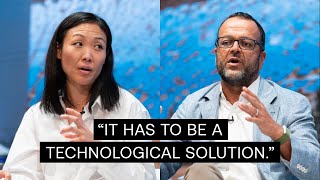
Samir Kaul and Michelle Liu discuss scaling carbon removal and hard-tech solutions to fight climate change. Direct air capture needs to remove 10 billion tonnes of CO₂ annually, but costs must drop below $100 per ton. Policy signals like the Inflation Reduction Act and public-private partnerships are essential to unlock the market.
Chapters
Sims, thank you so much. I'm going to be joined on stage now by Samir Kaul, the founding partner and managing director at Kozler Ventures, and by Michelle Liu, the co-founder and CEO of Supercritical, a software company helping people get to net zero. Both of you, thank you very much. Welcome. Just very briefly as an introduction, I just wonder what you would say about what you are each doing in your respective companies that is helping this process.
Sure, yeah. Hi, I'm Michelle. I'm one of the co-founders of Supercritical. We're building a carbon removal marketplace for businesses, and the reason why we've chosen to focus on carbon removal is in order to hit net zero as a planet by 2050, even if we reduce our emissions, electrify everything, we need to remove 10 billion tons of carbon dioxide from the atmosphere annually. There is no way of hitting net zero and staying below 1.5 degrees without it. These technologies— direct air capture is the best, best probably known example. Stack of fans absorbs CO2, sequesters it underground. They have only removed a few thousand tons to date. So there's this urgent scaling challenge, and we believe that businesses that have made net zero commitments are the way to scale these early-stage technologies. Great.
Yes, I'm Samir Kaul. I helped start a firm called Coastal Ventures, and we have about $20 billion under management, and a large focus of what we invest in are breakthrough technologies that address climate, from everything from hydrogen to carbon capture to electric batteries, etc.
So why do you think there is this shortfall in climate financing that we heard from Raja, we've heard in all the presentations.
Look, I'll tell you, it's every technology innovation we've seen, whether it was dot-com and now we've seen in crypto, and I fear we'll see in AI as well, is it gets overhyped. Too much capital pours in and then it disappoints investors, and then you go through these cold spells. And so, I mean, we were one of the early investors in clean tech from '06 to '10, and we did well on some companies, but the vast majority failed, and we made a lot of mistakes because it was the first time venture capital went into a new sector. And that happened in dot-com, and everyone wrote off the internet and said— I remember when we were raising funds in 2009, large institutional investors said, you know, venture had its run, it's kind of over, it's all buyouts, etc., etc., and they couldn't have been more wrong. Venture's been the best asset class the last decade by quite a margin. So I think investors tend to follow herds and trends, and unfortunately, climate 1.0, save a few examples like Tesla and some of the companies, was largely a disappointment. What we firmly believe, though, is that it's the second wave, where you, in the analogy in dot-com, would be the Ubers, the Airbnbs, the Squares, the Stripes, where you've learned your lessons and you've got a bunch more people investing in the space. So I think I'm very, very bullish.
Are we there now?
We are there now, and it's because you can always tell when a space is going to be highly successful when you look at where are the young PhDs, where are the young entrepreneurs wanting to spend their time. And for about 10 years, no one would come into my office and say, hey, we want to work on climate or environment or sustainability. And now more than half of the people want to work in that area. And we have the benefit of now the space being in venture for over two decades where we've learned a lot of lessons.
We, we specifically work with businesses who have voluntarily made a net zero commitment and know that in order to hit that commitment, they need to buy permanent carbon removal. Our biggest challenge is in demand, and the lack of clear guidance and regulation around these commitments is what holds back our, our business, I would say. So I think it's— people know they have to do this. They know they have to do it by 2050. What that means along the way and the interim milestones required to buy carbon removal and get there are just very unclear. And that confusion and uncertainty is what's held back the demand for our specific sector.
Well, I agree with Michelle there, because Right now, carbon direct air capture isn't affordable. And so what happens is that the large companies, the Amazons, and they'll take it out of their marketing budget and say, look, we'll spend a few million dollars and pay $700 a ton for carbon capture. That's just not a sustainable business. It has to be below $100 to do that. So how do you get there? That's where the private— you're the expert, but that's where the government has to say, look, It's important enough for us that we have to set targets and set incentives to reach those targets. And they could be temporary because eventually, as you scale— and everyone talks about scale— another reason why energy is hard, it's a massive market and it's massive scale. So it just takes longer to get to the price target. But when it does, it should be incredibly lucrative for investors because the markets are massive. So if. And we've seen that with the Net Zero Act in Europe and the IRA bill in the United States, where we've now set targets for hydrogen, we've set targets for carbon, we've set targets for batteries and electric vehicles. And now you're seeing a lot more money pile in because you can see that here we have these targets out there. And yeah, we can make hydrogen for $3 a kilogram. You know, we can capture carbon for X amount of money.
And that cooperation between the private and public sector presumably you think is absolutely essential to generate that sort of investment. And you were just talking about the IRA, the Inflation Reduction Act, which has been such a significant piece from the Biden administration.
Yeah, it's absolutely critical. I mean, there's no better demand lever than regulation that forces companies to do the right thing. You know, we're lucky to work with ambitious businesses that can afford a $500 a ton offset that want to do it because they can see how catalytic that demand signal is, but to get to gigaton scale, we can't rely on the voluntary carbon markets. And in what we do, there are conventional offsets that have very little impact, cost $5 a ton, they're cheap, because they don't do anything, and we're trying to sell something that's $100 a ton. If people don't understand the difference and don't know why they should tell the difference between these two things, they're just going to buy the cheaper thing, and that's where clear guidelines, policy can help make businesses do the right thing.
I don't know whether you were here for the morning discussion, and I never thought I'd be bringing in the morning discussion about food safety and into this afternoon's discussion. But, you know, we had then Jamie Oliver saying, you know, regulation, and Henry Dimbleby saying you can't just leave it to the, the private sector to decide what the rules are. You need regulation to have this, to make this happen.
Well, look at the COVID vaccine. Probably one of the best examples that we— I assume everyone here benefited from was you had technology. Well, I'm not an RFK Jr. fan, so I assume we all have a stab in our arms. But, you know, Moderna decided to pivot their technology to make COVID vaccines, and the government said, we'll buy them if you make them. And it was an incredibly profitable and successful partnership. And I think this, to me, climate— we've had 3 of the hottest days in the history of the Earth in the last few weeks. So why would people not view climate and global warming as an equally catastrophic potential for the, for the world?
So yeah, I think advanced market commitments in vaccines is exactly the model that many in carbon removal also look to. And Similarly, the power purchase agreements and the long-term offtakes that help to scale renewables are how carbon removal also have to— will also have to scale. And I think that the challenge with climate change is it's not evenly distributed, right? Like, the hottest days in the world are in certain places at certain times, and we can read the headlines and forget about it. It's like a massive tragedy of the commons challenge, and we just need ambitious leaders that will mobilize and work together to make the right thing happen.
We heard from Sims a moment ago about the importance that technology is going to play in all of this, and technological innovation absolutely critical in tackling climate change. Are you seeing the solutions now being developed?
I came to carbon removal not because I'm a tech— I'm actually not a techno-optimist, but I, you know, I did after I left my first business I realized climate change was a thing, probably like a lot of the founders that come into you, they exit their first company and, oh shit, climate change, what do we do about it? And after doing a lot of exploration and falling in love with trees and lots of other solutions, I realized that the fact of the matter is, with the science, is we don't have enough land on the planet to plant all the trees we need to absorb all the carbon dioxide. It has to be a technological solution. We don't have all the answers yet, but we don't have a choice but to invest in it. And I think that I do believe in the power of human ingenuity. I look at how fast technologies have scaled in my lifetime, and so I can only bet that carbon removal will reach the same kind of scaling potential.
It has to. Yeah, I mean, that's the essence of our business, is believing in technology innovation. So a couple of things to think about. If technology is the only solution, in my opinion, for climate change, because we've kind of tapped out what solar can do, what wind can do, as you talked about, there's only so much land you can plant trees on. There's only so much you can incent people to ride their bike or walk to work. Changing human behavior is just very difficult. You have to make it convenient for them. And so to me, what limits— there are numbers saying we have to get to 25 million electric cars. What's one of the big limitations there? Is getting batteries, getting charging stations, getting— you don't want to have a 300-mile range. It'd be great to have a 600-mile range. That's all going to come. From technology innovation. So we're not there yet. We have to keep innovating. And that's another thing that the government can do, just like they do for cancer moonshots or things in public health, is incent people to take that kind of risk. Go fund 10 projects to get a 1,000-mile battery range. Or we now have dozens of nuclear fusion companies funded by venture capitalists in the United States. Because Lawrence Berkeley finally showed that for the first time ever, fusion can produce more energy than it took to get the reaction started. That's what will drive these kind of changes.
I mean, you said you're not a Robert F. Kennedy fan. I'm guessing— I don't know what you view about Donald Trump, but Donald Trump says we don't need to worry about climate change because technology is going to supply the answer, so let's carry on doing what we're doing. You know, behavioral economics is a really interesting area of how you get people to change behavior. If people believe there is a simple solution in technology, does that encourage people to think, well, I can carry on driving?
No, I, I, I think not when it affects them personally. So that's a great point. You know, there's so much debate in the United States about— which is ridiculous— about climate change, about whether it matters or not. And my argument has always been, well, do you think your house is going to burn down? And most people say no. I said, well, why do you get insurance for it? So even if you took a certain sliver of the budget and put it towards just in case, now obviously I believe in it, and then the government, and governments, private, public sectors have done amazing things when they work together to point this. My second favorite prime minister from Great Britain, look what they did in World War II, how quickly they started the Richmond shipyard.
[Speaker:MS] Can I just ask who your favorite one is?
I mean, I feel like ethnically it should be Rishi, but I'm a guest of Mr. Blair, so I think I'll stick with Tony for the next 25 minutes. But think of what would happen in World War II in this country, how quickly the warships were built because private and public sector worked together. This is as catastrophic a problem, and we just have to recognize it, not run from it,, and then we'll solve it.
Yeah, I love your point about human behavioral change because I feel that kind of a— I meet a lot of young people who want to work in climate, and they feel a lot of climate guilt, and they try to take the actions upon themselves, like stop flying or not eat meat. And these are, you know, great signals to our social circles about the right solutions, but the fact of the matter is we've got decades to get to gigaton scale across, you know, like massive scale across everything, that's not going to come by individuals hair-shredding their way to climate solutions. It's just not going to. We saw with COVID people stopped flying, people stopped buying things, emissions dropped by 7%. It's just simply not enough. So we have to bet on scaling these technologies to get there.
Okay, we've got about 2 minutes left. I'm going to ask each of you a question which I reckon you could speak on for about an hour, but I'd like you to give me a 1-minute answer each about What is the change that you would like to see in the way the world is dealing with climate change?
I'm going to give a very motivated answer. I mean, I believe that the lack of awareness around the need to scale carbon removal is really distressing. I think that everyone is rightly focused on reductions, but at this point in time, we've left it so late that we have to start scaling up removing carbon from the atmosphere as well. There is just no way of us, you know, staying alive as a species without it. And I'd love everyone to really grasp and understand it and understand that it's twin targets that we need.
Are you getting there? Do you think that people are beginning to understand it?
Yeah, I think people are beginning to understand it. In the last 2 years of building SuperCritical, I've been surprised by how fast-paced the sector has been, but it's starting from such a tiny starting point and needs to get to billions of tons. So whether it'll get there fast enough, I'm not, I'm not quite sure.
Samir? I think we have to adopt and embrace nuclear. I don't see how else we can get to the scale we need in the time we have without out of.
So nuclear is the simplest, most significant—
it's the— it should be the cheapest 24/7 way to do it. And there are concerns with fission, but I think there's enough fusion projects that not allowing regulation to get in the way of slowing down the deployment of these technologies will be a big deal.
Fascinating. Samir, Michelle, both of you. Thank you very much indeed. There'll be a short tea break now.
More from Samir
Building & Scaling Brilliant Companies - Kevin Systrom (Instagram) & Samir Kaul (Khosla Ventures)