Lessons from Five Bosses | Keith Rabois & Samir Kaul
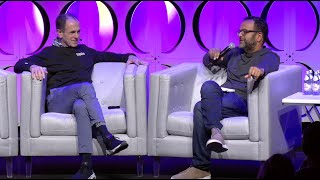
Keith Rabois reflects on five influential bosses: Peter Thiel, Reid Hoffman, Max Levchin, Jack Dorsey, and Vinod Khosla. He shares what each taught him about hiring young talent, decision-making frameworks, building culture, and why he believes successful startups must operate in-person, not remote.
Chapters
Alright, this is gonna be fun. I get to have a fireside chat with my— put that picture of skinny Keith back up there.
I don't think it goes backwards.
It doesn't go backwards? Okay. Oh, there you go. So I had a great introduction. You know, when Keith worked with us, he was not quite so fit. Barry hadn't opened yet. So I thought I was gonna open with that, but that's probably mean. Then I said, okay, well, maybe I can take a record of all of Keith's tweets that were now proven to be incorrect, but there was way too many of them, so I figured—
Yeah, so there's 32,000 and there's 2 that are incorrect? Yeah.
So, that's Keith's math. But anyway, so, for those of you who don't know Keith, he's an original member of the PayPal Mafia, then went on to LinkedIn, and then worked at 2 KV companies, Slide and Square. Before joining us and working with us for 6 years, left and went to some no-name fund that, you know, doesn't need to be mentioned here. But most importantly, we brought him back because he is now CEO of Open Store. And so he just can't get enough of me. So anyways, he— we're going to talk about— he's had the distinct pleasure of working for 5 bosses who are all, you know, pretty exceptional people. And Which one's Keith?
You don't want to know. Look at that cool guy in the middle who looks clueless.
How confused he looks. Anyways, so he's had the pleasure of working for 5 really good bosses, and I think he's had a lot of lessons from them. So let's start with boss number 1, Peter Thiel. So what have you learned from Peter?
Sure. So I've been working with Peter professionally for 23 years. And most of the lessons, actually, I learned in week 1 of working with them in November 2000, and then have applied them and remixed them. The most important one is, in building a company, how to find— the importance, first of all, of finding undiscovered talent, and then learning how to do that. So, theoretically, it's actually easy to explain why you have to scale a company using undiscovered talent. You don't wanna be competing with— back then, we would talk about competing with Yahoo, Microsoft, and Google for talent. And actually, not even really Google yet, it was probably some other big company that failed, but fundamentally, you can't compete to assemble and marshal critical density talent by going after the exact same people that companies that generate infinite profits will pay and overpay for. So, basically, Peter had a lesson that basically, you have to hire people under 30. That was, like, how he expressed it, because, and not to be ageist, the point was that by the time you're 30, anybody can apply—
Don't start being politically correct now.
Me? No. But legitimately, by the time you're 30, Everybody who runs a hiring algorithm should be able to roughly come out with the same conclusion about someone's strengths and weaknesses. When you're really, really young, think like 18, like an intern, it's very difficult for organizations that run a homogenized hiring process to assess people. So, there's a lot of alpha there. It's a little bit like, for those of you who are sports fans, you draft athletes out of high school in the NBA. There's more alpha there than signing a free agent that's been playing in the league for 10 years. Everybody can look at the the same, you know, films, same stats, and come to roughly the same conclusions. So Peter was like, you absolutely have to hire undiscovered talent. We can't afford to hire proven talent at the end of the day. Second, value of time. People systematically, in Peter's words, undervalue their time. This has kind of become a mantra of my life. This is how I somehow invest in companies, run a company, teach Barry's classes, have babies all at the same time, is I am extremely disciplined about the, allocating my time, the value of each incremental minute. It's something I try to scale and teach other up-and-coming managers, but Peter really was the first one who instilled it in my brain. Many other lessons, I constantly remix stuff. It's not usually, like, replicating Peter views. They've sort of become my own. The last one that's really valuable for founders is the value of focus. So Peter, like Peter can be, is an extremist when he has a view. He takes it all the way to, like, the polar, you know, extreme. So he had this mandate at PayPal about focus that every single Every single person in the organization, and this is a time when we had 300 people in, let's say, the Bay Area, and like 600 people in Omaha. Every single person in the Bay Area was allowed to do exactly one thing, literally one thing, including execs. And Peter would absolutely refuse to talk to you about any topic that was not that one thing, period. And he was the only one who was allowed to violate it, of course, being Peter, he exempts himself from most rules. But fundamentally, the discipline of, You're only allowed to do one thing led to significant breakthroughs. Because what basically happens is there's really hard challenges in any startup, period. And it's easy to substitute your own time, your own attention to solving the ones you know how to solve. But those are not the breakthroughs, those are not the 10x ideas. But when Peter would say to me, like, you need to fix this, and I literally won't talk to you for the next month or two until you've fixed it, it would force me to bang my head against that damn wall every single day. Go home, sleep, think about it, go in the shower, dream about it. And once in a while,, it would lead to a holy cow, there's an answer, we can do this. And imagine that across an entire organization of 300 people. 5 or 10 ideas that probably wouldn't have happened are a direct result of Peter's management philosophy. So I don't apply it with quite the same rigor, I wish I could. I allow people to push back at me too much, but I try to narrow it from 1 to 3 things, but it is an incredibly useful philosophy.
You've also said that the best startups are cults. Yes.
Talk about that a bit. Yeah, so another Peterism. This one he talks about and describes in, you know, Zero to One or his lecture notes at Stanford, that basically when you start a company, you have to have a secret about the world that you believe to be true that nobody else really understands or denies. And that's what a cult is. You have a view about the world that most people think is wrong. And then that's how you become a magnet for talent. You have this cult-like, "There is going to be this change in the world, and we're gonna propel this change. We're gonna improve the world. We're gonna improve society, and we can do it, and we alone can do it." And then you reinforce that through a bunch of cultural techniques, even in your office design, everything. But that cult mentality is absolutely critical. It's one of the reasons why, as a practical result, when I'm giving advice to founders, I— first advice is, after we fund a seed company, is get your own office. You can't build a cult if you're sharing space with other people that don't believe the same things. And you need to customize the cult to accomplish your goals. So every cult should be different. If your business goals are different, if your market goals are different, you have a different type of cult. If your leadership style is different, you have a different type of cult.
Got it. Let's move on to Reid Hoffman, obviously the founder of LinkedIn. You started working with him at PayPal. So talk about that and then how he recruited you over to LinkedIn.
So there's two specific things I remember Reid teaching me. First was the value of time. So Reid is probably the most impressive business development executive in, like, my experience in Silicon Valley. He can negotiate anything with anybody and wind up on a pretty good side of that transaction. And, um, The dimension he taught me that I didn't understand, I was a pretty good negotiator when I joined PayPal, and pretty good at biz dev, I think. But he taught me this one dimension that I had no clue for, which is the value of time. There's an extra variable in every business negotiation, which is, who really cares about this closing, let's say, tomorrow or not? And if you understand that dimension, terms that are otherwise not so easy to manipulate, you can manipulate. So that was incredibly valuable. More valuable, across my whole life was Reid has a very specific view of how to make decisions. They can be personal decisions, they can be decisions for your kids, like where should your kid go to college? They can be professional decisions, like should we raise money or not? Should we work with this partner or that partner? And most people create a pros and cons list, you know, it's kind of like an accounting thing, you know, you probably, almost everybody in this room has probably done this at some point. You know, here's the pros of working with Samir, here's the pros and negatives, and here's the pros of working with Keith, or some, you know, something like that. And Reid is like adamant that that is the worst possible way to make a decision. And so he trained me that you should never do that. And so since this conversation, probably in 2002, I never do that. You will never find a notebook where I write down pros and cons of any decision. The counter model is, and I'll explain the flaw of that conventional model, is the counter model is you rank strictly your priorities in life. You rank strictly your priorities in your company. Then you try to make a decision between two choices solely on the first priority. And if there's a tie and you can't, then you only, and then, do you go to your second or third. And the reason why Reid's, like, sort of model is so brilliant is when you create pros and cons, you're creating effectively and visually a false equivalence. Like, you know, you have a pro here and a con there, and you have 3 in this column and 2 in that. And your brain is artificially looking at these as equivalent, where what, there's like a kind of a power law. Like, maybe the first one's really, really important and the second one's not that important.. But when you see it arrayed that way, your brain makes the wrong decision often. So I've been using that since 2002 every single day.
Got it. OK. Now, another PayPal co-founder that you then worked with, I guess, at PayPal, Slide, and then on the board of Affirm.
Talk about Max. So Max taught me several things. He was very scary when I first met him. He was pretty intimidating at PayPal. My first meeting presenting to him, I prepared for like 2 weeks.. And I got out of the meeting sort of unscathed where it was a détente. It was about a fairly technical topic. And a détente was considered a massive victory for me. But the, the, there's a few key lessons from Max. One is you have to model behavior you want your employees to emulate. So even to this day, I've been on the board of a firm since we invested at KV in 2013, I think. There was a problem about 3 or 4 years ago, and it was really difficult to figure out empirically what was driving what. Max literally slept in the office with the team for 3 days until they figured out the problem, what was driving it. It was like related to fraud, it's obviously very important in a payments company, but still like, you know, after all his success, he still is willing to sleep in the office when there's a problem, and that of course cascades to the entire company. So first is lead by example. Second, Max actually was pretty important and instrumental to me that even when I'm very busy, I should be training. Max, every day at PayPal, would go for a run, and so I would try to actually shadow him on runs. The problem is, he actually can run a 4:38. He could run the sub-5-minute mile, and I definitely can't, so— No one expects that from you, Keith. No, no, thank God. But in any event, it was like, even when you're the CTO of the company, even when everything is breaking loose, you still need time to keep in shape, and it affects your brain, it affects your decision-making, so that was important. And then third, The classic lesson from Max is, and he was famous for this in 2001 even, he was on the COVID of Wired magazine in 2001 or '02, is how do you use machines and people in an interactive loop? This is now common, probably half this room uses some version of this today at least, but it was actually pioneering. It was basically an invention. And so Max taught me how do you construct, when you're starting a company, maybe 99% humans or 90% humans or 80% humans and very little data 'cause you don't have data,. And then you, how do you switch the equation over time? So that, that's been indispensable to lots of companies, including you glossed over the one we did at KVE, Opendoor as well. So we worked on that together and a lot of lessons there.
Got it. No, very true.
Next, Jack Dorsey, where I think we put you. You did actually. So I did not really know Jack before a KVE partner— You're welcome. —had invested in— Square, a seed Series A, like $10 million. And Jack really needed a business or an accompaniment that understood a little bit about financial services at the time, and that was still innovative. In 2010, that Venn diagram basically was a handful of people in the world. Now there's a lot. There's been a lot of great companies built. There's a great pool of people. So your former colleague said, "Hey, would you ever," direct quote, "Would you ever consider Square?" And I looked up at the end of this coffee, and I said, "Consider? Sure." So immediately, like any good VC, within a minute, he had introduced me to Jack and said, "You guys gotta meet tomorrow morning." So I did, and Jack, I don't know whether he ever did this as a sales technique or not, but he showed up for the meeting wearing a Yankees hat. And if you know me, I'm a fanatical Yankees fan for like 40 years. And so I was like, "Oh, I'm probably gonna wind up doing this job." But the lesson, the most important lessons are intentional culture. Square, Jack wrote a blog post you can read. It's kind of amusing to read now, 13 years later, but the 10 principles of working at Square. And they had, like, cultish things like you must have a fine haircut. Like, you can think about how ridiculous this is, and we can debate it forever, but he had a design-driven culture, and he, believe that everything you do in your life will show in the product you build for customers. So people at Square dressed immaculately for a startup. People showed up at, we started work at 8 AM in the Bay Area, engineers included, which actually at the time I thought was crazy, but it was a very intentional calculation, a design-driven, top-down company-building philosophy, which I had read about Apple, but I'd never worked at Apple, and learning from Jack, who'd really had immersed himself in like what actually Apple does differently,, and tried to apply it to financial services, and it worked.
Yeah, he always would tell me that he made it a point to push in the chairs after he left a conference room.
100%. Like, all of us were trained. Some of you who I've worked with will see me do this, actually, when I meet with you at board meetings or one-on-ones. I actually am so trained that I can't walk out of a conference room without pushing all the chairs in. Okay, last but not least, Vinod. Oh, this one could be fun. So, the most important lesson I learned was when Vinod was on the board of Square. Which is, he had this adage, which is, "The team you build is the company you build." And it may sound simple, but it's really provocative because everybody in Silicon Valley tends to focus on everything else: technology, products, you know, markets. But ultimately, it comes down to the people. If you have the right people, you're gonna succeed. If you have the wrong people, it's highly unlikely. And it's just so clarifying to be— this was a Peter and PayPal lesson too,. We had an incredible critical density of talent at PayPal, which is why, you know, the proverbial PayPal Mafia has gone on to do interesting things. Let's focus on Vinod. Okay, Vinod, yes. So, "Team you build is the company you build." And it instantly locked in my brain, and it really does— when you're doing your ranking, number one thing is, "Do I have the right people doing the right thing? And if not, how do I go find them? What pools of talent?" Like, how do you do the gene pool engineering? How do you go get them? And, like, if you get all that right, everything will take care of itself. So that was the most important. By far.
I mean, I literally give this advice, dispense this advice daily. Okay, so then you left and went to that other firm, and we got to work together again.
Tell us about this new company that you started that we got to invest in. Yeah, so we worked together a lot. I mean, I think Samir and KV and I, we probably have like at least 10 companies that we worked together on, maybe more actually, including Traba, which is— I'm wearing intentionally because It was a great, inspired investment by Samir. Secondly, it's in Miami, so you should all move to Miami. And third, actually, another Vinod point, which, you know, is really important, is the distinction between venture assistance and venture capital. So they did not give these sweatshirts, which are really nice, to everybody or other investors. It's like you have to earn it by being— assisting the company. And so it reminded me of a lot of the— we're not in the venture capital business, we're in the venture assistance business. Which is what you— what can you do to help the founders achieve their dreams and ambitions and maximize the probabilities of success? And I take that really seriously. Like, when I invest, my goal is how can I improve the probabilities of success?
And I definitely learned that here and through Vinod.
Tell me about Open Store. So Open Store is a company that we started in Miami 2.5 years ago. The idea was crazy ambitious. No one has built a horizontal e-commerce platform in the West since the '90s. Basically, most of the stuff we shop on was really built in the '90s, late '90s, and has kind of continued with its lock-in network effects, blah, blah, blah, blah, whatever theory of accumulating advantages you prefer, whatever moats. But no one's really been able to rebuild one. And we had an idea about— I had a lot of reasons why I thought that was true. I mean, people have pitched me on this as a VC, and usually my eyes glaze over immediately, the chance you could actually do this is really small. The reasons are, first of all, capital intensity is just incredibly expensive. If you wanted to rebuild Amazon, Amazon Retail, how would you even think about that? How would you compete with Google Shopping from scratch? And most of them would fail any good VC's test. So I've been chewing on this for a while, and then we thought we discovered a formulation, which is Shopify, which has been this incredible wave that a lot of people hadn't paid attention to. Very under Amazon's, you know, sort of nose over the last 13 years, 14, 15 years. Basically, someone built, at the time, $150 billion, $160 billion direct competitor to Amazon, and that was the future of direct-to-consumer transactions. If you buy, like, a branded axe, it's most likely you discovered it on Instagram and purchased it through a shop store. And so we had this epiphany that there's a lot of very small shop stores, and they're not gonna have access to capital. Like, VCs are not gonna give them money, their local banks are definitely not giving them money, so they basically are running as cash flow businesses, but it's just impossible to escape that treadmill. So, we said, what if we acquired them all at, you know, fairly efficient price, stitched them together, built consumer scale, but with a proven CAC and a proven payback model, so we didn't have to raise infinite money to see what the CAC lifetime value equation would be. We would actually have Darwinistic evolved evidence, and we just scale it together, and then layer a serendipitous discovery engine on top of that. So there's another point that I was talking about with Samir at lunch. A couple years ago, Jeff Bezos spoke here, and I was fortunate enough to sit in the audience. And Jeff was paranoid at the time about not letting competitors attend the speech, which I thought was kind of ridiculous. Like, you know, the delta between Jeff and Amazon and like someone sitting at the KV Summit.
We were the early investors in Instacart, and Jeff specifically asked the Instacart founder not to be in the audience.
So I thought that was kind of overkill, like at the time. But as he was speaking, he actually said, well, he said lots of absolutely fascinating things. But one germ of an idea for Open Store was a function of how he described Amazon's culture and their DNA. And I realized that there was no chance he would figure out how to do what I wanted to do at Open Store from that speech. So he was actually right that he should have kicked out anybody who could compete with Amazon.
In person, you've been very vocal about remote work versus hybrid work.
Talk a little bit about that. Yeah. So we have a view at Founders Fund that we will not fund a company that doesn't work in person. And this has been my experience, you know, having built companies, let's say, 13 years before I became a VC and tried to do it again. That there's no way to build a company successfully without in-person, and I'll walk you through why. So actually, interestingly enough, last year at the KB Summit, by accident, I was sitting next to Joe Gebbia from Airbnb at lunch. And it was the same week that Airbnb announced this, you know, remote everything policy. So I said to Joe, you know, if you were starting Airbnb again, would you ever do this? And he said, no. And I said, QED, I'm done. No argument. But the reasons why, or if you're gonna build a company on undiscovered talent, to stitch this all together, If you're gonna build a company based upon undiscovered talent, these people are early in their career, they're learning their craft. The way you learn a craft is by osmosis. It's true in venture, too. And osmosis and unstructured learning does not work remotely. So you either then have a choice. You either have to hire very experienced people and have a linear roadmap that you can predict so you know what kind of talent you need with experience. But that's pretty rare. In most companies that really succeed, that's not true of. So, we just realized that if there's one exception every 10 years, we should just have a policy that we're just not gonna fund people that aren't gonna build a company. And I will distinguish between distributed offices, where everybody works in person, but they're in different offices, versus remote. And we just won't fund it, because we've never seen it really work. And, you know, having run a lot of companies, I actually wouldn't even know who to promote. So, if you're running a company with a lot of undiscovered talent, these people are ambitious., and you wanna take advantage of the people that are very ambitious. So, for example, at PayPal, we had this 29-year-old finance guy who's a little annoying sometimes, but very talented. And Peter made him CFO at 29 years old and said, "He's gonna be CFO when we're a public company. I don't care, all these other CFOs are stupid." His name's Roloff Botha. There's no way he would've got promoted at a remote company, because the signals that led to Peter concluding that this would actually work are these little soft interactive signals that you watch with your eyes. So, you know, my probably number 2 person at Open Store was hired as the most junior person in the company. There's 2 people that were hired as like the most junior people. He's been promoted 5, going on 6 times. There is no chance, he's now 29, he will be a fabulous CEO, whether my company or some other CEO, definitely in his career. There's no chance he could have gone on this promotion ladder without me being able to watch how he interacts with other people and see how people trust him and go to him to solve problems. And so his whole career trajectory is completely different because he joined an in-person company.
I agree. We have a few minutes left. I know you've been very vocal and passionate about China and AI and what the US should be doing.
So tell us a little bit about that. So, yeah, I agree with Vinod. Vinod also, you know, I saw him give a presentation recently in DC that we have a really serious problem confronting China, the CCP specifically, and AI is the most dangerous sort of, let's say, landscape for that competition. And I'm not so sure we're winning. And whoever wins that race will have economic leverage, which usually leads to military and political leverage, as well as potential direct military leverage. So it's extremely scary and terrifying. So what do we do with that? Well, that's a really good question. So I think there's Bad things, like bad ideas, like regulating AI when you're confronting a military enemy is a very bad idea.
Secondly, I don't know what to do, but who would even know at the government?
That's what baffles me is who there understands AI well enough. No, literally nobody. So I had a conversation about a month ago with Kevin McCarthy, Speaker of the House, and he actually asked me, you'll like this, So, he actually asked me, like, who should I meet to learn about AI? It was actually a good question. I mean, that's a good question from the speaker, actually. Okay, Keith, I can disagree. Okay, no, it is fine. But so, I set him up to meet Sam Altman. He actually didn't know who Sam was, which is, you know, part of the problem with politics. But like, now he was able to sit down with Sam and Sam could at least teach him something.
Yeah, yeah, I worry about that too.
But, and China won't do any regulation. Well, they will, but in a way that's designed to achieve their goals. So think about the advantages. Let me decompose this a little bit. And I have some tweets explaining this. Obviously, they have more people with more data with less privacy protections. Typically in AI, more data is a pretty big deal and they have a lot more, like probably a couple of orders of magnitude more data. Secondly, they even create data, I think, to fuel like their chips are much better than people in the United States realize. This is something I actually hadn't appreciated until recently. People think that we have this advantage in like high-end chips. It's actually not true. And then the third point, and there's a good movie like Oppenheimer coming out that kind of reflects this. A lot of my most sophisticated AI friends believe that a top-down organization will thrive better in AI than a traditional Silicon Valley-oriented bottoms-up organization. And so those, that culmination of more data, more people, less privacy, equal or better chips, and a better organizational structure is very terrifying.
Okay, last thing we'll talk about before we open up for questions.
What's the biggest mistake you've made in your career? So, you want me to say leaving KV, but— Okay, great. Let's move on. Actually, one very specific one I remember is we had a debate about a seed investment in a polarizing founder at the time. And we wound up giving a term sheet to this founder. And let's say it was a post-money of $25 million, and an up-and-coming new fund gave him a term sheet of $35 million. And the founder really preferred to work with me and KB, but for a variety of reasons, we decided to stay disciplined with the price. Well, this company's now a $12 billion company, for real.
And so I lose sleep about this, you know, pretty much every other day. Got it. Okay, well, that was great.
Let's open it up for some questions. So when you say you won't fund a remote company, well, I've got two questions. First of all, would you fund hybrid companies? Second of all, how would you suggest founders transition from hybrids to basically full up, back in the office?
So I was talking to Jackie after her board meeting presentation because we both serve on the board and running board meetings even in a remote way. It's pretty challenging to get high value out of that. I actually fly around to go to board meetings, 'cause I really don't believe I can be constructive as a board member on Zoom. So watching hybrid board meetings seems to be the worst, actually, of all worlds. So I'd almost rather like a remote board meeting, like digitally, and then, or in person, and if you're not there, you're not there, and you don't get to participate. In a company, the hardest intellectual question for me, and I do get asked this, is, There were people who obviously built a company, let's say scaled a company between roughly March of 2020 and let's say a year later when it was impossible to run pretty much an in-person company. And if you scaled a meaningful number of employees during that time frame, what do you do? And that's not so easy. And I admit that like there may be a cohort of companies that are challenged, that have these challenges, but doesn't mean repeat that. One lesson is don't repeat the mistake. Like, so don't start now a company, and don't run a company now if you're hiring for scale. That's predicated on a window that really did force some pretty significant trade-offs.
Did you have a second question, or was that it? Yeah, how would you suggest founders and CEOs, you know—
Well, I would, if you could, it depends on how many employees you have, and I would actually plot out, like, how many employees do I have, where are they? And then I actually would do what, like, actually one of, one of the CEOs we work with recommended to me yesterday is, I would incentivize the best people to move. And even if you have to overpay them, like move to a concentrated place. And you may not get all your people, but if you get, like, you know, traditionally the top 10% of a company is gonna produce disproportionate value. Get them all concentrated, then the aspirational people who wanna be promoted, challenged, will maybe move with them. And it's not gonna be perfect, but you can get, like, maybe 20% of the effort, you'll get 80% of the rewards. Sorry, what about the people who live in the same place, but just don't want to come into the office? That's a non-starter. Like, so, it's been hard in the Bay Area. I admit, I have like 6 or 7 boards still in the Bay Area, and all the CEOs I talk to are frustrated about it, including some really strong companies, really excellent CEOs. And in the Bay Area, I only know of one private CEO at scaled company who's just Adam and like this Parker at Rippling has no excuses. You're in the office in the Bay Area and I haven't seen any other—
I haven't seen any other CEO pull this off in the Bay Area. Adam. So couldn't agree more about the philosophy. I'm curious what you do. So for reference, we scaled significantly throughout the last couple of years and I don't know, maybe 3, 4 months ago we essentially said got to get back in the office, we're doing— you can work home 5 days a month and you can pick those days, but your team has to have coverage. I'll say even that has been a significant struggle. And what I think I didn't appreciate is that people change their lives, like, you know, married somebody who has an important career that, you know, is in a different location or etc., etc.
And I'm curious, what you do with that, 'cause it is something we struggle with. [Speaker] That's why I say there may be a cohort of companies built in a certain era that just have these constraints. Like, if you've added 200 people with those expectations, that's all, Jeannie, that's pretty hard to put back in the bottle. But again, it doesn't mean you should counsel new founders or companies that are scaling now to do that. But I agree that life is complicated that way. We had several companies scale during that time frame, And some of the founders knew in their own heart that COVID would end at some point and that people would want to work in person, that would be superior. And other founders were like, COVID's changing everything, and depends upon who you believed. But if you were in the model of COVID's going to change everything, I could see how that scaling is almost impossible to correct. And, you know, hopefully the companies work out, but I personally think they'll be suboptimal to some degree. To some extent. I mean, like, for example, if you're young and ambitious, where— if you were young and ambitious, if I was young and ambitious Keith again, where would I go? I personally would go to a company where I could— yeah, where I could work with the best people. And I want to learn from them every day. And so I think the companies that have that magnet are going to wind up with an unfair advantage of talent. And it's not even a top-down thing. It's just like, if I— my personal atomic unit wants to be in the environment where I can learn the most fast and the fastest.
I agree with Keith. I think we've had a lot of companies in our portfolio struggle with this. Look, the top 15 to 20% of your employees, they could work from anywhere and be super productive. What happens is that you've got 80% that just can't. And I think Keith alluded to this, is that if the folks that are coming in the office, the folks that are at the headquarters, are getting more promotions, are learning more, maybe that signals to folks to come in. You know, at KV, we're in the office every day and there was a lot of hesitancy at first. You know, some was location, some was commute, some was COVID. But now you can see that people are really great in a mentorship business. There's nothing like just walking by and taking someone for a walk or an office. I think you have to start small and let the, let, let the word of mouth show the benefits of doing that, and that'll drive behavior more than an authoritarian, you must be in. That just doesn't seem to work, sadly.
We probably have time for one more question if there's one. Yeah, Asan. Hi. I think one important learning from our battles, our arguments, was inputs versus outputs and how to think about companies. And I think I think that's an important learning for me from you.
So I think it'll be pretty good to talk about that. This is one of the— you know, Samir jokes with me, like, you know, that I have these views whenever. One of the most important views in company building is actually a pretty radical departure from how I believed you should build a company for the first decade of my career, which was output-driven. I was like a big fan, high-output management, Andy Grove. You know, if you watch my YC lecture from 2013 on how to operate, It's like 90% outputs. And then having actually listened a lot to Jeff Bezos' talk here, I had already been somewhat sympathetic on the input side because Jock had kind of reoriented my brain in Square kind of in an input direction. So I was already kind of transitioning my views. But then Jeff Bezos just nailed all the reasons here of why input measurement and input driving is so much better than output. So I've had to kind of marry them in my brain now, and it's kind of a little bit weird, actually. But I think the— replaying the value of inputs versus outputs is what Jeff said is like, look, if you're gonna start a new project that has high upside, if you only measure outputs, all your best people are not gonna raise their hand and say, I'm gonna take on this suicidal crusade, this perceived to be suicidal crusade, because the only way I get promoted is if it succeeds. And when you're trying to to do like 10x breakthroughs in a company, you want your best people to raise their hand and say, "I want to do that." And the only way you're gonna get them is if you gauge their inputs, not their outputs. That's the biggest lesson for me.
The second is, well, that's the most important by like order of magnitude, probably. Well, let's thank Keith. Keith, appreciate you coming out. Thank you.
It was really great. Thank you.
More from Samir
Building & Scaling Brilliant Companies - Kevin Systrom (Instagram) & Samir Kaul (Khosla Ventures)