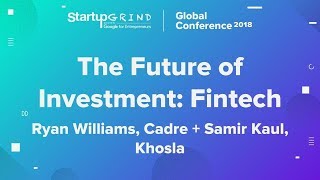
The Future of Investment: Fintech - Ryan Williams + Samir Kaul
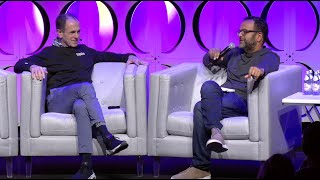
In this fireside interview, Samir Kaul talks with Ryan Williams, founder and CEO of Cadre, about his personal journey from a modest upbringing in Louisiana to building a fintech platform that aims to democratize real‑estate investing. Williams recounts early entrepreneurial experiments, the pivotal moment during the 2008 subprime crisis that sparked his interest in real‑estate tech, and his subsequent stint at Blackstone before launching Cadre. He explains how Cadre leverages technology in three core ways—transparency for investors, workflow automation that reduces fees, and data‑driven opportunity sourcing—to create a secondary market for an otherwise illiquid asset class. The conversation moves to operational challenges, especially integrating high‑paid real‑estate private‑equity talent with equity‑focused data scientists, and the compensation philosophies used to align them. Williams shares his vision of scaling from accredited U.S. investors (about 13 million with $20 trillion net worth) to a broader mass‑market audience, emphasizing trust, service, and brand equity as prerequisites for expansion. He describes a painful leadership decision involving a senior hire before a major Goldman Sachs partnership, illustrating how personal networks and transparency helped him navigate the crisis. Kaul and Williams discuss macro‑economic resilience, recommending an 18‑month cash runway to weather corrections, and reflect on income inequality, highlighting education as a key lever for social mobility. Finally, Williams reveals a personal interest in ed‑tech as a potential future focus, underscoring his belief that technology can be an equalizer. The interview blends personal anecdotes, strategic insights, and forward‑looking perspectives on fintech, real‑estate, and societal impact.
Chapters
Thank you for that standing up. I was feeling a little insecure after the last speaker said boards are useless. I was thinking I better brush up on my golf game or something. So it's a pleasure to be here. Ryan, you know, you've got— one of the things that attracted me to investing in you was your personal story. I think it'd be great to share with the audience. Tell us about your life growing up in Louisiana and how you ended up where you are now.
Sure. Um, it's really great to be here. I, uh, I'm excited to also answer any questions that might come up. So I'm from Louisiana originally, and I think some people would look at that as a disadvantage. I looked at it as an advantage. Some people look at it as a disadvantage because there aren't that many startups or resources frankly in that area. I think there's one or two Fortune 500 companies. But in many ways I think that's actually what allowed me to sort of prosper and build Cadre. I've always been excited about the prospect of building organizations and companies and not necessarily fearful of failure associated with trying to create things and That manifested itself about 15 years ago when I started my first company up. I love playing sports, wearing sports apparel. I didn't like paying the high costs associated with buying Nike and Adidas and Jordan headbands and wristbands. And so stumbled upon an opportunity where I could actually solve this pain point. In New Orleans, we have what's analogous to New York City's wholesale district on a really, really small scale. And I realized I could buy terry cloth headbands and wristbands for a couple dollars, whereas if I went to the Nike store, I'd have to pay $20. So I started buying and selling to friends, realized I could distribute them by building a website, did that, taught myself how to code when I was 15, and ended up actually selling the company my freshman year of college and used some of that money to basically start trying to build other companies. And most failed. And most people don't ask about all those failures, but that's what I learned the most from. And in 2008, one of the ideas I seeded actually ended up working. It was the subprime credit crisis, so a ton of distress, a ton of foreclosures in the real estate space. I was in Atlanta, Georgia with a roommate from college, and we ended up buying a bunch of foreclosed homes that we found by looking online and seeing that the banks would list all these REOs and these foreclosures. What I realized is that when there are those dislocations, generally a ton of opportunity as well. And I also realized that real estate, biggest industry in the world, omnipresent, we're in a real estate building now. Most people have no idea how to navigate it, how to participate in the industry. And it's the most important asset class to build multi-generational and intergenerational wealth. And so I had this paradigm where I was a rookie in real estate investing and as an entrepreneur, but I actually could build a business that was enduring because I was able to leverage tech to find value. And I took that kind of idea and scaled that business throughout my college years so that by the time I graduated, we had thousands of units that we owned. And after spending some time at Blackstone, after selling that company, I realized that the commercial real estate space in particular was like residential real estate on steroids. It was—
Ryan, before you get too far, how did you learn about this? You were the first person in your family to go to college?
Yeah, so I guess, I mean, I grew up and growing up I had a lot of people that believed in me, it's the first thing. But I also was incredibly curious about pretty much everything. And so I think One of the, one of my sort of basic principles is output's never greater than input. And so you can always work hard, you can control the degree with which you put in effort. And if I had a problem or a challenge, I would literally read and study until I could try to figure out how to navigate whatever that challenge was and think of a solution. So in the real estate space, I taught myself real estate investing, what an NOI was. I also asked a lot of questions. I went to Harvard undergrad, so for me it was like a playground of resources. Most people were sort of just happy to be there. I wanted more. And so I leveraged the resources, the network, and that curiosity really let me get up the curve. But in terms of how I got to Cadre, after spending some time at Blackstone, I saw people everywhere getting rich and making a lot of money, except for the people that I felt actually needed the opportunities to invest. And I thought technology can uniquely add transparency to markets where there's asymmetry in information or dislocations in access. Put a prototype together, went to a couple of friends with the idea behind Cadre, and Samir was one of the earliest investors and backers of us. And that network really proved to be incredibly valuable. Now, you know, we're sitting here with more than $1 billion in assets in terms of value on our platform, raised more than $135 million in venture capital, and we think the best is still yet to come.
There's a lot of skepticism that technology can make any difference in real estate. It hasn't to date. I think the systems at Blackstone or Starwood are reasonably rudimentary. So tell me why technology and data science and the things that you've invested so heavily in actually make a difference versus just being, you know, window dressing to raise money.
Yeah, it's a good question, and I think really what it comes down to is—
you fooled me, I want to make sure we save the next piece here.
Yeah, I think what it comes down to, it's really value. How do you optimize the increase value. Value to the people buying the real estate, value to the people managing the real estate, value to our VCs and investors as well. And I think technology in our company really has 3 major applications that are critical. First, it's about transparency. So the user experience, the product itself, it's easy to understand, to digest, and that hopefully reduces misalignment, conflicts of interest that you oftentimes see in the fund world and promotes better fee savings and efficiency. The second value driver is workflow automation. So everything from reporting to analytics to signing docs is almost like Amazon checkout versus, you know, going to the grocery store and sitting and waiting for your food to go down the conveyor belt. We think that automation of workflow and process can help reduce the overhead that people charge for building these big institutions and save fees for our users and investors. And then finally, it's about data. That's the third application. We think what data does is allows us to identify better opportunities faster. It allows us to connect the right type of opportunities to the right users so that they can own their future and add value ultimately to our users' portfolios. So with those three applications, we're able to create a more transparent, more efficient investing platform And also do things like create liquidity. So the only way you can build a secondary market, which has never existed in real estate, because real estate's been illiquid for so long, is through technology. It's about building sort of a distributed system where you can, not quite blockchain, but maintain a ledger of records and match people to the right type of opportunities at scale. So you can not just do it for 1 or 2 people, but thousands. Tech allows that. Better than anything else.
Talk about that, because some might say, well, this is just another tool for the ultra-rich to get a leg up. How widely spread will this platform apply? Yes.
I mean, our vision is to improve every single person's financial future on the globe. We want to build a new global economy. And today we are focused on accredited investors in the US. There's about 13 million alone that represents roughly $20 trillion of net worth. You assume 10% allocation to real estate, it's more than a $15 billion opportunity just there. And so we could build a massive business if that's all we focused on. But our goal and our desire is broader than that. It's about letting anybody have access to this asset class and have greater prosperity. And so what we're doing is we're almost staging how we grow the business. We want to focus first and foremost on scale. How do we get the greatest scale? You go to people who can put the most money in. We want to create brand equity, trust, at that scale. And then over time, what we want to do is start rolling out products that can allow more people to access the asset class. If you think about Airbnb or Amazon or Apple, you know, what did they do really well? They built trust. They built trust with a core product, and that's what allowed them to scale and build even greater products. And that trust came because they built quality, and that's really what we want to do too.
One of the things that I was really worried about when we first invested was you have— you're hiring world-class—
I thought you were going to say you. I was like, oh no.
Well, that I'm stuck with. So, but I was really worried about that you were going to hire all these hotshot data scientists and all these hotshot real estate people. And both sets of folks are used to being, you know, the top dogs in their respective organizations. And have very different compensation structures. Real estate private equity people have a lot of cash. Top-notch data scientists get a lot of equity. How do you have them all under the same roof and coordinate all that?
Yeah, I mean, it's a challenge. It's a challenge because no one I think has really cracked the code on it to date. I haven't met a company or CEO or an investor. So that's a really good model to bring sort of the old-school antiquated industry incumbents with the new school sort of technology product team. So we iterate, we learn a lot on the fly, but I think there has to be alignment on a common vision and a common mission. Because when that happens, even if you disagree and even if people sacrifice, they know that they're working towards the overall good. And so the way that we've thought about compensation and alignment is you don't leave a real estate private equity firm to come to Cadre because we're not going to pay you the amount of cash you get there. Sometimes it's half of what you'd get. So you have to believe in the enterprise value and creating your equity value. And if you're leaving a place like Google or Facebook or Apple or a startup, you're not going to get the equity that you'd get if you were early stage there, but that's also because in many ways people recognize the opportunity we have is just significantly bigger than— not to pick on any industries in particular, but building a company in like the food space, right? Because This is literally the biggest asset class in the world. So I think both sides have to sacrifice a little bit for the greater good. And then if you find people who are putting self—
You know I invest in a lot of food companies.
I know, that's why I was hesitant to say that, but I was like, you know what, we're gonna say it. They're good ones though.
I can't wait till our next comp committee meeting.
But I think really what you do is you have to iterate and filter out people who demonstrate that they care more about themselves than the team, even if it's painful.
So I'll ask you one last question that the audience, I'm sure, has a number of questions for you. It sounds awesome. Like, you know, I'm thrilled to be an investor, but tell us about, you know, one of your toughest days and how you think that'll help you face the risks and the downfalls that are inevitable in that context.
Yeah. So I don't know how many people here are aspiring entrepreneurs or CEO, just by a raise of hand, how many people are thinking about or starting something? Okay, wow, so a good number. So as you already started something, that's great. Yeah, it's a really good number. So as you all probably know, building a company, you know, Samir knows, it's not easy, and in many ways it's almost irrational just based off probability of how many companies are ultimately successful. How much pain you kind of have to endure. And so I've had tough days personally, professionally. I mean, professionally had to let go of basically my number 2 a week before we were supposed to close the first part of a half billion dollar banking partnership with Goldman Sachs. He was very critical to that, and there's an argument to be made that if we told Goldman, we'd lose all the money. Had to make that decision. Wasn't as painful from a professional standpoint as it was more personal. Like, this is someone who we committed and invested a lot in, and the decision that was made was one that was more about self versus team. And explaining that to the company and how this could disrupt people's lives and opportunities is really, really tough. How did I get through it? Called you up and Samir actually was the first person who really I think level set me when he asked me, you know, do you trust the guy, do you trust that he's making a decision based off the team versus self. And when I really dug deep I realized that that trust wasn't there and it's tough and you kind of have to reconcile that with the reality of figuring out how to make sure the business still moves forward. And then knowing that you're going to have to work through that, but I think The, you know, when the going gets tough, the tough get going. And having that network is really what's allowed me to sort of persevere through all that.
The organization has rallied. That's the one piece of advice I'd give. It's so tempting to just push off these tough decisions, especially in the light of a financing or a deal. It always bites you in the ass. It just always does. And I've learned after 20 years of doing this, just take your pain, rip the Band-Aid off, and move forward. And 9 out of 10 times, the person on the other side of the table will appreciate the transparency because they'll know, like, how hard it is for you to come forward and be like, look, I know you're about to wire me half a billion dollars, but I got to tell you this really important thing before you do. And you have lifelong trust. This is a long— sometimes in startups it feels like a sprint because every day is just chaos, but it really is a marathon. If you're building the right type of company. So I think that was a great— I really applaud you going with that. But that was a really good lesson for you to learn early on.
And surround yourself with great investors too, even if they don't give you the best terms all the time, because it's also a long-term relationship.
Well, Rob Ryan wrote his term sheet. I just signed it.
I didn't say you were the one I was referring to.
But yeah. Should we open it up for questions?
Yes. Yeah, how many, uh, how many experiences did it take for your business to become successful? Or like, how many failures did it take for you just to be like, oh hey, this works and that doesn't work? So for Cadre or just in general? Just in general. I mean, dozens. I've started so many things that worked for a week and then didn't, or for like 10 minutes and then didn't, or for a few hours and then didn't. In college I started a couple different things, one almost got me ad-boarded because I was using student information to create this digital marketing platform. So it's, you know, the percentages of sort of success are single digits, but you know, you learn from that. I don't know if—
No, I think when we look to, when I look to entrepreneurs or I look to hire people into our companies, As Sterling has a resume, you get so many resumes that are Stanford CS to Google to Facebook. And there's some really obviously very talented, successful people with that background. But I always ask myself, well, what's the hard day he or she has had? Because when you have that tough day and he or she has to deliver that day, that's when you find who's got the entrepreneurial metal and who doesn't. Yeah, so you— if you haven't faced it, boy, startup's not the first— it shouldn't be your first experience in a tough day.
Good day. The name is Jamari Peterson. Good way to remember, Jamari goes on safari in his Ferrari. Jamari. The question I'm asking is kind of from—
Can you say that again?
Jamari goes on safari in his Ferrari. Jamari.
Got it.
It helps me remember. But the reason I have this question is because I'm kind of working on a fintech cryptocurrency aspect. But the thing that I always think about is the organizational customer service part versus the technology. And kind of what is your perspective in what the customer service impact is going to have over time in the fintech arena? Is it really going to continue to focus on technology aspect capabilities, or is that customer service part going to start rising as kind of that differentiator?
So it's a great point, and I would actually argue that the reason fintech and real estate tech are so different is you need a pretty big focus on the service element out the door. This isn't a space where you can today get viral growth based off like a widget or a filter or tweaking the color scheme on the product itself. People need to trust that what they're investing in, participating in, transacting on is quality, is transparent, and is what it's being presented as. And so I actually think you need to build a world-class service and sales team in the same way you need to build a world-class product. To get that trust at sort of a critical mass built, and that's what allows you to create the network effects and grow and scale. So I think at some point, yes, product will become predominant focus for the winners in the space. Out the gate though, it's about that team, and for us, what is our service? I mean, in many ways it's like the investment professionals. Those are the ones who are doing the curation, the diligence, speaking with folks like Samir, making sure that they feel like there's quality and there's trust there. And over time, as we build trust and create that engagement, you can kind of pull them back a bit. But out the gate, I think the sort of runway that you need on the service front is much longer in fintech than some of the other consumer businesses. Hey, thanks, Ryan. So Blackstone's a great firm. What was that like giving that up, and when did you know it was time to move on and start your own company? Yeah, it is a great firm actually. And my former boss just got announced, he's getting promoted to president, he'll be the next CEO. So I was in a good seat and working with a great team and person. So when I told Blackstone what I was doing, I had just been promoted, they gave me this quick accelerated path to partner and told me that they would let me go to Europe and help with debt business out there. And so they were shocked and surprised, but they were dismissive when I told them what I was doing. They made a lot of jokes about it. But I knew that it was time for me to leave when I had a discussion 3 months in with the head of my group and he told me there's no way— this was 2000, must be 2012— there's no way Airbnb will ever have more rooms on their platform than Hilton or Marriott individually. And now they have more than both of them combined. And I also knew when I pitched him on actually creating like a mini real estate VC within our team, and he said that, you know, VC is great for consumer businesses and Facebook was once in a generation and nothing like that will ever scale outside of consumer, that it was also probably good for me to move on. Just a Jurassic industry, and you have people at the top who are paid based off stock price, which is correlated to enterprise and equity value, which is correlated to how many deals you do. There's no reason for innovation. So I saw that the culture there was one about profits, not purpose, and people didn't really want to embrace tech early on.
I want to know what kind of attracted you to work for them and also how it differentiates from other big names in the industry. For me, I was 30 years old. I just promoted to partner at my old firm Flagship Ventures in Boston, which is still a great, great firm. But, you know, at that age I didn't have kids. It was just my wife and I. It was a time time to take risk and to be able to work. Venture business is a total mentorship business and to be able to work with one of the all-time greats, Vinod Khosla, was like, I think by the time I hung up the phone I'd already started packing and was ready to move out west. And it was hard because our whole family is in DC, my wife had just passed the Massachusetts bar, she'd take the California bar, so it was a big sacrifice. I mean, I wouldn't be able to do it without her making that sacrifice, but it's been a great 12 or 13-year run. And whether it's companies or venture or investments, it's all about mentorship, and it's been incredible. What differentiates us is hopefully that, you know, again, the previous speaker, I'd love to be on stage with him, with the Venture is Just Money. I, you know, we're all technical, we've all been entrepreneurs, we invest more than 10% of the funds ourselves. So, you know, we put $200 million of our own money into every set of funds that we raise. So we really are aligned with both our entrepreneurs who we ask to take massive pay cuts as well as our LPs. And I think that drives the way we work. And I think you can ask Ryan or others offline. We've gone through a lot of these tough experiences that they face and hopefully can give them good advice. And the last— and we won't invest in anything where technology isn't the big driver. So I love Ryan, I love the company, but I was very clear with them. I said, look, if you're not going to make technology be a central part of your business going forward, we're the wrong investor for you. We're going to keep bugging you about it. So we don't think there's any part of the value chain in any industry that can't be disrupted by technology.
They're great too. You guys should— if you're looking at raising money, awesome partner.
Now he's kissing up to us.
No. We have a board meeting coming up.
Great, great presentation, guys. Wanted to get your take on the macroeconomy given the current correction that's happening. You know, a lot of economists are predicting some reckoning in the next couple of years after the 10-year boom in the market. And do you— let's say there is a crash or correction in the market. How will that affect fintech and private investing and VC? Second part, I'd love to get your take on income inequality in society. And Brian, you're so inspirational as a leader. What are some of the solutions you think to creating more opportunity and advancing the American dream for this generation? Do you think there is the American dream still alive and growing in terms of, you know, helping anyone make it and grow in our society?
So there's a great, great question. So on the first one, I give all my companies the same advice I give myself, which is, you know, I've lived through the dot-com crash, I've lived through the 2008 crash, and trust me, like in the dark days of the financial crisis, everyone thought the world was falling apart. I mean, it was crazy. I, my wife and I, we cancelled our Comcast subscription subscription to save $30. We gave up HBO and we're going to friends' houses to watch The Sopranos to give up. It was that, you know, and I'm— that was so how irrational people got. I thought for $30, I was saving $30 a month, that's like as if it was going to make a difference. But, um, uh, and I learned a lot out of that, which is even as dark and deep as those days were, it lasted for about 18 months. So what that's taught me is I keep 18 months of my current family burn in a very safe place, and I tell my companies to do the same thing. Always, when money's available, even if the terms aren't perfect or the valuation's not perfect, have 18 months of cash so that you can, you don't have to do anything unnatural, and if the crisis hits, you know, 18 months, you can pretty easily extend out to 24 months. Maybe not 30, but pretty much, and I think that's how companies should be living right now. Now, people have been— there will certainly be a correction. That I think everyone can agree on. People have been waiting for it for 3 or 4 years, so it could happen tomorrow. It could happen in 3 years. We don't know. And anyone who knows shouldn't be sitting here. They should be on their computer trading because they're going to make a ton more money doing that than listening to me and Ryan talk. So you just don't know. This could be the big correction we're waiting for. It could not. But you should always be ready and ready to plan on it. The income inequality thing hits very close to home for me. You know, I'm the kid of immigrants. My wife's the kid of immigrants. And, you know, the number one thing to me is education. So how do we, you know, improve public schools, increase teacher pay? And, you know, one of the— my wife and I, our biggest philanthropic causes are dealing with education and trying to allow more and more kids to get a fair shot. Because I think if you don't get that baseline, it's becoming very warped and very difficult. Oh, hello.
Over here, middle. Yeah.
Hello, my name is Alex.
I'm an 11-year-old. I was just wondering if If you had a chance to do something different, what would you do and why would you do it? Um, something different.
So if I weren't running Cadre, um, and you're a lousy basketball player, so yeah, I'm a lousy—
and I didn't have such a good jump shot and beat Samir in one-on-one or whatever. Um, I, uh, I probably would still be building a company. I'm actually pretty interested in edtech. In education, I mean, I agree with Samir 100%. I think our educational system is completely broken across the country. I actually did well in spite of the schools I went to and in spite of—
How many kids from your high school went to a 4-year college? How many ended up in correctional facilities? How many ended up at Ivy League schools?
None, none in Ivy League schools. Probably less than 10% in a 4-year school. Probably 20 or so percent either have been imprisoned or are currently in prison. And then the rest are sort of working in jobs that are not going to provide sort of for them and their families. So I think something in ed tech, I do believe, to go back to the question, that technology in many ways again can be one of the ultimate equalizers in and let people sort of leapfrog generations in some ways. So that's kind of probably where I'd spend my time if I wasn't at Cadre.
Yep. OK, well, thank you guys.
Thank you.
More from Samir
Building & Scaling Brilliant Companies - Kevin Systrom (Instagram) & Samir Kaul (Khosla Ventures)