10 Suggestions of We Can We Do as INDIVIDUALS to Help Stop Anti-Indigenous Racism
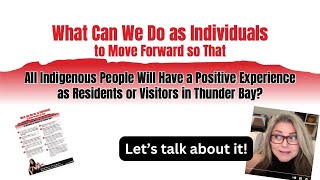
A YouTube video transcript by Sandi L. Boucher (Thunder Bay resident and member of Seine River First Nation) offering ten practical suggestions individuals can follow to reduce anti-Indigenous racism, particularly in Thunder Bay. The speaker frames the problem through personal experience, emphasizes responsibility and allyship, explains internalized oppression and nonviolent resistance, and concludes with a list of actionable behaviors and an offer to share her handout.
Chapters
Okay. So for those not aware, I live in the city of Thunder Bay. Thunder Bay, Ontario, Canada, a city known for its anti Indigenous racism. And even though the powers that be love to argue the point, as an indigenous woman living in the city of Thunder Bay, I can tell you the name, the title is most definitely deserved. And before anyone calls me out for the fact that I am very fair, one, I know that. Two, it actually gives me an incredible perspective of what's going on in this city because I can literally see how I am treated as opposed to the more darker skinned indigenous person right next to me. And I see that on a regular basis. So today, because there's so many new people on this channel watching these videos now, what I wanted to share was the response to a question I get asked all the time. The people of Thunder Bay, the people with their heart in the right place that want to be part of the solution and not the problem, ask me on a regular basis, well, what can I do as an individual to help? Or more importantly, this was a question I was past and I forgot to put on. Do not disturb. That's me bad. Let me fix that. We are good. So the question, this is quite a few years ago now, I was invited by a local non profit agency that will remain nameless. I was given, I believe, 10 minutes to answer this question. What can we do as individuals to move forward so that all indigenous people will have a positive experience as residents or visitors in Thunder Bay? 10 minutes. Don't do that for one. Don't do that. But we are going to talk about what I did and what I suggested as an answer. So let's talk about it. Bonjour, Mishko Paganon, Kwei Nadishnikas Mangdodem. Hi everybody. My name is Sandy Bouget. I'm Red Thunderbolt, woman of the Loon clan, a proud member of Seine River first nation in Treaty 3 territory in Northern Ontario. But as I mentioned in the opening, I am a longtime resident of the city of Thunder bay, like pushing 40 years almost. So I've been here a long time, I see what goes on. Yeah. And I'm a realist. You can't fix a problem if you don't deny it. The city of Thunder Bay is known for its anti Indigenous racism. And as I mentioned in the opening years ago, I was asked, what can we do as individuals to move forward so that all indigenous people will have a positive experience. Experience as residents or visitors in Thunder Bay. 10 minutes. So many indigenous speakers, influencers, activists would have turned down the information, understanding that 10 minutes is insulting. That if you want to address something as important as changing the reputation of this city by improving the treatment of Indigenous peoples, you might need more than 10 minutes. But I like a challenge and I knew this was an important topic and I knew the people that were in the room and I wanted to take a shot at reaching them. So not a lot you can explain in 10 minutes. So what I did was create a handout and I went over it with them incredibly quickly and I wanted to share that with you today. So the question is one more time. What can we do as individuals to move forward so that all Indigenous people will have a positive experience as residents or visitors in Thunder Bay? By the way, if you are not in the city of Thunder Bay, anti Indigenous racism is a problem across Canada and into the us I'm not going to debate which is worse. The problem exists. So even if you're not in the city of Thunder Bay, listen to these suggestions. Figure out how to use them in your city or town, municipality, hamlet, whatever. First one. In a time when so many feel hope powerless, responsibility is power. Own that making people welcome here is a responsibility we all carry. So what did I mean by that? I believe anytime you feel helpless, responsibility is the end to do. If you feel overwhelmed, you can't control your environment. One of the most empowering things you can do is ask yourself, okay, what do I control? What can I do? So in the city of Thunder Bay or in your city, town, municipality, if you want it to be a better place for Indigenous people, that's your responsibility. Yours and everyone else's. So own that it's a responsibility we all carry, including you. That's step one. Number two, own your privilege. Know your experience is not the experience. I always get hair in my lip gloss even though this is such an important topic. Okay, own your privilege. Know your experience is not the experience. Take the quiz. So what does that mean? People in Canada? I'm going to focus on Canada. People in Canada suffer every single day and I know the women watching this can relate. We're seeing this in the States play out. And in Canada, all those situations where some quote unquote man thinks they know what's best for all the people in the country, including the women. You don't have the perspective. So how can you speak for us in the same way that non indigenous people do not know what it's like to be indigenous or what we need? You don't have. Your experience is not the experience. I have long said that There are two Thunder Bays. The Thunder Bay you live in. If you're a non indigenous white person, you talk about the beautiful landscape and the great things you can do here. But if you're an indigenous person, it's a totally different experience. So no, your experience is not the experience. And of course, when I say take the Queen quiz, I'm Talking about Peggy McIntosh's Unpack the Invisible Knapsack quiz. I can put a link in the notes below this video. If you want to take that quiz, I always suggest people take it once to determine your own level of privilege and then do it a second time. Ask answering no to all the statements. That'll give you an idea of what it's like to be indigenous. Okay. Number three, know that choosing to do nothing or to stay silent is a great example of your privilege. Others can take their skin off. So the fact that if you're a dark skinned indigenous person, you're going to suffer. All these eye rolls and comments and the just the horrific service doing nothing about that means you're really comfy with the fact that it doesn't happen to you and you don't care if it happens to other people. That is not making your community safer, more welcome for indigenous people. So do your part. Choosing to do nothing is not an option. Number four, be an ally. While understanding that ally in this context is a verb, not a noun, and take action. And one of the best pieces of advice I heard this years ago on how best to help support indigenous people, the answer was shut up, listen and do only what is asked. And I love that because yes, it might come across as blunt, but you know what? It's true. Quit thinking like, if you want to help indigenous people, listen to indigenous people. Your opinion is not what's not needed in that context. So shut up, listen and do only what is asked. Don't do extra because you think it would be better. Again, your opinion is not what matters. So an ally is someone actively doing something. You can't say you're an ally. It's not a job description. It's something you're recognized as by the per the group or people you're in allyship with. So don't go walking around patting yourself on the back saying you're an ally only when you're doing something. Number five, educate yourself on what internalized oppression is and what it looks like. Recognize the three ways human react to long term oppression when you see it. So this is the, the bedrock, the foundation of my work. There are three natural human reactions to Oppression. And you see them play out every single day in every oppressed group. The first one is violence. When you're being held down and it feels like society's looking down on you, you lash out. And it's really hard to hit the federal government, punch them in the nose. So you lash out against the people closest to you. Your family, your friends, your children, your partner, your community members, or the people in the municipal nearby. The second one is acquiescence, the complete and total giving up. These are the people so often lost to the streets. These are the people that don't bother getting out to bed, out of bed, or even trying. They're not lazy, they're oppressed. They're reacting to their environment. Change the environment, you change the reaction. Last but not least, people like me. Nonviolent resistance. Daring not to be the stereotype, daring to have a voice, daring to fight for change, daring to learn the things we need to learn to thrive and help others do same. So educate yourself on what internalized oppression looks like. And if you check out my videos, you're really going to get a good idea of that. Number six, Support any and all nonviolent resistance. Do not take the mic when an indigenous person is talking. You know what, you can share their contact as much as you want. That helps get their word out, but you don't need to add your two cents to it. You can add, watch this. That's about it. Again, your voice is not the voice that is needed in this conversation. Number 7. Understand a positive experience is dependent upon relationships. Apologize and say I'm sorry. When getting by someone, say excuse me with a smile. Comment on a beautiful baby. Hold open the door. Understand the shock. Forgive the rudeness. I tell this to people all the time. You see a young parent with a beautiful little baby, comment on the beautiful baby. But if you're non indigenous, do not expect to thank you. Because they're a complete and total shock. But you're helping them destroy stereotypes. Because by the way, we have stereotypes about non indigenous people and they get to go home and think, wow, some white person thought my baby was beautiful. And then helps them destroy all the things they've been told about you. And that's a beautiful thing. Don't get offended by them. Help them realize it's not true. Number eight, hold and make space for someone. No indigenous peoples at your meeting. Bring someone along. Suggest diverse memberships. Pass the mic. Make room for Anishinaabemowin, which is indigenous languages, in this case Anishinaabe or Ojibwe. So get really good at looking around the room. And if you don't see if it's a community meeting and you don't see any indigenous people there and you have indigenous people in your community, you got to fix that. If you are planning some kind of project or event to, to welcome, you know, and be open to all the people in this, your city, I'm just going to say the city of Thunder Bay in this case, but your city and there's no indigenous people on that planning committee. Fix that. You do not have the lens. And guess what, everybody welcome has never meant we were welcome. So that's not good enough. We got to move past that. Number nine, call out and disrupt racism. Give up your seat. Let me help you. Get in between racism and the victim or just tell the offensive one to shut up. Often all it takes is getting in between the victim and the person saying the racist thing. So you're standing in a grocery lineup and someone in the lineup says something, you know, disrespectful towards, derogatory towards indigenous people and there's another obviously indigenous person in the lineup. Ignore the person that's saying the rude things and talk to the indigenous person. Hi, how are you doing? Don't worry about him, just talk to me. I looks like you got a lot of stuff there. You're going to be making a big dinner tonight. Have a conversation and it shuts down the person that has an issue with being them. And more importantly, it shows the victim they're not alone and that not everyone thinks like the person causing the disruption. If you really want to be brave, just tell the ignorant person to shut up. I have said not my city, I don't know how many times. Last but not least, use the four sacred tools as mentioned in my book the Path Patience. This will not be solved in one day. Awareness of what is going on in your community, not just for people who look like you. Tenacity, keep going, don't give up. And humility set out to learn. If you would like a copy of this handout, just maybe it's something your group or your team can work with. Be happy to send it to you. You just going to send me an email at sandy@sandy boucher.com and I'll happy be happy to send it to you. So there you go. What can you do to make your community, municipality, town, group, whatever, more inclusive and more welcoming for indigenous people? Now you have 10 ideas. I hope it helped. I'd love to hear your comments. Which one surprised you? Which one are you gonna try next? Comment below. Until next time. I love you. Bye. Bye.
More from Sandi

How I Handle "The Four Uglies!" (Alcohol, Diabetes, Healing & Cheap Seat Comments)


All the Stuff We Don't Talk About with NO SHAME! (WMT Podcast w Antoinette Godin)


When Authors Chat ... (Radio Interview for the Launch of "Copper Stone - Glimpse of Blood Memory)



MORE PROOF of Indigenous/Non-Indigenous Relationships that Work! (Walking My Talk w Millie Gormely)
