12 Principles for Decolonizing Your Soul!
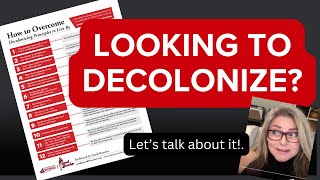
Sandi L Boucher, Anishinaabe Kwe from Seine River First Nation, presents 12 principles for decolonizing beliefs and reclaiming agency. The framework covers creating safe spaces, separating your worth from your skills, encouraging dreams, and lifelong learning. A downloadable handout and follow-up video on next steps are included.
Chapters
Hello, you absolutely amazing person, you. I hope you're having an awesome day. Thank you so much for checking out my channel in this video. Now, I want to finish off this week a little bit different in that I really want to focus in on decolonization. So it's a buzzword that we're hearing a lot of lately. The way my one elder describes it is, it is the process or practice of remembering, quote, unquote, who we were before the others came. It's going back to Indigenous processes, Indigenous practices, really embracing our Indigenous worldview, which may or may not be easy for the person involved, depending on the level of the colonization that you endure, the assimilation tactics, the pressure to assimilate and become more non Indigenous or like the non Indigenous. So what I wanted to do, I came up with a handy dandy handout quite a while ago. 12 decolonizing principles and then the next steps. Hang on. 1, 2, 3, 4, 5, 6, 7, 8, 9, 10. 10 next steps you can take. Today, I want to focus on the 12 decolonizing principles. And by the way, if you've watched any of my videos hung out on my channel for any length of time, you know, my focus is Indigenous Canadian reconciliation. I'm either talking to Canadians who want to learn how to work with, engage, recruit, retain, reconcile with Indigenous peoples, or I'm talking to Indigenous peoples themselves, my friends, family, followers, whoever the case may be. But when it comes to decolonizing, this kind of applies to any culture that has been colonized. And there, if you look back in history, this has happened to many people, not just Indigenous. So I'm going to go out on a limb and say these decolonizing practices are going to help many marginalized, racialized people, whether they're Indigenous or not. So today, the 12 decolonizing principles, tomorrow the 10 next steps. Let's talk about it. Hi, everybody. My name is Sandy Boucher. I'm Red Thunderbolt, woman of the loon clan, a proud member of Seine River first nation in Treaty 3 territory in Northern Ontario. We're going to forget the mess on my floor. We're going to forget the mess on my desk. We're going to forget the fact that I'm still in the middle of moving and unpacking. And we're going to focus on something way more important, which is decolonization. And as Anishinaabe Kwe, as an Indigenous woman, as an Ojibwe female who has lived my entire life within Canadian borders, my confidence, my wisdom, my self awareness was born out of decolonization. Now, just to give you a little bit of background here, my mom, a beautiful Nishnaabe, a member of Seine River First Nation. Our bloodline is couching First Nation. And my dad, an amazing Frenchman from St. Jerome, Quebec. I was like five the first time I noticed that the world or people outside of our family is what I'm referring to. Treated dad a lot different than they treated Mom. Now, my mom was a lot darker than I am, and she was born in 1927. She wasn't educated. She was an indigenous female. I mean, she had so many things playing against her. And I can remember seeing the difference. How sales clerks and clerks in stores would welcome my dad in and with a big smile. And not so much for my mom unless they knew her. And I used to. I was very. I'm just going to turn my phone off here because that was annoying. I was so young by the time I realized, or when I first realized the world could be wrong. Because my mom was this wise, incredibly compassionate woman. She may not have been formally educated, but her wisdom could help so many people. And I was lucky enough to have the opportunity to listen to her. Decolonizing is all about moving away from the stereotype, moving away what other people say you are. All those horrible things they say about indigenous people and remembering who we were when we were proud of every part of our culture because there was no one around saying we shouldn't be. That's why decolonization is so important. So let's look at this. I have a little quote at the top of this handout. It says, and this is harsh. This is. This is hard. Brace yourself. It's also true. It is easier to remain oppressed than it is to overcome it. Which is why we must do it. Choose to be one who overcomes. And what I mean by that is it is so easy. Just. It may be soul crushing, but, you know, I'm not going to fight, I'm not going to convince. I'm not going to say that that offended me. And every single. What you're destroying is you. And it's not about changing their minds. It's about defending. Defending that barrier and saying, you can't treat me that way, you can't speak to me that way. But you can't do that until you decolonize and start believing your value, even when others can't see it. Remember, their vision problem is not your value problem. Just because someone can't see how amazing you are does not mean you are not amazing. Your value does not go down just because they're blind. Keep it in mind. So let's look. 12 principles to overcome. It's how to overcome decolonizing principles to live by. So the first one. Okay, you ready? Overcoming oppression is not about changing practices. Overcoming oppression is not about changing practices. Overcoming oppression requires us to change our beliefs. So it's not just about saying nicer things to yourself. It's believing that you deserve to hear nicer things. The practice might get you there, but the what you need is to change the belief. I don't care if every single person you've ever met has told you you're less than they were wrong. I can be the first person to tell you that they were wrong. Creator doesn't make mistakes. He made you. Okay, so one, Overcoming oppression is not about changing practices. Overcoming oppression requires us to change our beliefs. Number two, and you have heard me say this one a million times, the answer is always on our side of the feather. It is not up to someone else to change. They do not need to change first. And I hear that so often. Well, I'm. When I, you know, stop the gossiping. Got the. Stop the bullying. Well, they gossip about me. So be the example of something different. Do not continue these negative practices that were born in oppression. If you want healthier communities, it starts with you. Your side of the feather. Next one. These are principles. This is going to be hard hitting here. Next one. I snuck ahead. Your value is not determined by another person. I'm going to repeat that. Your value is not determined by another person. Your value was gifted to you on the day you were born. And no one can take it from you unless you give them the power or two. And you've heard me say this before, but I'm going to do it again. Imagine a cute little munchkin, 2, 3, 4, 5 year old. Maybe your niece, nephew, grandchild, child, your next door neighbor's kid, whoever. Imagine the cute little munchkin. If I asked you in dollars and cents, how much is that child worth? What would you tell me? Don't you dare say 50 bucks. I do this in seminar all the time. They start screaming out priceless. Absolutely true. Second question, at what age does that change? What? What age does it stop? Now I get very upset. People saying it never does. Absolutely true. My children are in their 30s, as priceless as the day they were born. Third and final question, then why did it for you? You are that priceless child. And your value, it never stops. Start treating yourself that way even when others can't see it. Next one again. I Jumped ahead. Number four. Their vision problem is not your value problem. Already said that. Just because another doesn't see your value doesn't mean you do not have value. Yay, Number five. This one is so, so important. Separate evaluations of your skill from your personal value. I'm going to repeat that. Separate evaluations of your skill from your personal value. An evaluation of your skills is not an attack on your value as a human being. Your boss can tell you he wants to win you to improve some skill. That is not a personal attack. That is an evaluation of your skills, not your value as a human being. We have to separate the two. It's part of the healing. Okay, number six, we're halfway there. Create safe spaces everywhere you can and consciously enjoy them. Now be willing to bet some of you just went, I can't do that. You might be surprised at the follow up statement. Create safe spaces in your mind. In your home, in your yard, in your cubicle, in your office, in your lunchroom, in the circle of your personal space. Your mind should be the first place where nothing negative is ever said to you. And if it isn't, you need to change that. You need to tell that voice to shut up. And every time it says something negative, you say, nope, I'm going to say this instead. Takes practice, but it works. Make your home a safe space. My home is definitely a safe space. No one is insulting me within these four walls. Not happening. So is my yard. And now so is my friend circle. Because if you want to insult me, you're not in my friend circle. Easy peasy lemon squeezy. Number seven. Two parts to this. Two sides. Encourage dreams. Chase yours. So you know someone that that youngster in your area who once has a dream, you encourage them to go for it. I encouraged a junior kindergarten student to be Captain America. Why? That's who he wanted to be. Who am I to say he can't be. He's Canadian. A little complicated, but hey, who says he can't figure it out? Encourage dreams. Chase yours. Why? Oppression says you'll never be able to succeed. That you'll never have more than you do now. Prove oppression. Wrong. I did it. So can you. Next. Number eight. Success is not a sin. And poverty is not humility. Success is not a sin. Poverty is not humility. You deserve financial security. A healthy bank account does not mean you think yourself better than another. You've just prepared for the cold season better. So I had a friend years ago who said poverty is in our culture and it's just the environment we've lived in for far too long. Keep it in mind. Number nine. Speak up with humility and respect, not anger. Anger is a signal of an unhealthy person, Right? And do I get angry at times? Of course. I'm not perfectly healed. I'm human. Like there are still things that are going to trigger me. Far less things than in the past. I now realize what is said to me is all about the person saying it, not about me. There's a difference. But you speak up with humility and respect, not anger. Healing is required to move from dependence to independence to the healthiest stage of all interdependence. Once healed, we can share our truth with assertiveness, not aggression. Doing it all on your own, you're only halfway through the healing journey. It's when you can actually acknowledge knowledge that you need other people in your life, that you need their skill set or what they bring to the table. And that doesn't make you less. That's intra dependence. Now we're talking. Number 10, huge advocate. Practice lifelong learning. Simple, simple, simple. Keep learning, keep doing. With each new skill, with each improved talent, your confidence will grow and the grip of oppression will weaken. Exciting stuff. Principle number 11. Dare to say yes, dare to say no, Dare to decide. Because if you don't, someone else will. It's your life journey, hun. No one is going to rescue you. It's up to you to decide what you need and don't need. And with each decision, oppression loses its grip on you. Last but not least, know that your actions are always your decision. No one else is to blame. You decide what you do and say or what you don't do or don't say. There you have it. The 12 principles. How to overcome its Decolonizing Principles to live By. For those of you who belong to my membership, not my YouTube membership, but the membership on my website, Mishkway CA. You have access to all my video courses, my blog posts. There's books in there that don't exist anywhere else. And there's this neat little folder called PDFs and handouts. And that's where you would find this. You should check it out. I'll put the link below. Like I said, tomorrow we're going to continue this. We're going to talk about next steps. How do you decolonize? How do you get to that confident place you deserve to be? We will talk about it until tomorrow. I love you. Take care. Bye bye.
More from Sandi

How I Handle "The Four Uglies!" (Alcohol, Diabetes, Healing & Cheap Seat Comments)


All the Stuff We Don't Talk About with NO SHAME! (WMT Podcast w Antoinette Godin)


When Authors Chat ... (Radio Interview for the Launch of "Copper Stone - Glimpse of Blood Memory)



MORE PROOF of Indigenous/Non-Indigenous Relationships that Work! (Walking My Talk w Millie Gormely)
