A Lesson in Humility (Examining Maslow's Hierarchy of Needs Through Indigenous Eyes)
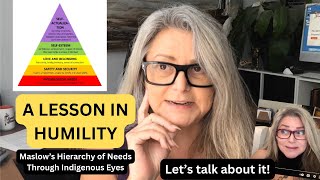
A short YouTube talk by Sandi L Boucher (Red Thunderbolt, Seine River First Nation) that explains and defends Maslow's hierarchy of needs from an Indigenous and lived-experience perspective. She outlines the levels (physiological, safety, love/belonging, esteem, self-actualization), rebuts three common criticisms (needs aren't singular, motivations vary in order, higher levels remove lower motivations), and emphasizes privilege, humility, and advocacy for those lacking base needs.
Chapters
Hello, you absolutely amazing person, you. I want to talk about something different this week. I said it again. I say that at the beginning of every video. I really got to find another line, but it is different from the last video, if that counts. What I want to do today is actually offer you what I consider a lesson in humility. We're going to look at Maslow's hierarchy of needs, which I'll be totally upfront with you, I am a huge fan of. And we're going to look at some criticism that has been leveled against this model and why I don't think they apply. So let's talk about it. Hi, everybody. My name is Sandy Boucher. I'm Red Thunderbolt, woman of the Loon clan, a proud member of Seine River First Nation in Treaty 3 Territory in Northern Ontario. And. And as I said today, we're going to be talking about Maslow's hierarchy of needs, this cute little image that you've probably seen a million times. The idea is that there are different levels of needs and that you got to have your base needs met before you can move up. Now, as I mentioned in the opening, there has been some criticism leveled against this hierarchy. And I should say this is the only hierarchy I'm a fan of. I'm Anishinaabe. We all sit in the circle at the same level. But I don't consider it as much a hierarchy as I do an order of operations. I'm in business. You do step one first, step two, step three, step four for. And that's how I've always looked at Maslow's hierarchy of needs. But there has been criticism. Namely, there's three points. Yes, I have my notes here. The first, one, that people are rarely motivated by one need at a time. Two, that motivations are unique and may be in different orders, and three, the idea that at higher levels you no longer are motivated by low, lower just doesn't make sense. So I'm going to challenge every single one of those points. But let's look at the hierarchy first. So at the bottom is the idea that. Or what this represents is that you start at the bottom and those needs have to be met before you move up the chain up the hierarchy. So at the bottom is psychological needs. We're talking about the need to breathe. We're talking the need for food and fresh water, the need for shelter so you can survive. The elements, the need for clothing and the physical need for sleep. These are your psychological needs. And by the way, I did mention that I'm calling this a Lesson in humility. Do you remember? Now, I've mentioned it in several videos over the years, but a little while back I mentioned Peggy McIntosh's Unpacking the Invisible Knapsack. It's a PR. It's a quiz to help you determine your level of privilege. And everyone goes through it. And, well, everyone that does it, they go through it. And some are shocked at their level of privilege, some are shocked at their lack of privilege. But a lot of people just, meh, just take it in stride. So what I've always invited people to do is redo the quiz, do it again, and this time answer no to every statement and figure out or imagine what your life would be like without privilege. You have answered no to all of the statements. I'm mentioning that today because that's what I want you to do. And that's why I think this is a lesson in humility. The people that don't get Maslow's hierarchy have never gone without the base needs. For example, the second level, after you have your psychological needs met, the second level, it falls under the heading of safety and security. So this is health, employment, property, family, and your social ability, ability to socialize with others. If you don't have food, which is the base needs, psychological needs, you will risk your safety to get food. You will risk robbing someone, getting arrested, breaking into somewhere to get the food. Do you see what I mean? So safety is a higher need. To get the base needs, you're willing to sacrifice that higher need. Now think of the most impoverished people. You know, often indigenous people, they risk family relationships. They will risk employment opportunities to meet their base needs. Okay, does that make sense? After you have your base needs, you got food, you got water, you got shelter, and now you have a job, you have property, you have your relationships with your family, you. The next one you're going to start working at worrying about is love and belonging, friendships, families, intimate relationships, your sense of connection. Trust me, you're not thinking about a relationship if you have no idea how to pay your bills. And if you are, it might be because you think that relationship will be a way to pay the bills. Again, look at this as if been there, done that, that you don't have these needs. You can also see. Let's backtrack for a sec. Food and water at the very, very bottom are base human needs. Why do you think indigenous people freak out over mining developments or pipelines? Because it's risking the water, which they see as a base human need. And next level up, safety and security is where you find food, family, you're risking the safety of their family because they're in the areas where these mines and pipelines are going to be. You're risking the water, of course they're fighting you. You are risking their base needs. So physiological needs at the bottom, then safety and security, then love and belonging. Now you start talking about self esteem, confidence, achievement, respect from other people, the need to be a unique individual when you are totally, completely. And how many times backtracking here, how many times have we heard seminars going after I want to improve your self esteem. I can't feed my kids. Don't talk to me about self esteem. I don't have a roof over my head. How am I supposed to feel good for about myself or have the respect of others? I don't have a job, I'm not in a relationship, I don't have any close friends. How am I supposed to feel better about myself? You don't even think about that until you have those base needs met. And then if you have your base needs, your shelter, your food, your water, you have your job, you have your property, you have your family, you have your intimate relationships, your social connections with friends, you're feeling good about yourself, you have your self esteem. Now we're looking at what is known as self actualization. This is you being you. Morality, creativity comes into it, spontaneity, acceptance. Don't talk to people about being creative if they can't feed their family. Again, unless we're talking about a starving artist who sees the creativity as a way to get the food, water and shelter they need. But those base, these are natural human reactions. This is not a choice. This is if you are working on self esteem, pat yourself on the back because that means you have some level of your base needs met. And am I passionate about this? Absolutely. Been there, done that. I have sold furniture for food to feed my kids. I am a 10 year domestic abuse survivor. I did not have safety. Trust me, I had zero self esteem. Which is hard for people to believe if they know me now. But truth hurts and that was my truth. Now I'm living a self actualized life. I am me. I love being me, I love being creative. But it's because my base needs have been met. Which is a perfect time to take us back to these challenges. So the first one was people are rarely motivated by one need at a time. You would only think it's one need if you're only looking at the titles of each level. In that very base level is breathing food, water, shelter, Clothing, sleep, that's a whole lot of needs. That's not one and I don't care. You are not worrying about, look at the people that take shelter in the doorways of public buildings. That's not a safe place to be. But it's some kind of shelter because they're trying to meet their most base needs. So one need at a time doesn't even apply. Right. Because again, you're not thinking about self esteem if you're living on the streets, you're trying to survive. It does not even enter the equation. And if you're thinking about it, that's because you have the privilege and the, the luxury of having those base needs met. Okay, second one. Motivations are unique. They may be done in different orders. I disagree. As someone who has not had those base needs, all of the lighter stuff, the self actualization, the self esteem, comes after you know, your tummy's not growling because you have food. And last but not least, the idea that higher, at higher levels you no longer are motivated by lower ones. That's looking at the, the triangle the wrong way. It's not that when you're at a high level, you're not worried about the lower level. You're at a high level because the lower ones are already met. You're not motivated by them because they're already met. And can you get knocked down? Absolutely. Talk to any stay at home mom, who is state, mom, dad, whoever, a stay at home parent who suddenly their relationship falls apart and now a shelter is not a given. They are no longer worried about self actualization and being their own person. They're trying to get a roof over their head. They're trying to feed their kids. So as long as the level below you is met, you have the luxury of working on the next one and you can bop back and forth. So I don't believe those criticisms apply. I think if, and this is a big if, if you can actually walk a mile in someone else's moccasins, if you can actually look at this hierarchy as someone imagining what it'd be like not to have those base levels and how you would behave, then maybe, just maybe, you can understand the people a little bit better when that's their actual reality. I hope that made sense. I hope this is a very valuable lesson in humility. We got it. If there's one challenge I face on the regular basis, it's working with people with privilege and who think their reality is the reality for everyone. It's why it doesn't work that all of our politicians have to have a serious annual income to even be able to run for a position. And then they go into it with that mindset and they're trying to make decisions for everyone. They don't have the experience or the worldview or the knowledge of the people who could never afford to run for office. And humility requires that we all remember that. I am not impoverished anymore, but I pray I never forget what that journey is like so that I can continue to advocate for and support the people still struggling to meet base level needs. Let's not attack the model. Let's get the work done to help the people who truly need us. Until next week. I love you. Take care. Bye bye.
More from Sandi

How I Handle "The Four Uglies!" (Alcohol, Diabetes, Healing & Cheap Seat Comments)


All the Stuff We Don't Talk About with NO SHAME! (WMT Podcast w Antoinette Godin)


When Authors Chat ... (Radio Interview for the Launch of "Copper Stone - Glimpse of Blood Memory)



MORE PROOF of Indigenous/Non-Indigenous Relationships that Work! (Walking My Talk w Millie Gormely)
