Acknowledging Indigenous Challenges or Whining?
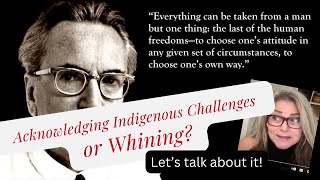
Sandi L Boucher of Seine River First Nation argues that Indigenous people naming poverty, addiction, and underfunded services aren't whining but resisting internalized oppression. She separates acknowledging real barriers from accepting them, citing Viktor Frankl on choosing your attitude and the principle that circumstances don't decide your future, decisions do.
Chapters
Okay, people, we gotta talk. Let's start today's video with a question. When you hear Indigenous people, whether in person or on the news or wherever you read it online, and you hear us talking about poverty or the addictions that are decimating our communities, or the lack of healthcare services or the underfunding of education, where does your mind go? Do you think there's two options here? Do you think this is an example of Indigenous people sharing the challenges we face? Or do you think it's whining? Now, reality is, if you're watching this video, if you're on my channel, chances are really good it's the former. You realize that we are identifying and trying to bring attention to the challenges we face, the very real challenges we faced. And no, let's not go into. We're the only ones. No one is saying that. But in Canada, you look at Canadian history, you look at modern day the Canadian institution the government has set out intentionally to marginalize indigenous people, and that still continues. Identifying that, still trying to get people to pay attention to that fact is not a negative. But even if you're one of those people that realize that, and even if you're one of those people that subscribe to my channel and thank you so much for that, I'd be willing to bet, yeah, run into the other people like I do, the people who think it's just whining. I. I have two handy dandy index cards today. Just the comments that come to mind. If they just tried harder, if they weren't so lazy they could overcome this, they should pull themselves up by the bootstraps. And we had it bad too. So we got to talk about this because you may not realize what you're hearing when you hear that. And maybe if you do, you'll have a counteraction to those people that say things like, we should just work harder. So let's talk about it. Foreign. Hi, everybody. My name is Sandy Boucher. I'm Red Thunderbolt, woman of the loon clan, a proud member of Seine River First Nation in Treaty 3 Territory in Northern Ontario. And today's video was the result of a thread conversation. So Threads is kind of tied to Instagram. I guess it's the counterbalance to Twitter or whatever that's called. Now I forget what it's called. X. That's what it's called. So I had shared a motivational quote, which I do every single morning on Threads. So if you're on there, and that's interest to you, follow me. The quote was, I am Not a product of my circumstances, I am a product of my decisions. There are few quotes I believe more because as you've heard me say a hundred times, Indigenous people believing we can stand up again and overcome our obstacles and challenges is as important as the standing up. The belief is the first step. If you believe you can't climb that mountain, you are never climbing that mountain. Which is why I fight so hard against that internalized oppression. I have something in my eye and I'm going to try ignoring that. So what is the difference between believing your circumstances dictate your life or that your decisions do? It's internalized oppression, 110%. For example, when Indigenous people are talking about poverty, we are acknowledging the challenge without ever believing that we can't overcome it. Because the second we believe we can't, we've succumbed to internalized oppression. That's the acquiescence. That's the why bother? That's the it's never going to change, so why even try? That is a documented reaction to oppression. We got to stay away from that. People who believe, and I'm not saying the belief is wrong, it's just how much power it has is important. If you believe that you have more challenges being successful because you're female, for one, you would be right. Two, just make sure you don't believe that you can't overcome them. Another one, being Indigenous, does that mean there's more challenges? More than likely, unless you're in some rare circumstance, absolutely. That does not mean it can stop you. Do you see the difference? The second you believe it can, that's acquiescence. That's when it gets dangerous. Now, just a reminder to everyone who on a bad day might be leaning towards that whining, that believing that Indigenous talking about barriers is whining. You can't overcome a challenge if you don't identify it right. You have to know what the problem is to solve it. So the identification is important. On my little handy dandy index card, what I wrote was, we aren't whining. We are acknowledging what Canada did or does to us and announcing the mountains we will overcome. Right now we're just saving up for the climbing gear. Okay? So. So keep that in mind. Another thing that came to my mind as I was preparing for this video, and this is for the Indigenous watching Indigenous if your nation believes in sacred items. I don't think I've ever come across one that didn't. But you never know. I haven't visited them all humility teaching here so many times. I Run into people who think the power is in the sacred item. And that couldn't be further from the truth. Our sacred items are called helpers on purpose. We have the power. It is in us. The sacred items help bring that out, help encourage us. Help us have confidence in what we're being able to do. But we are not dependent on the sacred items. If we were, every bit of our cultures would have died in the residential school era when we were separated from our sacred items, often the sacred items were destroyed. They are our helpers. You are the source of the power. Creator sent the sacred items to support and encourage you. Don't get it twisted. The power is not in the eagle feather. The power is in you. That can be enhanced and focused on with the use of an eagle feather. Don't listen. Oh, yeah, it says, you know, when it comes to the sacred items, don't listen to the haters or history. We are way more powerful than people try to point us to be. And just a mainstream reference here. What he reminded me of, what this entire conversation reminded me of was Victor Frankel's quote, a man's search for meaning. If you have not read it, you need to read it. Read it. Need to read it. You need to read it. I mean, any man who can believe in the power of the mind when he in a concentration camp gets my respect and admiration. His quote. Everything can be taken from a man but one thing. The last of the human freedoms. To choose one's attitude in any given set of circumstances, to choose one's own way. That is how you overcome oppression. Realizing these are my circumstances. This is not who I am. These are the mountains I will climb. And then, just the last thing. As I prepared for this video, I was watching my morning videos. Now I'm gonna sneeze. Oh, my God. It's quite the morning here. And that's funny because I was watching Ed Mylat's Monday motivation on the Growth Day app Shameless Plug. This is not sponsored. And his quote, and I'm certain it's not his, but whatever, he's the one that shared it in this case, sometimes you got to play hurt. That's very much an athletic quote. But what he was talking about is sometimes you got to perform when the circumstances are less than ideal. And when I heard that quote, sometimes you got to play hurt, I added an indigenous people are masters of it because we play hurt every single day. We play hurt in relationships. We play hurt in our jobs. We play hurt in the grocery store. We play hurt. We rise above Those circumstances. So I believe that is everything I wanted to cover. Your future is dictated by your decisions, not by your circumstances. You know what? When I was dead broke, working full time, trying to raise two kids. Kids are expensive, rent expensive. I realized happy was a choice. And that it didn't cost anything to sit down and play with my kids or to walk to the local park and just have fun with them. It's a choice. And I couldn't choose. I couldn't make more money. At that time. I was making everything I can. I was working for the federal government, by the way, so I had a good salary. My poverty was not because of lack of trying. It's not that I couldn't work harder full time job raising two kids alone. I was working pretty darn hard. But my decision was to create a happy life for my kids. My decision was to realize this is a temporary situation that I will overcome. Poverty was the boss on that level of the video game I was playing. In the video game is life. What chapter are you on? What boss are you facing? And are you really going to let it defeat you? I hope not. I hope you've got the gamer spirit in you no matter what age you are. They know how to defeat a level we we rag on our kids for playing video games. If they took those exact same skills and mindset and applied it to real life, the sky would be the limit. Maybe we got to learn instead of judge. Food for thought, my friend. Food for thought. Your circumstances do not decide your future. Your decisions do. Let's work on that until tomorrow. I love you. Take care. Bye bye.
More from Sandi

How I Handle "The Four Uglies!" (Alcohol, Diabetes, Healing & Cheap Seat Comments)


All the Stuff We Don't Talk About with NO SHAME! (WMT Podcast w Antoinette Godin)


When Authors Chat ... (Radio Interview for the Launch of "Copper Stone - Glimpse of Blood Memory)



MORE PROOF of Indigenous/Non-Indigenous Relationships that Work! (Walking My Talk w Millie Gormely)
