An Exercise in Reconciliation - Part Two
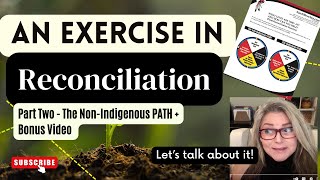
Sandi L. Boucher uses the Medicine Wheel to map reconciliation in four stages: learning the facts as a baby, unpacking privilege as youth, taking action as an adult, and building community bridges as an elder. The framework asks non-Indigenous people to accept history, recognize their privilege, stop causing harm, and tailor work to specific Indigenous communities.
Chapters
Okay, so I moved a few things on my desk. And if you honestly think that means that I put them away in their proper place, then you have no idea how busy I am right now. Suffice to say there, that stuff is no longer in camera range, which makes this part of my desk look clean. I'll try to fix that part for tomorrow. You Yesterday we talked about the indigenous path to reconciliation. Today we focus on the non indigenous path. So let's talk about it. Hi everybody. My name is Sandy Boucher. I'm Red Thunderbolt, woman of the Loon clan, a proud member of Seine River First Nation in Treaty 3 Territory in Northern Ontario. And, and as I mentioned in yesterday's video, if you're watching this, I'm not here. This is a figment of your imagination. Now, I'm shooting this ahead of time because I'm on a road trip. I actually have two amazing events to do in southern Ontario. Brought out my Mustang to go on a road trip kind of belated birthday present to myself. I want to introduce the mustang to the 400 series highways. Anyone who's done them will know what that means. But what I wanted to do, because my followers on this page are on this channel, are all about practical information. And by the way, if you're new here, please subscribe. So you don't miss any of the videos in this series because it's definitely going to be worth your time. So what I had shared is we're focusing on the Path, which is my third book, the Action Plan to get us to Reconciliation. And that book morphed into a full day seminar. And one of the best loved, most loved parts of that seminar is this final reconciliation exercise. The framework that I used was the Medicine wheel. And you need to understand those frameworks to be able to do the exercise. And I'm going to walk through the exercise with you. But yesterday we talked about the Indigenous path to reconciliation and I put that image into the community. Today we're talking about the non indigenous path. So exact same thing. It's Medicine wheel. It does not start at the top. Even though this is the non indigenous framework. It starts in the east on the right side because that's where every new day begins. And again, it mimics the four life stages. So baby stage is a massive learning stage. That's where everything starts. It's also where everything can seem really overwhelming. There's so much to learn learn and I'm never going to get all of this. Does that sound familiar? That sounds like a lot of people. I Know that are just starting on learning about reconciliation. So that's the baby stage. Then we move into the south, which is the youth stage, which is still a learning stage, but it's a higher learning stage. Now the problem with this stage is this is where we find the non indigenous activists that tend to overstep. This is a little bit of knowledge is dangerous. They've learned something, they tend to be outraged about it and they want to go out and do something. Problem is they often cause more harm because they only have a little bit of knowledge. So even though you may be tempted to go out and do all these amazing things, this is a learning stage. And I need you to rein in the horses and do the learning before you get to the next stage, which is on the left hand side, which is the adult stage and that's the action stage. And then again the elder stage, where all of the magic happens. Because you have the learning, you have the wisdom now, you have the understanding. Now we can build bridges. Okay, so that's the framework. Now let's talk about the specifics on the non indigenous path. The baby stage. The very first stage of this framework work is acceptance of facts. No more. Well, it wasn't that bad. You know, a lot of people got an education thanks to the wreck. The residential schools that would have never happened if they didn't go. What price did they pay? A lot of people went to residential school. You know, they were escaping from horrific family situations. Why were they in horrific finance or family situations? When a flower doesn't bloom, you don't blame the flower. You fix the environment. Right? Right. Accepting the facts, finding out what the facts are.
Looking.
I do a full day seminar just on the oppressive legislation, going through the timeline of all the things that have been done to Indigenous peoples. And I've yet to have an audience that is not shocked to learn of that legislation. So no more minimizing, no more excuses accepting the facts as truth. This is not about shame or guilt. This is about facts. This is Canadian history. This is not Indigenous history. This is Canada's history. How it was created and what it did to the Indigenous people along the path to that creation. And then of course, just like with the Indigenous path, there has to be a desire to reconcile, a desire to make amends, a desire to change. If nothing changes, then nothing changes. And there is so much about modern day Canada that does not work for Indigenous people. Can you say education system? Can you say justice system? Can you say governance system? And on and on and on and on. That's not reconciliation. Reconciliation is not, we've been doing it this long or we've been doing it this way for this long. Just put up with it. That's assimilation that is forcing us to endure. That's not reconciling anything. Think about reconciling with your partner. If you've done something that caused harm and you minimize it, you don't want to change and because of that you keep causing harm. Have you reconciled with your partner? Of course you haven't. It's the exact same thing. So that's stage one and it's huge on the Indigenous path. Stage one was healing also huge. No one said these paths were going to be easy. It's just how we get to reconciliation. Stage two, the youth stage, the higher learning stage. Kind of like the Indigenous path, you gotta unpack the suitcase. For non Indigenous people. This is recognizing your privilege. The fact that of course you have barriers to overcome, but the color of your skin was never one of them. I am Indigenous, but I'm white presenting. I have have tons of privilege. I can walk into a restaurant and there's a good chance, even though I live in the city of Thunder Bay, unless I'm wearing beadwork or my tattoos are showing, I'm probably going to be treated quite well. But if one of my cousins or even my son walks in who is darker skinned, the treatment is going to be totally different. That's privilege, white privilege. So in this section there's a whole quiz you can do that helps you identify your privilege. I think I did a video on that. I can always attach that when we get to that. And it's looking at identifying the benefits that non Indigenous Canadians enjoyed and the corresponding oppression for Indigenous people. For example, to help you understand, when the settlers arrived and started settling and creating municipalities or settlements, whatever they were using their mother tongues, whether it was English or French, it was the indigenous people who had to compromise, who had to learn another language if they wanted to be heard. That's a benefit for the colonists. They never had to learn anything new. And oppression for Indigenous people. So that stage is all about those things. And there's a whole bunch of tools and things you can use to do that. Third stage, the adult stage, is the action stage. So for non Indigenous people, this stage requires a commitment to no more harm. That the first stage, recognizing that the first stage to reconciliation is stopping the. The infliction of pain Indigenous people cannot heal if the attacks keep coming. Right? So it's really, really owning that and changing behavior, changing processes, changing the words you might use, it's not political correctness, it's stopping the harm. That's the difference. Right? So this is a hugely important stage, as you can well imagine. And then again, the elder stage is undefined because it totally depends who you're working with. Working with the First Nation community on the east coast is going to be totally different than working with a First Nation community on the west coast or here in the middle. As Pam Ponder always says, if it's convenient. It's not reconciliation. Again, using the analogy of you and your intimate partner. There is nothing easy about reconciliation. Owning that you caused harm, apologizing for it, and more importantly, changing your behavior so it doesn't happen again. That's not easy, but that is reconciliation. Now, I explain those two things to you because this exercise, it. It's an exercise. There's some things I'm going to get you to do. And the answers are found in those two diagrams, which is why I put them into my community on my YouTube channel. Tomorrow we're going to start that exercise and you'll see what I mean. And I'll probably put the medicine wheels, the frame up on the screen to help you as you're watching the video, just to make it easier on you because reconciliation is hard enough. Does that make sense? Do these frameworks make sense to you? I hope so. Until tomorrow. I love you. Take care. Bye. Bye.
Foreign. Hi, everybody, it's Sandy Boucher here once again as we continue on this journey of the 52 steps to reconciliation. Now, this whole series with the black background is all about what it's like on the indigenous side of the feather. But you can't really understand the differences until you understand privilege. And honestly, as an indigenous woman, I kind of hesitate to even use that word because if you. There's one thing that's going to upset non indigenous people, it's talking about their privilege. Now, there's an exercise that many, many people have used over the years, and I've definitely used it in seminar. You have people sitting in their chairs, they have no idea you're going to do the exercise. What you do is put a waste paper basket at the front of the room and you get every single one of them to crumple up a piece of of paper and you tell them that without moving their butts, have to stay in their chair. They get one shot at trying to get that crumpled up piece of paper into the waste paper basket. So then you better move out of the way because all these projectiles are going to come towards you. They all take a shot at it. Some get it, some don't. But then you ask them what they thought of the exorcist. And of course you're going to hear from some people that that was totally unfair, that the people in the front row had the advantage. Welcome to privilege. Now, what I have noticed over the years is that the people in the very front row, the ones that have always had access to the greatest education, the greatest health care, they knew people that owned businesses so they could get a job really super easy. The people that are in that very front row, most of those people that I've met know they have privilege. They don't even try to hide it. They know that they won that lottery in the same way. The people in the very back row. And that's what I always think of the indigenous and the First Nation communities that don't even have fresh coffee, clean drinking water. They don't have medical services in their communities. They may have a nurse, they may have police services. Chances are really good if something happened to their mental or physical health, they'd have to get flown out to a community hours away, all by themselves, without support. Those people know that they don't have privilege. It's the people in the middle that want to argue with me, and they're the first ones to say, I have worked hard for everything I've achieved. And guess what? You have. You absolutely have. But you do have privileges that other people don't. Ages ago, I discussed how fair I am. I have white privilege. I have a lot more privilege than one of my family members with darker skin. If I walk into a restaurant and I have my tattoo covered up and I'm not wearing beaded earrings, chances are people assume I'm another culture entirely and just welcome me in. But if I walk in wearing my beadwork and I have my tattoo showing, that's when you start seeing the eye rolls. I have actually had cab drivers pass by the obviously stereotypical looking indigenous people to come pick me up, only to be told they better go back and get those other people. Then be crystal clear, none of us choose our level of privilege. If you have privilege, there is no sense feeling guilty about it. Just don't assume everyone else has the same opportunities. And every chance you get, use your privilege to help the people that don't have it. There are still rooms that I can't get into, and that's when I depend on my allies to hold the door open for me. Now, if you're not sure how much privilege you have. You need to Google something. I want you to go on the Internet and look up Peggy McIntosh's Unpacking the Invisible Knapsack. It's a quiz that it's 25 different statements that she came up with to identify the privilege she had in her life as a white female. She is only talking about herself in her quiz, but she's encouraged other people to go through the list and identify how many apply to them. Back in the day, when I had a TV show on the local community TV channel, I actually invited one of my friends onto the show to do the quiz with me. Or more accurately, we did the quiz before the show and then showed up to tape the show live. And live is when we revealed our answers. I can honestly say, even though I've known this woman for years, when she told me she scored a perfect 25 out of 25, I almost fell out of my chair. And she was equally shocked when she hesitated and wanted to know what my score was. And I believe at the time, my score was 17. It comes down to things like, are the band aids you buy in the store the same color as your skin? If you have an issue in a store and you ask to speak to the person in charge, what's the chance that they're going to be of the same cultural background as you? Privilege is often something that the people with it can't even see. But the more you know about your privilege, the more you can imagine what it's like for the people that don't have it. Do me a favor, Google that. I'll probably attach it in my email out to my list to make it easier for people to do the quiz. I would love to hear what your score is. And don't. No shame, no guilt. You didn't ask for your privilege. But everything improves if we can all identify how much privilege we have. Until next week. Take care. Bye. Bye.
More from Sandi

How I Handle "The Four Uglies!" (Alcohol, Diabetes, Healing & Cheap Seat Comments)


All the Stuff We Don't Talk About with NO SHAME! (WMT Podcast w Antoinette Godin)


When Authors Chat ... (Radio Interview for the Launch of "Copper Stone - Glimpse of Blood Memory)



MORE PROOF of Indigenous/Non-Indigenous Relationships that Work! (Walking My Talk w Millie Gormely)
