Are YOU Marginalizing Someone?
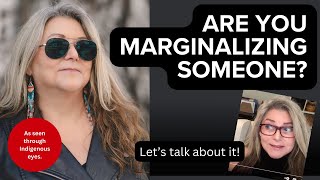
Sandi L Boucher argues that Indigenous marginalization happens daily in small ways: weather reports that skip First Nation communities, dismissive questions about Indigenous identity, refusing to learn Indigenous names, and vague labeling like "a Native American reservation" instead of naming the actual nation. These everyday choices matter for reconciliation.
Questions this video answers
1996.
Sandi L Boucher (Red Thunderbolt), woman of the Loon clan, member of Seine River First Nation, Treaty 3 territory.
Are YOU Marginalizing Someone?
Chapters
The practice of historicizing is a huge barrier when it comes to reconciliation or Indigenous empowerment, disempowerment, depending on which side you're looking at it from. And what I mean by that is this belief that something happened only in the past. When we talk about the oppression of Indigenous people, many people believe that that happened with the residential schools. Those ended a long time ago, by the way. 1996 is when the last residential school closed. It wasn't that long ago. Depending on your age, there's a really good chance you were alive when residential schools were still going on. The oppression of Indigenous people continues today. I don't know any other group that has to send their children to go live with strangers just to get a high school education. But that's the reality for Indigenous children in remote Indigenous communities. No fresh, clean drinking water. All of these things keep happening. That's the oppression continues. We cannot historicize it. What I wanted to focus on today is the marginalization of people. Setting them aside from mainstream othering them. Again, people think that that's happened in the past, but it is still happening today. And I wanted to give you some solid concrete examples so you can do a little self check and make sure you're not marginalizing anyone. Let's talk about it. Hi everybody. My name is Sandy Boucher. I'm Red Thunderbolt, woman of the Loon clan, a proud member of Seine River First Nation and Treaty 3 territory in northern Ontario. And yes, I am committed to all things Indigenous Canadian reconciliation. What I bring to the table is through Indigenous eyes I share an Indigenous perspective on many different topics to allow non Indigenous and Indigenous to actually build bridges to together. Indigenous hearing my words, realize they're not insane for how they saw things. And non Indigenous hear a perspective that up until now they've been denied. So as mentioned in the opener, and yes, I have a handy dandy index card. Even though I'm still holding my microphone cuz I still haven't found that I'll get to it. I will find it. Always good. Still in the middle of a move still, still dealing with my infection and swollen face. Life goes on. I know a whole bunch of people watching this have continued their lives in the face of adversity. So if you can do it, so can I. Today we're talking about marginalizing someone. So to be clear, just to really give you context on that, that is when we say something or take actions that establish establish a difference whether we're excluding someone or hyper focusing on them, that's marginalization. So for example I don't know if this happens in your area. I live in the city of Thunder Bay in northern Ontario and it most definitely happens here. Not. I don't think it's as bad. Oh, now I can hear Blue. I don't think it's as bad. How did Blue get in the door? Door. She opened the door. Well, isn't she a smart kitty? I'm not sure it happens as often now. That would make me very happy. But up until very recently, this was common. What am I talking about? Let's not bury the lead here. Listen to. Do you still listen to the radio? Is that an older person thing? I like listening to the radio in my car, especially to hear the news. And as part of the news you hear the weather. So here's the question. You can check this out the next time you're listening to the radio. When whoever is speaking, the radio announcer is listing off the weather, especially if it's in various areas, right? Like, I don't know if that happens in Toronto, someplace big, but up here they're going to list off the temperature or the forecast for many little small communities. The question do they only list the temperature or the weather forecast for municipalities or our First Nation communities included, or are they excluded and marginalized right out of normal everyday conversation? Now, here's the scary part about marginalization. If it's been going on for a long time, you don't even notice as Anishinaabe Kwe, the acceptance is real. It wasn't until I started listening to CBC Radio. Kudos to cbc. And as a matter of fact, they list off the temperatures in First Nation communities right alongside municipalities every hour, whatever. They pick a couple municipalities, a couple First Nation communities and they'll tell you the temperature. And I stopped in my tracks because I realized that was the first time I had ever heard that. That's because we get used to marginalization. And even if you're the marginalized one, you can get used to it. How scary is that? So that's example number one. Example number two, I run into all the time in seminar. So the question is usually something along the lines of, well, how do I ask someone if they're indigenous? Do I say Indigenous? Do I say Aboriginal? Do I say First Nation? Do I say Native? What is the proper term? And after being asked that question for years, I was going to say decades, but I've only done one decade so far. If after being asked over and over, I finally just look at these people and say, okay, but I have a question. You're at one, ask the new employee this. Did you ask the employee before them if they were Finn or Italian or whatever? Right. And of course they're stunned. No, I would never do that. Then why are you asking this person? There's the hyper focus. There's the, you are so different. I need to ask this. You are an oddity and I'm interested, so I need to ask this. That is othering. That is setting someone aside. Is difference different through hyper focus? Yeah, so let's stop doing that. The third one. I hear this so often. I have definitely heard it when it comes to indigenous surnames or indigenous words, but definitely not the only culture I've heard this applied to. Keeping in mind, of course, there's many, many, many indigenous cultures. Blue wants to be part of this video so much. Here someone says their name or it uses a word, whatever the case may be, and the response is, well, that's way too hard to pronounce. So I'm just going to call you this. Or that's way too hard to pronounce. So I'm just going to say this. I have run into some English words that are really hard to pronounce. I have run into words from other languages that are really hard to pronounce. But guess what? You want to build a bridge, learn how to pronounce it. That is the definition of privilege to say, I'm going to give you another name. Go through Canadian history and look how many times Indigenous people were assigned a name. Okay, we gotta stop doing that. And then the last example I want to give you because. And again, I realize, I recognize that I look at the world through an Indigenous lens, through Indigenous eyes. So I notice things that other people may not notice, non Indigenous people may not notice. And this is a perfect, glaring example. And I was just like, now what I want to share with you. I was watching a video recently. I know you're shocked. It is not an Ed Mylett video. There's the shocker. It was actually a TED Talk. This one is TedX. Norcoming. I should have googled how to pronounce that. So it's a TEDx event. And it's Carol Dweck is talking. Yes, I'll put the link in the notes below the video. There is a lot of valuable information in this video. I was not watching it to critique it. She's talking about a growth mindset, which I absolutely believe in. She's talking about the power of not yet, which I think is the best grade I have ever heard assigned to a student who didn't fail. The grade is not yet. You haven't achieved this yet. I just think that's mind blowing. But my heart sank, maybe even kind of broke when she started talking about three different experiments, for lack of a better way of putting it, three different incidents where the growth, mindset and how to do that absolutely benefited the people involved. And she lists off. These are the three scenarios, the three locations. Are you ready for this? Are you ready for this? I hope you catch it as loudly as I did. The first one was in Harlem, New York. They were working in students there, with students there. The second one was South Bronx, New York, another area where they were working with the students. And the third one, a Native American reservation. Harlem, New York. South Bronx, New York and a Native American reservation. Not even the state it's in. Definitely not the name of the community, just a Native American reservation. That is marginalizing, that is othering. That is the problem in modern day. And that has to change if we're going to build bridges. I would love to hear of some examples you've tripped over. Even if you don't comment on this video for a week because you're out there now looking for them or you're aware of them, watch the video, see if it stands out as loudly for you as it did for me. We have one more video for the week and then I am done. Hopefully by the next time I shoot videos, my face will be back to normal. Maybe I won't have a deck chair in my office. I don't think I'll have my office furniture yet. Pretty sure not one more week, then closer to normal. Whatever normal is in my world. Until tomorrow. I love you. Take care. Bye bye.
More from Sandi

How I Handle "The Four Uglies!" (Alcohol, Diabetes, Healing & Cheap Seat Comments)


All the Stuff We Don't Talk About with NO SHAME! (WMT Podcast w Antoinette Godin)


When Authors Chat ... (Radio Interview for the Launch of "Copper Stone - Glimpse of Blood Memory)



MORE PROOF of Indigenous/Non-Indigenous Relationships that Work! (Walking My Talk w Millie Gormely)
