Cutting Indigenous Hair - NO DICE!!
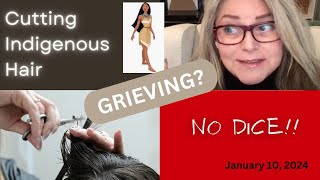
Sandi L Boucher explains why cutting Indigenous children's hair without consent is harmful. It echoes residential school delousing practices and retraumatizes communities. Long hair holds cultural significance: a health marker, a grief ritual, and a practical tool that colonizers tried to strip away.
Chapters
So we're touching on a super sensitive topic this morning. All those cases. And you can google them and find them easy enough. When an Indigenous child's hair has been cut and why that is so problematic. So we better talk about it. Froggy thinks so. Let's talk about it. Sa. Hi, everybody. My name is Sandy Boucher. I'm Red Thunderbolt, woman of the Loon clan, a proud member of Seine River First Nation in Treaty 3 Territory in Northern Ontario. And you can bet I have a Handy Dandy index card because as always, the crime and shouldn't use air quotes because in my opinion, it is most definitely a crime. It's assault, the crime of cutting an Indigenous person's hair and why that is so problematic. And I just thought of something else I should mention. I'm just going to add this into my Handy Dandy index card. So if you googled it, like I said, there are so many different cases where a teacher gets frustrated. A young child has hair hanging in their eyes or whatever the case may be, and they feel the need to take a pair of scissors and cut the child's hair. Or they didn't like that the boy had long hair and chopped it off. I mean, there's a whole bunch of different excuses given for why they did it. First and foremost, why this is so problematic. I hope you realize, and if not, you're about to realize that cutting the children's hair was one of the first thing they did to the children when they entered the residential schools. Delousing them, putting chemicals all over them because they were dirty and contaminated, and chopping off their hair, making the boys look like boys. And even the girl's hair was often cut short. It was. Anyone who's ever had someone cut your hair against your will, it makes you feel so helpless. Which, of course, was the point. And when it comes to teachers in school, I have never signed a consent form that would have allowed for that. So that's a no dice. What we're talking about is generational trauma that brings back and just suggests to Indigenous people very strongly that Canadian history is present day. What happened in the past is still happening. So, no, no. Secondly, can I just say, how much audacity do you have to have to think you'd have the right to do that? It is total white supremacy. It is total. That paternalistic. I know what's better for you. I'm looking down on your parents because they didn't take care of you. Obviously they don't know how. So I'm going to have to do this overstepping, crossing to the other side of the eagle feather in every way possible. Hard pass. No, no, no. There's one thing I've said a hundred times, and I'm going to say it again, is keep your hands off our kids. 100% keep your hands off our kids. And this often comes up for me when I'm talking about the child welfare systems, because again, you can Google it. Documented case after case after case of an indigenous child dying while they're in care. If you're going to take our children because you have deemed their home environment so detrimental, and I'm not even saying you're wrong, flowers trying to grow in gasoline. Remember, their parents were those children at one point and got zero support and help. Let's get real on the reality here. But if you're going to take those children and you can't guarantee that they're going to be safe, then what the heck are you taking them in the first place? How is that any better? You've. You've removed them from any supports they might have in the community. Maybe their home life is horrific, but Grandma's house isn't. Kokum's house isn't. Their aunties isn't. Their friend's place isn't. Right. Now, from a traditional standpoint, why the long hair? Well, for one, like, very practical reasons, if you have healthy long hair, you're a healthy person when it comes to picking a partner that you want to have children with and spend your life with. And traditionally, you would want someone who can provide for the family, male and female. You want to see that long, healthy hair. Practically, when you're out in the bush and you know you have to tie something together or weave something together, hair can be incredibly practical. That might be a case where you're going to cut it off to if it means saving your life. Let's never mind the fact that it's sexy af it just looks incredibly. Well, the only time, besides the practical, in the bush, cutting your hair to save your life kind of thing or whatever the case may be, the only other time I can think of indigenous people intentionally cutting their hair is when we're grieving. And again, speaking at this from Anishinaabe standpoint and Ojibwe standpoint, because that's my cultural basis, it may be different in other nations. Do not want to imply we are all the same, because that's wrong. But the way I was taught. Well, I'm not even going to go there. I'm going to tell you what happened as it relates to my teachings. When I lost my mom, my mom didn't survive heart surgery, for one. So we didn't see it coming. She was actually getting surgery to prolong her life. It was called the quality of life surgery that she didn't survive. So taken out of the knees, total shock. Did not see it coming. Thought I had many more years with her. Turned out that was not the case. Shortly after my mom passed away, very shortly after I can remember coming home. My son was still living with me at the time. He would have been, I have no idea. Late teens, early 20s, late teens, I would guess. And I was just so angry. And we know that's one of the stages of grieving. I was just so angry that I grabbed a pair of scissors and my son was sitting in the living room. And on my way to the bathroom, I just said to him, I've had it. I'm just chopping my hair off. And I went into the bathroom. Later on, he shared with me that he knew this was not going to end well, but I thought it was a good idea. Of course, it ended up with a panicked call to the hairdresser to try to even out the mess I had created. But that anger of cutting my hair helped me express the anger I was feeling. And I can only imagine that was part of our traditional teachings. The second part, the idea that comes in from the cutting of your hair, is that often people get stuck in their grief. They start identifying as a grieving person rather than remembering. This is a stage you go through. It's not who you are. It's not something to hang on to. It's a stage. It's a season. So the idea, when we cut our hair and I cut my hair really, really short, I should put a picture up here. And this was after the hairstylist fixed it. But that's how short I cut it. The idea is that now, anyone who's ever been grieving, you know that in the beginning stages, one, it's totally overwhelming. Two, it feels like it's going to last forever. It's never going to get easier. It's never going to get better. The idea is, as the days go on and you're looking in the mirror, you can see your hair growing. It's getting longer. It's reminding you of the passage of time. And the teaching says that when your hair returns to its original length, the length it was when you cut it, that is your reminder from Creator that it's time to move on. Now it is time to Put your grief down and go back to living your life. So incredibly practical. Measurement of time, measurement of the grieving process. Always incredibly practical. So imagine when some other culture, some other person just takes it upon themselves to cut your hair. Something you might be incredibly proud of. I know my son. Now, granted, he was watching the movie Pocahontas. This is long before I learned of how problematic the Disney version is. If you don't understand, why Google Pocahontas, find out the real story. Missing and murdered Indigenous women and girls. This was not a love story. I'll leave it at that. But when he saw that movie, he asked me. And up until then, I had always kept his hair short. I hadn't started decolonizing yet. I need to eat again. Oh, my God, why do I do this every single time? Anyways. And it's like quarter to one. Not even kidding. Anyways, he asked me why the men have long hair in the movie. And I explained to him basically what I explained to you that traditionally Indigenous men kept their hair long. And he asked if he could grow his hair long. And I absolutely told him he could. My son endured so much bullying because of that, so much name calling. He was a girl, whatever the case may be. Why is being a girl an insult or whatever? And he never gave in. Just he kept his hair long. At one point, he cut it short again. Now my son's in his mid-30s and he has his hair long and he always wears it long. And I love that that's his decolonizing. I hope that helped you understand why anyone doing that to any child would be problematic. But remember, this space is Indigenous centered for us. Considering Canadian history in the residential schools, considering that having the long hair is part of our culture, which is why, at 59 years old, I still have long ha hair, even though a whole bunch of hairdressers want me to cut it short. That's not going to happen because that's not my culture. Maybe that's what we got to get better at. Recognizing when other people do something differently. Maybe they're not trying to be disrespectful. Maybe they're not lousy parents or have lousy parents. Maybe it's a different culture. I'd love to hear your comments. Don't forget to, like, subscribe. Whatever. What am I talking about tomorrow? Oh, boy. I know what we're talking about tomorrow. We're talking about First Nation communities and the infighting that happens, why that happens, all the different ways it happens. This is going to be a good one. Talk to you tomorrow. I love you. Take care. Bye. Bye.
More from Sandi

How I Handle "The Four Uglies!" (Alcohol, Diabetes, Healing & Cheap Seat Comments)


All the Stuff We Don't Talk About with NO SHAME! (WMT Podcast w Antoinette Godin)


When Authors Chat ... (Radio Interview for the Launch of "Copper Stone - Glimpse of Blood Memory)



MORE PROOF of Indigenous/Non-Indigenous Relationships that Work! (Walking My Talk w Millie Gormely)
