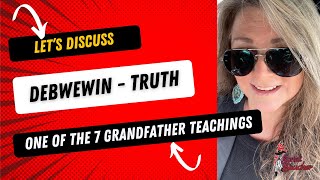
Speaker Sandi L Boucher (Red Thunderbolt, Loon clan, Seine River First Nation, Treaty 3 territory) gives a short talk on Debwewin (truth), emphasizing that in her understanding it denotes deep, lived authenticity that 'resonates in your bones' rather than surface-level honesty. She contrasts two regional renderings: Treaty 3 (via Seven Generations Educational Institute) which defines Debwewin as 'to speak only to the extent we have lived or experienced,' and the 1850 Robinson Superior Treaty-area account (Thunder Bay Indigenous Friendship Centre) which positions Truth as the final teaching that follows mastery of the other six. The talk stresses cultural/linguistic differences between Nations and the practical importance of lived experience when working with communities.
Chapters
It's Wednesday, so it's time to do yet another one of the seven grandfather teachings. And today I'm excited to share this one with you because this is the one that blew me away. This is the one that resonated with me. This is the word I use on a regular basis to identify when I experience it in my life. Today we're talking about Debwei Win. We're talking about truth. Let's talk about it. Hi, everybody. My name is Sandy Boucher. I'm Red Thunderbolt, woman of the Loon clan, a proud member of Seine River first nation in Treaty 3 territory in Northern Ontario. And as I mentioned in the opening, today, we're talking about Deb Waywin Truth. Now, I wanted to share with you yesterday, I touched on how First Nation communities are so incredibly different from each other and the nations. The Creed, Dene, Haudenosaunee, Kos, Salish, Mi', Kmaq, Anishinaabe, all of these have different cultures, different traditions that. That they look at things differently. And I really wanted to highlight that for you. So when I was first introduced to Deb Waywen, which is truth, the way it was explained to me and the way that resonates with me, and I'm not saying anyone else's interpretation is wrong. We don't do that. But the way it made sense to me was that we're talking so much more than being honest in telling the truth. That is a very, like, superficial, easy way of looking at it. For me, Debway Win is when something is so true, it resonates in your bones that, you know, someone identifies their pain or they identify their desperation, their vulnerability. When you realize that, like, authenticity to, like, authenticity on steroids, that deep, resonating truth. So when someone says something and it's just so powerful, often inspirational, resonates deep in my bones. I will often, if it's on social media, I will often just type Debway when. Right. So that's my interpretation. But I really wanted to highlight this difference between the nations so you really understand that often because of the language, we know that how you express things in a language really guides and molds with that nation is going to look at things like it's defined in. In the wording. If you don't have a word for it. For example, the example I always give in Anishinaabe, and I don't know the word, so don't ask me for the words, but there is a word for a river that is flowing away from you, and there's a Word, it's totally different word for a river flowing towards you that it is more action based, that verb based than it is noun based. Because the reality is living in the bush and surviving. We didn't need to know it was a river. That wasn't helpful. But it was really important to know where you're going to be fighting the current or going with the current. If you jump into that river and you know where you want to go, does that make sense? So that's how language really reflects what's important in a nation. If there is no word for it, it's not important. What I wanted to share with you. I actually have two documents in my hand here. I am from Treaty 3, which think Northern Ontario, Manitoba border kind of thing, that area. And we look at different things differently than the 1850 Robinson Superior Treaty area where I live. I wanted to share with you the difference. So I have a copy of the Seven Grandfather teachings again as expressed by the Seven Generations Educational Institute. You can find this information on their website. They are Treaty 3 based. I swear, every time I go to Treaty 3, everyone I meet, even if I've never met them before, they all sound like my mum. I feel again, my blood just sighs when I cross into Treaty three, cross the boundary. It resonates. It totally resonates. And anyone who knows that connection knows what I mean. In Treaty 3, according to 7GEMS, the definition of dibwe win is truth. But the phrase and they're very concise. Wonder where I get it from. The phrase they use to describe this. Get this. This is powerful. To speak only to the extent we have lived or experienced. To speak only to the extent we have lived or experienced. Meaning you're not out anywhere blowing smoke up someone's butt. You are speaking your truth based on your wisdom and your experience. It is. When I went into that rant about all these people that are denying the experts now and want like we're supposed to just listen to these people that have no experience, no lived experience, no knowledge. What anyone who has worked with. I know a lot of people that work with the houseless population, often called the homeless population. I prefer useless because they have a home. Their home is that tent intense city. Their home is that cardboard box. And when you just choose to destroy it, you're destroying someone's home. Just because it doesn't look like your home doesn't mean it's not a home. They have a home. They need a house or an apartment or whatever the case may be. But people that work with them often are looking for people with quote unquote lived experience because they know that if we design a program working with them, it's going to have an impact. Nothing for us or about us without us applies to any group that you don't belong to. If you want to design an event for youth and you're not a youth, get youth on your planning committee. If you want to plan an event for elders and you're not an elder, get elders on your planning committee. Nothing for us or about us without us. So According to Treaty 3, Deb Waywen Truth is to speak only to the extent we have lived or experienced. But now let's jump to 1850 Robinson Superior Treaty Area and this copy of the Seven Grandfather Teachings I got from the Thunder Bay Indigenous Friendship center that I been involved with for. I don't want to do the math. 30 years right in around there they actually put truth. Now in Treaty 3, truth is the first of the seven grandfather teachings that is discussed in 1850 Robinson Superior Treaty Area. Truth is the last one which explains the wording. So what it says Truth is to know all of these things. Referring to the other grandfather teachings. Be true to yourself and your fellow man. Be able to speak the truth. This is considered the final and last teaching. Because to live this teaching one must achieve and understand the first six by being honest with those around you, with your feelings and behaviors. By loving self and others. By respecting others with what they say and do. By being humble, knowing that everyone around you deserves your respect and you theirs. And by being brave when facing new challenges. And by accepting your own and others wisdom. That is how you achieve Truth or Deb Way when So there you have it. Like I said, it is not easy to live the seven Grandfather teachings. I think it's worth the effort. I think it is something I strive for every single day. Those are the puzzle pieces I need. And nothing makes me smile more authentically than hearing someone sharing their debweb when I hope you appreciated that. Until tomorrow. I love you. Take care. Bye bye.