Four Steps to Retaining Your New and Not-So-New Indigenous Employees
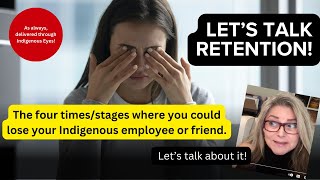
Sandi L. Boucher (Red Thunderbolt woman, Loon clan, Seine River First Nation) explains barriers Indigenous people face when joining non-Indigenous organizations and how to support retention. She references her book The Path to and Through Reconciliation (two-path framework), describes pre-arrival fears from systemic oppression (three natural reactions: violence, acquiescence, nonviolent resistance), and uses metaphors (cat-and-bird; "Indigenous are flowers trying to grow in soil doused in gasoline") to explain why new Indigenous hires are on high alert, may feel abandoned after orientation, and can be pushed out if tokenized or silenced. She urges check-ins, respectful engagement with Indigenous perspectives, and organizational awareness to improve retention.
Chapters
Hello, you absolutely incredible person, you. Thank you so much for joining me again for today's video. Before I say anything else, for those of you who show up on a regular basis, I just wanted to say thank you so, so much for sticking with me as I transition into my new home. The last couple of videos, the sound quality definitely wasn't there. And I felt finally realized it's because at this temporary desk setup, the microphone was too far away. So I am actually once again holding my microphone, which, believe it or not, I've also realized is comfortable to me. I'm used to being on stage. I'm used to either having the air earpiece, the. The little microphone on your collar. I forget what that's called. Whatever, Irrelevant. Or holding a microphone. So this seems so much more comfy to me. But I did want to say thank you for, for watching those videos, even though the sound quality wasn't there. Now, anyone who's followed my career for a while, you've heard me talk about the path. It's actually the name of my third book. It is the Path to and Through Reconciliation. For anyone who's read the book or taken the full day seminar that is based on that book, you know that there are two paths. There is a path that outlines all the work that Indigenous people have to do to prepare for reconciliation, and there's a path for non Indigenous Canadians and all the work they have to do. If there's one thing I hear on a regular basis, anyone who's read the book or taken the course, they are no longer wondering why reconciliation hasn't happened yet, because they understand they have a lot of work to do as well. So today I kind of wanted to play off that a little bit. And what we're talking about is the path, the experience of an Indigenous person coming to work for your agency or organization or coming to volunteer on your committee or coming to be a new member of your friend group. What's going on for them? What can you expect to see and how can you help? Let's talk about it. Hi, everybody. My name is Andy Boucher. I'm Red Thunderbolt, woman of the Loon clan, a proud member of Seine River first nation in Treaty 3 territory in Northern Ontario. And, and as I said, I wanted to talk today about the Indigenous path into your organization, your group, your committee, your friend, your community, whatever the case may be. So first step is actually, before they show up, what is going on for that quote, unquote Indigenous person. Now, keep in mind many, many Indigenous, different Indigenous cultures in Canada different teachings, different backgrounds. The one thing we have in common might have another, couple others. But one thing we definitely have in common is the oppression and discrimination aimed at the anti indigenous racism. So that is felt across the board. The oppression is felt across the board and the reactions to it you can see in every territory, every province, every community. So that's why I'm lumping it together, because we're talking about oppression today. Not necessarily the oppression they're going to experience in your organization or business, but the reality of their existence within Canadian borders. So even before they, you know, they applied for that job or enrolled to try to take a class at college or decided to join your volleyball team or whatever the case may be, remember this image, the cat and the bird. You gotta understand. Well, there's three natural human reactions to oppression or, or internalized oppression. Violence, acquiescence and nonviolent resistance. So the violence is the anger. The I'm going to come across as rude and in your face because I'm scared stiff, you're going to do that to me. That's violence, acquiescence you don't tend to see because they're not even walking into your space for any of those businesses or organizations trying to engage more with indigenous people. And you're wondering why they're not walking in the door. That's the one. And then non violent resistance is the people like me who speak up respectfully, assertively, not aggressively and say, you know what, that really doesn't work for me, or this makes me uncomfortable. The reaction we get to that is incredibly varied. Some people are totally open to hearing from us and want to learn and make adjustments so we're comfortable. And others see us as troublemakers. We're ghosting on the organizations to see us as troublemakers. So before they arrive, because of the cat and bird image, it's survival mechanisms, we have learned from a very young age that non indigenous can be dangerous, they can hurt us, whether it's emotionally, physically, spiritually, mentally. So that fear on top of that racial battle fatigue, like what are we already enduring on a regular basis, what kind of criticisms, what kind of racism, what kind of challenges. I'm balancing my handy dandy index card here so I don't need to hold it. Oh, it finally worked. So all of that is going on as they try to determine do they want to walk in your door, do they want to accept that job, do they actually want to attend the class, do they want to go out to the social event, do they want to meet you for coffee? So no, that if they do, in my, my personal opinion, I'm thinking that's a huge compliment to you, to your organization, to your social group, to your committee, whatever it is, because they have decided you and what you do and being part of what you do is more important and worth overcoming. All of that fear, all of that uncomfortableness, it's going, daring to show up in front of the cat. I think we can all agree that's huge. So they have walked in the door. Please keep in mind the quote. Indigenous are flowers trying to grow in soil doused in gasoline. Now, where did that come from? Well, it's a rip off this quote. When a flower doesn't bloom, you fix the environment in which it grows, not the flower. So in Canada, indigenous people are flowers trying to grow in gasoline. So that's why all of this stuff before they even walk in the door. And then they walk in the door, they make it past those mountains and they walk in the door. I would bet my last buck in that first five minutes, hour, even a day, if not longer. They are on high alert. They are looking for the cat. They are trying to determine if this is a safe space for them or not. So I've talked about this before. Our wall, our defensive wall, hovering in the middle. If they see things that reassure them, they can bring it down and just be themselves. If they see something that's a potential threat, they're going to slam it up. So they're on high alert. Keep that in mind. If some joke is made in the staff meeting or in the lunchroom, that's, well, okay for one, can we all agree those jokes should never be made, but this is. They'll ghost you, they'll be gone if you give them some indication this is not safe space. Right. And again, do not judge us for that. Survival mechanisms, it's how we've learned to survive within Canadian borders. So if they are greeted, if the person that greets them has a smile, did they feel welcomed? What they are asking themselves is, is do I endure? Can I handle this? If there are bare minimum responses, is there, you know, can't really pinpoint that something's wrong, but it sure doesn't feel right. Or they're welcome, they're encouraged to share, they feel safe. All of that plays into it. So we're going to imagine at this point that whatever happens in that first period of time goes okay. It goes well enough, or it goes great, for whatever reason they choose to stay. Now, there's another point that might happen often and I've seen this happen. And in all of these cases, this is not the fault of the corporation. But if you're not aware of what's going on for that marginalized indigenous person you just hired, and if you want to keep them on board, you need to be aware of this stuff. So next, often they are given a job assignment or they're given their orientation package. Read this manual, go watch these videos, fill in this form, and they're sent off into their own little cubicle or office and given this work assignment or in some cases, just start the job right. Often that is going to lead to the biggest feeling of abandonment ever. And I'm going to sound really dramatic here for a second just to make a point. Abandoned in enemy territory. They know they're not in their community. They know they're not surrounded by people like them. And they're now feeling incredibly alone. Guess what the reaction is going to be? Anxiety is going through the work roof. Fear is going crazy. No one is talking to me again. This could be enough to get them to ghost. If you're losing money, hiring someone's not cheap. Between the marketing and then the interviewing and then the training, you don't want to be losing them after the fact. So you've got to be aware of these things going on. Say they make it through that through some fluke. Yeah. Checking in on a regular basis. Or they're in the classroom with other people doing orientation so they can chat. Whatever the reason, they don't feel alone. They decide to stick it out. So now they've been on the job for a while, they are feeling a little more comfy. The walls probably still hovering in the middle, but it hasn't slammed up. So this is a good thing. It's. And now they start to use their voice. They share their opinion, they give their feedback on something. And this is the next hurdle. Are they lectured for having a different opinion? Because they come in with a different worldview, a different lens, a different cultural lens. Chances are they're going to provide a perspective that you are not privy to or haven't been up until now, that is a positive. They are not being a troublemaker. Even though if you're already developing some product or service and now you're finally hearing this other perspective, it may seem to you like it's going to slow progress, but it might also save you money and guarantee that your product or service is way more successful if you consider their opinion. So are they lectured for offering their opinion? Are they judged for offering their opinion? Do you ask respectful questions to try to understand. Are they allowed to be part of a plan and working on it with you or is the plan just dictated to them if they are being tokenized? If you've hired an indigenous person so you can say in your stats you've hired an indigenous person and no one wants to hear their opinion and they're just supposed to do what they're told. But look, brown, while they're doing it, there is a really good chance they're going to leave and the odds of them returning are slim. Next to none. And they unfortunately will be judged for that. They didn't want the job. They were too low, lazy, they couldn't handle it. Why should they have to? Would you work in somewhere, somewhere that is so absolutely uncomfortable? Then why do we expect them to reckon? Some remember the two row Wombum. Reconciliation is learning how to swim in the water between the lanes, learning how to do this together. And that no longer means that we just endure how mainstream wants to do things. We want to work with you. We're just not willing to pay that high of a price. Again, I would love to hear your feedback. HR people, if you're watching this, please share it. If you know HR people, please share it with them. And of course, if you have any questions, reach out to me at any time. I would love to work with you. Thanks so much for joining me today. I love you. Take care. Bye bye.
More from Sandi

How I Handle "The Four Uglies!" (Alcohol, Diabetes, Healing & Cheap Seat Comments)


All the Stuff We Don't Talk About with NO SHAME! (WMT Podcast w Antoinette Godin)


When Authors Chat ... (Radio Interview for the Launch of "Copper Stone - Glimpse of Blood Memory)



MORE PROOF of Indigenous/Non-Indigenous Relationships that Work! (Walking My Talk w Millie Gormely)
