"Get Over It!" is Not Even Possible! (Showing the Past in Modern Day)
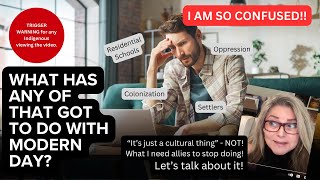
YouTube video (transcript) by Sandi L Boucher reflecting on the continuing effects of residential schools in Canada. Using two older blog entries she reads aloud—"The Blanket of Shame" and "The Line"—she illustrates intergenerational trauma, the social/environmental roots of Indigenous marginalization, and the emotional complexity when an individual begins to heal but family members remain affected. The tone is personal, reflective, and didactic, addressing both Indigenous listeners and non-Indigenous allies.
Chapters
Hello you absolutely amazing person you. It's Andy Boucher here yet again. A little bit later than usual but still here now you're not going to notice the difference on your end. This video is going to be released at the same time but just behind the scenes context. I usually shoot these videos around 9:10am in the morning, master them and then schedule for the next morning. I wasn't feeling well this morning so I took some sandy time and some down time. So it's now like 3:30 in the afternoon that I'm shooting this. Definitely a different time, but I still wanted to get this video out to you. Now as mentioned in other videos this week, still going through my office, still looking at these old blog posts, just really reflecting. I have no One of the ones I wanted to share with you today is written in December 2014 so even older than yesterday. The first one though, however I have remember I was talking about turning one of them into a fancy dandy graphic design. This one has been so I'm not I would have to do some research to find out when it was written. But that's not the important part. Why I wanted to share these with you is if there's one question that is coming up a lot in my work nowadays and for the record, I love that this question is coming up. It's showing progress. People are now more aware. More people are aware. That's probably the better way to put it of the residential schools. They understand what's happened in the past. They're doing things like the blanket exercise so they're really starting to get a grasp of Indigenous Canadian history. The problem, and this is the question that I get, is they have yet to cross the bridge. Understanding what happened in the past and and how it's manifesting in the present that not yet realizing they are seeing the effects. They are seeing the plants that resulted from the seeds growing in soil dosed in gasoline to use a quote I use all the time. So what I wanted to share today is one I did not go to residential school. For the record, neither did my mom, but she was definitely affected by it and lived her life in constant fear that the government would change its mind and either come get her or come get us. I wouldn't wish that on anyone. So the two blog posts today are an example of that transition. First, as a woman man person like me who began the unpacking process and started to realize the stereotypes were wrong, that what other people were saying about us were wrong, that we could do what they said we couldn't do. So that's the first one, and it's called the Blanket of Shame. And then in the second one, I wanted to touch on something that so few people talk about because the reality is you may be the one in your family that breaks the chain and breaks away from the stereotypes and the marginalization and the, you know, unpacks that and decolonizes that. That doesn't necessarily mean your loved ones do so. For every successful indigenous person, you know, I guarantee you there are indigenous people in their family who are very much struggling under the stereotypes and the marginalization, perhaps with addictions, perhaps with violence, that just because one finds the way, it's not the family that finds the way. And that's not a judgment. That is a really hard journey to walk, to stay healthy and strong without appearing like you're better than someone else and still wanting to love your family even when they're awfully often turning on you because you're no longer on the same path as them. That sounds like a lot, and it is a lot. And I'm hoping that I can bring you a little bit of clarity with these blog posts. So again, the first one's called the Blanket of Shame. The second one's called the Line. Let's talk about it. Bonjour. Hi, everybody. My name is Sandy Boucher. I'm Red Thunderbolt, woman of the Loon clan, a proud member of Seine River First Nation in Treaty 3 Territory in Northern Ontario. And as I mentioned in the opening, I'm really trying today to help people understand the residential schools were in the past. That statement is not wrong. The effects of the residential schools are very much in the present day. And saying something God awful like get over it helps nothing. That's the equivalent of saying, calm down. It does not help. But I wanted to try to highlight how it's moved into modern day. And of course, as always with all of my work, I'm going to use my unpacking and my decolonization process as the example. So the first one is called the Blanket of Shame. And this most definitely references my parents. Here it is. Life at home was so amazing. The little group girl grew up surrounded by love and happiness. Swinging on the swing made lovingly by her father. She would fly between the leaves and branches, forever dreaming of all she would one day be. But eventually it would happen. Dad would call out, mom would give instructions to get ready. They would have to go to town for something. She would have to go to school. For whatever reason, she would have to leave the sanctuary that her Mother so painstakingly created. And then it would happen. The little girl would watch as her beautiful, intelligent, humorous mom would try to hide from the eyes of those who dared double take upon seeing her beautiful dark eyes, her dark hair, her brown skin. Without comment, the little girl observed how strangers treated dad differently from mom and how without words, her mom would instinctively bring her children even closer. The blanket of shame seemed comforting to them, and little did the girl know how long she would so willingly wear it. Soon, school brought accolades and life brought opportunities. But still the blanket hung at her shoulders, reinforced by the ignorant among us. Time and time again she heard the words that informed her she could never do this or never achieve that word spoken to her or spoken by her in the darkness of her greatest fears. It's not that she wouldn't try, because she did, and often she would even succeed. But inside was the ever constant feared fear. Is this allowed? Can I do this? Should I? Now a grown woman, she sits quietly, lost in thought at the realization that she has fought suffocation for more than 50 years, that she has fought her entire life. I can do this. She would cry out. I can achieve this. I can do it too. And now, on the days that she does, she cries. She cries as she realizes she did it. Even if only for a few moments, she did it. She cast the blanket aside and dared to stand tall, to stand proud in spite of and with no fear of who may be watching. And although sometimes she still feels a little chilly in the company of strangers, she now knows there are much better ways to stay warm and safe. The blanket of shame. And you know what? As I was reading that, I want you to really be careful if you're non indigenous. Be careful of the things, the common beliefs among the non indigenous about the indigenous. For example, to give you some context here, I have heard many, many, many non indigenous people say that indigenous people look down at their shoes and won't look you in their in the eye. It's a sign of respect, that it's a cultural thing for us. Excuse the expression, but how flipping con. I have met very few First Nation people that do that. When it is not the blanket of shame, when it is not the overwhelm of being the only indigenous in a non indigenous group. When it is that cat looking down at the bird, that that fear of judgment, the fear of, you know, the disgust that is so often follows the looks and the glances that we get. But how convenient to blame us, to say it's just what we do, rather than realizing it's a reaction to the environment. So what I need allies, people who want to be true allies to do is to really start the unpacking on your side of the feather. Quit assuming we just do things because it's a cultural thing and start realizing how many things we do. That's an environmental thing. When the flower doesn't bloom, you fix the environment in which it grows, not the flower. Indigenous people are flowers trying to grow in soil doused in gasoline in that soil is called Canada. So quit with the excuses and start doing better. Now, the second one, I promise to share with you. This is a hard one. This is. If you're indigenous watching this, I want to smudge. Might want to grab a loved one. This is the reality we face every day. By the way, Richard Wagamese, if you've had the pleasure of reading any one of his books or seeing the movie based on his book Indian Horse, I believe that man was so flipping amazing. And I didn't realize. Well, I knew he was amazing. He was a friend and. But after his passing, I was actually asked to go out to Kelowna, bc. He had been invited to a. It was a book club, basically, and they had reviewed. They were reviewing one of his books, the Medicine Walk, and they wanted his comments about the book. And of course, Richard could no longer be there. So they asked me, as his friend, if I would go, which, of course, I not only read the book, it meant that I had to really read the book and really pay attention. My friend was so wise even before, even beyond his years, because what Richard understood, which I hadn't until I realized Richard wrote fiction. Nobody gets their guard up reading fiction because it's fiction. So you're just going to read it and then you're just going to discard it. But in his book, specifically the Medicine Walk, Richard is describing an authentic Indigenous journey. How it feels to have that indigenous loved one, someone you love, perhaps even a parent, who is lost to their addictions and what that does to a human. And I was so blown away by reading that book because the walls didn't go up. Like, I talk about the same things, but because I speak real life, the walls do come up. And it made me kind of wish I could write fiction. Not anything I'm really interested in doing, but Medicine Walk by Richard Wagamese. If you have not read it, highly recommend. It is along the lines of Medicine Walk that I write this December 23, 2014 entry called the Line. Here it is. She is lost in thought as she stares at the ground Slowly she bends, chalk in hand, and draws a line dividing herself from the one she loves. She has drawn the line. She ponders it, knowing that he will try to drag her across it into his chaos, into his upset, into his anger, into his world. But she cannot go. She cannot go. She turns and looks at the people and places and things in her world on her side of the line. She has worked so hard to keep this a place of sanctuary, of peace. At times, chaos erupts on the other side of the line as well, but it is her that hits the fan in those cases. She's getting better at taking ownership and responsibility for those occurrences, can't get dragged across that line anymore, even if she loves him, for she cannot be made to rescue him. It is not her place. His world is his cross to bear. The garden he planted, his responsibilities, his actions, his consequences. And she knows she can't get upset just because he is. She can't be mad just because he is. She can't ruin her day just because he's having a bad one and she shouldn't have to. She is lost in thought as she stares at the ground. Slowly, she turns away from the chalk line and stares at her garden. Perhaps she'll plant more flowers today. Maybe she will read a book. All she knows for certain is that today she will enjoy her sanctuary. And instead of crossing that line, she will choose to pray. Pray that one day soon he decides to create his own sanctuary next to hers so they can both enjoy the flowers. Now, I do have to make one final comment because I'm certain some of you kind of went. What? At the part where it said that she can't save him? It's not her place. If there's one thing I stress with my audiences over and over, us indigenous people remembering and realizing we have the power to heal, that we have the power to stand up again and be strong and proud is just as important as the act of standing up and being strong and proud. There is no empowerment in being saved. It is my mom's teaching all over again. When I asked her a question, she knew that if she gave me the answer, it would increase my belief in her wisdom. But if she helped me find mine, it increased my belief in me. That's empowerment. Long story short, we do not need savior. Saviors is how we got into this mess in the first place. Other people, other cultures believing they knew what was best for us, or in reality, what's best for them. It just would have been way more convenient if we all assimilated and became like like them. And we hear that rhetoric all around the world nowadays. You can't steal someone's culture because it's going to result in devastation. It's going to result in what Canada is dealing now. And there's so many people that would like to reset time and pretend it didn't happen. Then let's start from today. And that's just not how time works. You are the result of the people that came before you, whether you chose to replicate them or do the opposite it. But that history is part of who you are and our history is part of who we are. We're trying our dangness to stand up. That takes time, that takes space and it takes the saviors backing up so we can do this on our own. I hope that made sense. I hope you enjoyed today's sharings. I'm going to watch the comments. I'd love to hear what you have to say. I'm going to go master this video and get it out so I can go back to relaxing on my couch and hopefully feeling a whole lot better by tomorrow. I love you. Take care. Bye. Bye.
More from Sandi

How I Handle "The Four Uglies!" (Alcohol, Diabetes, Healing & Cheap Seat Comments)


All the Stuff We Don't Talk About with NO SHAME! (WMT Podcast w Antoinette Godin)


When Authors Chat ... (Radio Interview for the Launch of "Copper Stone - Glimpse of Blood Memory)



MORE PROOF of Indigenous/Non-Indigenous Relationships that Work! (Walking My Talk w Millie Gormely)
