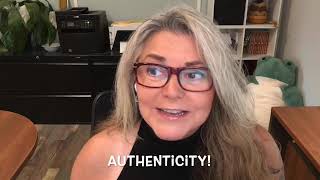
Sandi L Boucher, Red Thunderbolt of the Loon clan, explains that land acknowledgments only work when they're authentic. Skip the cookie-cutter script. Say what you actually mean to Indigenous peoples whose lands you occupy, even if it's imperfect and hesitant.
Questions this video answers
Sandi L Boucher (Red Thunderbolt)
Woman of the Loon clan; member of Seine River First Nation in Treaty 3 territory (Northern Ontario)
Chapters
Hello, Wyndkin. This week, we're talking about land acknowledgments. Yesterday, I explained to you why land acknowledgments are important. Today we're going to look at the one key thing you have to do for your land acknowledgment to do what it's supposed to do. I think you're going to be surprised at what the answer is. Stay tuned. Sam. Hi, everybody. My name is Sandy Boucher. I'm Red Thunderbolt, woman of the Loon clan and a proud member of Seine River first nation in Treaty 3 territory in Northern Ontario. And today, once again, we're talking about land acknowledgments. Now, yesterday, I explained to you how I feel. Land acknowledgments are one an essential part of reconciliation acknowledgment. The truth comes before reconciliation. The official apology told the truth about the residential school era. And land acknowledgments tell the truth about the fact that we are on Indigenous lands, not just in history, but in modern day, that the nations still exist. So that's why. But what should be in a land acknowledgement? So you have to answer one question to get that answer. You now know why we want you to do land acknowledgments. My question is, what do you want to say? As your business entity, your corporation, your school board, your nonprofit, whatever it is, what do you want to say? And then say that. Because the most important part of a land acknowledgment, in my humble opinion, is authenticity. That cookie cutter. I'd like to acknowledge that we're on the official territory or traditional territories of blah, blah, blah, nation and blah, blah, blah is not worth the time it takes or. Or the air it took to read that statement. There is no heart in it. There is no commitment in it. There's nothing. And I know why people use those versions of land acknowledgments because it makes it easier on the person delivering the land acknowledgement. But if your focus is on how to make it easy for you, you're thinking of the wrong person. When you're creating your land acknowledgement, you should be thinking about Indigenous peoples whose land you get to live, work and play on. What would you like to say to them about the fact that up until now it was never acknowledged that you were on their lands, that you benefit from being on their lands? What would you like to say about that? And I can honestly say, do not worry about forgetting someone or using the wrong terminology, because, honest, I would rather hear someone stand up, no paper in their hand, stumble over their words, but say something authentic, maybe even containing a commitment that this company is making to work with indigenous people or whatever it is. I would rather hear that than that cookie cutter dry checkbox that they do at the front of an event, right along with telling you when the coffee break's going to be and where the bathrooms are. How is that respectful? How is that anything worth anything? And I think you can agree it isn't. So what would you like to say to the indigenous peoples whose lands you're on? Considering the fact that that's not been acknowledged up to now, what would your business entity or corporation or nonprofit like to say? Say that now. There are some guidelines, things you shouldn't do. I'm going to talk about those tomorrow. Lots to think about. Talk to you soon. I love you. Bye. Bye.