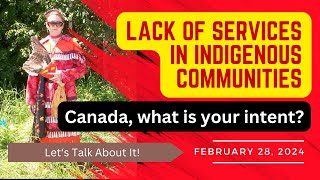
Sandi L. Boucher argues that chronic service shortages in First Nation communities—boil-water advisories, limited healthcare, no local retail—aren't just inconvenient. They force teenagers into city boarding homes, send elders to distant care facilities, and trap people away from family. She calls it an attack on community bonds, not a problem to study.
Chapters
Lack of services in First Nation communities. I'd be willing to bet you've heard that or seen that on the news. I'd also be willing to bet that a bunch of people just write that off as inconvenient. What if I told you it's way more insidious, way more dangerous to the lives of first nations people? Let's talk about it. Bonjour, Mishko Poke N addition Hi everyone. My name is Sandy Boucher. I'm Red Thunderbolt, woman of the Loon clan, a proud member of Seine River first nation in Treaty 3 territory in Northern Ontario. And today I really wanted to touch on that lack of services that we hear so much about on the news, in coffee shop conversations, maybe even the soil that births the slur, the insult, the judgment of First Nation people. So what am I talking about first off when I talk about lack of services? Well, I think if you're Canadian, in Canada, aware of any kind of news going on, you know that there are many First Nation communities still under boil water advisories, some for decades. Like not just a decade, which is 10 years, but decades. They're in their 20 something years of boil water advisory. Imagine that for a moment. And if you can't, let me help you because I've been in those communities and I've watched as two 1 liter bottles of water get deliver for every person in the household every morning I have taken a shower and been instructed to keep my mouth closed. Hint, you really don't feel clean. And when you can't use the tap water to brush your teeth or to cook, now you start getting the idea. So is it inconvenient? Of course. But what I'm going to prove to you is it's so much more than that. What about no doctor? Forget about a doctor. If you're lucky, you have a nurse. If you're really lucky, you have a nurse practitioner in the health center in your remote community. That health center has office hours because of course one human staffs it. They need their downtime too. And if there's some kind of emergency, you're getting flown out by and I hope that the weather is good enough for the planes to fly. Another one that comes to mind. And I knew this was bad. I didn't realize how bad. So policing again, we're talking one or two officers, might be opp, might be rcmp, if you're in a different province, might be an indigenous police force. But we now have situations where remote fly in First Nation communities are actually sharing their policing, which means One officer flies into that community, stays there for a while, flies to the next community, stays there for a while. And yes, if something happens while the officer is not in your community, pray for the best. And last but not least, this has been coming up in my mind a lot lately and I don't know why, but the northern store, which is the one grocery store in town, there is definitely a monopoly. There's no one and I really need to look into that. Is there a reason why a competitor grocery store can't get in there? Like, is it restricted or is it just lacking interest? Because that would not be an easy journey to go on. But I want you to picture, like they don't even have as much stuff as, as a corner store in the city. I'm thinking of small town gas station, used to have some things for sale that would be more equivalent. It's not the choice of what you want for dinner, it's what's available. I can remember being in one first nation community and my coworker, the woman from the community that had brought me in, having to phone home to her partner and tell the tell. Tell her partner that they couldn't have whatever they had planned for dinner because dairy doesn't come in till Wednesday. So that's the lack of services I'm talking about. And 110% it's inconvenient. But like I said, what if it's so much more? What if it is destroying the community that means everything to us? And I'm not talking the physical community here. I'm talking about feeling like you're part of a community and that you have people you know and can turn to. What if it's further adding to the isolation of indigenous peoples that's the problem? So I'm going to give you some examples and you tell me, would this be isolating? Would it help destroy community? We have grade nine students. So what's that? 13 years old, 14 maybe, being sent out of the remote communities to live in boarding homes in the city just so they can get a high school education, so they can get Grade 9, leaving behind their family. Imagine being the oldest in the family. You're the first to go out, maybe if you're lucky, you know other students in the school, but they're not going to be in your boarding home. You're living with strangers to figure out city buses to get to the school, street lights, and a population you've never seen and a population that may not like the look of your skin. And we're doing this to 13 year olds welcome to Canada or other end of the spectrum are elders that so often need medical care. I don't care what nationality you are, you get older, things start happening. These elders are flown out of the community. What if they have advanced diabetes or they need dialysis or whatever the case may be. So often they need ongoing medical care that is not available in their community, which means they never get to go home. They are stuck in the city, there's a good chance there's no family around and then they're going to be put into long term care that's not family caring for them. And even if you have the most caring staff, the staff is working a shift and going home at the end of the day or at the end of the shift and that's where they stay alone and isolated. The only time they're going home is when they go on to Spirit World or our youth. And I've already talked about them coming to the city for school, which is there is no other option if they want a high school education and we're talking about indigenous people need to get an education. You don't know the mountain we have to climb to do that. Or these people from remote communities have to climb to do that. So often the youth come to the city, they're alone, they're hurting or for a number of reasons. There are so many, just imagine for a second that God forbid they end up addicted, they get into taking pills or whatever the case may be. And so often when they decide to go into recovery and they want to get on a healthier path, the doctor prescribes methadone. Now if you don't know methadone is, it requires a pharmacy, it has to be prepared in a pharmacy and then it's set to the clinic where they can give the methadone to the patients. First Nation communities, remote First Nation communities, I don't know of any First Nation community, remote or not, that has a pharmacy. They could have subscribed, prescribed Suboxone, which same kind of medication or for the same reason in pill form that is available in the community. Methadone prescription guarantees that person cannot go home. There you have it. In my humble opinion, any service not provided in community further decimates that safety and well being feeling that comes with being part of a community and further isolates indigenous people. Canada. I need you to prove to me that isn't your intent. Because otherwise, if you are truly concerned about our suicide rates and what's happening in our communities and our lack of health and mental well being, then do something. Because words or looking into it or hiring a consultant are not enough. So the next time you hear about a lack of services in a First Nation community, think about what it really is. An attack on community. Until next time. I love you. Take care. Bye bye.