Indigenous Don't DO Land Acknowledgements!
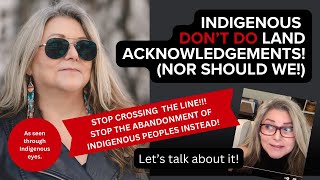
Sandi L Boucher argues that land acknowledgments aren't an Indigenous practice, and that Indigenous people should follow their own traditions instead of adopting mainstream reconciliation approaches. She pushes back on the pressure to assimilate cultural practices.
Chapters
Hello, you absolutely amazing person, you. I'm planning ahead here. I'm trying to do a couple extra videos ahead of the weekend, getting them ready for next week because this weekend is the official move. My desk arrives. But I don't know how long it's going to be before I'm situated again. So I thought I'll do a couple videos to make sure you get quality content. Even if I'm actually in the background pulling my hair out as you watch it. But we're gonna hope for the best. Today is probably best described as a rant. It's about land. Acknowledgments. Eventually. But I gotta give you some context first. We gotta talk about this nasty flipping habit that way too many people have of crossing the line. Let's talk about it. Foreign. Hi everybody. My name is Andy Boucher. I'm Red Thunderbolt, woman of the Loon clan, a proud member of Seine River First Nation in Treaty 3 Territory in Northern Ontario and Holy moly's, we have to stop this. We have to. I see so many people. I'm going to give them the benefit of the doubt and say well meaning people trying to do things that. That are either working them closer to reconciliation and this is why I hesitated or making it look like they're working towards reconciliation. There is a difference. But there's so much confusion and so many people just taking the easy route and doing what everyone else is doing because that must be the right thing and not thinking about why they're doing it that they're actually ending up doing the wrong thing. So background context. That crossing the line I was talking about. I want to show you something. I'm going to actually work in some gifts into this because this is going to be awesome. Cool. Check this out. Out. It's like a. What do you call those? Sun catcher. Right. That you would hang. And so the eagle feather isn't that amazing? And if you didn't think that one was awesome. Okay. I have long said that I do it for the speaker's gifts. That that's the best part of my career. These aren't actually not a speaker's gift. These are gifts from my sister in law. They're red and black, red and black, red and black. My colors. Mind blowing. Anyways, why am I showing you this? Because you've heard me talk about the feather teaching how many times and the line that goes down the middle of the feather and how one side represents indigenous people and the other side represents non indigenous people. That's all well and good. The Problem is history and the practices we've adopted for Indigenous people. Now the rule is do not cross the line that Indigenous people live their lives, run their communities, whatever it is in line with our traditional teachings and customs, our ways of doing. That's the decolonization process. On the non indigenous side, don't cross into no more saving us. You can support and encourage us, but you got work to do on your side because that's where all the ickies are, those bullies and those racists that attack us. We can't heal if the attacks don't stop. That is the work of the non Indigenous. On the non indigenous side, do not cross the line. Now here's the problem. Indigenous have been taught to cross the line since the day we were born. It's called assimilation. Learn how to do it the way mainstream does, learn how to behave, learn how to dress, learn how to parent, learn how to speak as mainstream does. Cross the line. And if the assimilators would have their, their wish, we wouldn't come back. We would just assimilate. And on the non indigenous side, well, they've been crossing the lines for ages, coming into our communities, telling us what to do, how to say. That's again the assimilation. In my book the Path, the third book that I wrote, the action planned reconciliation, there are two paths. Respecting the two sides of the feather, understanding that to get ready for reconciliation is two entirely different processes. If you're Indigenous, there are the four stages you must go through. The first one is healing, because let's look at Canadian history and what's still going on. Like I said, we can't heal if the attack starts. Don't stop. And on the non indigenous side, there's four very different steps, A lot of it education and becoming aware. Because there are two separate paths. There are different things that need to be done on one side or the other. And that's where land acknowledgments come in. Now, I did a series of three videos on how to do a good land acknowledgment, why you should do it, what it should include and what you definitely shouldn't be doing or including. And I will put the links to those videos in the show notes here in these video notes just to make it easy on you. I think, done well, done properly, that a land acknowledgment is not just a checkbox, it's a commitment. It's a promise. And hopefully not an empty promise, a promise that is followed up on the problem. And I can't believe I'm about to say this, but indigenous entities are now starting to do land acknowledgments. What? For one, I don't know anyone who practices their traditional teachings that doesn't acknowledge Mother Earth daily. That's a relationship we're constantly in. And so acknowledging we're standing on our land, isn't that a given? The idea of the land acknowledgement is for settler descendants to acknowledge that they're on traditional lands. No more erasing us, reminding us that we're still here. I just want to look up something here because where's that note I sent to myself? Oh, duh. I'm in the wrong section. That's why I wrote an email to myself last night about why indigenous people don't do land acknowledgments. That's not it. That's not it. That's not it. Oh, duh. I know why. I know why. Because I don't know what in the world that was. Here we go. I finally found it. I'm not crazy. I covered everything I wrote in my own indigenous. Do not do land acknowledgments. Wrong side of the feather. The path steps. I. Indigenous people don't do land acknowledgments. We live the land acknowledgment. We live with the land. When an indigenous entity wants to do a land acknowledgment, that tells me they're just copying what other people are doing. They haven't even thought that through. It's more assimilation. It's the wrong side of the feather. We have other work to do. Don't do a land acknowledgment. Do a smudging ceremony. Do an elder's opening. And guess what? Every indigenous entity and gathering I've been to already does that. We don't do land acknowledgments. We live land acknowledgments. I'm so confused. So when it comes to reconciliation, quit doing what everyone else is doing. There's the rule. Stay on your own side of the feather. If you don't know what your four steps are, well, then you need to read the path or you need to take the seminar, or you need to send me an email and let's talk about some consulting. But we need to strengthen our sides of the feather, because I am fighting every single day to heal this feather. Because if we do, this feather represents Canada. I kind of like that it's red and white now that I've said that. And if we heal both sides, then Canada can grow to heights it's never even seen before. This is not about abandoning anyone. It's actually stopping the abandonment of Indigenous peoples. But we don't heal through assimilation. We don't heal by doing what mainstream does or has to do. We have our own path and the paths run side by side. It's not excluding anyone. It's reconciliation. It's true partnership. It's red and white like the flag. And considering Canada Day is coming up. And by the way, Reconciliation works Canada, my second company, the newsletter comes out the first of every month. The July 1 edition, a special July 1 edition, is already on the website. If you're on the email list, you're going to get it July 1st. Or just go to ReconciliationWorks Canada CA and check it out. It talks about the four steps for non Indigenous peoples. Until the next video. I love you. Take care. Bye bye.
More from Sandi

How I Handle "The Four Uglies!" (Alcohol, Diabetes, Healing & Cheap Seat Comments)


All the Stuff We Don't Talk About with NO SHAME! (WMT Podcast w Antoinette Godin)


When Authors Chat ... (Radio Interview for the Launch of "Copper Stone - Glimpse of Blood Memory)



MORE PROOF of Indigenous/Non-Indigenous Relationships that Work! (Walking My Talk w Millie Gormely)
