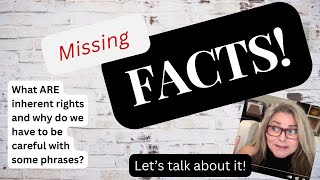
Sandi L Boucher (Red Thunderbolt woman, Loon clan, Seine River First Nation) gives an educational YouTube monologue explaining the meaning and origins of "inherent rights" for Indigenous peoples. She frames inherent rights as rights and responsibilities (self-government, property/stewardship of lands and resources) that predate European colonization, supports this with archaeological timelines (human presence in North America dated between ~18,000 and 10,000 BCE and other ranges cited), and contrasts regional Indigenous societies (Northeast Woodlands agriculture; West Coast chiefdoms) to show they were functioning, sovereign nations prior to contact.
Chapters
Hello, you absolutely amazing person, you. I got an idea this morning and I'm hoping you're gonna appreciate it. You see, for years now, I've been doing a certain seminar called missing pieces history 101. And it goes over all of the legislation that has been imposed and inflicted harm on Indigenous peoples. Because it's really easy to say we have always been oppressed, but. But this seminar fills in the information, the missing pieces, so that people can really understand how we got to today. This is the stuff we should have learned in school and didn't. It's getting better, but we're not there yet. So today I thought, you know what, what if my YouTube audience or some of those people that are missing information. Today I want to focus on inherent rights, a phrase we use often or hear often, but what does it mean? Where did it come from? And we got to talk about why. We got to be careful with the phrasing because we can actually add to the confusion and misinformation rather than clarifying it. Today I'm just going to focus on before the Common Era, BC time. If you don't know how we record time, we can talk about that too. So let's talk about it. Foreign. Hi, everyone. My name is Sandy Boucher. I'm Red Thunderbolt, woman of the Loon clan, a proud member of Seine River First Nation in Treaty 3 Territory in Northern Ontario. And like I said, we gotta look at some legislation and some things that have been happening long before we walked on the planet that'll help you understand how Indigenous Canadian relations got to where they are today. But first we got to talk about how time's recorded. And I have this handy dandy little image that I can show you. As you can see, time before the Before Christ or before the Common Era time actually was recorded. It's like you start from a certain spot. Sp spot, and then it moves away into the negatives. Or in modern day, we move into the positive. We're in 2024, which means we are 20, 24 years from that point. Why did I have to clarify that? Because today we're going to talk about what happened before this point. And yes, it's relevant. It's going to help you understand the word inherent. What we're talking about is that period of time that is often referred to as pre contact, before the settlers got here to make it understandable. So prior to the arrival of the settlers from Europe, we were sovereign nations. The Indigenous people had. We had our own cultures, economies, governments and laws. I always use that image with the feathers, we both had functioning societies. They looked incredibly different from each other, but they were functioning. Now, generally, Indigenous people were in exclusive use of the land, meaning we were the only human beings around. So if you put that into modern terms, that means we had jurisdiction or authority over the land. Now, many First Nation communities, like Anishinaabe Nation, and like many, many nations I've worked with, we look at it not as much as jurisdiction, but having the responsibility to be the stewards of the lands and resources. So it's not their hours to own or use. It is our responsibility to take care of them. Now, again, if you put that into modern terms, we would say that would be we have the property rights to our traditional territories, which is North America, for the most part. Indigenous peoples still to this day believe that the responsibility were placed on us by Creator to take care of the land and all of the plants and animals that live there. You're going to run into that if you work with Indigenous peoples. And this is where we're going to talk about inherent rights. Now, by definition, inherent rights is existing in something as a permanent, essential or characteristic attribute. So it's essential right. Now, how does that play into this? The inherent right of self government for Indigenous peoples today in Canadian law comes from that sovereignty that existed before the Europeans got here. Our rights are inherent because it existed before European colonization and the imposition of European law. Indigenous rights to lands and natural resources. Resources are also inherent because they predate colonization. So when you hear about inherent rights, what we are talking about is the rights and responsibilities we had long before the settlers got here. Now, when it comes to origin stories, Indigenous nations, we have various stories different to the nations about the origins of the world and our place in it. And that dates way back to the beginning of the time. But even if you look at archaeological data, when humans first came to North America, there's anything from 30,000 to 13,500 years ago. So this is where we got to get specific here. And we're going to go lean on the data for a bit because mainstream loves its data between 18,000 and 10,000 BCE. So remember that point in time I talked about. This is before that 10,000 years before modern times started counting irrefutable archaeological evidence that there were humans here. And they're in four different places in Alaska, out in Haida, Gwaii and B.C. in Alberta and Nova Scotia, we were here. This is irrefutable. Bottom line, settlers or settlements and communities, not settlers settle settlements and communities of Indigenous people existed from coast to coast. We were literally everywhere. So why is that important to know? Well, I don't know about you. I don't know where you live. Maybe you have some construction going on in those areas. Often when there's any kind of change, any kind of construction that highways, more often than not, or mining, whatever, and you start digging up Mother Earth, you come across remains. It's a sacred burial ground. And I have heard people say that it's a bunch of baloney that the indigenous people just like to say that to slow the progress. Not when you think of about the fact that indigenous people existed on Mother Earth, existed on Turtle island, existed in North America from coast to coast. We didn't have cemeteries back home that we. We were migrant people chasing the moose or whatever the case may be. That's a Nishnaabe reference. But we didn't head back to bury our. Our loved ones. They were buried in where they fell. We. We honored them where we were. So you are literally going to have sacred burial grounds everywhere. To this day, my First Nation community does not have a cemetery. People are buried all over the community. And yes, the band office has the records of where they are, but there are no markers. There is nothing. Because we believe that the greatest honor is to return to Mother Earth and join her just the way she is. Because she's beautiful just the way she is. Now, this one I had to share with you because this always blows away my audiences. Remember I mentioned in the beginning about phrasing and how we have to be really careful the phrasing we use because actually add to the confusion and not the clarity. So look at this. This is 2300 to a thousand years BCE so again, a thousand years before the beginning of the modern era, or 2300 years, 2, 300 years before. So what it says is, the Northeast Woodlands indigenous groups introduce agriculture. These groups start farming. So this is not something that came with the settlers. This is something many, many, many indigenous nations have done since before the beginning of time, before modern time was. Was calculated. Northeast Woodlands indigenous groups. Sounds like one group of people, right? Well, a quick Google search. Are you ready for this? Are you ready for this? I got to show you this. Okay, so Northeast Woodlands indigenous groups includes. Hang on. These people and these people and these people and these nations and these nations. Oh, these two. And these people and these people. Oh, and still these people and these people. 10 different slides. That's how big the Northeast Woodlands group of first nations is. Is that what you thought when you heard that phrase? That's exactly what I'm talking about now, the last thing I want to point out is 2000 to 200 BCE. So now we're getting within 200 years of that point when time changes. Indigenous groups out on the west coast, and we know West Coast first nations are very advanced. They establish settled communities. They have hierarchies of chiefs. They have chiefdoms and stratified communities. They have recognizable governments, intellectual traditions, spiritual and educational practices and sophisticated implements. The tools they use for hunting and fishing and cooking. Why is this important to know? We weren't dependent on the settlers for those things. So I am wondering now, how much of that did you know? How much of that did you realize? Did you learn something new? Because this is missing pieces. Don't beat yourself up if you didn't know it. Most people don't know this stuff, which is why I do the seminars. If you're interested in the seminar, you got to reach out to me. I don't do public events. Usually a municipality or a community brings me in and I speak to the people. Would be happy to come to your area to share this. So there you have it. Probably going to do more did you know videos. Do you think this is valuable? Would you like to learn more? You may be surprised at how much legislation has happened. And once you hear it, you won't be surprised. That reconciliation is going to take a while. Until tomorrow. I love you. Take care of. Bye bye.