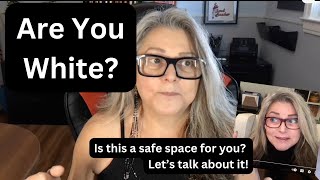
Sandi L Boucher asks non-Indigenous viewers whether her platform feels like a safe space for learning about reconciliation and Indigenous issues. She emphasizes building a respectful, humble environment for dialogue.
Chapters
So today's going to be a shorter video. It's going to be like one question, but it's a really important question to me and I would super appreciate your answer. You may not believe what the question is going to be though, because the question is, are you white? Let's talk about it. Sam. Bojum Mishko Pagan. Hi, everybody. My name is Andy Boucher. I'm Red Thunderbolt, woman of the Loon clan, a proud member of Seine River First Nation in Treaty 3 Territory in Northern Ontario. And as I mentioned in the opening, I have a question and the question is specifically for you. If you're watching this video, this is not about my participants and that my keynote speeches or my seminars or workshops. This is about the people viewing my videos. The question was, are you white? And here's why I want to ask. I am known for creating safe spaces. When I do my seminars, I often either have. If I'm not in a First Nation community, then my audience is often all non indigenous with maybe one or two indigenous people or mixed more, close to half and half. And in those spaces, as much as I focus on providing valuable information, I make sure to create a safe space. I make sure that it's a place where someone can say I don't understand while also pushing back on a stereotype or misinformation they may share. And I often say that it's like, okay, thanks for sharing, but I gotta push back a little bit and I will clarify whatever the point is. I do that because I am acutely aware of how many non indigenous people who are scared stiff to take part in reconciliation work. They may want to be an ally, but they're scared to death to say something. They don't understand that it's a learning curve. They don't understand that they are going to say things and have to be corrected on it. Now, in my work, I do push back if there is a comment on a video. Whether again, if it's they're lacking some information, they've almost got it right, or it's a total stereotype, I'm going to comment on that. I am not going to attack. I have zero interest in attacking people. I'm not going to do shame or guilt. By the way, I should clarify if you're going to attack me, there is a really good chance I'm not even responding to you. I'm just block, delete, we're out of here. But I am going to push back because it is a learning curve and this is where we put ego aside Non indigenous people. If you had all the information you needed, if what you believed was accurate, there would be no need to reconcile. We would have fixed this relationship by now. It's back to back teaching. I am trying to share with you the things I know you cannot see. But the core of the backto back teaching is if you don't believe what I'm telling you to be true, if you don't believe there is an area in the room that you can't see that there's information you're missing, then we're not going to be able to build the bridge. It requires humility, not ego. Humility builds bridges. Ego burns them. So I do push back. I don't attack. I don't do shame or guilt. I correct. I appreciate the comments. I try to create a safe space for everyone on my social media, whether it's YouTube, LinkedIn, not really on Facebook anymore. Zuckerberg. But besides the point, I try and of course I'm adamant that it has to be a safe space for indigenous peoples because those are so rare. But even when indigenous spit out like for example, and I've had it happen where indigenous people will comment and share some stereotypes, some horrific, usually stereotype about another group, another marginalized group that's not staying on my page. Racism is ugly. I don't care who you're aiming your arrow at. Okay, so I try to create a safe space. There are times I will let an indigenous comment stand if I believe it's important for people reading the comments to hear the pain or to understand the nuances or whatever they're sharing. Like there's, there's a definite value there. Attacks don't stay on my page. But this is why the reason for this video or this is the reason for the video, if you're non indigenous, if you're quote, unquote white, do you feel this is a safe space for you? Now? Of course, again, there's a really good chance you don't. If you've come at me with some stereotype or judgment or whatever. Maybe you didn't like getting the pushback. That's part of the learning curve. You got to be willing to learn. But as a general rule, does it feel like a safe space for you? I would love to hear your comments. Again, of course, the same rules apply. Don't attack. But I'd love to hear your feedback. I truly hope you do feel this is a place that you're safe to learn, that this is a place where you can humbly ask a respectful question. I don't understand why indigenous people don't do this. That's a beautiful question. I'm going to answer that. But if you come at me with, why don't they just. That's not respectful. That's not humble. That's judgment dripping off every word. And that's not going to help me keep in a safe space. So I'm curious. We're still relatively new in 2025. It's never too late to learn. So is it a safe space? Do you feel safe here? Please comment. Until tomorrow. I love you. Take care. Bye. Bye.