It Was Just a Dream (or Was It?)
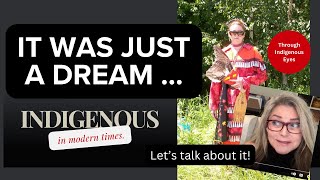
Sandi L Boucher, Red Thunderbolt woman of the Loon clan, reflects on Indigenous identity and the weight of colonial history. She reads from her blog post "The Nightmare We Live," tracing intergenerational trauma from residential schools through poverty and addiction, then counters with a refrain: "I am awake, I am alive."
Chapters
Hello, you absolutely amazing person, you. I'm sitting here giggling, thinking that I don't know if this ever happens to you. But as I go through the week and I'm shooting my videos, often a theme presents itself. I see the common thread, the commonality between all the videos. And I'm starting to think that this week's common thread is not normal stuff, meaning not my usual content, not my usual misunderstandings between indigenous and non Indigenous, not the usual guidance or expectation. Today is definitely a look behind the scenes, because I guess the one thing that is in common always is the fact that I spend my life in contemplation and reflection. I am constantly looking back, I am constantly looking back at the comment that I heard in that conversation earlier today that warrants me pondering it, or, you know, a comment I read online or something that happened years ago that I now have a different perspective on or I want to have a different perspective on. So, so I'm reflecting on it and recently I've noticed this misunderstanding, this, I've heard the term before, Hollywood Indian perspective, that when people think of Indigenous people, I guess it's black or white, they either think struggling on, you know, homeless, on the street, and that's often laced in judgment and disgust, or the pedestal and the ceremonies and the traditions and the beautiful regalia and the beadwork and holy moly's. I want to be one of them. The whole pretending issue. So what I have noticed of late is so many assume that Indigenous is regalia, Indigenous is smudging ceremonies, Indigenous is having a spirit name, Indigenous is, you know, sweat lodge and going to powwow every weekend. And all of that may apply, but it often applies because healing is either being attempted or has already happened. To a certain extent. The common thread is the poverty. The common thread is the trying to overcome the hopelessness, the, the violence, the addictions that are destroying our communities. And of course, I know we are not the only ones. But so much of our suffering is rooted in Canadian history, in the generations of our families literally physically being torn apart, children being denied knowing their parents and the actions that the parents chose to try to deal with, their children being taken. And then the actions of the children who were taken, who are now adults trying not to think about all they went through. It is a history of suppressed anger and hurt, pain and a history of experiences no one wants to talk about and wish they couldn't, they could forget. That's what it's like to be Indigenous. And on top of that, I think there's a very naive feeling that being Indigenous in modern day, now we're accepted and now we're even admired. And that may be the case in some circles with some people, but that is far from the norm. So this weekend, as I finished up cleaning my office, I actually came across some old blog posts. And I love those. I love that I've been writing since I was like 8 years old, because now I get to reflect on my own words, written in a different time, when I was in a different place, different age, experiencing different things. And I get to look at has it changed. And in some cases it absolutely is of or has. And often it's me that's changed. But in the case of the blog post I want to share with you today, dare I say nothing has changed. Let's talk about it. Foreign. Hi everybody. My name is Sandy Boucher. I'm Red Thunderbolt, woman of the Loon clan, a proud member of Zane River First Nation in Treaty 3 Territory in Northern Ontario. And I've worked as an Indigenous Canadian reconciliation guide for the last 50, 15 years. Before that was 20 plus years in Indigenous empowerment. And long before that, I was an author, or at least a writer. My first book didn't come out till 2010, but I was writing long before that. I wrote for newspapers. I had articles included in, you know, excerpts in books. I was quoted because writing has always been the way I made sense of my world. And often writing is how I captured my world, in the same way that so many of us grab our phones to capture a picture of you, a beautiful sunrise or sunset, the laugh of our grandchild. Whatever the case may be, my writing is, often it serves that same purpose. And as I mentioned this weekend I came across a blog post that I had written long ago, back when all of my blog posts began with I am awake, I am alive. Which is of course, why that's the title of my last book. When I read this, not only did I know every single word was mine, but I can still relate to it as if I wrote this this morning. So if you're Indigenous hearing this, chances are really good you're going to be able to relate. And if you're non Indigenous reading this, we don't need sympathy. We don't need saviors. We need you. Empathy and compassion. We did not ask for what has happened to us, what happened to our families, what what continues to happen to our women and children and men. That is what we deal with every single day. And that's what this blog post highlights. So maybe by listening and Hearing and understand a little bit more. If that friend of yours, that indigenous friend, has pulled away, or if they're struggling at work, maybe there's a really good chance that, just maybe they're struggling with something you couldn't even possibly comprehend. The blog post is called the Nightmare We Live. Here it is. I am awake. I am alive. Yet this morning I remain haunted by the nightmare just ended. A dream as real to my spirit as the tears still drying on my cheek. The pressure to assimilate so much more than a Dalek line, for it is real and never ending. Acceptance is given when and if we toe the line sufficiently. And there are so many ways we are expected to conform. Laugh, but not too loudly. Share, but not too personally. Speak but not too passionately. And never ever take up too much space. The dinner party setting of the dream was all too familiar. Colleagues intermingled with people I didn't know, people privileged enough to feel the right to judge, the right to convict, the right to condemn. The cow offended her, or so she felt the need to whisper to me my crime, sitting too heavily on the couch that we shared. God forbid I have weight. Uncivilized, was her description to her partner and to mine. And well he felt. If I hadn't laughed so loud, perhaps she wouldn't have been so offended. It was just a dream, yet it highlighted the slings and arrows. Those outside the norm endure every single day. A modern day in which some will get the Shakespearean reference just made, while others will giggle, thinking how appropriate the quote was for an Indian to use, and the latter will emphasize the reality. Yes, the pressure to assimilate is strong, but one simple truth is not yet lost in the noise. I am not dancing in your world. You are dancing in mine. A fact so painstakingly tried to erase from the collective unconsciousness, but to no avail. I hear the one drum, the heartbeat of Mother Earth, and I will dance to that beat with jingles that can be heard for city blocks. And I will laugh as loud as my spirit means. This quay is here to stay, no matter what you throw. So to my mainstream friends, I beg you, be careful. The stones you throw each time you celebrate one of us being more like you. And to my indigenous friends, stay strong, dance hard, laugh loud. The day has just begun. Last week I did a video on decolonization. I guess two videos, Decolonization principles and then the next steps you just heard. A real life explanation and description of what decolonizing is like on any given day. Until tomorrow, my friend. I hope this resonated. I love you. Take care. Bye bye.
More from Sandi

How I Handle "The Four Uglies!" (Alcohol, Diabetes, Healing & Cheap Seat Comments)


All the Stuff We Don't Talk About with NO SHAME! (WMT Podcast w Antoinette Godin)


When Authors Chat ... (Radio Interview for the Launch of "Copper Stone - Glimpse of Blood Memory)



MORE PROOF of Indigenous/Non-Indigenous Relationships that Work! (Walking My Talk w Millie Gormely)
